Automated Code Review in 2026: Moving Beyond Static Analysis to AI Consensus
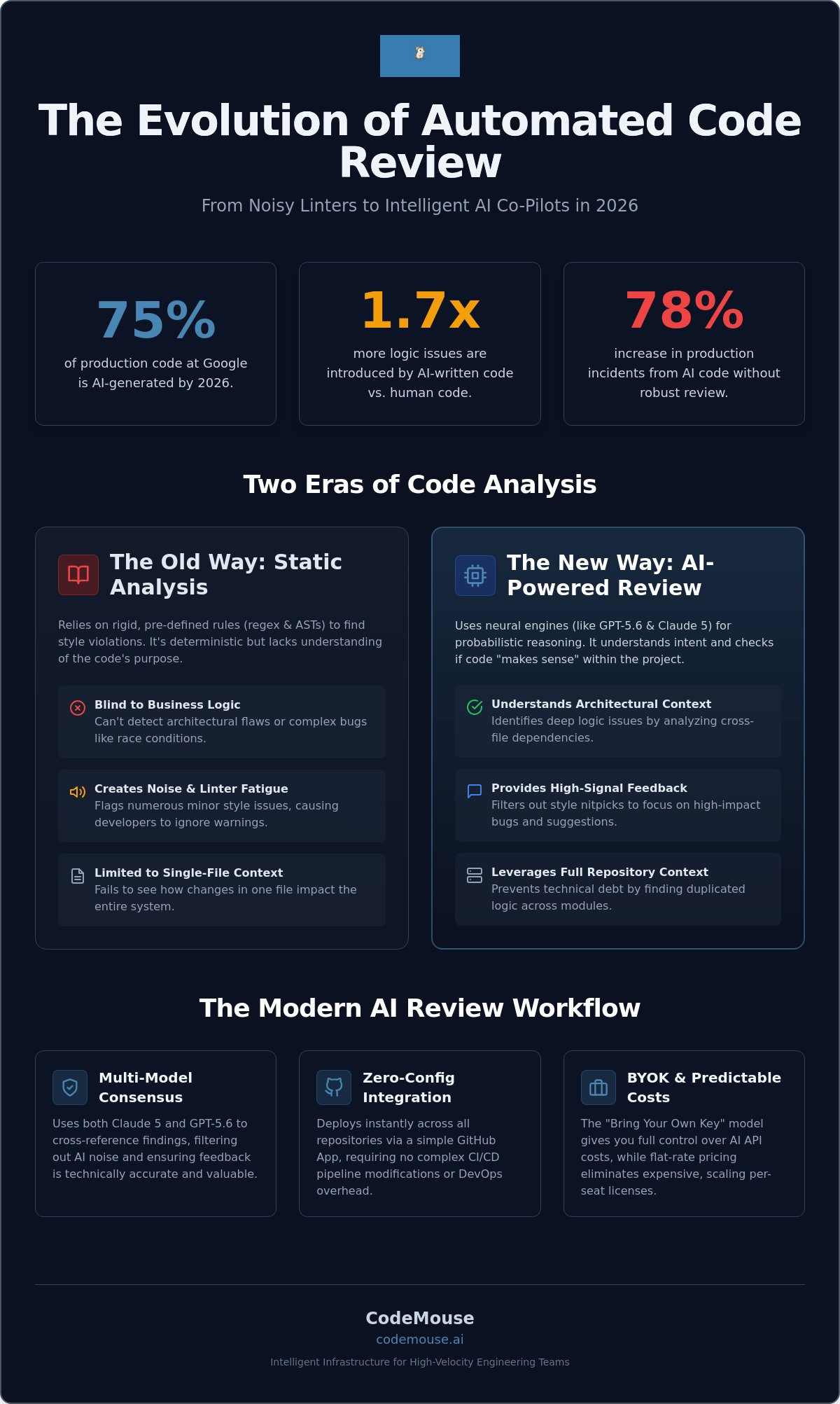
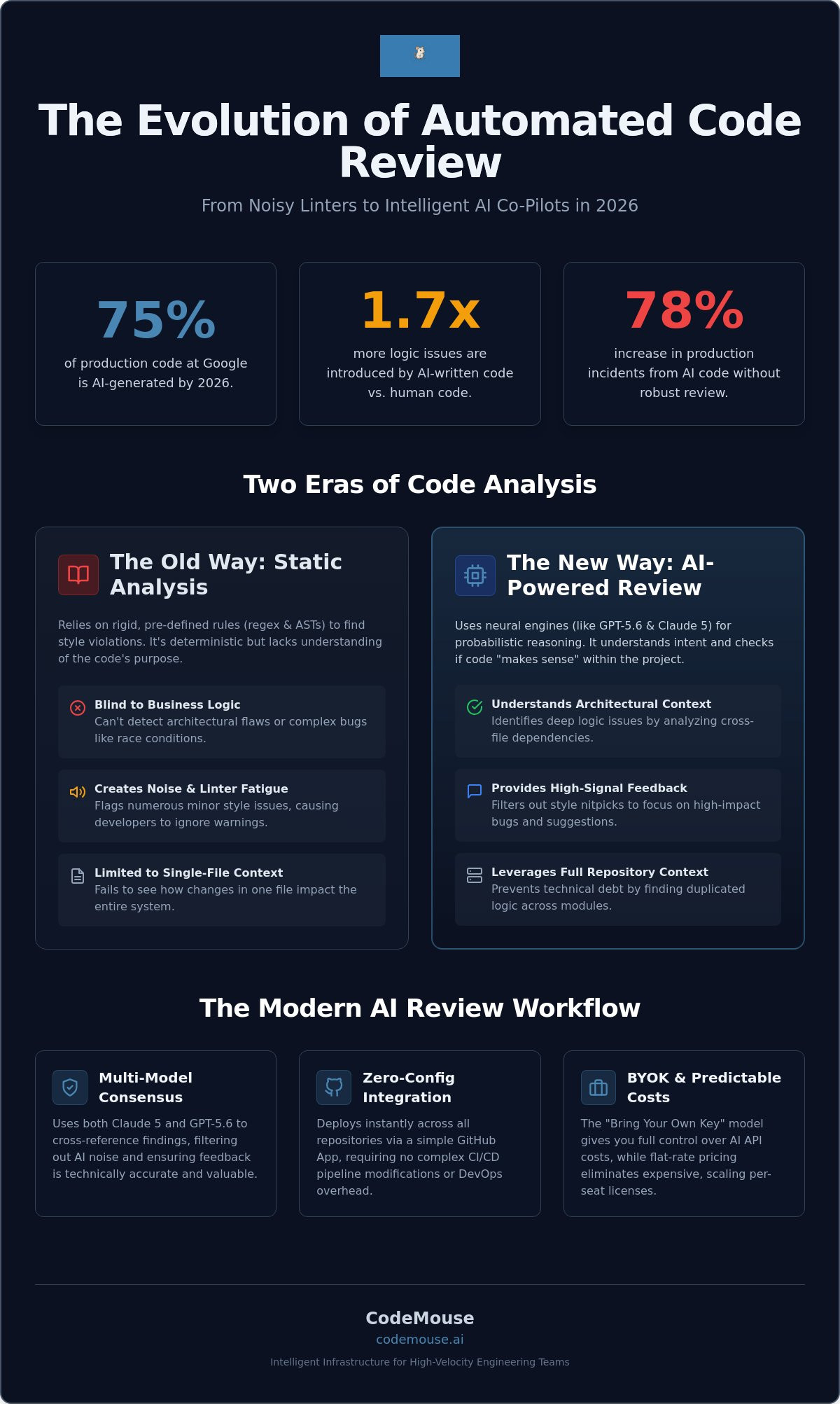
In 2026, Google reports that 75% of its production code is AI-generated, yet AI-written code introduces 1.7 times more logic issues than human-authored scripts. You've likely seen the fallout in your own PR backlogs. Your current automated code review tools probably flag every style violation while missing the architectural flaws that actually break production. Senior developers are stuck in a loop of manual oversight, and enterprise seat costs for intelligent tools are scaling faster than your revenue.
It's time to move past the vibe coding era and noisy linters. You can implement a high-velocity, multi-model automated code review workflow that catches real bugs without the typical overhead. By leveraging a consensus model between Claude 5 and GPT-5.6, your team can achieve faster cycle times and predictable, low-cost scaling. This article outlines the transition from basic static analysis to a sophisticated, BYOK infrastructure that acts as a silent partner for your engineering team.
Key Takeaways
- Move beyond regex-based linters by adopting context-aware neural engines that catch architectural flaws and logic bugs.
- Implement multi-model consensus to filter out AI noise and ensure feedback is technically accurate.
- Streamline your automated code review pipeline with GitHub App integration for instant, repository-wide deployment.
- Adopt a BYOK (Bring Your Own Key) model to maintain full control over AI API costs and model selection.
- Scale your engineering team without increasing per-seat expenses through predictable, flat-rate organization pricing.
The Evolution of Automated Code Review: From Linters to LLMs
Automated code review is the systematic use of software to inspect source code for bugs, style violations, and logic errors before it's merged. By 2026, this process has fundamentally shifted. We've moved from "dumb" regex-based linters to context-aware AI agents. With industry data showing that roughly 75% of production code is now AI-generated, the sheer volume of new code has outpaced human capacity. Manual review is a scaling bottleneck. It's slow. It's expensive. It's prone to human fatigue. Modern engineering teams need infrastructure that acts as a silent partner, not a gatekeeper.
The Limitations of Traditional Static Analysis
Traditional tools like ESLint or SonarQube rely on rigid, rule-based engines. They're deterministic. If X occurs, flag Y. This creates a significant noise problem. Developers often spend more time silencing irrelevant style warnings than fixing critical logic gaps. There's a massive distance between code that compiles and code that's maintainable. Old-school static analysis can't bridge that gap. It misses the architectural context. It doesn't understand why a specific pattern was chosen; it only knows if that pattern violates a pre-defined rule. This leads to "linter fatigue" where developers ignore automated feedback entirely.
The Rise of Generative AI in the PR Workflow
Generative AI changed the math. Modern LLMs like GPT-5.6 and Claude 5 understand intent. They don't just scan for syntax; they reason through logic. This marks the transition from simple error detection to proactive architectural suggestions. 2026 is the year of the Reviewer Agent. These agents analyze the diff within the context of the entire repository. They catch the logic issues that AI-generated code introduces at 1.7 times the rate of human code. They provide feedback that feels peer-to-peer, explaining the "why" behind a suggestion rather than just pointing at a line number.
The democratization of this technology happened through GitHub Apps. Integration is now zero-config. You don't need a massive DevOps budget or a total overhaul of your habits to run a sophisticated automated code review cycle. Tools like CodeMouse provide the necessary infrastructure to run these models at scale. By using a BYOK (Bring Your Own Key) model, teams maintain full control over their API costs while benefiting from multi-model consensus. This setup turns the PR process into a high-velocity feedback loop rather than a deployment hurdle. It's about getting back to shipping features instead of debating semicolons.
Static Analysis vs. AI-Powered Review: A Technical Breakdown
Rule-based engines like ESLint or Sonar operate on Abstract Syntax Trees (ASTs) and regular expressions. They are deterministic. If a pattern matches a rule, it triggers an alert. While useful for maintaining style guides, this method is blind to business logic. Neural engines, such as GPT-5.6 and Claude 5, use probabilistic reasoning. They don't just check if code is valid; they check if it makes sense. This technical shift is the core of modern automated code review. It's about moving from syntax to semantics.
AI excels at identifying edge cases that escape static analysis. A linter sees perfectly valid asynchronous syntax but fails to recognize a potential race condition in a high-concurrency environment. AI models analyze the execution flow. They flag where shared state might be corrupted because they understand how different parts of the system interact. This reduces the time spent on production incidents, which have increased by 78% in organizations relying solely on AI-generated code without robust review. AI filters out irrelevant style nitpicks, focusing instead on high-impact logic issues.
How AI Understands Code Context
Traditional analysis is often limited to a single file. Modern AI review agents use repository-wide context. They employ semantic search to identify duplicated logic across different modules. This prevents the technical debt that standard linters ignore. Context-aware review analyzes code by mapping cross-file dependencies and architectural patterns rather than treating each source file as an isolated text block. By understanding the relationship between a controller and its service layer, AI suggests functional refactors that improve the whole system's maintainability.
Performance Benchmarks: Speed and Accuracy
In 2026, the hybrid approach is the gold standard. Use linters for immediate, "cheap" feedback on formatting. Use AI for deep logic analysis. CI/CD pipelines traditionally take minutes to run full test suites. AI-powered comments can appear on a PR within seconds of a commit. Accuracy rates for functional refactors have reached new highs with models like Claude 5 Sonnet. These tools don't just find errors; they suggest optimized code blocks. For teams looking to implement this, CodeMouse provides the infrastructure to run these models without the complexity of manual integration. It balances speed with the precision required for enterprise-grade deployments.
The Multi-Model Consensus: Why Claude and GPT are Better Together
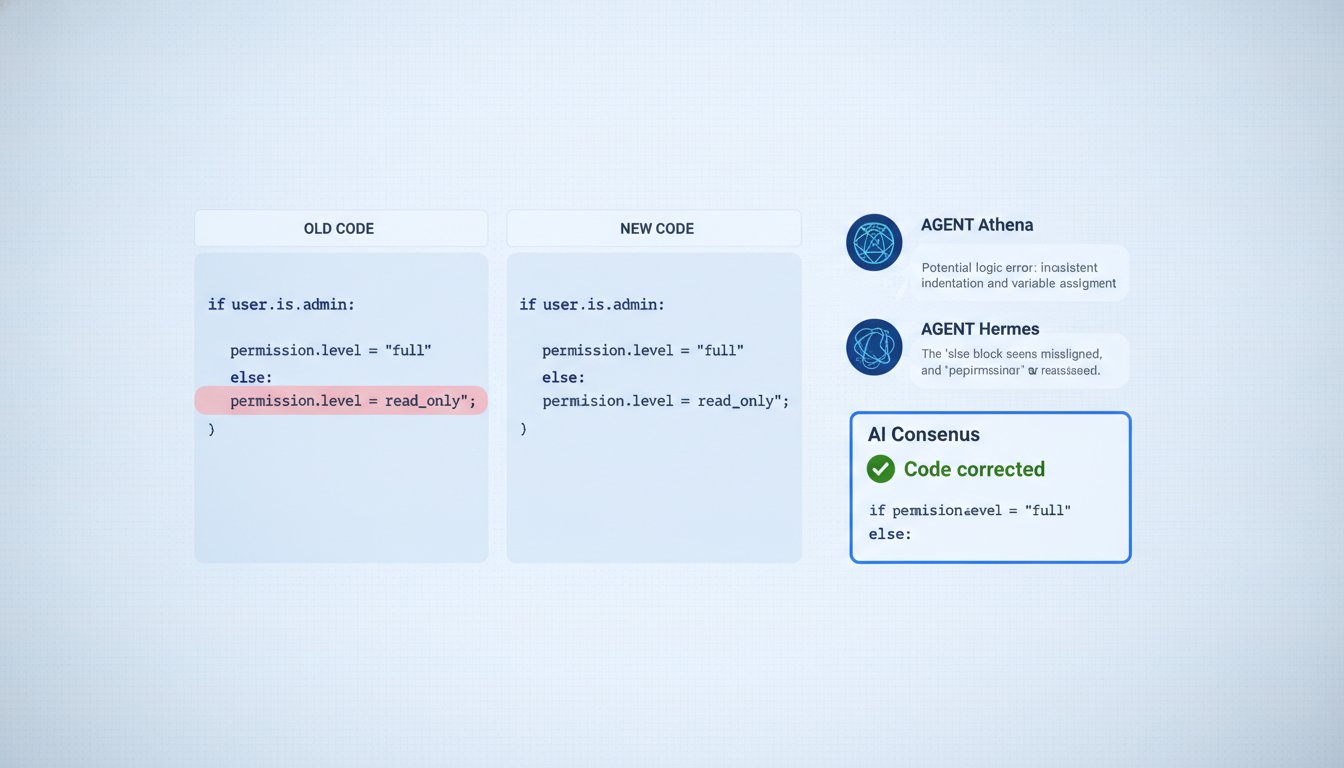
Single-model dependency is a failure point in automated code review. Every LLM has inherent biases and specific blind spots based on its training data. Claude 5 might over-index on functional purity; GPT-5.6 might favor concise, albeit less readable, syntax. CodeMouse solves this by running both models in parallel. It cross-references their outputs to identify points of agreement. This consensus logic acts as a high-pass filter for feedback. If two distinct neural engines identify the same architectural flaw, the probability of a false positive drops significantly.
Claude 5 brings surgical precision to the workflow. Its long-context window allows it to ingest entire modules, maintaining a deep understanding of complex instruction sets. It excels at following strict "don't do X" rules. GPT-5.6 provides the creative breadth. It's often better at suggesting novel solutions to legacy technical debt. A recent study on LLM-based automated code review highlights that multi-model approaches are more effective at catching the logic errors that single-model tools miss. CodeMouse leverages these unique strengths to generate a weighted review score, prioritizing issues where both models align.
Eliminating AI Hallucinations in Code Feedback
Hallucinations are the primary barrier to developer trust. A model might suggest a library function that doesn't exist or a deprecated API from 2021. Consensus AI mitigates this. When models disagree, the system uses a tie-breaker logic to determine if the suggestion is valid. This prevents phantom bugs from cluttering your PR. For mission-critical production code, this layered verification is mandatory. It ensures that the feedback your team receives is grounded in current documentation and functional reality.
Customizing the Reviewer's Personality
Multi-model setups allow for granular control over the review's voice. You can configure the system to be pedantic about performance or helpful toward junior developers. This goes beyond style. You can train the AI on your team's internal standards by providing specific context files. The result is a reviewer that understands your unique architectural goals. Because the system uses both Claude and GPT, it can balance strict adherence to rules with pragmatic suggestions, mirroring the nuanced feedback of a senior human reviewer. This turns automated code review from a simple check into a tailored mentorship tool.
Implementing a Lean Automated Review Workflow in 2026
Modern implementation of an automated code review pipeline is no longer a multi-week infrastructure project. It's a configuration task. You can deploy a multi-model system across your entire organization in under ten minutes. The goal is to remove the friction between a git push and a merge without adding maintenance overhead.
- Step 1: Integrate a GitHub App. This provides zero-config repository access. It bypasses the manual webhook setup and credential management required by legacy tools.
- Step 2: Configure your API keys. Link your OpenAI and Anthropic accounts. This grants access to GPT-5.6 and Claude 5 models while keeping your data within your existing billing structures.
- Step 3: Define thresholds. Not every PR needs senior oversight. Set "Auto-Approve" for low-risk changes like documentation or style updates. Mark mission-critical logic for "Human Required" review.
- Step 4: Iterate. Monitor the feedback loop. If the AI is too pedantic, adjust the system prompt. If it misses edge cases, increase the model tier from GPT-5.6 Luna to Sol.
The 'Bring Your Own API Key' (BYOK) Advantage
Cost transparency is the primary driver for the BYOK model. You pay for what you use at the token level. Typical reviews in 2026 cost between $0.05 and $0.15. This avoids the per-seat pricing traps of enterprise tools that punish team growth. BYOK empowers dev leads to manage budgets by selecting model tiers based on the complexity of the repository or the criticality of the feature branch. You aren't locked into a single provider's markup. If OpenAI drops prices, your review costs drop instantly.
Best Practices for AI-Human Collaboration
Use AI for "First Pass" reviews. It catches the logic errors that often plague high-velocity development environments. This clears the noise so humans can focus on high-level architecture. Automated comments act as a 24/7 mentor for junior developers, providing immediate feedback on PRs before a senior dev even opens the tab. Set clear boundaries. A human must step in for security-sensitive modules or major architectural shifts. This hybrid model ensures speed without sacrificing system integrity during the automated code review process.
Ready to streamline your workflow? You can start a 14-day free trial of CodeMouse AI Code Review to see how multi-model consensus improves your PR cycle times.
CodeMouse: Unlimited Automated Reviews for $10 a Month
While previous sections detailed the technical mechanics of multi-model logic, the operational reality of CodeMouse centers on accessibility and predictability. Most enterprise tools demand a per-seat tax that punishes team growth. CodeMouse operates on a flat $10/month fee for your entire organization. There is no throttling. You get unlimited repositories and unlimited team members under one predictable bill. It's a tool designed for the builder mindset, prioritizing modularity and cost control. By applying the BYOK infrastructure discussed earlier, you maintain full ownership of your data and API costs.
Integration is immediate. You install the GitHub App, grant repository access, and link your API keys. You can start your first automated code review in minutes. The system orchestrates Claude 5 and GPT-5.6 in tandem for every pull request, ensuring that logic bugs are caught before they reach production. This removes the friction of manual oversight without the complexity of traditional enterprise platforms. You get a high-velocity feedback loop that fits into your existing git workflow without demanding a total overhaul of your habits.
- Predictable Scaling: One flat fee regardless of how many developers join your team.
- Full Autonomy: Use your own API keys for Claude and GPT to manage your budget at the token level.
- High Utility: Multi-model consensus reduces hallucinations and filters out style noise.
- Zero Config: GitHub App integration means no manual webhook maintenance or server setup.
Why CodeMouse is the Pragmatic Developer's Choice
We've stripped away the corporate jargon and flashy presentations. CodeMouse provides high-utility feedback that respects your time and intelligence. It acts as a silent partner in your workflow, identifying architectural flaws and logic errors that linters miss. The focus is on clarity and speed. You can test the consensus model risk-free with a 14-day free trial. It's the most direct way to see how multi-model analysis impacts your PR cycle times. We provide the infrastructure, then we step out of the way so you can ship code.
The Future of CodeMouse and AI Orchestration
The roadmap includes deeper architectural analysis and automated security auditing. We're moving toward a more holistic view of the codebase, identifying patterns that span across multiple microservices. You can also join our affiliate program to promote better code quality within your network. The goal is simple: provide the necessary infrastructure for high-velocity development and eliminate the PR backlog. This is the next step in automated code review, moving from static rules to intelligent, multi-model reasoning.
Start your 14-day free trial of CodeMouse today and experience a faster, more reliable review process for your entire team.
Scaling Engineering Velocity with AI Consensus
The 2026 development cycle demands a shift from rigid static rules to intelligent reasoning. You've seen how traditional linters fail to catch the logic errors common in modern AI-generated code. Implementing a multi-model automated code review workflow solves this by filtering out hallucinations and style noise. By leveraging the combined strengths of Claude and GPT, your team moves from basic syntax checking to deep architectural analysis. This ensures that every pull request is verified against functional intent rather than just formatting rules.
This transition doesn't require a complex overhaul or an enterprise-scale budget. A lean, BYOK approach provides the transparency and cost control necessary for sustainable growth. You'll maintain high code quality without the PR backlogs or per-seat pricing traps of legacy tools. It's about providing your developers with a silent partner that handles the heavy lifting of logic verification so they can focus on high-level feature development. This infrastructure scales with your team while keeping costs predictable and low.
Get started with CodeMouse for $10/month to implement Claude and GPT consensus across your repositories. You can test the platform with a 14-day free trial and see the impact on your deployment speed immediately. Build faster and ship cleaner code today.
Frequently Asked Questions
How does automated code review differ from simple linting?
Automated code review evaluates logic, intent, and architecture, whereas linting only checks syntax and style. Linting uses deterministic rules to find formatting errors. AI review uses probabilistic reasoning to identify race conditions or inefficient algorithms. It understands the context behind the code instead of just checking if it follows a style guide.
Can I use my own Claude and GPT API keys with CodeMouse?
Yes, CodeMouse uses a Bring Your Own Key (BYOK) model for both Claude and GPT. You provide your own API keys from Anthropic and OpenAI. This setup gives you full control over token costs. It allows you to choose specific model tiers like GPT-5.6 Sol or Claude 5 Sonnet based on your specific performance needs.
Is automated code review secure for private GitHub repositories?
Security depends on the integration method and the underlying LLM provider. CodeMouse integrates via a GitHub App, which uses fine-grained permissions to access code only during the review process. Data handling follows the privacy policies of OpenAI and Anthropic. Many teams use enterprise API tiers to ensure code isn't used for model training.
Does an AI code reviewer replace the need for human senior developers?
No, it acts as a silent partner to handle low-level logic checks and repetitive tasks. Senior developers are still required for high-level architectural decisions and complex business logic. The tool reduces the manual overhead of PR reviews. This allows seniors to focus on mentorship and system design rather than catching syntax-level logic bugs.
How much does CodeMouse cost for a team of 50 developers?
It costs a flat $10/month for the entire organization. CodeMouse doesn't use per-seat pricing, so a team of 50 pays the same as a team of five. You also pay your AI providers directly for token usage. This model is more predictable and scalable than enterprise seat licenses that punish your team's growth.
Which AI model is best for reviewing Python vs. TypeScript code?
Claude 5 often excels at Python due to its precision and long-context window. GPT-5.6 is highly effective for TypeScript's complex type systems and broad knowledge base. The best results come from using both. Multi-model consensus ensures that language-specific nuances are caught by at least one engine, reducing missed errors in polyglot codebases.
What is 'Consensus AI' in the context of pull request reviews?
Consensus AI is the process of running a PR through multiple models and only surfacing points where they agree. This method significantly reduces hallucinations. If both Claude and GPT flag a specific block of code, the feedback is highly likely to be accurate. It filters out the noise common in single-model automated code review tools.
Can automated tools detect security vulnerabilities like SQL injection?
Yes, modern AI reviewers identify common vulnerabilities including SQL injection, XSS, and insecure credential handling. They analyze the data flow from input to execution. While they don't replace dedicated security audits, they provide a critical first line of defense during the automated code review process before code reaches a staging environment.