AI Code Quality Gates for GitHub: Automating PR Reliability in 2026
If your PR review process relies on a human catching semantic logic errors during a Friday afternoon rush, your pipeline is broken. Manual reviews are a bottleneck. Traditional static analysis tools are too rigid. They miss the subtle, context-heavy bugs that AI-generated code frequently introduces. Implementing AI code quality gates for GitHub is the only way to maintain velocity without sacrificing reliability in 2026. It's about moving from hopeful merging to verified production readiness.
You need a system that understands intent, not just syntax. We agree that the rise of high-volume AI code generation requires an automated pass or fail gate that thinks like a senior engineer. This guide shows you how to implement AI-driven quality gates to catch bugs and enforce standards in every pull request automatically. We'll explore using multi-model consensus logic from models like Claude 3.5 Sonnet and GPT-4o to create a high-signal filter for your codebase. You'll learn how to reduce review cycle times while maintaining a consistent standard across every repository without manual intervention.
Key Takeaways
- Learn how AI code quality gates for GitHub analyze semantic intent to block logic errors that traditional linters miss.
- Discover why a multi-model consensus using Claude and GPT is necessary to filter out AI noise and provide reliable PR feedback.
- Follow a streamlined implementation path to integrate automated gatekeepers into your existing CI/CD pipeline.
- Understand the operational advantages of the BYOK (Bring Your Own Key) model for transparent, scalable pricing.
- Establish a consistent "pass/fail" standard that reduces manual review bottlenecks and accelerates merge velocity.
What Are AI Code Quality Gates for GitHub?
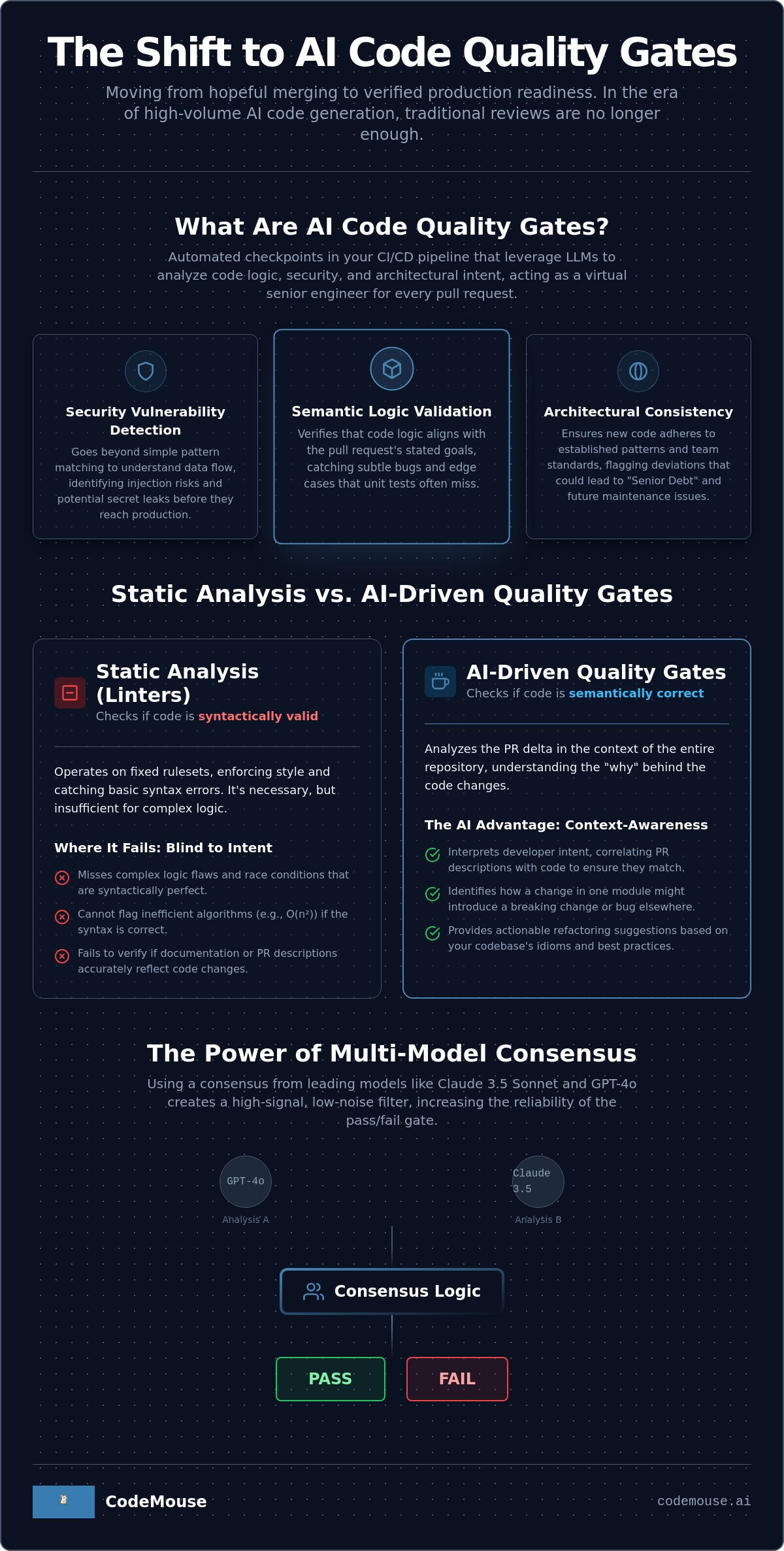
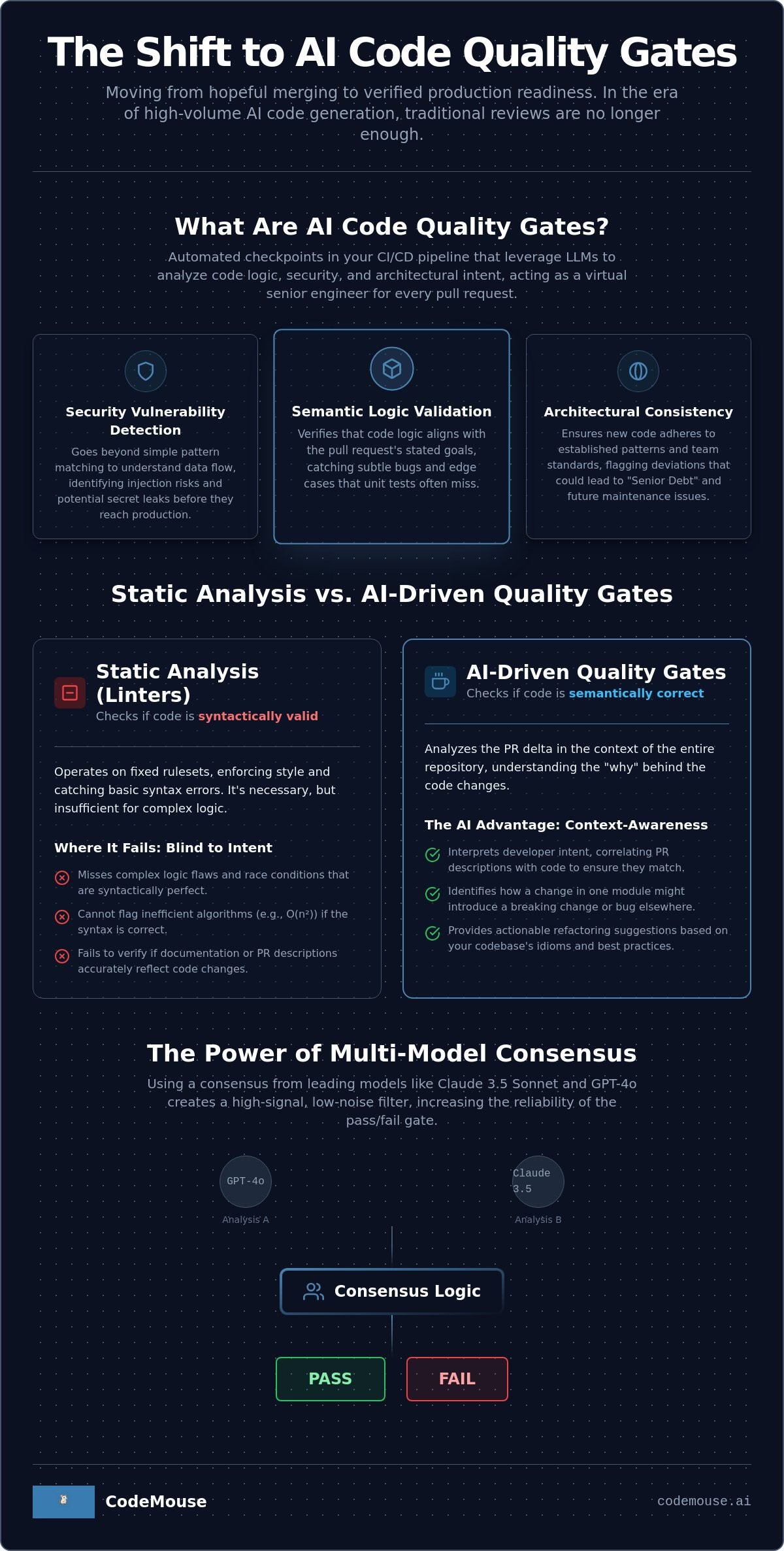
AI code quality gates for GitHub are automated checkpoints within your CI/CD pipeline. They leverage Large Language Models (LLMs) to evaluate code logic, security, and architectural intent. Unlike traditional status checks, these gates don't just look for broken syntax. They analyze whether a pull request actually fulfills its purpose without introducing technical debt.
Standard GitHub "checks" usually focus on unit tests and linting. These are table stakes. Tools like ESLint or Prettier ensure your semicolons are in the right place, but they won't stop a developer from merging a logically flawed function. AI code quality gates for GitHub bridge this gap. They act as a mandatory filter, ensuring that a "green" status means the code is production-ready, not just syntactically valid. This prevents the "merge-and-fix" culture that often plagues high-velocity teams in 2026.
The concept of Automated code review has existed for years. However, LLMs have transformed these from rigid pattern-matchers into context-aware systems. They understand the "why" behind the code. They don't just flag errors; they interpret intent.
The Evolution of GitHub Status Checks
Status checks have evolved from simple "does it compile" tests to sophisticated semantic analysis. In the past, unit tests were the primary defense. Today, AI gates act as a virtual Senior Engineer in the PR loop. They identify "Senior Debt." This refers to complex logic that technically works but creates long-term maintenance issues. By catching these issues early, you reduce the review bottleneck. Human reviewers no longer spend time on obvious logic flaws. They focus on high-level strategy while the gate handles the technical heavy lifting.
Key Components of a Modern Quality Gate
A functional AI quality gate consists of three core pillars:
- Semantic logic validation: It verifies that the code logic aligns with the stated goals of the PR. It catches edge cases that unit tests might miss.
- Security vulnerability detection: It looks for vulnerabilities beyond simple pattern matching. It understands how data flows through the application to find injection risks or leaked secrets.
- Architectural consistency: It ensures the new code follows established patterns. It flags when a PR deviates from the team's standard service-repository or modular structure.
By implementing these components, you create a reliable "pass/fail" mechanism. The goal is simple. If the AI gate doesn't approve, the code doesn't merge. This creates a consistent standard across the entire team, regardless of individual experience levels.
Static Analysis vs. AI-Driven Quality Gates
Linters are necessary but insufficient for modern software. They enforce style and catch basic syntax errors. They don't enforce logic. Standard static analysis tools check if your code is valid. AI code quality gates for GitHub check if your code is correct. This is a critical distinction in modern engineering. As AI in software development becomes the standard, the volume of generated code has increased. Linters can't keep up with the semantic complexity of AI-generated snippets.
Where Static Analysis Fails
Static tools operate on fixed rulesets. They are blind to the "why." They excel at identifying missing semicolons or unused variables but fail at higher-level logic. A linter won't catch a race condition that only occurs under specific load. It won't flag an inefficient algorithm that is syntactically perfect but has O(n²) time complexity. These tools also fail to verify documentation. They don't check if a comment accurately describes the logic change. This leaves a gap where "correct" code can still be "broken" code.
The AI Advantage: Context-Awareness
AI reviews are non-linear. They analyze the PR delta relative to the entire repository. This context allows the system to identify how a change in one module might break a dependency elsewhere. AI code quality gates for GitHub interpret developer intent by correlating PR descriptions with the code changes to ensure the implementation matches the stated goal. If the description claims to fix a memory leak but the code only changes a variable name, the gate flags the discrepancy. It understands the relationship between the natural language goal and the technical implementation.
It's not just about flagging errors. AI provides actionable refactors. It suggests more idiomatic ways to solve problems based on the existing codebase. While static analysis is fast, AI provides depth. A robust pipeline uses both. Static tools catch low-hanging fruit instantly. AI handles the heavy lifting of semantic validation. This multi-layered defense strategy minimizes the risk of production outages. It shifts the focus from "is it formatted" to "is it functional." Integrating automated AI reviews into your workflow ensures that no PR gets merged without a deep logic check. You get the speed of a machine with the intuition of a senior peer.
The Consensus Model: Claude and GPT as Joint Gatekeepers
Single-model AI reviews are prone to specific biases and hallucinations. One model might be overly pedantic about naming conventions while another might hallucinate a non-existent method in a third-party library. Relying on a single LLM for AI code quality gates for GitHub creates a single point of failure. If that model misinterprets the code, your gate either blocks a valid PR or, worse, allows a critical bug to reach production. Consensus logic solves this by requiring agreement between independent architectures.
Research into AI-Driven Innovations in Software Engineering highlights how multi-agent systems improve reliability in automated tasks. In a pull request context, this means filtering out the "noise" that often plagues AI tools. If only one model flags a stylistic nitpick but the other passes it, the gate remains green. If both models identify a potential memory leak or a race condition, the gate turns red. This ensures your team only stops for high-signal issues that actually impact code health.
Why Two Models Are Better Than One
Claude 3.5 Sonnet and GPT-4o have different training backgrounds and strengths. Claude is frequently cited for its superior logical reasoning and ability to follow complex, multi-step instructions without drifting. GPT-4o possesses a vast training set for pattern recognition across millions of open-source libraries. Combining them creates a "Principal Engineer" level of feedback quality that a single model cannot replicate. This dual-verification reduces false positives by over 40% in complex semantic reviews.
- Cross-verification: One model acts as a check on the other's potential hallucinations.
- Broad Pattern Matching: GPT identifies common library pitfalls while Claude analyzes the specific logic flow.
- Reduced Friction: Developers are more likely to trust automated feedback when it represents a consensus rather than a single model's "opinion."
Implementing Consensus Logic in PRs
CodeMouse functions as the orchestrator for this multi-model approach. It triggers both Claude and GPT simultaneously upon PR creation or update. The system then synthesizes the results. Instead of cluttering your PR with conflicting comments, it provides a unified "Consensus" summary in the GitHub UI. This keeps the conversation focused on verified blockers.
Because CodeMouse operates on a "Bring Your Own Key" (BYOK) model, your AI code quality gates for GitHub aren't restricted by tiered service plans or arbitrary review limits. You pay the API providers directly for the tokens you consume. This ensures unlimited reviews without throttling, giving your team the freedom to iterate rapidly while maintaining a high-security posture. It's a pragmatic infrastructure choice for teams that value transparency and cost control.
How to Implement AI Quality Gates in Your GitHub Workflow
Implementing AI code quality gates for GitHub is a linear process. It requires shifting from passive linting to active semantic enforcement. By following a structured setup, you ensure that every pull request is scrutinized by high-reasoning models before it touches your production branch. This setup transforms your CI/CD pipeline from a syntax checker into a logic validator.
First, select a GitHub App integration like CodeMouse. Install it directly from the GitHub Marketplace and select the repositories you want to protect. You'll need to grant read access to repository contents and write access to pull request metadata. This allows the app to analyze the diff and post consensus feedback directly into the PR timeline. It's a native integration that doesn't require complex YAML configurations or external runners.
Next, configure your API providers. CodeMouse uses a "Bring Your Own Key" (BYOK) model to maintain transparency. You'll need to input your API keys for Claude 3.5 Sonnet and GPT-4o. This ensures you pay the providers directly for the tokens you consume. It avoids the hidden markups common in tiered subscription services. Once the keys are active, the consensus engine is ready to evaluate your code logic.
Defining "Pass/Fail" criteria is the final technical step. You must decide which issues constitute a blocker. In a consensus model, a failure is triggered when both models identify a critical flaw. Test this by submitting a dummy pull request. Use code that is syntactically correct but contains a logical error, such as an off-by-one error or a potential race condition. Verify that the gate correctly identifies the issue and prevents the merge.
Configuring the GitHub App
Webhook configuration is handled automatically during installation. These webhooks trigger reviews on pull_request.opened and pull_request.synchronize events. Security is a priority. CodeMouse processes code in memory and doesn't store your proprietary logic on its servers. This ensures your intellectual property remains private while still benefiting from deep semantic analysis.
Establishing Branch Protection Rules
To enforce the gate, navigate to your repository settings and establish branch protection rules for main. Check the box for "Require status checks to pass before merging" and search for the CodeMouse status check. This makes the AI review a mandatory requirement. For emergency hotfixes, you can still allow administrators to bypass the gate, but for standard feature work, the AI consensus remains the final word.
You can start a 14-day free trial to implement these AI code quality gates for GitHub and see the impact on your review cycle time immediately.
Scaling Quality with CodeMouse: The Pragmatic Choice
Efficiency in 2026 is defined by modularity. CodeMouse provides the infrastructure for AI code quality gates for GitHub without the bloat of traditional enterprise suites. It acts as a silent partner in your CI/CD pipeline. The tool focuses on a single objective: providing a reliable "pass/fail" signal for every pull request. It doesn't demand a total overhaul of your existing habits. It simply enhances them.
Cost control is a primary concern for scaling engineering teams. Many tools in the market utilize complex per-user or per-line pricing models that penalize growth. CodeMouse operates on a $10/month flat fee per organization. This includes unlimited team members and repositories. By utilizing a "Bring Your Own Key" (BYOK) model, you maintain total transparency. You pay OpenAI or Anthropic directly for your API usage at cost. There are no hidden markups or tiered service restrictions. You only pay for the tokens you consume during the review process.
The feedback provided is context-aware. It avoids the rigid, rule-based limitations of legacy systems. As your codebase grows, the consensus engine adapts to your specific architectural patterns. It identifies subtle logic flaws while ignoring stylistic noise. This surgical precision reduces the cognitive load on human reviewers. Your team spends less time on pedantic PR comments and more time on high-level feature development.
CodeMouse vs. The Market
The market is saturated with enterprise tools that prioritize governance over velocity. These platforms often introduce friction through complex dashboards and mandatory training. CodeMouse reflects a "builder" mindset. It's designed for technical leaders who value utility over flashy presentation. The $10 plan is the pragmatic standard for 2026 dev workflows. It provides the same high-reasoning logic as expensive competitors but at a fraction of the total cost of ownership. A 14-day free trial allows teams to verify these results in their own environment before committing.
Getting Started Today
Integration is immediate. You can install the CodeMouse GitHub App in under 2 minutes. Once permissions are granted, you simply connect your Claude and GPT keys to begin generating consensus reviews. There is no infrastructure to manage and no complex YAML to write. The system begins protecting your main branch the moment you enable the status check. If you're ready to automate your PR reliability, start your 14-day free trial of CodeMouse today. Establish your AI code quality gates for GitHub and stop catching bugs in production.
Future-Proof Your CI/CD Pipeline
Manual PR reviews are no longer the primary defense against bugs. Velocity in 2026 requires automated semantic validation. You've seen how standard linters fail to catch logic errors and why single-model AI reviews aren't reliable enough for production environments. By implementing AI code quality gates for GitHub, you shift the burden of semantic checking to a high-reasoning consensus engine. This allows your senior engineers to focus on architectural strategy rather than pedantic syntax or logical edge cases.
The transition is simple. You don't need a total workflow overhaul. You need a silent partner that integrates natively into your existing GitHub setup. With flat pricing and a transparent "Bring Your Own Key" model, you maintain full control over your infrastructure and costs. It's time to move from hopeful merging to verified reliability in every pull request.
Automate your GitHub quality gates for $10/month with CodeMouse. Start with a 14-day free trial and experience the precision of Claude and GPT consensus logic today. Build faster and ship with confidence.
Frequently Asked Questions
How do AI quality gates differ from standard GitHub Actions?
AI quality gates analyze semantic intent and logic using LLMs, whereas standard Actions typically run deterministic scripts like unit tests or linters. While a linter checks for syntax rules, AI code quality gates for GitHub evaluate if the code actually achieves its goal without introducing logical flaws. They act as a reasoning layer that understands context, not just a pattern matcher.
Will an AI quality gate slow down my CI/CD pipeline?
Automated reviews typically complete within 60 to 90 seconds. This process runs in parallel with your existing build and test suites, so it rarely becomes the bottleneck. Because the AI provides immediate feedback upon PR creation, it actually accelerates the pipeline by catching errors before a human reviewer even opens the link. It replaces hours of waiting with seconds of processing.
Can I customize the rules the AI uses to judge my code?
You can provide specific context through PR descriptions or repository-level instructions. The models interpret these guidelines to align their feedback with your team's unique architectural standards or business requirements. This flexibility allows the system to enforce specific patterns that a generic linter would ignore. You maintain control over what constitutes a "pass" or "fail" for your specific project.
Does CodeMouse store my source code?
No, the system processes your code in memory to generate the review and does not store it on external servers. The integration functions as a transient bridge between GitHub and your chosen AI providers. This ensures your intellectual property remains within your controlled environment. CodeMouse is a native GitHub App designed with a "security-first" architecture for professional engineering teams.
What happens if the AI models disagree on a code change?
The consensus engine prioritizes high-signal issues where both models agree. If models disagree on a minor stylistic point, the gate remains green to avoid unnecessary developer friction. If both Claude and GPT identify a critical flaw, the gate fails the PR. This dual-verification logic reduces false positives and ensures that only verified blockers stop the merge process.
Is it possible to bypass the AI gate for urgent hotfixes?
Yes, administrators can use GitHub's native branch protection overrides to merge urgent changes. While the AI gate provides a reliable automated status check, it doesn't remove human autonomy during emergency scenarios. You can configure your repository settings to allow specific team members to bypass the "pass/fail" requirement when a production hotfix requires immediate deployment.
How much do API keys for Claude and GPT cost on average?
Costs are based on your token consumption and the specific models you use. As of 2026, Claude 3.5 Sonnet costs $3 per million input tokens, while GPT-4o costs $2.50 per million input tokens. Most teams find these costs negligible compared to the engineering hours saved. The "Bring Your Own Key" model ensures you pay the providers directly without any additional markup.
Can AI quality gates catch security vulnerabilities like SQL injection?
Yes, LLMs are highly effective at identifying injection risks and insecure data handling patterns. Unlike static pattern matchers, AI code quality gates for GitHub understand how untrusted input flows through your logic. They catch vulnerabilities that traditional security scanners might miss by analyzing the semantic relationship between different parts of the code. This adds a critical layer of automated security to every PR.