AI Code Review for GitHub: Scaling Quality with Multi-Model Consensus
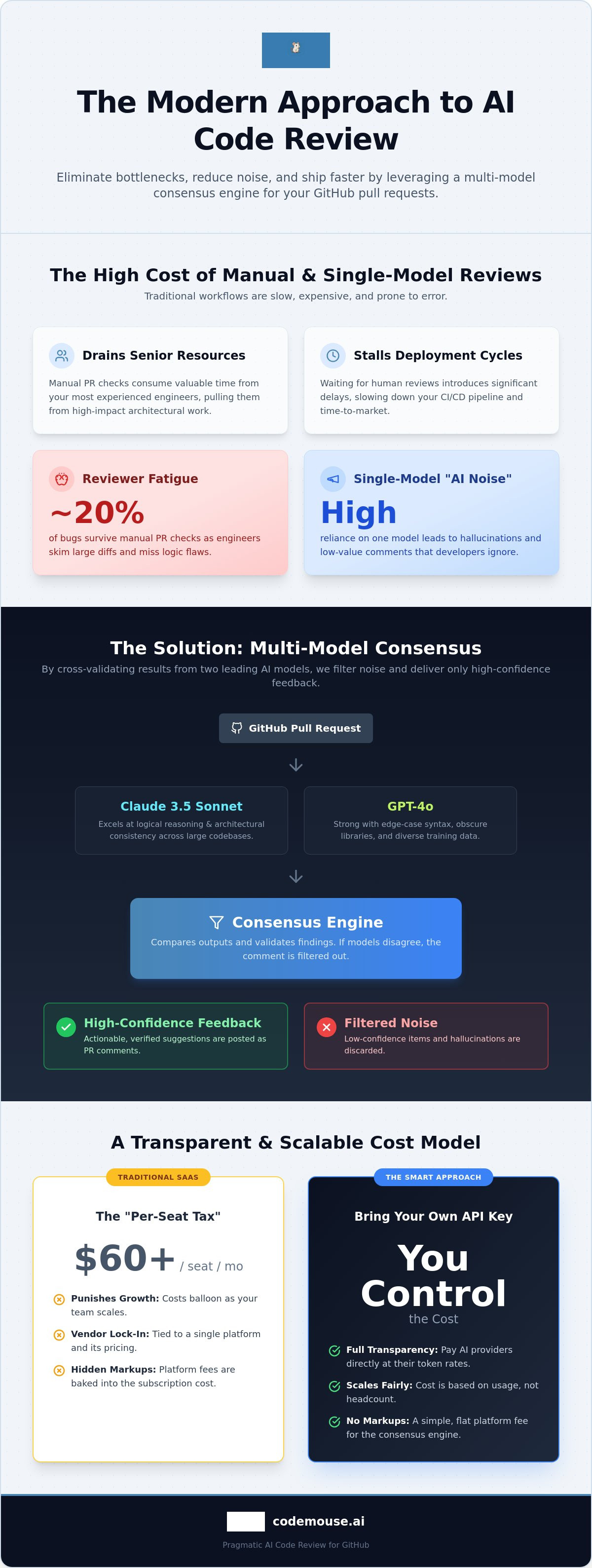
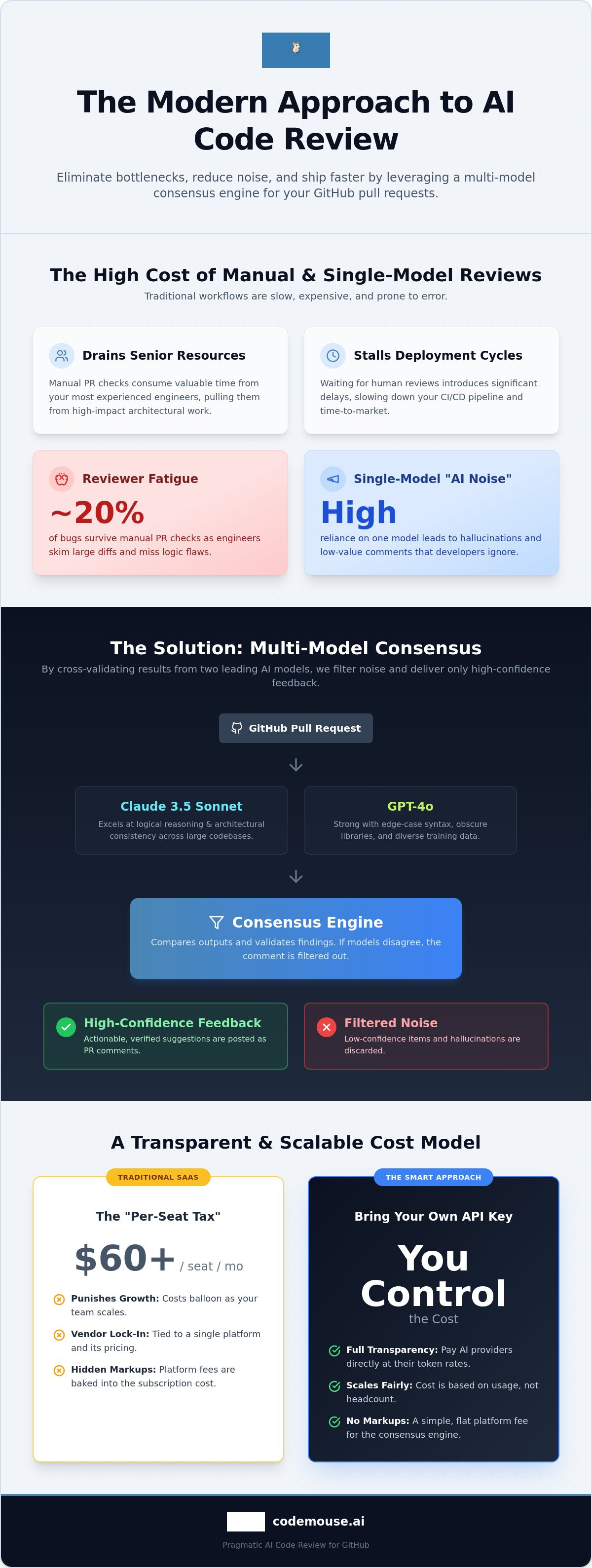
Why pay $60 per seat for an AI tool that still misses basic logic errors? Manual pull request reviews are the ultimate bottleneck. They drain senior engineering resources. They stall deployment cycles. Relying on a single AI model often trades human time for "AI noise" that developers eventually ignore. You need a scalable way to implement AI code review for GitHub that provides actual utility.
We agree that the current per-seat subscription model is inefficient. It punishes growing teams. It creates unnecessary vendor lock-in. You deserve a workflow that prioritizes high-signal feedback and cost transparency. This article explains how to automate your PR reviews using a multi-model consensus approach. By running models like Claude 3.5 Sonnet and GPT-4o in parallel, you can eliminate hallucinations. We will cover the technical steps to build a robust system that catches more bugs and operates at a fraction of the cost of enterprise alternatives.
Key Takeaways
- Multi-model consensus reduces noise. Combining Claude’s logic with GPT’s context catches bugs that single-model tools often miss.
- Avoid the per-seat tax. Flat-rate pricing scales with your team without the financial penalties associated with traditional SaaS models.
- Automate your AI code review for GitHub to bypass manual bottlenecks. Reclaim senior developer time for high-level architecture rather than routine PR checks.
- Use the "Bring Your Own API Key" strategy for transparency. Pay direct provider rates for tokens and eliminate hidden platform markups.
- Deploy in minutes. A pragmatic, builder-first setup integrates directly into your existing workflow without demanding habit changes.
Table of Contents
- Beyond Manual PRs: The State of AI Code Review for GitHub in 2026
- The Consensus Engine: Why Claude and GPT-4 Together Beat Single LLMs
- Evaluating the Market: Platform Credits vs. BYO API Key Models
- Implementation Guide: Integrating AI Feedback into Your GitHub Workflow
- CodeMouse: The Pragmatic Solution for GitHub PR Automation
Beyond Manual PRs: The State of AI Code Review for GitHub in 2026
Software development in 2026 is defined by velocity. The 2025 GitHub Octoverse report noted a 29% increase in merged pull requests. This volume makes manual oversight impossible. Traditional AI code review for GitHub has evolved. It moved from simple regex-based linting to deep semantic understanding. Modern tools don't just look for missing semicolons. They analyze intent. They understand how a change in one module affects the entire system.
Manual reviews are a persistent bottleneck. Humans are prone to "Reviewer Fatigue." Data indicates that approximately 20% of bugs survive manual PR checks. Senior engineers often skim large diffs. They miss logic flaws while focusing on style. High-quality automated code review systems now fill this gap. They provide a first pass that never gets tired. GitHub remains the primary staging ground for these workflows. Its robust API allows AI tools to sit directly in the developer's path. This integration ensures that quality checks happen before a single line of code reaches production.
The Limitations of Traditional Static Analysis
Linters are necessary but insufficient. They rely on fixed rules. If a pattern isn't in the config, the linter ignores it. These tools lack a context window. A traditional tool won't notice that a function call violates business logic or creates a race condition. Developers often ignore noisy, low-value comments from these tools. This leads to alert fatigue. Modern AI code review for GitHub solves this by understanding the codebase context. It ignores trivialities. It focuses on functional risk and logical consistency. It bridges the gap between syntax and semantics.
The Rise of the AI Peer Reviewer
AI is a force multiplier. It isn't a replacement for senior talent. It's a filter. It handles the nitpicking so humans can focus on architecture. Feedback arrives in seconds. This reduces cycle time significantly. Instead of waiting hours for a human peer, a developer gets immediate validation. It changes the role of the senior engineer. They move from spotting syntax errors to providing high-level oversight. LLMs in 2026 have shifted from basic syntax checking to complex architectural feedback. They identify cross-file dependencies and potential security vulnerabilities that span multiple services. The workflow is leaner. Results are more predictable.
The Consensus Engine: Why Claude and GPT-4 Together Beat Single LLMs
Single-model AI code review for GitHub often fails due to hallucinations. One model might flag a valid pattern as a bug. Another might miss a critical security flaw entirely. Relying on a single LLM creates a single point of failure in your CI/CD pipeline. It lacks the checks and balances required for production-grade software. You need a system that doesn't just guess. You need one that verifies.
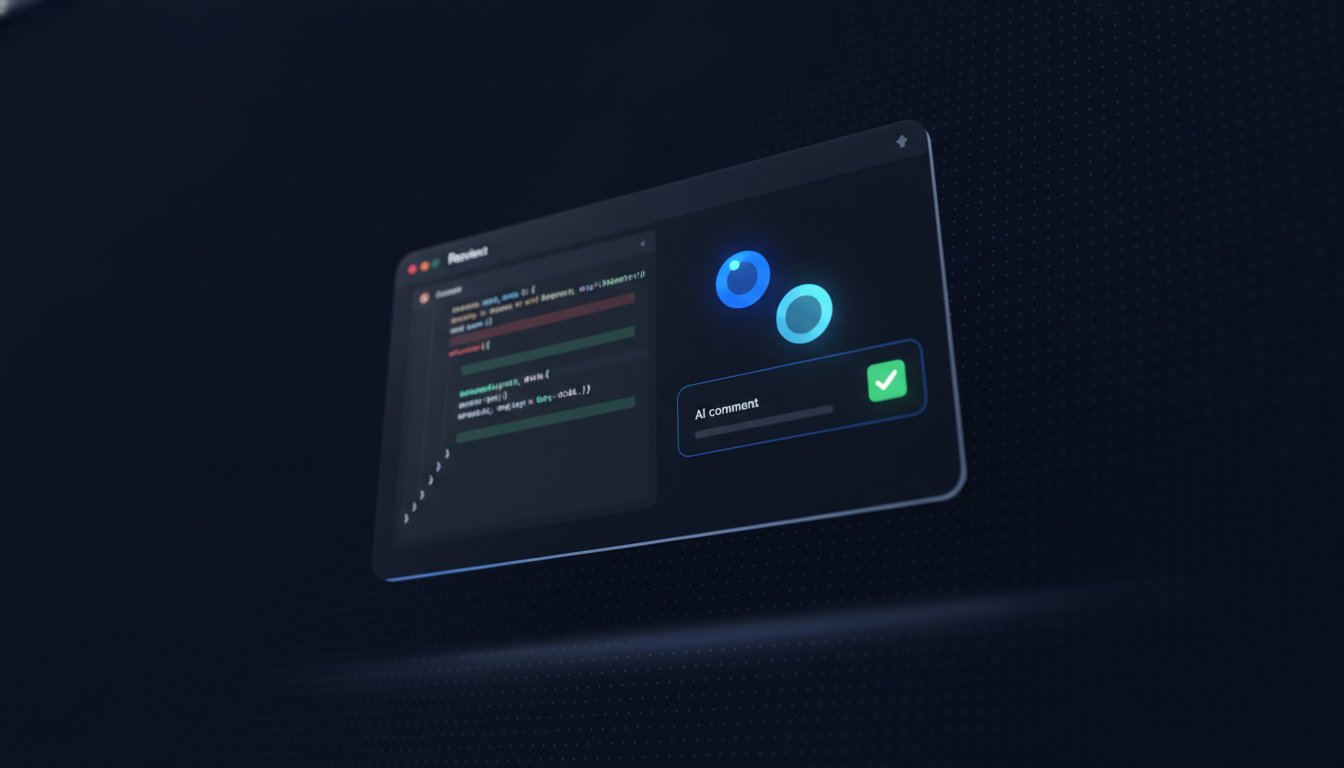
CodeMouse solves this with a multi-model consensus engine. It treats Anthropic’s Claude and OpenAI’s GPT as a peer-review pair. This approach mirrors human workflows where two developers check a complex diff. If both models identify an issue, the confidence level is high. If they disagree, the system filters out the noise. This orchestration ensures that AI code review for GitHub remains a high-signal activity that developers actually trust.
Claude vs. GPT: Complementary Strengths in Code Analysis
Claude 3.5 Sonnet excels at logical reasoning and maintaining state across large files. Its 200k+ context window allows it to analyze entire repositories for architectural consistency rather than just looking at isolated snippets. GPT-4o brings a different advantage. It has seen more obscure library implementations and edge-case syntax in its training data. AI Consensus is the validation of a code flaw by two independent LLMs. By combining these strengths, you cover more ground than any single-platform tool. The market for AI code review is growing, but most enterprise tools still lock you into one ecosystem. This modularity allows for deeper analysis without sacrificing speed.
Reducing False Positives Through Cross-Validation
Developer trust is fragile. One hallucinated bug comment can lead a team to ignore the tool forever. CodeMouse uses a "Double-Check" mechanism to prevent this. If Claude flags a potential memory leak but GPT disagrees, the system treats it as a low-confidence item. It won't clutter your pull request with questionable advice. We prioritize high-confidence issues that require immediate attention. Two models represent the sweet spot for balancing accuracy and latency. Adding a third model often increases token costs without a proportional gain in quality. This lean approach keeps reviews fast and relevant. You can start a 14-day free trial to see this consensus engine in action on your own private repositories.
Evaluating the Market: Platform Credits vs. BYO API Key Models
SaaS pricing is often a tax on growth. For engineering leaders, per-seat licenses for AI code review for GitHub create unnecessary friction. Hiring a new developer shouldn't increase your tooling bill by $30 every month. This "per-seat tax" discourages full-team adoption. It forces managers to decide which developers "deserve" automated feedback. We believe every pull request deserves a quality check. The pricing model should reflect that reality.
The Math of Automated Code Review
Consider the math for a 20-person engineering team. Standard SaaS pricing at $30 per seat results in a $600 monthly bill. This cost persists even if half the team is focused on documentation or architecture that month. CodeMouse utilizes a flat $10 monthly fee for the entire organization. You pay for the raw compute through your own provider accounts. Verified usage data suggests the average cost per review is between $0.05 and $0.15. A team performing 500 reviews a month would pay roughly $25 to $75 in API fees. The total cost is a fraction of the per-seat model. This structure eliminates the "black box" of platform credits. You see the exact token usage in your OpenAI or Anthropic console. It’s a pragmatic choice for teams that value efficiency over flashy dashboards.
BYO-AK (Bring Your Own API Key) prevents vendor lock-in. Most platforms bundle AI access to hide the true cost of the models. They buy tokens at wholesale and sell them to you at a premium. If a new, more efficient model version releases, you can't switch until the vendor updates their backend. With CodeMouse, you switch instantly in your provider dashboard. You maintain total control over your tech stack and your budget.
Autonomy and Control
Autonomy extends to technical configuration. Using your own API keys gives you direct control over rate limits and tier access. You aren't shared across a SaaS provider's pool of enterprise credits. If you have a Tier 5 OpenAI account, your AI code review for GitHub benefits from that throughput immediately. Academic studies on multi-model consensus in code review show that model performance is highly task-dependent. BYO-AK gives you the flexibility to swap Claude for GPT or Gemini as these models evolve. CodeMouse provides the orchestration layer. We don't markup the intelligence. This ensures your interests are aligned with the tool's utility, not the vendor's margin on tokens. Startup CFOs prefer this predictability. It turns a variable, per-head expense into a manageable, usage-based cost. You pay for the integration. You own the results.
Implementation Guide: Integrating AI Feedback into Your GitHub Workflow
Setting up AI code review for GitHub shouldn't require a weekend of configuration. Efficiency is the priority. The process starts with the CodeMouse GitHub App. Installation takes approximately two minutes. You authorize the app for specific repositories or your entire organization. This allows the tool to listen for pull request events and respond with automated feedback immediately. No complex YAML files are required for basic operation. It’s designed to fit into your existing CI/CD pipeline without friction.
Setting Up Your Consensus Environment
You provide the infrastructure. Generate API keys in the Anthropic and OpenAI dashboards. CodeMouse acts as the orchestration layer. We store your keys securely using industry-standard encryption. We never use your code to train models. This ensures your intellectual property remains private. Once keys are provided, test the integration by opening a dummy PR. This verifies that the consensus engine can reach both providers and post a unified comment back to GitHub. It’s a transparent, step-by-step progression. You see the results in seconds.
Defining the review scope is critical for signal quality. You can configure which branches trigger the AI. Some teams run reviews on every feature branch. Others restrict the tool to `main` or `develop` to save on token costs. You also control the review depth. You can set the AI to focus on specific areas like security vulnerabilities, performance bottlenecks, or simple readability. This flexibility respects your team's specific coding standards and priorities. Install the CodeMouse GitHub App to begin your 14-day free trial.
Optimizing the Feedback Loop
Feedback is only useful if it's actionable. CodeMouse comments appear directly in the GitHub PR conversation. These aren't static alerts. You can use GitHub's native threading to "chat" with the AI for clarifications. If a suggestion seems incorrect or requires more context, reply to the comment. The system maintains the context of the diff and provides a reasoned response. This human-in-the-loop approach ensures the AI acts as a partner rather than a gatekeeper.
- Focus on high-impact areas: Configure the AI to ignore style nits if you already use a linter.
- Security-first reviews: Prioritize checks for SQL injection, hardcoded secrets, and unsafe dependencies.
- Performance audits: Look for O(n^2) operations or unnecessary database queries in the diff.
The goal is to reduce the cognitive load on senior engineers. By the time a human reviewer opens the PR, the "easy" bugs are already caught. The discussion moves from syntax to architecture. This shift increases the value of human review time and speeds up the entire delivery cycle. It’s a lean, logic-driven workflow that scales with your repository volume.
CodeMouse: The Pragmatic $10 Solution for GitHub PR Automation
CodeMouse isn't another bloated enterprise platform. It's a functional utility designed for efficiency. We built it to solve a specific problem: providing high-quality AI code review for GitHub without the high-cost overhead of per-seat licensing. You get unlimited reviews for a flat $10 monthly fee. We don't markup your API tokens. We don't hide costs behind complex credit systems that expire. It's a transparent bridge between your repository and the world’s best LLMs. You pay for the orchestration. You own the intelligence.
Squidcode designed this tool for developers who hate unnecessary complexity. We value modularity and user autonomy. CodeMouse stays out of your way. It provides the necessary infrastructure for multi-model consensus and then steps back. You maintain control of your API keys, your data, and your budget. This isn't a sales-heavy service. It's a builder-first tool that respects your time and your intelligence. It’s a silent partner in your development cycle that enhances existing workflows rather than demanding a total overhaul.
Built for Scale, Priced for Everyone
The $10 model works for any team size. A solo developer gets enterprise-grade feedback for a negligible cost. A 50-person engineering team avoids the thousands of dollars typically spent on "Pro" plans. Scaling your quality checks shouldn't result in a financial penalty. Our roadmap includes expanded multi-model support to integrate new reasoning models as they reach the market. This ensures your AI code review for GitHub always utilizes the latest advancements. You can also join our affiliate program to earn by promoting better code quality within your network. We believe in a lean ecosystem where utility is the only metric that matters.
Get Started with CodeMouse Today
Testing the consensus engine is straightforward. We offer a 14-day free trial with full access to every feature. You can verify the quality of the feedback on your own private repositories without any initial commitment. No credit card is required to start. It’s a pragmatic way to see exactly how much senior developer time you can reclaim. Automate your first GitHub PR review with CodeMouse and move from manual nitpicking to high-level architectural oversight today. The setup is fast. The results are immediate. The value is clear.
Ship Better Code Without the Per-Seat Tax
Manual review bottlenecks shouldn't stall your deployment cycles. High-quality AI code review for GitHub is now a requirement for teams maintaining velocity. By leveraging Claude and GPT-4 consensus logic, you eliminate the hallucinations common in single-model tools. You get high-signal feedback that developers actually trust. This isn't about replacing humans; it's about filtering the noise so your senior engineers can focus on architecture and complex logic.
CodeMouse offers a pragmatic path forward. You avoid the "black box" of platform credits and expensive per-seat pricing. Our flat $10/month model ensures that scaling your team doesn't penalize your budget. You get no-throttling, unlimited reviews while maintaining total cost control through your own API keys. It's a lean, builder-first solution that integrates into your existing workflow in minutes. Start your 14-day free trial of CodeMouse to automate your PR checks and reclaim your team's focus. Build faster. Review smarter.
Frequently Asked Questions
How does AI code review for GitHub actually work?
AI code review for GitHub works by integrating directly with your pull request workflow. When you push code, the GitHub App triggers a webhook that sends the file diffs to our consensus engine. The system analyzes the changes using multiple models and posts consolidated feedback directly as PR comments. It automates the first pass of review so your team can focus on complex logic and architecture.
Is CodeMouse secure? Does it train on my code?
We do not train on your code. CodeMouse uses official enterprise APIs from Anthropic and OpenAI, which explicitly exclude API data from their training sets. We process code in-memory and don't store your repository contents on our servers. Your intellectual property remains yours. We only store the minimal metadata necessary to manage your subscription and API configurations.
Why do I need to provide my own API keys?
Using your own API keys eliminates vendor markups and hidden fees. It gives you direct access to your AI provider's rate limits and tier benefits. This model ensures that you only pay for the raw token usage you consume. It also prevents vendor lock-in; you can swap or update model versions as soon as they are released by the providers.
Can the AI catch security vulnerabilities like SQL injection?
The consensus engine is highly effective at spotting common security flaws. It identifies patterns like SQL injection, insecure dependency usage, and hardcoded credentials. Because Claude and GPT analyze the code independently, they provide a more robust check than a single model. This dual-verification reduces the risk of overlooking critical vulnerabilities in your production environment.
How much will the API usage cost me on top of the $10 fee?
API costs are usage-based and paid directly to your chosen provider. Based on current token pricing, a standard review typically costs between $0.05 and $0.15. A team performing 200 reviews per month might see an additional $10 to $30 on their OpenAI or Anthropic bill. This remains significantly cheaper than traditional per-seat SaaS tools that markup AI access.
Does CodeMouse support private GitHub repositories?
Yes, CodeMouse fully supports private GitHub repositories. You maintain granular control over permissions. During setup, you choose whether to grant access to all repositories or a specific subset. The app uses GitHub’s secure authentication to fetch diffs only when a PR event occurs. This ensures your private codebase remains protected while receiving automated feedback.
What happens if Claude and GPT disagree on a code change?
Conflicting feedback is filtered to maintain a high signal-to-noise ratio. If Claude flags an issue that GPT ignores, or vice versa, the system often treats it as a low-confidence hallucination. We only post comments when there is strong consensus or high logical certainty. This approach ensures your AI code review for GitHub doesn't waste developer time with false positives.
How do I install the CodeMouse GitHub App?
Installation takes less than two minutes. You visit our dashboard, click "Install GitHub App," and select your organization. After granting repository permissions, you paste your API keys from OpenAI or Anthropic into the secure settings. The system is then live. Every new pull request in your selected repositories will automatically receive a multi-model consensus review.