The Real Cost of Manual Code Review in 2026: A Developer’s Guide
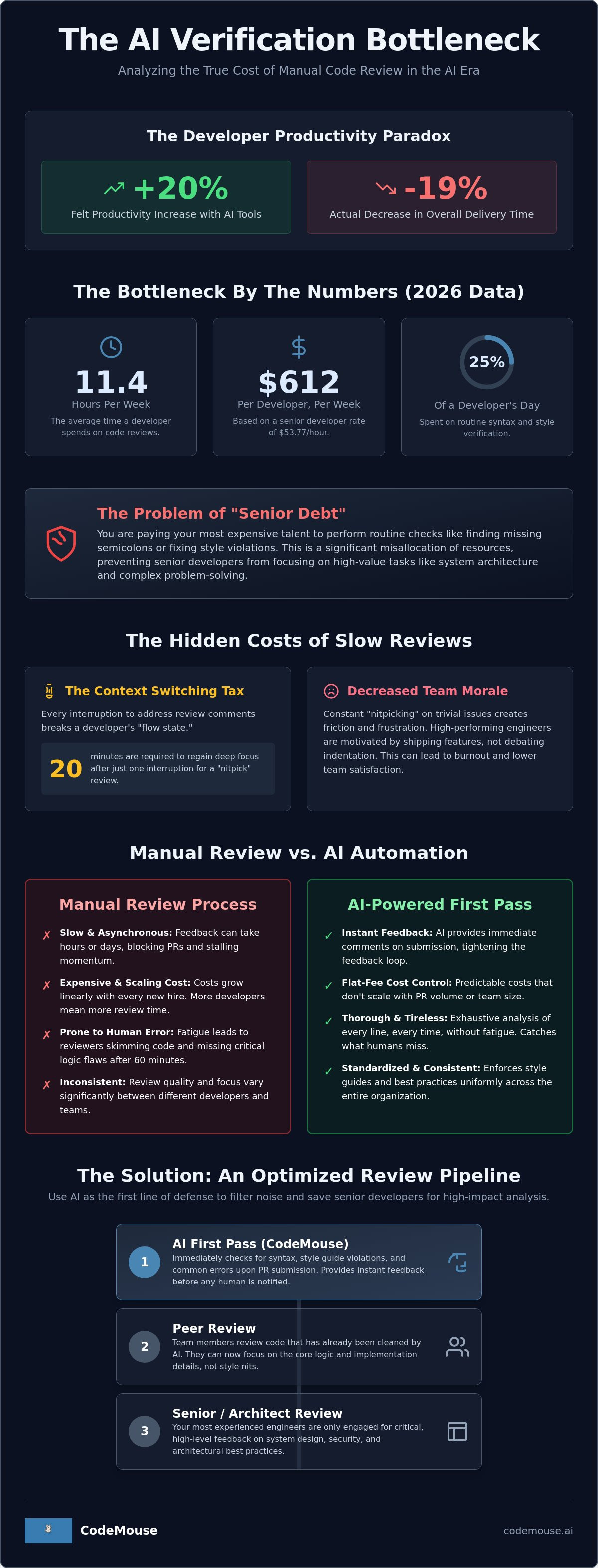
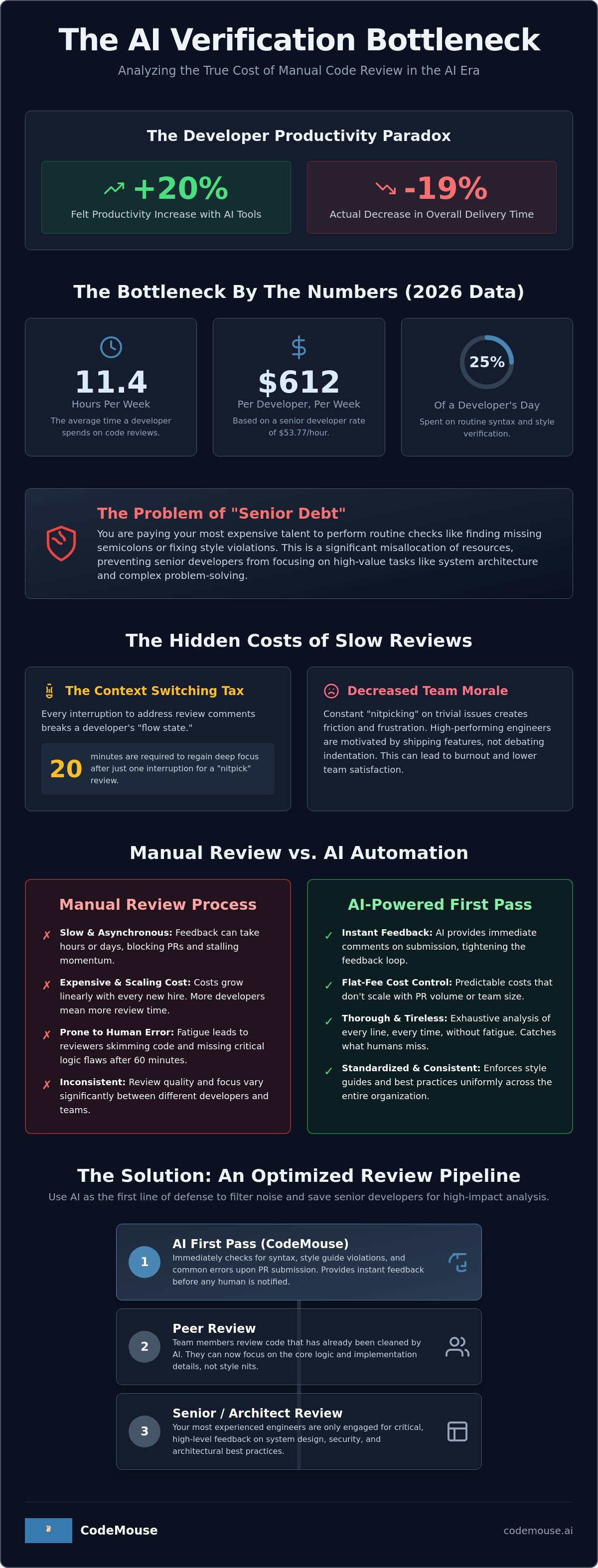
Developers using AI tools feel 20% more productive, yet telemetry data shows they are actually 19% slower in overall delivery time. The culprit is the AI verification bottleneck. As of 2026, teams spend an average of 11.4 hours per week reviewing code. At an average senior developer rate of $53.77 per hour, the cost of manual code review quickly scales into a significant budgetary leak. When your most expensive talent spends 25% of their day on basic syntax checks, you are paying a premium for a process that should be automated.
You've likely felt the frustration of a stalled PR cycle. Context switching between deep work and basic diff reviews creates significant cognitive fatigue. It is an inefficient way to maintain code quality. This guide breaks down the financial and productivity burden of manual processes. You will learn how to build an ROI framework for automation, reduce PR cycle times, and return your senior developers to high-level architecture. We will examine how to optimize your pipeline to ensure faster shipping cycles and higher team satisfaction.
Key Takeaways
- Calculate total financial burden by mapping engineering labor hours to PR volume.
- Identify the "Senior Debt" created when high-salary talent performs routine syntax and pattern checks.
- Analyze the true cost of manual code review including the 20-minute productivity tax triggered by context switching.
- Build a tiered review pipeline that uses AI as a first line of defense for immediate feedback.
- Control infrastructure costs with flat-fee automation and a bring-your-own-API-key model.
Table of Contents
Calculating the Direct Financial Cost of Manual Code Review
The cost of manual code review is a variable expense that scales with your team's growth. It is not just a part of the job; it is a measurable line item on your balance sheet. Data published in April 2026 indicates that developers now spend an average of 11.4 hours per week reviewing code. This is more time than they spend writing new code. At an average hourly rate of $53.77, a single developer costs your company roughly $612 per week just for reviews. Multiply this across a team of ten, and you are burning over $26,000 every month on manual verification.
To calculate your team's monthly burn rate, use this formula:
Monthly Burn = (Total Developers) x ($53.77) x (11.4 Hours) x 4.33
Senior developers often bear the heaviest review load. This creates "Senior Debt." You are paying a high-salary architect to catch missing semicolons or style guide violations. It is a misallocation of resources that prevents your most experienced talent from focusing on high-level system design or complex logic. Every hour a senior dev spends on a routine code review is an hour of expensive architectural insight lost.
The Hourly Rate Reality
Base salary is only the starting point. Total compensation includes payroll taxes, benefits, and equity. These factors push the real cost of labor significantly higher than the $53.77 base. As teams grow, these costs scale linearly. Every new hire adds more PRs to the queue. This leads to more asynchronous discussions and follow-up meetings. If a manual review triggers a 30-minute sync, that specific review cost doubles instantly. These hidden hours contribute to a compounding financial drain that many managers fail to track.
Time Allocation vs. Value Creation
The traditional 20% rule, where developers spend one day a week on reviews, is dead. Current data shows that review cycles now consume nearly 30% of the work week. This shift happened because AI-generated code has increased the volume of PRs, creating a massive verification bottleneck. The opportunity cost is the real danger. Features that could drive revenue remain stuck in the queue. For startups, this delay is a competitive disadvantage. Without a large senior staff to absorb the load, manual reviews become a primary blocker for shipping and scaling.
The Hidden Impact of Slow Code Reviews and Bottlenecks
Engineering velocity dies in the pull request (PR) queue. While the direct cost of manual code review is visible in payroll data, the indirect costs are often more damaging to a company's bottom line. A developer finishes a feature, submits a PR, and then begins the waiting game. This idle time isn't just a pause; it is a total break in momentum. When a reviewer finally provides feedback, the original author must drop their current task to address the comments. This is the "context switching tax."
Research suggests it takes roughly 20 minutes to regain deep focus after a single interruption. If a PR goes through three rounds of manual "nits" regarding style or naming conventions, that is one hour of pure cognitive overhead per developer. Over a month, this friction inflates cycle times. A logic change that took one hour to code can take three days to merge. This delay is rarely caused by the complexity of the code. It is caused by the scheduling conflicts inherent in human-to-human review cycles.
The psychological impact is equally severe. Constant "nitpicking" on PRs creates friction between team members. It turns a collaborative process into a source of frustration. When developers feel their time is being wasted on trivial syntax debates, morale drops. High-performing engineers want to ship, not argue about indentation for 48 hours. To rebuild this lost camaraderie, many teams utilize the time saved by automation to host digital games nights with interactive party games using Gameznights.
Developer Productivity and Flow State
Feedback loops must be tight to maintain flow. When feedback is slow, developers start batching changes into massive, 1,000-line PRs to avoid the "waiting game." These "mega-PRs" are significantly riskier and harder to debug. Recent findings from the KTH Royal Institute of Technology show that developers spend 10-15% of their time on code reviews. In many AI-augmented environments, this figure is climbing even higher. Slow feedback loops directly impact your "Time to Market," allowing competitors to ship features while your code sits unmerged. Implementing CodeMouse AI Code Review as a first line of defense can collapse these wait times by providing instant feedback before a human even sees the diff.
The Quality Paradox
Manual review is often less thorough than teams realize. Humans are poor at repetitive pattern matching and exhaustive semantic analysis. As a review session extends past 60 minutes, the error rate climbs due to fatigue. Reviewers begin to skim. They miss critical logic flaws because they are mentally exhausted from checking for style consistency. This paradox means the cost of manual code review often includes the price of bugs that were "reviewed" but never seen. Different reviewers also apply different standards, leading to a fragmented codebase. Automated semantic analysis provides a level of consistency and depth that manual human checks cannot match during high-volume periods.
Manual vs. Automated: A 2026 Cost Comparison
The unit economics of software development shifted drastically in 2026. A standard manual review performed by a senior engineer now costs upwards of $50 per PR when factoring in total compensation and overhead. In contrast, an automated review using high-reasoning models costs less than $1. This 50x difference in the cost of manual code review makes automation a financial necessity for teams shipping daily. Humans are essential for high-level architectural decisions, but they are an expensive bottleneck for routine verification.
Reliability is the secondary differentiator. Human reviewers experience cognitive decline as the day progresses. A PR submitted at 4:30 PM on a Friday rarely receives the same scrutiny as one submitted on Tuesday morning. AI models maintain a constant baseline of quality. They don't skip over complex diffs or ignore edge cases because of meeting fatigue. Adopting a hybrid model allows your team to use AI as the first pass. This ensures that by the time a human reviewer opens the PR, the "low-hanging fruit" is already resolved.
A survey of 484 Microsoft developers found that 5% of their actual workweek is spent specifically on pull requests and reviews. While this seems like a small percentage, it represents a recurring interruption that shatters flow state. Automating the first 80% of the review process reclaims these hours for feature development.
AI Capabilities in 2026
Modern automation has moved beyond basic static analysis. Using Claude and GPT-4o models, tools now understand developer intent. They don't just flag syntax errors; they catch logical inconsistencies across the entire codebase. Context-aware feedback allows these models to identify how a change in one module might break a dependency in another. By utilizing multi-model consensus, systems can merge findings from different LLMs to reduce false positives and provide more accurate suggestions than a tired human reviewer.
Scalability and Throughput
Manual processes cannot scale without increasing headcount. If your team doubles its PR volume, you must either hire more reviewers or accept slower shipping cycles. Automation eliminates this constraint. You can process 100 PRs simultaneously without adding a single dollar to your payroll. This throughput is critical for distributed teams working across different time zones. It removes the "reviewer availability" blocker, ensuring that code moves through the pipeline the moment it is ready. Standardizing quality across a global team becomes a matter of configuration rather than constant management oversight.
Optimizing the Review Pipeline for Maximum Efficiency
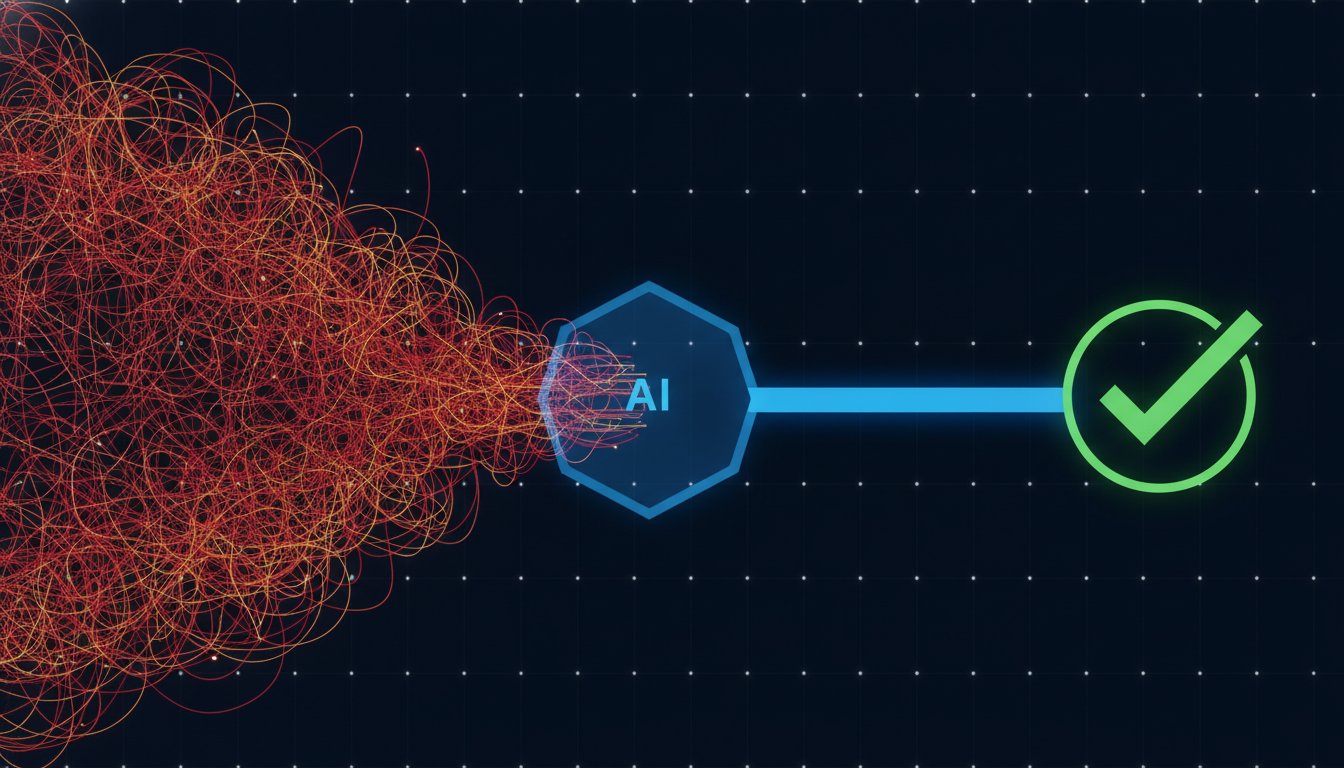
Efficiency in 2026 requires a tiered approach to quality control. You cannot simply replace humans with AI; you must re-engineer the workflow. The goal is to treat human intervention as the final, most expensive gate in the process. By restructuring the pipeline, you minimize the cost of manual code review by ensuring that when a senior developer finally opens a PR, the trivial issues are already resolved. This prevents "review fatigue" and keeps your most expensive assets focused on high-level logic.
Follow this four-step progression to optimize your delivery speed:
- Step 1: Automate the low-hanging fruit. Offload syntax checks, style guide adherence, and common bug patterns to your automated layer. AI models are more consistent at catching these than humans.
- Step 2: Trigger immediate feedback. Automated PR comments should appear seconds after a push. This allows the author to fix errors while the context is still fresh, eliminating the 20-minute context-switching tax.
- Step 3: Reserve humans for architecture. Shift human review to high-risk logic, security implications, and architectural alignment. If the AI hasn't given a green check to the basics, the human shouldn't even see the notification.
- Step 4: Continuous inspection. Use automation to monitor the entire codebase, not just the diff. This prevents technical debt from accumulating in unedited files.
Integrate CodeMouse AI Code Review into your workflow to automate this first-pass verification and reclaim your engineering hours.
Best Practices for AI Integration
Deploy a GitHub PR bot that acts as your first line of defense. This bot should provide context-aware feedback rather than generic linting errors. Create a feedback loop where the system learns from human overrides. If a senior developer consistently ignores a specific AI suggestion, the system should adapt. This pre-screening process ensures that manual code review effort is spent only on the most complex 20% of the code, where human nuance is still required.
Measuring Success
Track the right metrics to validate your pipeline changes. Monitor Cycle Time and Lead Time for Changes to see how much faster code moves from "committed" to "merged." A successful integration will show a sharp decrease in these numbers. Additionally, analyze your "Reviewer to Developer" ratio. If your senior staff can support more junior developers without a corresponding increase in PR wait times, your automation is working. Finally, track the reduction in production bugs. High-quality automated reviews often catch edge cases that human reviewers miss during long sessions. This data provides the concrete ROI needed to justify moving away from purely manual processes.
CodeMouse: Drastically Reducing Review Costs with AI
CodeMouse provides a pragmatic solution to the ballooning cost of manual code review. It acts as a context-aware filter that intercepts pull requests before they ever reach a human reviewer. By leveraging high-reasoning models like Claude and GPT, the system provides detailed feedback that goes beyond basic linting. It integrates as a native GitHub App. This ensures your team maintains its current velocity without the friction of learning new platforms or complicated CLI tools.
The pricing structure is built for engineering teams that value transparency. CodeMouse costs a flat $10 per month for unlimited repositories. This eliminates the financial penalty often associated with growing a team. While traditional enterprise tools charge per seat, this model keeps your fixed costs low. You maintain full control over your infrastructure by using the "Bring Your Own API Key" (BYO) approach. This ensures you only pay for the AI tokens you actually consume during the review process.
Why the BYO API Key Model Wins
The BYO API key model is a strategic advantage for modern dev teams. It removes the "black box" pricing typical of SaaS platforms. You can scale your developer headcount from five to fifty without seeing a corresponding jump in your CodeMouse bill. This model also provides unmatched flexibility. You can switch between Anthropic's Claude or OpenAI's GPT models based on the specific complexity of your codebase or your current budget requirements. From a security perspective, this approach is superior. You manage your own API limits and data retention policies directly with the model providers. It ensures that your code remains within the boundaries you have already established for your AI tools.
Getting Started with CodeMouse
Implementation is fast. You can link the GitHub App and be operational in less than five minutes. There are no complex configuration files to manage or proprietary languages to learn. The system begins analyzing PRs immediately, providing the "first line of defense" feedback discussed in previous sections. This allows your senior engineers to stop acting as human compilers and start focusing on high-impact architectural work. You can evaluate the impact on your PR cycle times and team productivity with a Start your 14-day free trial of CodeMouse. Testing the tool in a live environment provides the clearest data on how much engineering budget you can reclaim by automating routine verification.
Reclaim Your Engineering Velocity
Engineering teams in 2026 cannot afford to use senior talent for routine syntax and style checks. The high hourly burn and the context-switching tax make manual processes a liability for scaling. Shifting to an automated-first pipeline protects your team's flow state. It ensures that human expertise is reserved for high-risk logic and architectural alignment. Reducing the cost of manual code review isn't just about saving money; it's about shipping faster and keeping your developers engaged in meaningful work.
A tiered review strategy allows your pipeline to handle high volume while you maintain oversight. You need a tool that fits into your existing workflow without adding per-seat overhead. CodeMouse functions as a native GitHub App, leveraging Claude and GPT models to provide context-aware feedback instantly. With flat pricing and a bring-your-own-key model, you gain full control over your LLM spend. It is the most pragmatic way to eliminate the verification bottleneck and standardize quality across your repositories.
Automate your GitHub PR reviews for $10/month with CodeMouse. Start building a more efficient delivery cycle today.
Frequently Asked Questions
How much does the average manual code review cost a company?
A single manual review costs approximately $50 to $60 per PR when performed by a senior developer. This calculation is based on the 2026 average hourly rate of $53.77 and includes the time spent on the initial pass and subsequent follow-up discussions. When companies factor in payroll taxes and benefits, the cost of manual code review often exceeds $80 per PR for complex features.
Is AI code review as effective as manual review?
AI code review is highly effective for identifying syntax errors, security vulnerabilities, and logical inconsistencies that humans often overlook due to fatigue. Modern models like Claude and GPT-4o provide deep semantic analysis that rivals human reviewers for 80% of routine PR tasks. Humans remain essential for the final 20% of work involving high-level architectural alignment and unique business logic requirements.
What are the main causes of code review bottlenecks?
Bottlenecks primarily stem from asynchronous scheduling conflicts and excessive PR volume. When a PR sits in a queue waiting for a specific senior developer, the entire shipping cycle stalls. This is frequently worsened by "mega-PRs" that are too large to review in a single session. These delays create a verification backlog that forces authors to wait days for feedback on simple changes.
How does slow code review impact developer productivity?
Slow feedback cycles trigger a 20-minute productivity tax every time a developer must stop their current task to address late PR comments. This constant context switching prevents engineers from maintaining deep focus. Additionally, long wait times encourage developers to juggle multiple features at once, which increases cognitive load and the likelihood of introducing regressions.
Can AI code review replace human reviewers entirely?
AI functions best as a first line of defense rather than a total replacement for human judgment. It automates the repetitive and objective parts of the process so that human eyes are reserved for subjective, high-risk logic. A hybrid model is the most efficient approach, where AI filters out trivial errors and humans provide the final sign-off on architectural integrity.
What is the most cost-effective way to automate GitHub PR reviews?
The most economical approach is using a tool with a flat-fee pricing model and a "Bring Your Own API Key" structure. This avoids per-seat licensing that punishes team growth. By paying a fixed $10 monthly rate for the infrastructure and only paying for the specific AI tokens consumed, teams can scale PR volume without a linear increase in their cost of manual code review.
How do I calculate the ROI of an automated code review tool?
Calculate ROI by subtracting the tool subscription and API costs from the total engineering labor hours reclaimed. Multiply the number of hours saved per month by your average developer hourly rate. If automation reduces cycle time by just 10 hours per developer monthly, a team of ten saves over $5,000 in labor. This represents a massive return on investment compared to the low fixed cost of automation tools.