Code Review Automation Benefits: Scaling Engineering Quality in 2026
Your most expensive senior engineers are currently acting as high-priced spellcheckers. It's a common frustration. Pull requests sit in queues for days while developers trade comments on indentation or naming conventions instead of system logic. These bottlenecks don't just delay deployments; they kill momentum and let technical debt accumulate silently. You need a way to maintain quality without sacrificing velocity.
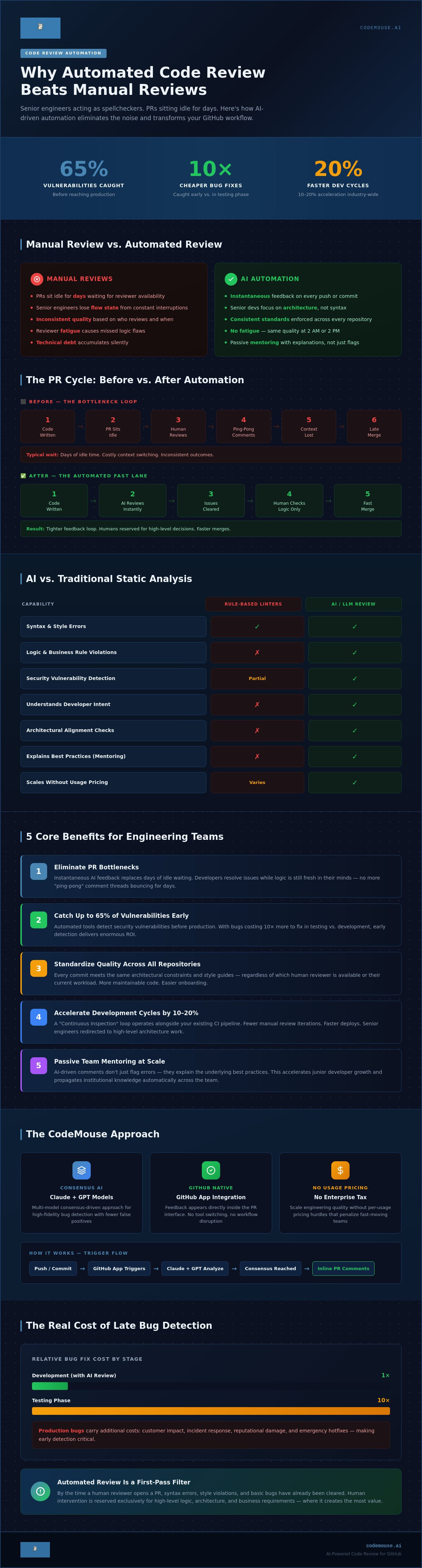
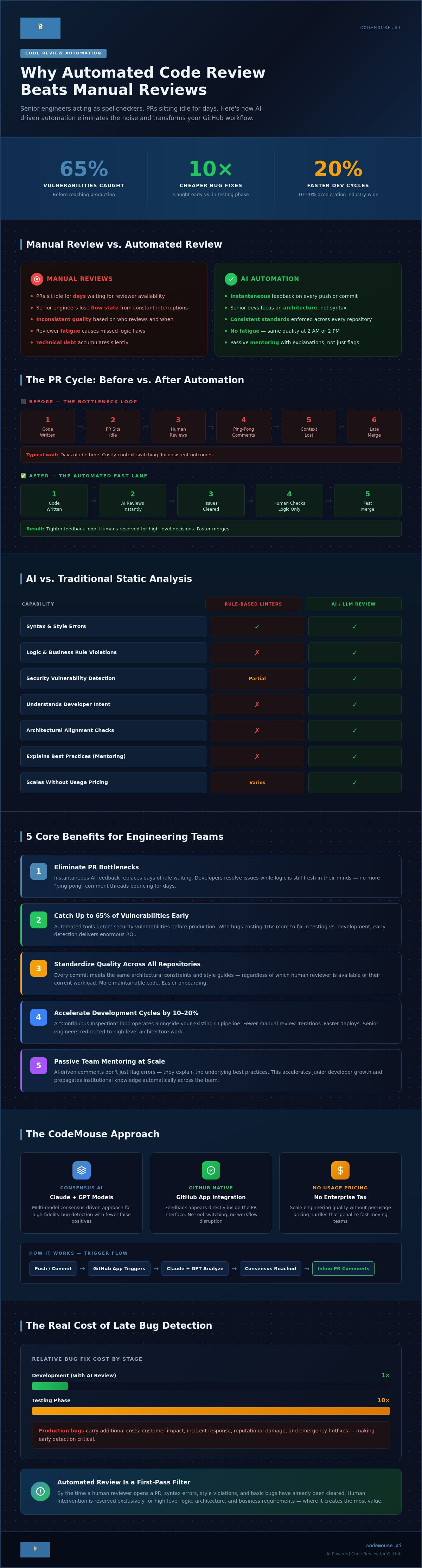
You likely agree that manual reviews are often inconsistent and difficult to scale across a growing team. Realizing the full range of code review automation benefits means moving past basic linting toward semantic, context-aware analysis that understands your codebase. This article explores how AI-driven reviews eliminate the noise and catch up to 65% of vulnerabilities before they reach production. We will look at how to streamline your GitHub workflow, reduce merge times, and ensure your team spends their energy on building features rather than correcting syntax.
Key Takeaways
- Reduce PR cycle times with instantaneous AI feedback. Stop waiting days for manual reviews on routine syntax and formatting.
- Address the context gap by moving beyond basic linters. Use semantic analysis to identify complex logic errors and business rule violations that static analysis misses.
- Realize full code review automation benefits by standardizing quality across your entire repository. Free senior developers to focus on high-level architecture instead of repetitive checks.
- Integrate directly into existing GitHub workflows via GitHub Apps. Ensure feedback appears within the PR interface to maintain developer focus and minimize tool switching.
- Scale engineering quality without usage-based pricing hurdles. Leverage a consensus-driven approach with Claude and GPT models for high-fidelity bug detection.
The Evolution of Code Review: From Manual to Automated
The velocity of modern software delivery has outpaced the capacity of manual peer review. In high-performance engineering teams, pull requests (PRs) often sit idle, waiting for a human reviewer to find a gap in their schedule. This delay creates a ripple effect. It stalls feature deployment and forces developers into costly context switching. Relying solely on human intervention for every line of code is no longer a viable strategy for teams shipping multiple times per day.
We are seeing a fundamental shift from traditional, rule-based linting to semantic-aware analysis. While older tools relied on regex patterns to find syntax errors, modern automated code review leverages Large Language Models (LLMs) to understand developer intent. This transition is a core component of code review automation benefits, allowing tools to act as a high-fidelity first-pass filter for every GitHub PR. By catching issues early, teams can reduce the cost of fixing bugs, which is often 10 times higher during the testing phase than during initial development.
The Hidden Cost of Manual PR Reviews
Manual reviews are inherently unscalable. When a senior developer stops feature work to review a PR, they lose their flow state. It can take significant time to regain deep focus after these interruptions. Beyond the time lost, human reviewers are subject to fatigue and cognitive bias. A reviewer at the end of a long shift might miss a logic flaw that they would have caught in the morning. This inconsistency leads to technical debt and fragmented code quality across the repository. One of the primary code review automation benefits is the elimination of this "human noise," ensuring that every line of code meets a baseline standard before a human even sees it.
What is Automated Code Review?
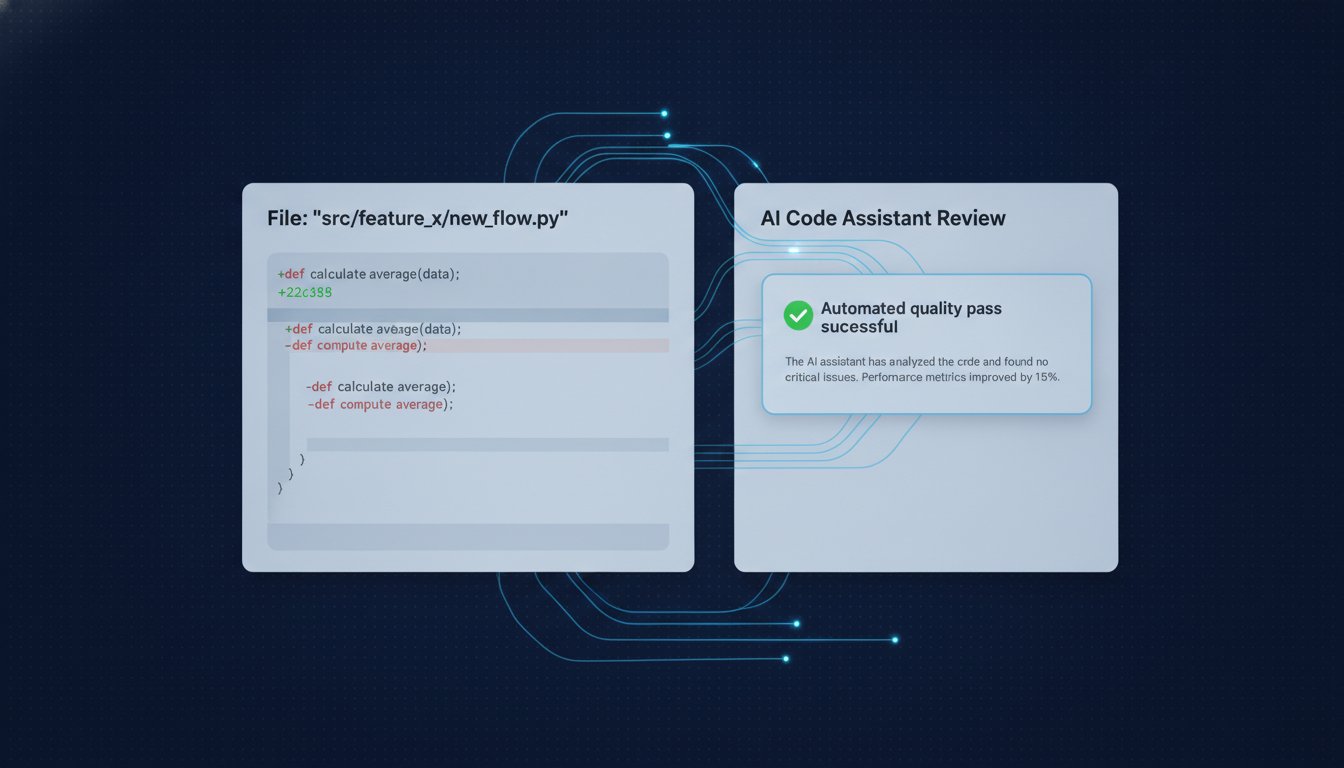
Automated code review is a programmatic layer integrated directly into the version control system, typically as a GitHub App. It triggers automatically on every push or commit. Unlike a simple compiler check or linter, it provides human-like feedback on code logic, security vulnerabilities, and architectural alignment. Research indicates that up to 65% of vulnerabilities can be caught before production deployment with automated tools. By the time a human reviewer opens the PR, the repetitive issues—syntax errors, style violations, and basic bugs—have already been cleared. This ensures that human intervention is reserved for high-level logic, architectural decisions, and specific business requirements.
Core Benefits of Code Review Automation for Engineering Teams
Deploying an automated layer transforms the pull request from a bottleneck into a high-speed quality checkpoint. The most immediate code review automation benefits involve reclaiming engineering hours lost to administrative friction. When feedback is instantaneous, developers can resolve issues while the logic is still fresh in their minds. This eliminates the "ping-pong" effect where PRs bounce between team members for days over trivial formatting or predictable bugs. It creates a tighter loop between writing code and validating it.
Standardization is a critical byproduct of this approach. In manual environments, code quality is often subjective. It depends on which senior developer is available and their current workload. Automation ensures that every commit across every repository adheres to the same architectural constraints and style guides. This consistency makes the codebase more maintainable and easier for new hires to navigate. Recent academic research on automation suggests that deep learning models are increasingly capable of identifying complex patterns that human reviewers might overlook during high-volume periods. This provides a persistent safety net that protects production from high-risk vulnerabilities.
Accelerating the Development Lifecycle
Speed is the most visible metric of success. Automation provides a "Continuous Inspection" loop that operates alongside your existing CI pipeline. By catching errors before a human reviewer even opens the PR, you significantly reduce the number of manual iterations required. Industry data indicates that automated tools can accelerate development cycles by 10-20%. It's about surgical precision. If you want to see these results in your own workflow, you can integrate CodeMouse AI Code Review to start removing PR bottlenecks immediately.
Improving Code Health and Maintainability
Automation also serves as a passive mentoring tool. AI-driven comments don't just flag errors; they explain the underlying best practices. This facilitates constant knowledge transfer to junior developers without draining a senior engineer's time. It also lowers the cognitive load for your lead developers. They no longer need to hunt for code smells or common anti-patterns. Instead, they focus their energy on high-level architecture and complex business logic that requires human intuition. This division of labor ensures the codebase stays clean while the team remains focused on shipping high-impact features.
AI vs. Traditional Static Analysis: The Semantic Advantage
Traditional static analysis is a solved problem. Linters catch missing semicolons and unused imports. They enforce indentation rules. But they don't catch logic. If you write a syntactically perfect loop that never terminates, a linter stays silent. This is where the most significant code review automation benefits emerge. Modern AI understands the "why" behind the code, moving beyond simple pattern matching to genuine semantic understanding.
Traditional tools suffer from the "Context Gap." They analyze files in isolation. They lack the ability to see how a change in a utility function affects a downstream consumer three directories away. Recent industrial studies on the impact of LLM-based automated code review show that AI models bridge this gap by considering the relationship between modified files and the broader codebase. This allows for the detection of subtle edge cases and logic-based vulnerabilities that static rules cannot define.
Beyond Syntax: Understanding Intent
AI identifies inefficient algorithms that are syntactically correct. It recognizes O(n^2) operations where O(log n) is possible. It suggests refactoring based on modern design patterns, moving beyond basic "clean code" rules to actual architectural improvements. Semantic analysis in PRs is the evaluation of code based on logical execution and developer intent rather than structural compliance. It ensures your code doesn't just run; it performs as intended.
Solving the "Noise" Problem
Traditional static tools often drown developers in irrelevant warnings. This leads to alert fatigue. Critical issues are ignored alongside stylistic nits. AI-driven systems filter this noise with surgical precision. They prioritize critical bugs over trivial preferences. By leveraging multi-model consensus, tools like CodeMouse AI Code Review significantly improve the signal-to-noise ratio. Using both Claude and GPT models ensures that every comment is actionable and high-value. This prevents the "noise" problem from stalling your deployment pipeline.
Implementing Automation Without Workflow Friction
Friction is the primary reason automation fails. If a tool requires complex YAML configuration or slows down the CI pipeline, developers will naturally bypass it. Successful implementation depends on choosing the right integration point. GitHub Apps offer a significant advantage over CI/CD actions by triggering directly on repository events without consuming Action minutes. This is a key part of realizing code review automation benefits without adding operational overhead.
Cost management is often an afterthought that becomes a blocker as teams scale. Many tools use usage-based pricing that becomes unpredictable as PR volume grows. A Bring Your Own API Key (BYO-AK) model provides a transparent alternative. By decoupling the review logic from the AI compute costs, you maintain unlimited, unthrottled reviews for a flat $10/month subscription. It ensures that scaling your engineering team doesn't lead to exponential increases in tooling costs.
Don't treat AI as a gatekeeper. It's a high-fidelity assistant. The feedback loop works best when AI comments appear directly in the PR UI as suggestions. This allows developers to accept or reject changes with a single click. It maintains human oversight while offloading the repetitive labor of catching edge cases. This model ensures you capture the maximum code review automation benefits while keeping human reviewers focused on high-level logic.
Seamless GitHub Integration
GitHub App-based triggers are superior to manual CLI tools. They provide lower latency and require zero local configuration. You can configure these tools to monitor specific branches or apply them to every feature branch. The goal is a silent partner that provides feedback within seconds of a push. It shouldn't throttle development speed. It should enhance it.
Establishing Team Guidelines
Your team needs a framework for interacting with automated feedback. Define which suggestions are mandatory and which are advisory. For example, security vulnerabilities might require a fix before merging, while stylistic suggestions remain optional. Training the team to treat AI comments as peer feedback is essential for morale. For a deeper look at implementation strategies, see our guide on AI Code Review for GitHub.
Ready to optimize your workflow? You can start a 14-day free trial with CodeMouse to experience unthrottled AI reviews today.
CodeMouse: High-Fidelity Reviews Without the Enterprise Tax
Enterprise AI tools often come with bloated per-seat pricing and opaque models. CodeMouse takes a different approach. It provides a lean infrastructure for teams that value autonomy. By charging a flat subscription fee and requiring your own API keys, it eliminates the "enterprise tax" while delivering high-fidelity feedback. This setup ensures you capture the full range of code review automation benefits without being locked into a proprietary ecosystem or unpredictable usage tiers. It's built for engineers who prioritize utility over marketing fluff.
The product functions as a silent partner in your GitHub workflow. It doesn't demand a total overhaul of your habits. It integrates as a GitHub App, triggers on every PR, and steps out of the way. You get the power of advanced LLMs without the administrative burden of managing complex seat licenses or usage credits. It's a pragmatic solution for scaling engineering quality while keeping your overhead low and your focus on the codebase.
The Power of Multi-Model Consensus
Most tools rely on a single model. This creates a single point of failure for logic detection. CodeMouse orchestrates a consensus between Claude and GPT. If both models flag an issue, the signal is high. If they disagree, the system provides nuanced context rather than a binary warning. This multi-model approach effectively reduces hallucinations. It ensures that the feedback your team receives is actionable. It moves away from the "black box" logic common in other services, giving you transparency into how your code is being analyzed. This consensus-driven method is a primary driver of code review automation benefits in complex repositories.
Scaling with Predictable Costs
Per-seat models punish you for growing your team. If you double your engineering headcount, your tooling costs shouldn't double. With the BYO-AK model, you pay only for the tokens you actually consume. This provides total transparency. It also enhances data privacy. Since you use your own keys, you maintain control over your relationship with the AI providers. There are no hidden markups on compute costs. It's a functional tool designed for builders who want to scale engineering quality without the friction of enterprise procurement cycles. You maintain the flexibility to swap models or adjust usage as your project requirements evolve.
Start your 14-day free trial with CodeMouse to see how a silent, high-fidelity partner can transform your PR workflow today.
Scaling Engineering Quality Without the Bottleneck
Scaling a high-performance engineering team in 2026 requires a transition from manual oversight to intelligent, automated systems. You've seen how semantic AI analysis bridges the context gap that traditional linters miss. By offloading repetitive syntax checks to a multi-model consensus of Claude and GPT, your senior developers reclaim hours for architectural logic. These code review automation benefits translate directly into faster merge times and a more resilient codebase.
CodeMouse provides the necessary infrastructure to automate this process without the friction of enterprise per-seat pricing. You maintain total control with a flat monthly rate and the transparency of your own API keys. It's a pragmatic, silent partner that enhances your existing GitHub workflow without adding noise or unnecessary complexity. It's time to stop acting as a human spellchecker and start focusing on feature development.
Automate your GitHub PR reviews for $10/month with CodeMouse. Start with a 14-day free trial today. No credit card is required. Build faster and ship with confidence.
Frequently Asked Questions
What are the main benefits of code review automation?
The primary code review automation benefits include a significant reduction in PR cycle time and the elimination of repetitive manual checks. By providing instantaneous feedback on every commit, teams can identify up to 65% of vulnerabilities before production. This allows engineers to fix errors while the context is fresh, preventing the bottlenecks that typically stall high-velocity development teams.
Can AI code review tools replace human reviewers?
Automation functions as a high-fidelity first-pass filter, not a total replacement for human intuition. It handles the noise of syntax, style, and common anti-patterns. This division of labor ensures that human reviewers can dedicate their cognitive energy to complex business logic, architectural alignment, and system-wide implications that require deep domain expertise.
How does automated code review reduce technical debt?
Automated tools identify code smells and inefficient algorithms before they are merged into the main branch. By enforcing consistent standards across the entire repository, automation prevents the silent accumulation of technical debt. It acts as a continuous inspection layer that ensures new features don't compromise the long-term maintainability of the codebase.
Is AI code review safe for private repositories?
Security depends on the integration model. Tools that utilize a Bring Your Own API Key (BYO-AK) model, like CodeMouse, ensure you maintain direct control over your data and your relationship with AI providers. This transparency minimizes the risks associated with "black box" enterprise solutions that might store or train on your proprietary code without explicit consent.
What is the difference between static analysis and AI code review?
Static analysis uses predefined regex rules to catch syntax errors and formatting issues. AI code review uses semantic understanding to evaluate logic and intent. While a linter might flag a missing semicolon, an AI model can identify a syntactically correct loop that contains a logical flaw or an inefficient algorithm by understanding the context of the code.
How much does it cost to automate code reviews on GitHub?
Pricing models vary significantly across the industry. Many enterprise providers charge between $24 and $48 per user per month. CodeMouse offers a more predictable alternative with a flat $10 monthly subscription. This model allows for unlimited reviews on GitHub by leveraging your own API keys for compute costs, avoiding the "enterprise tax" common in scaling teams.
Does code review automation work for all programming languages?
Modern LLM-based tools are generally language-agnostic. They support a wide range of programming languages including Python, JavaScript, TypeScript, Go, Rust, and C++. Because these models are trained on massive datasets of public code, they can provide context-aware feedback across different frameworks and paradigms without requiring specialized plugins for every language.
How do I reduce noise in automated PR comments?
You can reduce noise by implementing multi-model consensus, where suggestions are only surfaced if multiple AI models agree on the issue. Additionally, you should define clear guidelines for what constitutes a mandatory fix versus an advisory suggestion. This ensures that the automated feedback remains high-signal and actionable rather than overwhelming developers with trivial stylistic preferences.