ROI of AI Code Review: Quantifying Engineering Efficiency in 2026
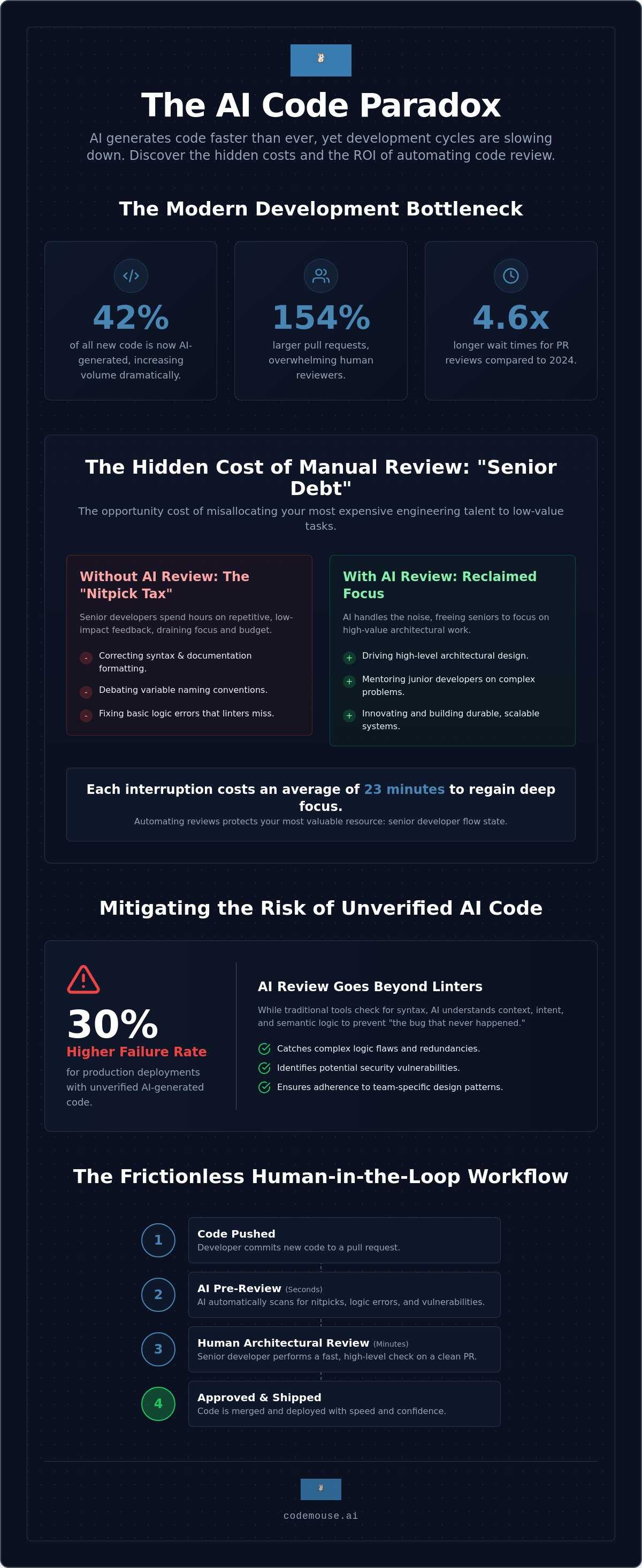
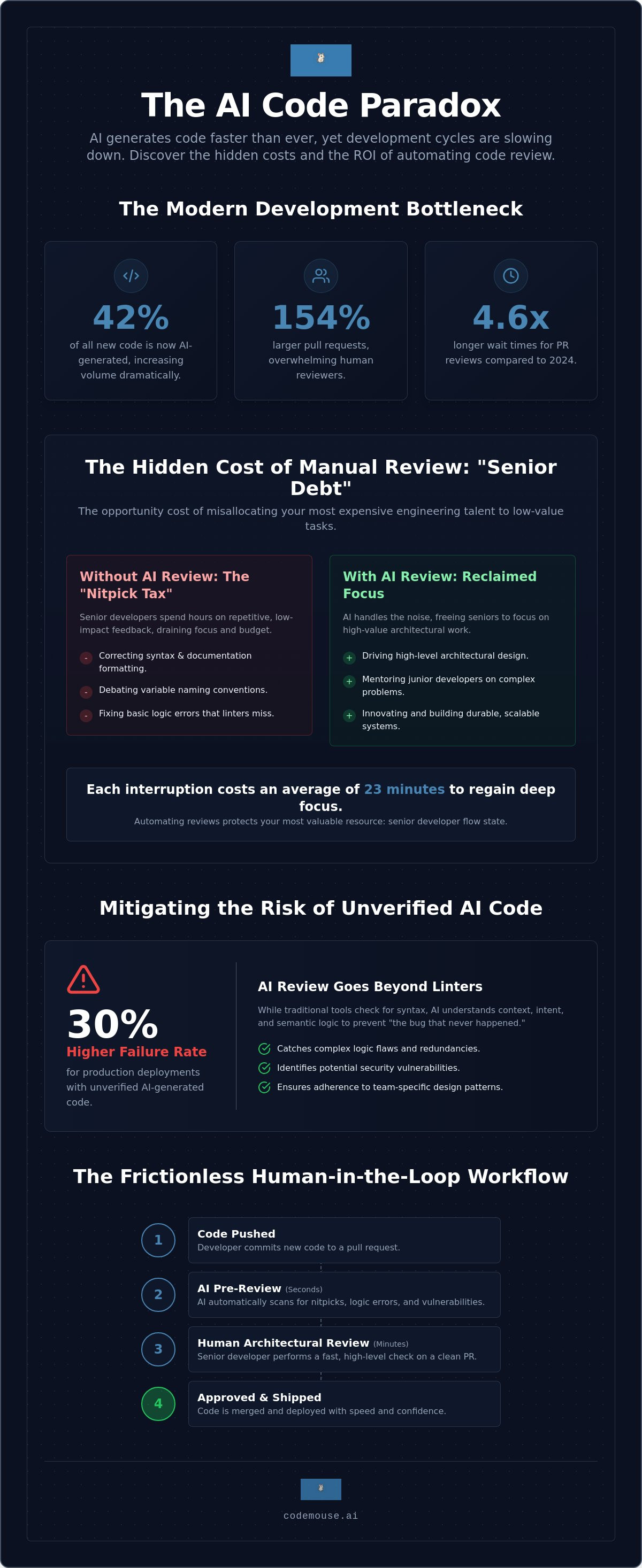
AI now generates 42% of all code, but pull requests are waiting 4.6 times longer in review than they did in 2024. This bottleneck creates a paradox. Teams code faster but ship slower. Senior developers are drowning in 154% larger PRs. They spend specialized time on "nitpick" comments rather than architectural innovation. Calculating the ROI of AI code review is now a necessity for reclaiming senior engineering hours and reducing the 30% higher failure rate linked to unverified AI output.
You feel the friction in stalled releases and inconsistent quality. Manual review cannot scale with the current volume of generated code. This article provides a framework to quantify the financial and operational impact of automated, AI-powered reviews. You'll learn to measure gains in engineering velocity, the reduction of "Senior Debt," and the impact on developer retention.
We cover how to lower PR cycle times and create predictable costs. We also look at shifting the senior workload from verification back to creation. This ensures your most expensive talent focuses on high-value tasks.
Key Takeaways
- Identify and eliminate "Senior Debt" by reallocating expensive engineering hours from basic syntax checks to high-level architectural tasks.
- Calculate the ROI of AI code review through measurable reductions in PR cycle times and improved lead times for critical changes.
- Mitigate production risks using multi-model consensus logic to catch complex logic errors and security vulnerabilities early in the development cycle.
- Evaluate the economic benefits of flat-rate pricing models that remove the "growth tax" associated with traditional per-seat licensing.
- Implement a frictionless human-in-the-loop workflow that uses AI as a pre-reviewer to prepare code for rapid human approval.
Table of Contents
- Beyond Speed: Reclaiming Senior Engineering Time and "Senior Debt"
- Quantifying Velocity: Reducing Cycle Time and PR Bottlenecks
- Risk Mitigation: The ROI of "The Bug That Never Happened"
- Strategic Implementation: Maximising Utility, Minimising Friction
- The Economics of AI: Flat-Rate vs. Per-Seat Pricing Models
Beyond Speed: Reclaiming Senior Engineering Time and "Senior Debt"
Senior Debt is the opportunity cost of high-salaried engineers performing low-value code quality checks. It represents a fundamental misallocation of specialized talent. When a senior developer spends sixty minutes debating variable naming or documentation formatting, the organization loses sixty minutes of architectural design. This is the "Nitpick Tax." It's an invisible drain on engineering budgets that compounds over every sprint cycle.
The ROI of AI code review isn't just about moving code faster. It's about talent density. In 2026, AI tools generate 42% of all code. This surge has caused pull requests to grow 154% larger than they were two years ago. The traditional code review process was never designed for this volume. Humans have become the primary bottleneck in modern CI/CD pipelines. PRs currently wait 4.6 times longer for human approval than in 2024, creating a massive lead-time delay.
Context switching adds a hidden layer of cost. Every time a senior developer stops their own feature work to address a junior's basic logic error, they lose their "flow state." Research shows it takes an average of 23 minutes to return to deep work after an interruption. Automating these checks protects the most expensive resource in your department: senior focus. By the time a human reviewer opens a PR, the AI should have already handled the noise.
Just as a developer's environment affects their flow, the right hardware is essential for peak performance in any high-stakes simulation; for those who value professional-grade precision, you can visit Apevie Simulators to see how they optimize the racing experience.
The Financial Impact of Talent Reallocation
Shifting senior focus from "how code is written" to "what is being built" changes the engineering trajectory. Burnout often stems from repetitive, uninspiring tasks like correcting documentation style. Automating the "nitpick" phase allows seniors to act as true architects. You can measure the ROI of AI code review by tracking the ratio of architectural comments versus syntax corrections. High-value oversight increases code durability and reduces the 30% higher failure rate currently associated with unverified AI-generated code.
Why Linters and Static Analysis Fall Short
Linters catch syntax errors. They follow rigid, rule-based patterns. AI understands intent and semantic logic. There is a massive ROI gap between simply "passing the build" and actually "maintaining a healthy codebase." Static analysis won't tell you if a logic flow is redundant or if a function violates a specific design pattern. Context-aware AI feedback moves beyond binary checks. It provides actionable insights that mirror the nuance of a human peer review without the associated salary cost.
Quantifying Velocity: Reducing Cycle Time and PR Bottlenecks
Lead time for changes is the heartbeat of engineering productivity. In 2026, this metric is under pressure. While AI coding assistants help developers write code 42% faster, the downstream process has stalled. Pull requests now wait 4.6 times longer for human review than they did two years ago. This creates a massive velocity gap. The ROI of AI code review is found by closing this gap and cutting the "waiting for human" phase out of the critical path.
Manual reviews often prioritize large, monolithic PRs because the scheduling overhead for small changes feels too high. This behavior is counterproductive. Small PRs are inherently safer and easier to debug. Automated reviews enable a "Small PR" culture by providing instant validation for incremental changes. Developers ship more frequently without increasing team headcount. This throughput gain allows your existing staff to handle a higher volume of features while maintaining a standardized level of quality across global, distributed teams.
Speed alone is insufficient if it sacrifices stability. According to Futurum Group research, the gap between generation speed and production quality is widening. Teams that rely solely on human oversight for AI-generated code see a 30% higher failure rate. Integrating a tool like CodeMouse AI Code Review ensures that every line is scrutinized by a machine before a human ever sees it, preserving both speed and trust.
Shortening the Feedback Loop
The time between "Code Pushed" and "First Feedback" should be measured in seconds, not hours. When a developer receives a review comment five minutes after pushing, the context is still fresh. They don't have to reload the project mental model. This eliminates the "ping-pong" effect where minor PR revisions stretch across multiple time zones. Rapid AI feedback allows for immediate correction, ensuring that by the time a senior engineer performs a final check, the "nitpicks" are already resolved.
Impact on DORA Metrics
Automated reviews directly influence your core DORA metrics. You improve the Change Failure Rate by catching logic bugs and security flaws pre-merge. Deployment Frequency increases because approval cycles no longer wait for a human to clear their calendar. AI code review acts as a force multiplier for CI/CD velocity by removing the manual friction that traditionally slows down the pipeline. This efficiency translates into predictable engineering costs and faster time-to-market for critical features.
Risk Mitigation: The ROI of "The Bug That Never Happened"
The most profitable bug is the one that never hits production. While previous sections focused on speed, the financial weight of the ROI of AI code review often rests on risk avoidance. A single production rollback can cost thousands in lost engineering hours and customer trust. In 2026, the stakes are higher. AI now generates 42% of all code, but this shift is correlated with a 23.5% increase in incidents. Without a rigorous "Shift Left" strategy, speed becomes a liability.
Just as software engineers strive to eliminate digital bugs before they compromise a system, property owners rely on specialists like Mosquito Assassin Pest Control LLC to eliminate environmental pests before they disrupt a home or business environment. In both cases, the return on investment is found in the crises that were successfully avoided through proactive management.
Automated reviews identify high-risk vulnerabilities before they leave the PR thread. Modern AI models are trained to flag exposed secrets, SQL injection patterns, and insecure dependencies that human reviewers often overlook during long sessions. The cost comparison is lopsided. An AI API call costs fractions of a cent. A production incident costs a developer's entire afternoon. Investing in prevention creates a predictable cost structure that replaces the chaos of emergency hotfixes.
Multi-Model Accuracy and Noise Reduction
Single-model AI tools often struggle with "hallucinations" or overly pedantic comments. CodeMouse solves this through consensus logic. By using multiple models like Claude and GPT to cross-verify complex logic, the system filters out the noise. If Claude identifies a potential race condition and GPT concurs, the signal is high. This "Second Opinion" effect identifies edge cases humans miss due to fatigue or lack of specific security expertise. It improves the signal-to-noise ratio, ensuring developers only spend time on valid concerns. You can learn more about AI code review for GitHub and how multi-model consensus stabilizes quality.
Scaling Code Quality Without Senior Oversight
Rapid team growth usually dilutes code quality. You can't hire senior engineers fast enough to maintain a 1:1 review ratio without destroying their productivity. AI acts as a 24/7 automated mentor for junior developers. It catches design flaws-which have increased by 153% in the AI-coding era-at the moment of creation. This immediate feedback loop trains the team in real-time. It maintains a high quality bar without requiring a senior engineer to manually explain every basic architectural principle. The ROI of AI code review here is found in the "invisible" work: the bugs that never reached the main branch and the senior time that stayed focused on the roadmap.
Strategic Implementation: Maximising Utility, Minimising Friction
Implementation doesn't require a multi-month cultural shift. Effective adoption relies on zero-friction integration. By connecting an AI reviewer directly to the GitHub PR thread, you avoid the overhead of new dashboards or external tools. The goal is to enhance existing workflows, not replace them. This pragmatic approach ensures the ROI of AI code review is realized immediately upon installation.
Position the AI as a "pre-reviewer." It acts as the first line of defense, filtering out the noise before a human ever opens the pull request. This human-in-the-loop model maintains developer autonomy. The AI suggests; the developer decides. You can customize the AI persona to align with your team's specific culture. Feedback strictness should match your internal standards. Whether you prefer strict enforcement of documentation or a focus on deep logic flaws, the output should feel like a peer-to-peer technical discussion.
Managing data privacy is a non-negotiable requirement for modern engineering teams. Using a "Bring Your Own Key" (BYOK) model provides full transparency over data handling. You control the API keys for Claude or GPT. This ensures your code remains within your controlled environment and isn't used for model training by third-party providers. It aligns the tool with your existing enterprise security policies without adding administrative bloat. To see this in action, you can start a 14-day free trial of CodeMouse and connect your GitHub repositories today.
The "Pre-Merge" Audit Workflow
Set the AI review as a required status check in GitHub. This ensures no PR reaches a human reviewer without first passing the automated audit. Train your team to treat AI comments as helpful suggestions rather than blockers. The "Apply Change" button remains the developer’s final decision point. This maintains ownership while offloading the mental burden of syntax and basic logic verification. It transforms the review process from a chore into a streamlined audit.
Privacy and the BYOK Advantage
Transparency is built into the BYOK architecture. By providing your own API keys, you gain granular control over AI processing costs and data residency. Most enterprise security policies prohibit the use of tools that ingest code for training purposes. The BYOK model bypasses this risk entirely. It allows you to leverage the latest Claude 3.5 Sonnet benchmarks for code analysis while maintaining strict compliance. This setup provides the security of a custom-built solution with the ease of a GitHub App integration.
The Economics of AI: Flat-Rate vs. Per-Seat Pricing Models
Traditional SaaS pricing models often act as a growth tax on engineering teams. As you hire more developers, your software costs scale linearly, regardless of individual usage or output. This model punishes successful scaling. To maximize the ROI of AI code review, the pricing structure must decouple the number of seats from the value delivered. A flat-rate subscription ensures that your tooling costs remain predictable even as your team expands from ten to one hundred engineers. You don't pay more just because your team is growing.
The "Bring Your Own Key" (BYOK) model provides a layer of economic transparency that bundled services lack. You pay a fixed fee for the review infrastructure and then pay Anthropic or OpenAI directly for the tokens you consume. There's no middleman markup on AI processing. This setup allows you to leverage specific models, like Claude 3.5 Sonnet, while maintaining full control over your budget. You only pay for the reviews you actually perform. This makes the ROI of AI code review easier to justify at every stage of growth because it aligns costs with actual engineering activity.
Predictable SaaS costs are essential for quarterly planning. Usage-based billing for the platform itself often leads to end-of-month surprises. By using a flat monthly rate, the only variable in your budget is the token usage, which you monitor directly at the API provider level. This modularity allows you to swap models or adjust usage limits without renegotiating your primary tool contract. It's a pragmatic approach designed for teams that value autonomy and financial clarity.
Calculating Your Specific ROI
Compare a fixed-cost subscription to the $30+ per-user alternatives common in the market. For a team of fifty, a per-seat model can cost thousands monthly. A flat-rate model combined with direct API costs is significantly more efficient. This transparency allows you to audit exactly where your budget goes. You can see the cost per PR down to the cent. Review the technical advantages of AI code review for GitHub to see how this economic efficiency pairs with high-quality multi-model output.
Getting Started with CodeMouse
Setup follows a linear, step-by-step progression. Installation happens via a one-click GitHub App integration. You configure your repositories, provide your API keys, and the system begins auditing your PR backlog immediately. Use the 14-day free trial to run a retrospective audit on your existing code. This allows you to see the logic errors and security flaws the system identifies before committing to a subscription. You can scale from a single repository to an entire organization with zero price increase. Your infrastructure should support your growth, not tax it.
Reclaiming Engineering Velocity for 2026
Quantifying the ROI of AI code review requires looking beyond simple speed metrics. The true value lies in reallocating senior engineering time from low-value syntax checks to high-impact architectural design. By automating the "pre-reviewer" phase, you eliminate the PR bottlenecks that currently stall modern delivery cycles. This shift reduces "Senior Debt" and ensures that every line of code meets your quality standards before a human ever sees it.
Strategic implementation doesn't have to be complex or expensive. A fixed monthly subscription for unlimited users removes the per-seat tax that often punishes growing teams. With deep GitHub App integration and support for Claude 3.5 and GPT-4o, you maintain full control over your data and your budget. This modular approach provides the infrastructure you need to scale without the friction of traditional SaaS pricing models. Similar principles of AI-driven efficiency apply to content management, where Editivo helps editorial teams automate production and focus on high-level strategy.
You can start auditing your pull request backlog immediately. Start your 14-day free trial of CodeMouse to see how automated reviews stabilize your codebase. Build faster, ship safer, and let your seniors get back to the work they were hired to do.
Frequently Asked Questions
How do you measure the ROI of AI code review tools?
Measure ROI by tracking the reduction in pull request cycle time and the reallocation of senior engineering hours. In 2026, data shows AI-generated PRs wait 4.6 times longer in review without automation. You calculate the ROI of AI code review by comparing the cost of the "Nitpick Tax" against a fixed subscription. A healthy return is typically 2.5 to 3.5x for most engineering organizations.
Does AI code review replace human senior developers?
No, it acts as a pre-reviewer to offload low-value tasks. AI handles syntax, documentation, and basic logic, which allows seniors to focus on high-level architecture. It solves the productivity paradox where faster coding leads to review bottlenecks. Seniors remain the final decision-makers, but they only review code that is already 90% verified by the machine.
How much can a team save by switching from per-seat to flat-rate pricing?
Savings scale with team size because you eliminate the growth tax of per-user monthly fees. For a team of fifty, per-seat costs can exceed $1,500 monthly. A flat-rate model keeps infrastructure costs fixed regardless of headcount. This makes the ROI of AI code review significantly higher for growing organizations that don't want their tool budget to balloon with every new hire.
Is it cheaper to use my own API keys for Claude or GPT?
Yes, because you pay the raw provider cost without a middleman markup. You only pay for the tokens you actually consume during reviews. Bundled services often overcharge to cover their heaviest users. By providing your own keys, you gain granular control over processing costs and can choose models based on current benchmarks like Claude 3.5 Sonnet.
Can AI detect complex logic bugs or just formatting errors?
Modern models identify semantic logic flaws, race conditions, and security vulnerabilities. While linters handle formatting, AI uses context-aware analysis to understand intent. Research shows AI now identifies 153% more design flaws than traditional static analysis. Using multi-model consensus between Claude and GPT further reduces false positives and catches edge cases humans might miss during long sessions.
How does the "Bring Your Own Key" model improve security?
It ensures your code isn't used for model training by third-party tool providers. You maintain a direct relationship with Anthropic or OpenAI under your existing enterprise security agreements. This transparency is critical for compliance. Your code stays within your controlled environment, and you have a clear audit trail of every API call made by the review tool.
What is the impact of AI code review on developer cycle time?
It reduces the time between code push and first feedback from hours to seconds. This maintains developer flow state and prevents expensive context switching. While AI-generated code has led to 20% faster PR creation, the review phase often stalls. Automation removes this friction, allowing teams to maintain high throughput without sacrificing code quality or increasing the failure rate.
How do I justify the cost of an AI review tool to my CFO?
Focus on the reduction of production incidents and the cost of rollbacks. Explain that preventing a single incident saves thousands in engineering hours. A flat-rate subscription provides cost predictability for the budget. It replaces variable human costs with a fixed, scalable infrastructure expense that protects your most expensive talent from performing repetitive, low-value tasks.