AI Code Analysis for Bugs: 2026 Reference Guide for Engineering Teams
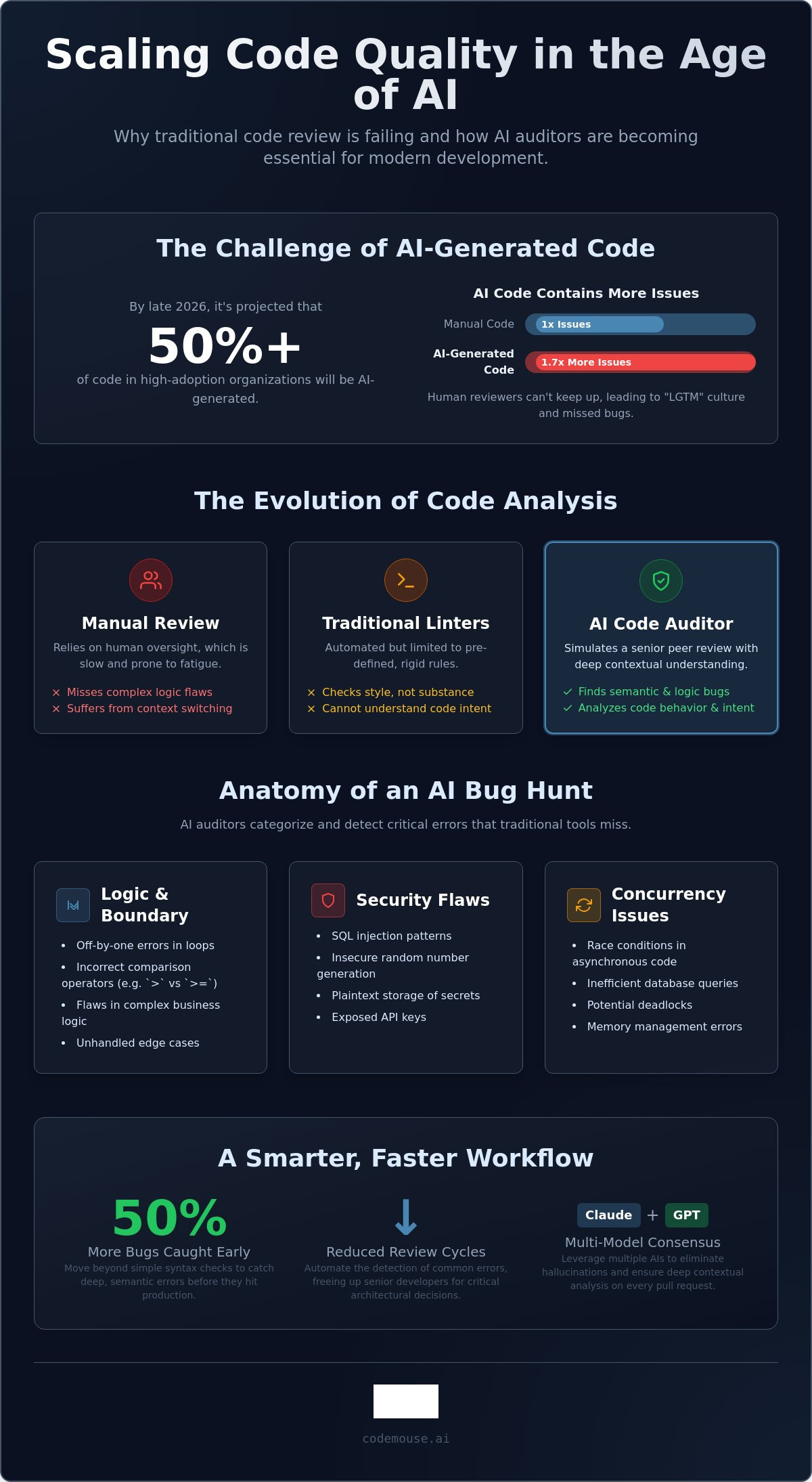
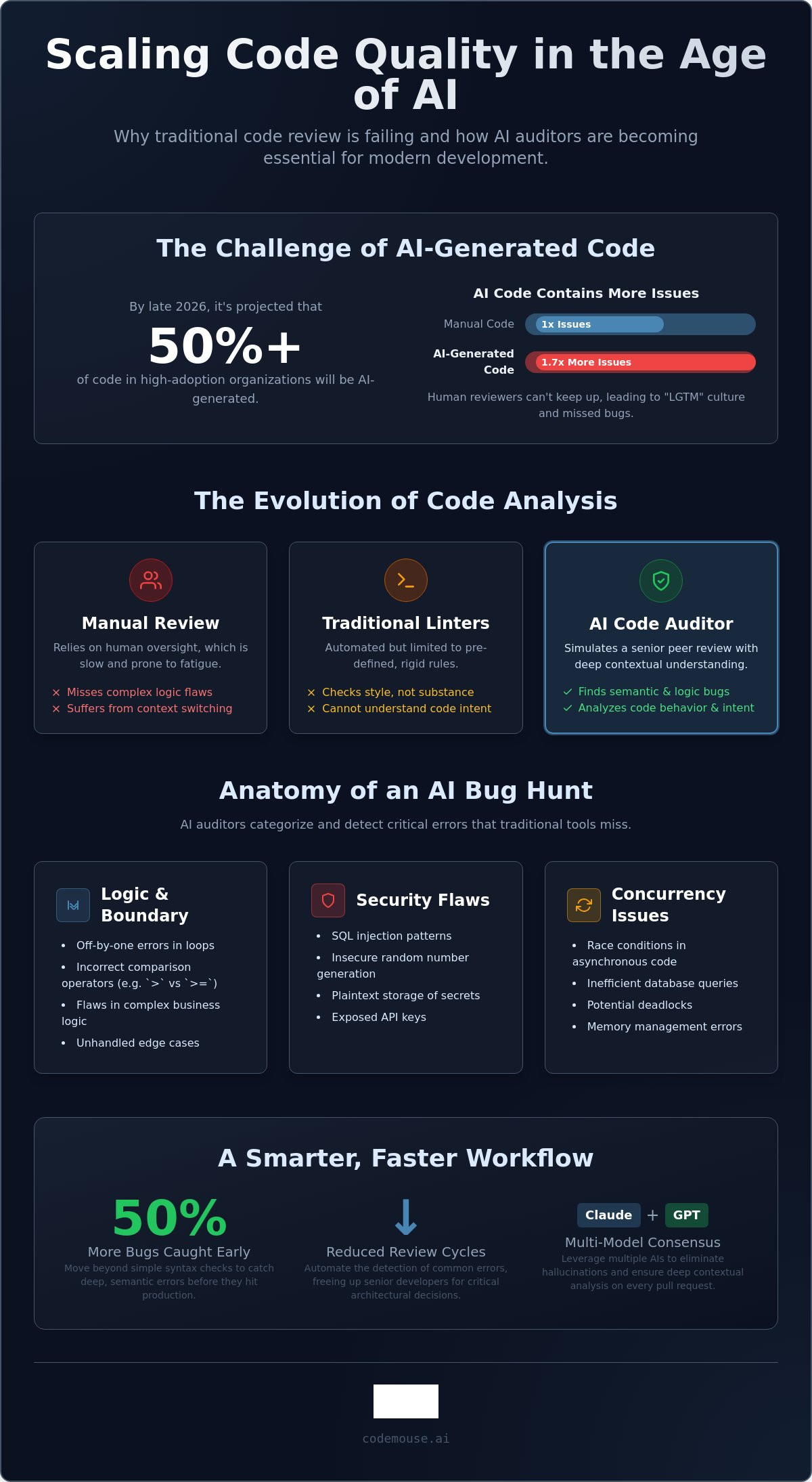
By late 2026, over 50% of code in high-adoption organizations is AI-generated, yet these pull requests contain 1.7 times more issues than manual code. Human reviewers can't keep up with the volume. Traditional linters catch formatting but miss deep architectural flaws. Implementing AI code analysis for bugs is now a baseline requirement for production stability. It's the only way to scale quality at the speed of modern development.
Review fatigue often leads to a "LGTM" culture; logic errors and race conditions slip through despite multiple approvals. You'll learn how to leverage AI code auditors to identify the security vulnerabilities and complex bugs that humans miss. We'll show you how to move from simple pattern matching to reasoning about code behavior and intent, using multi-model consensus to break the logic ceiling.
This reference guide details how to catch 50% more bugs early, reduce review cycle times, and maintain a lean, high-output engineering team. We're moving past simple autocomplete toward a system of surgical, automated auditing that integrates directly into your existing GitHub workflow without demanding a total overhaul of your habits.
Key Takeaways
- Transition from basic syntax linting to semantic auditing to catch complex logic errors and race conditions that manual reviews miss.
- Leverage multi-model consensus between Claude and GPT to eliminate hallucinations and ensure deep architectural context in long pull requests.
- Integrate AI code analysis for bugs directly into your GitHub workflow to identify security vulnerabilities like SQL injection early.
- Reduce code review cycle times and "LGTM" culture by automating the detection of boundary conditions and off-by-one errors.
- Scale your engineering team efficiently with flat-rate auditing tools and a bring-your-own-key (BYOK) model for high-volume repositories.
Table of Contents
- Why Traditional Bug Detection Fails: The Case for an AI Code Auditor
- Anatomy of an AI Bug Hunt: Categories of Errors Caught
- Multi-Model Analysis: Why Claude and GPT Catch More Bugs Together
- Implementing AI Code Analysis for Bugs in Your GitHub Workflow
- CodeMouse: Pragmatic AI Code Auditing for Every PR
Why Traditional Bug Detection Fails: The Case for an AI Code Auditor
Traditional bug detection relies on two pillars: manual human review and automated linting. Both are failing. As codebases grow more complex, the "Forward Pass" problem becomes a systemic risk. Human reviewers often scan code linearly, looking for patterns rather than deep logical inconsistencies. This leads to missing obvious off-by-one errors or boundary condition flaws because the brain fills in the gaps it expects to see. It's a cognitive bias that compromises safety. When a developer scans a loop, they see what they intended to write, not necessarily the edge case that triggers a crash.
Standard static program analysis tools are excellent at enforcing style guides and catching syntax errors. They function on rigid, predefined rules. However, they hit an "intent ceiling" quickly. They can tell you if a variable is unused or if a function is too long, but they cannot tell you if the logic behind that variable contradicts the core business requirements. AI code analysis for bugs moves beyond these structural checks into semantic understanding. It asks if the code makes sense in context, not just if it follows the grammar of the language. It understands that a specific database query might be technically valid but logically disastrous for performance.
The Limitations of Manual Human Review
Review fatigue is a primary driver of production incidents. After several hours of reviewing pull requests, senior engineers often fall into the "LGTM" trap. They approve changes based on the author's reputation rather than rigorous verification. The cost of context switching for these developers is immense. Pulling a lead architect away from a critical feature build to spot a subtle race condition in a 500-line diff is an inefficient use of talent. Humans are poorly suited for catching intermittent concurrency issues that require tracing state transitions across multiple files and services. These bugs are statistically more likely to reach production when teams rely solely on human oversight.
Defining the AI Code Auditor in 2026
An AI code auditor is a tool that uses Large Language Models to simulate a high-level senior peer review. Unlike a linter, it doesn't just check for missing semicolons or trailing whitespace. It analyzes the logic flow, data mutations, and potential side effects within a pull request. By leveraging automated code review, engineering teams bridge the critical gap between manual oversight and automated CI/CD pipelines. An AI code auditor is a context-aware logical validator that identifies behavioral discrepancies before they reach production. It provides a persistent, objective layer of defense that doesn't suffer from fatigue, deadlines, or context switching. This shift ensures that AI code analysis for bugs identifies the "invisible" errors that traditional structural tools simply cannot see.
Anatomy of an AI Bug Hunt: Categories of Errors Caught
Identifying bugs during a pull request requires more than scanning for syntax errors. Effective AI code analysis for bugs categorizes issues into logical, security, and concurrency domains. It treats code as a living system rather than a static text file. This approach allows for the detection of errors that typically only surface during production runtime or under heavy load. By simulating execution paths, these auditors catch what a standard linter ignores.
Logic and Boundary Condition Analysis
Logic errors are the most common cause of silent failures. AI models identify off-by-one errors in pagination and loops by calculating the expected range of indices. It flags incorrect comparison operators in complex conditional branches where a human reviewer might gloss over a `>` versus a `>=`. This is particularly valuable in business-specific logic. If a discount is only applicable for orders over $100, the AI understands the intent and flags a check that accidentally includes the boundary value. Recent studies on AI-driven code analysis and testing techniques demonstrate that LLMs can simulate execution paths to reveal these discrepancies before a single test case is written.
Security and Concurrency Detection
Security vulnerabilities often hide in plain sight. AI auditors scan for SQL injection patterns and insecure random number generation. They identify when sensitive data like API keys or PII are accidentally included in log statements. This proactive scanning is essential for maintaining compliance. Concurrency is another area where manual review fails. AI spots shared state mutations occurring without proper locks. It identifies async functions with incorrect await patterns that lead to race conditions or deadlocks. Static tools often miss these because they lack a temporal understanding of code execution. By using CodeMouse AI Code Review, teams can automate these deep-context checks across every pull request.
Dynamic languages present unique challenges for bug detection. AI finds missing None or Null checks that lead to runtime crashes. It identifies type assumptions where a function expects a string but receives an object. By analyzing the data flow across multiple files, the auditor flags these inconsistencies early. This reduces the cognitive load on senior developers. They don't need to act as human compilers. Instead, they focus on architectural decisions while the AI handles the granular bug hunt. This systematic approach transforms the pull request from a simple merge gate into a robust quality assurance layer. It ensures that AI code analysis for bugs provides a comprehensive safety net for every commit.
Multi-Model Analysis: Why Claude and GPT Catch More Bugs Together
Relying on a single LLM for AI code analysis for bugs introduces a systemic single point of failure. Every model has architectural biases. Some prioritize strict adherence to training data patterns; others excel at logical reasoning across long context windows. By employing a "Hallucination Hedge," engineering teams use two distinct architectures to verify findings. This cross-verification ensures that a hallucination from one model is flagged as an anomaly by the other. It transforms a probabilistic guess into a verified technical observation.
Claude vs. GPT for Technical Analysis
The strengths of Claude and GPT are complementary. Claude (Anthropic) is engineered for deep context. It follows complex, spec-driven requirements across large pull requests with high precision. It understands the nuance of internal documentation and architectural constraints. GPT (OpenAI) operates with superior speed in pattern matching. It's highly effective at identifying common vulnerability patterns and legacy code anti-patterns documented across millions of open-source repositories. Using both models in parallel can reduce false positives by up to 40%. This efficiency allows developers to focus on genuine issues rather than sifting through AI-generated noise.
The Power of Multi-Model Consensus
Implementing AI code review for GitHub through consensus logic creates a hierarchy of importance for feedback. When both models flag a specific line of code, the "Consensus Score" is at its highest. These are high-risk bugs that require immediate attention. When models disagree, the system can either suppress the notification or mark it as a "low-confidence" suggestion for human review. This filtering mechanism is critical for maintaining developer trust.
- High Consensus: Both models identify a logic error or security flaw. High probability of a genuine bug.
- Low Consensus: Only one model flags an issue. Potential false positive or a subtle architectural suggestion.
This approach addresses the primary weakness of early AI tools: the volume of irrelevant feedback. By requiring agreement between independent systems, the workflow prioritizes utility. It ensures that AI code analysis for bugs remains a functional tool rather than a distraction. Developers spend less time arguing with the AI and more time fixing confirmed vulnerabilities. This methodical cadence moves the review process forward with surgical precision. It respects the developer's time by ensuring that every comment has a high probability of being an actionable fix.
Implementing AI Code Analysis for Bugs in Your GitHub Workflow
Integrating AI code analysis for bugs into an existing pipeline requires minimal friction to be effective. The process begins by installing the GitHub App and granting it repository-level permissions. Once authorized, the auditor monitors pull requests in real-time. Configuration involves selecting the underlying models. For maximum depth, a combination of Claude and GPT is recommended. This allows the system to utilize the multi-model consensus discussed previously to validate findings before they reach the developer's screen.
Setting the feedback threshold is a critical step in preventing alert fatigue. Engineering leads should define which categories of issues trigger an automated comment. You can configure the auditor to flag high-risk security vulnerabilities and logic errors immediately while suppressing minor style or documentation suggestions. This ensures that the AI remains a high-signal tool. By filtering out low-priority noise, the team maintains focus on production-blocking defects.
Configuring the Feedback Loop
Automated PR comments shouldn't overwhelm the author. Effective setups use the AI as a "first pass" reviewer. It identifies obvious errors, such as missing null checks or incorrect boolean logic, within seconds of the PR being opened. This allows the developer to push a quick fix before a human reviewer even looks at the code. Establish clear rules for human overrides. If a developer disagrees with an AI suggestion, they should be able to dismiss it with a comment, providing a feedback loop that improves the model's future context. To start auditing your pull requests with this level of precision, you can install CodeMouse AI Code Review today.
Managing API Costs and Security
The "Bring Your Own API Key" (BYOK) model provides transparency and cost control. Instead of paying a "per-seat" tax that scales with your team size, you pay for the actual tokens consumed. This is particularly advantageous for high-volume repositories where automated reviews occur hundreds of times per day. Monitoring token usage across a large engineering team becomes straightforward through the AI provider's dashboard. It allows for granular tracking of costs associated with AI code analysis for bugs.
Security remains a primary concern during implementation. Ensure that your chosen configuration prevents your source code from being used for model training. Most enterprise-grade API tiers from OpenAI and Anthropic guarantee that data sent via API is not used to train global models. This keeps your intellectual property secure while still benefiting from the latest advancements in logical auditing. By maintaining control over the API keys, you retain the ability to rotate credentials and manage access levels without relying on a third-party intermediary.
CodeMouse: Pragmatic AI Code Auditing for Every PR
Engineering teams need a silent partner that provides infrastructure without demanding a total overhaul of existing habits. CodeMouse delivers AI code analysis for bugs through a minimalist GitHub App that prioritizes utility over marketing fluff. It doesn't lock you into proprietary models or opaque pricing tiers. Instead, it provides the necessary piping to run high-performance LLMs directly against your pull requests. This approach respects the developer's intelligence by offering a functional tool rather than a sales-heavy service.
Most AI tools in the 2026 market attempt to own the entire developer experience. CodeMouse takes a different path. It integrates into your workflow as a background process, scanning every commit for the logical inconsistencies and security vulnerabilities discussed in previous sections. It doesn't require on-premise deployment or complex configuration. You maintain your existing GitHub environment while adding a layer of automated, multi-model oversight that works at the speed of your CI/CD pipeline.
The Developer-First Pricing Model
Flat pricing is the only sustainable way to scale AI reviews across a growing startup or a lean engineering team. CodeMouse charges a flat $10 per month regardless of team size. This eliminates the "per-seat" tax that typically penalizes hiring and growth. You can add unlimited repositories and unlimited team members to a single plan without increasing your monthly overhead. It's a pragmatic model designed for builders who value cost predictability.
The benefit of the "Bring Your Own API Key" (BYOK) model is total transparency. You pay your chosen AI provider, such as Anthropic or OpenAI, directly for the tokens you consume. Research indicates this averages between $0.05 and $0.15 per review. This prevents the usage throttling and hidden markups common in enterprise tools that bundle API costs. You retain control over which models you use, whether it's Claude for deep contextual reasoning or GPT for rapid pattern matching. This flexibility ensures that your AI code analysis for bugs is always powered by the most cost-effective and capable models available.
Getting Started with CodeMouse
Setting up your first automated review takes under five minutes. After installing the GitHub App, you simply grant repository permissions and input your API keys. CodeMouse immediately begins providing context-aware feedback for complex diffs. It reads existing PR comments to avoid duplicating feedback and uses consensus logic to filter out hallucinations. This ensures that the feedback your team receives is actionable and high-signal. You can start your 14-day free trial today to audit your next PR. This allows you to verify the tool's utility in your specific environment before the flat monthly fee begins. Use this trial to see how a lean, multi-model auditor can catch the 50% of bugs that human reviews and static analysis typically miss.
Deploying a High-Signal Defense for Every Commit
Manual reviews are a bottleneck. Static tools hit a ceiling. Modern engineering teams require a persistent, logical auditor that understands intent. By implementing AI code analysis for bugs, you move from simple syntax checking to deep semantic verification. This shift catches the logic errors and race conditions that typically reach production when reviewer fatigue sets in. You no longer have to choose between speed and stability.
Multi-model consensus between Claude and GPT provides the context necessary to eliminate hallucinations. It ensures high-signal feedback without the noise of single-model tools. You maintain total control over your costs through a bring-your-own-key model while benefiting from a flat-rate infrastructure. It's a pragmatic solution for teams that value utility over marketing hype.
It's time to bridge the gap between manual oversight and automated CI/CD. Automate your GitHub PR reviews with CodeMouse for $10/mo and leverage both Claude and GPT for context-aware feedback. Start your 14-day free trial today to see how a silent partner enhances your existing workflow. Build faster and deploy with confidence.
Frequently Asked Questions
How does an AI code auditor differ from a standard linter?
Linters check syntax and style rules based on static configuration files. They flag missing semicolons or incorrect indentation. An AI code auditor analyzes logic and intent. It identifies when a loop condition is technically valid but functionally incorrect for the business requirement. It uses Large Language Models to simulate a senior peer review rather than just enforcing a rigid set of regex-based rules.
Can AI really find security vulnerabilities like SQL injection?
Yes, AI identifies complex security patterns like SQL injection and insecure random number generation by tracing data flow. Unlike static tools that rely on specific signatures, AI understands the context of how variables are sanitized. This makes AI code analysis for bugs effective at spotting vulnerabilities that bypass traditional scanners. It recognizes when untrusted input reaches a sensitive sink without proper validation.
Beyond backend security, ensuring full-stack compliance often requires managing user-facing privacy; for example, Conzent offers a source-available cookie consent platform to help meet GDPR and ePrivacy standards.
Does using an AI code analysis tool mean I can skip human reviews?
No, you shouldn't skip human reviews. AI acts as a "first pass" filter to catch obvious errors and architectural drift before a developer sees the code. It reduces the cognitive load on senior engineers but can't replace the final design decisions of a human. Use the AI to clean up the PR so humans focus on high-level architecture and specific business logic.
What are the most common bugs that AI catches but humans miss?
AI excels at spotting off-by-one errors, race conditions, and missing null checks in dynamic languages. Human reviewers often scan code linearly and suffer from review fatigue. AI maintains consistent attention across 500-line diffs. It identifies subtle state mutation issues and boundary condition flaws that are statistically more likely to reach production during manual-only review cycles where humans might gloss over details.
How do I reduce false positives in AI code analysis?
Use multi-model consensus to verify findings across different architectures. When both Claude and GPT flag an issue, the probability of a genuine bug is significantly higher. You can also set feedback thresholds to suppress style suggestions and only notify developers about critical logic or security flaws. Providing the AI with full repository context further improves accuracy by reducing the need for the model to make assumptions.
Is my code safe when using AI-powered analysis tools?
Code safety depends on your API configuration and provider settings. Most enterprise API tiers from OpenAI and Anthropic don't use submitted data for model training. By using a model that supports your own API keys, you retain direct control over data privacy. It's a pragmatic way to ensure your intellectual property remains secure while still benefiting from AI code analysis for bugs.
What is the cost of running AI code analysis on every pull request?
Costs typically consist of a flat platform fee and variable API usage. Platform fees provide the infrastructure, while API costs are paid directly to the model provider based on token consumption. Research suggests this averages between $0.05 and $0.15 per review. This model prevents the aggressive price scaling seen with per-seat enterprise tools and provides total transparency into your actual usage costs.
Which AI model is best for finding bugs in Python vs. TypeScript?
Claude Sonnet often performs better with the complex, spec-driven requirements of TypeScript because it handles long-range context well. GPT-4 is highly effective for Python due to its vast training data on common library anti-patterns and legacy code structures. For the best results, use both models in parallel. This allows you to leverage their respective architectural strengths to catch a wider variety of bugs.