AI Code Review for Startups: Scaling Engineering Quality in 2026
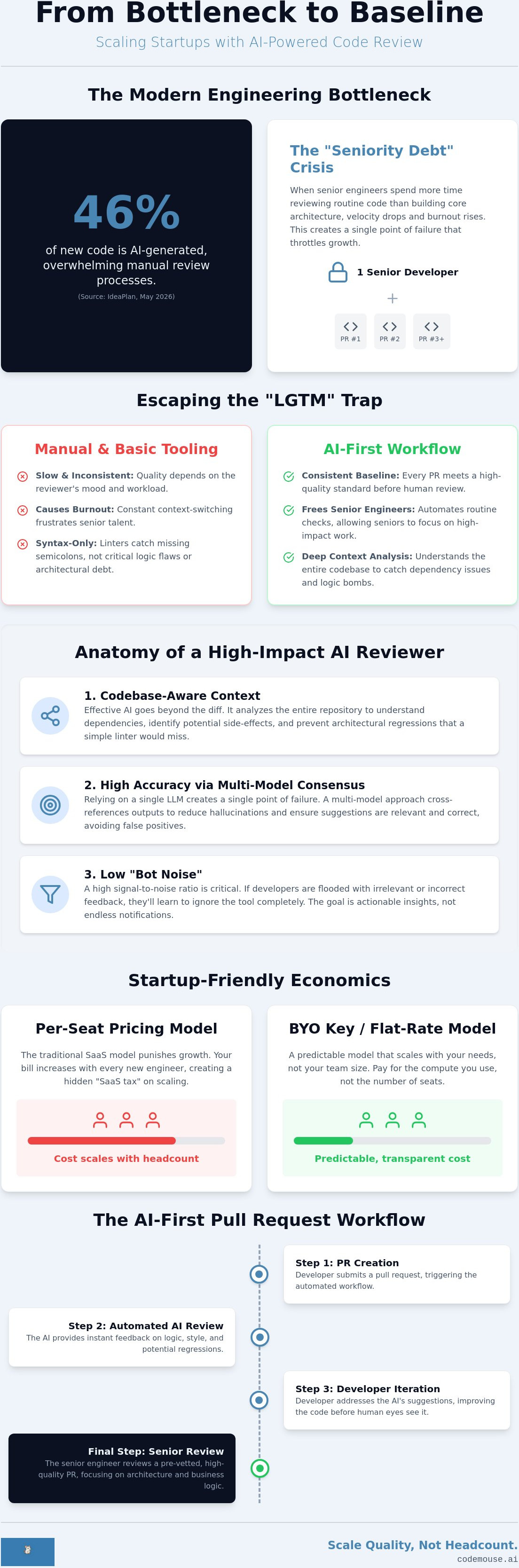
In 2026, 46% of new code is AI-generated, yet human-only review remains a primary bottleneck for scaling teams. Senior developers are losing hours to routine PR checks. Velocity drops as the PR queue grows. You're likely seeing technical debt accumulate because shipping fast has become a trade-off with shipping clean code.
Maintaining high standards shouldn't require a linear increase in senior headcount. We'll show you how AI code review for startups eliminates these bottlenecks by automating the first line of defense. You'll learn how to integrate multi-model consensus and codebase-aware context into your workflow to catch issues early. We'll also preview how to move away from expensive per-seat pricing toward predictable, transparent models that scale with your needs. This article covers the transition from manual oversight to an automated, silent partner that keeps your engineering velocity high and your costs under control.
Key Takeaways
- Resolve the "Seniority Debt" crisis by automating routine pull request checks and freeing senior engineers for high-level architecture.
- Identify how deep codebase context reduces bot noise and improves the accuracy of AI code review for startups.
- Compare per-seat pricing models against BYO API key strategies to eliminate the hidden "SaaS tax" on engineering growth.
- Establish an "AI-first" workflow that sets a quality baseline before human reviewers even open a PR.
- Scale engineering quality without throttling velocity by utilizing flat-rate, multi-model review infrastructure.
Table of Contents
The Startup Bottleneck: Why Manual Code Reviews Fail at Scale
Startups operate on a clock. Every day spent in a PR queue is a day lost to market competitors. This pressure creates a persistent trade-off: ship fast and risk breaking production, or move slow and maintain quality. Most choose speed. They incur "Seniority Debt." This happens when one senior engineer is responsible for reviewing the output of five or more junior or mid-level developers. The senior becomes a single point of failure. They aren't coding; they're reading. According to May 2026 data from IdeaPlan, 46% of new code is now AI-generated. This volume makes human-only review a massive bottleneck.
Traditional tools like linters or basic automated code review scripts help with syntax. They catch a missing semicolon or a naming convention violation. They don't catch logic bombs. They don't understand that a new service call will cause a circular dependency. Catching these requires human context, which is exactly what's in short supply. Without AI code review for startups, these architectural flaws slip through, only to be discovered after a deployment fails.
The emotional toll is real. Senior developers face constant context switching. They drop their deep work to unblock a peer. This leads to burnout. It also leads to friction. PR comments become terse. Reviewers get frustrated. The process meant to ensure quality becomes a source of team resentment. When the review process is painful, developers stop submitting small, frequent PRs and start bundling massive changes, which are even harder to review.
The Cost of "Ship Now, Fix Later"
Technical debt isn't just "messy code." It's a compounding interest rate on your team's velocity. In a startup, this debt compounds faster because the codebase is evolving daily. If you ship a flawed architectural decision today, you build three features on top of it tomorrow. Undoing that decision in six months is a weeks-long refactor. Poor code quality also makes onboarding harder. New hires spend weeks trying to understand "clever" hacks instead of shipping features. Production hotfixes are the most expensive way to write code. They pull the whole team away from the roadmap to put out fires that a proper review would have caught.
When these production hotfixes occur, maintaining transparency is key to preserving user trust. Utilizing StatusPulse for public status pages and uptime monitoring allows your team to communicate disruptions effectively while they work on a resolution.
Why Human-Only Reviews Don’t Scale
As engineering teams grow, the hiring process becomes a focal point for both startups and candidates. To navigate this competitive landscape, many tech professionals and students rely on QuickApply to automate their applications and find the best engineering opportunities.
Scaling an engineering team usually means hiring more developers. It rarely means hiring enough senior reviewers to keep up. While modern teams utilize Humae to streamline workforce management during rapid growth, the technical bottleneck of peer review often persists. This creates the "LGTM" trap. A senior engineer, swamped with ten open PRs, skims the diff. They look for obvious errors, see none, and comment "Looks good to me." They aren't inspecting; they're clearing a queue. This creates inconsistency. One reviewer is strict; another is lenient. Code quality becomes a roll of the dice. Implementing AI code review for startups solves this by providing a consistent, tireless first pass. It ensures that every PR meets a baseline before it ever touches a human's desk.
Evaluating AI Code Reviewers: Context, Accuracy, and Noise
Evaluating an AI reviewer requires looking beyond simple pattern matching. For most teams, the integration starts with a GitHub App. It's low friction. It works within existing PR workflows. CLI-based tools offer more control for local pre-commit hooks but often lack the centralized visibility needed for team-wide standards. Modern tools must support a broad stack, from TypeScript and Python to memory-safe languages like Rust and Go. But breadth is useless without depth.
To ensure your depth of implementation matches your breadth of tooling, you can explore Commercial SDK Licensing and Developer Tooling for specialized JavaScript and TypeScript development resources.
The primary failure of early automated tools was "bot noise." High false-positive rates lead developers to ignore feedback. Effective AI code review for startups relies on high signal-to-noise ratios. If a tool flags valid code as an error, it's a net negative for velocity. You need a system that understands intent, not just syntax—a domain where Ubestream Inc. excels with its research into advanced semantic algorithms. This is where context and model selection become the deciding factors for your engineering stack.
Context is King: Beyond Basic Syntax
A git diff shows what changed. It doesn't show what broke elsewhere. Context-aware review is the evolution of static analysis, moving from local syntax checks to global architectural understanding. If you change a function signature in your core library, the AI should check call sites across the entire repository for type mismatches or logical regressions. A Google Research study highlights that AI-assisted reviews are most effective when they align with established industrial coding practices, which require this broader codebase awareness. Without this context, an AI is just a glorified spell-checker. It misses function dependencies and downstream impacts that lead to production hotfixes.
Accuracy and the Multi-Model Approach
Hallucinations are the biggest risk in AI-driven workflows. Relying on a single LLM creates a single point of failure. GPT-4o might be excellent at Python logic but struggle with specific Rust ownership rules. Claude 3.5 Sonnet often shows superior reasoning for complex refactors. Using a consensus AI code review strategy mitigates this risk. By running multiple models in parallel, the system identifies where they agree and where they conflict. If three models flag a potential race condition, the signal is high. If only one flags it, it might be noise. This multi-agent consensus is critical for maintaining high standards in AI code review for startups. You can test this multi-model approach with a 14-day trial to see the difference in accuracy firsthand. It ensures your developers only spend time on meaningful feedback.
Startup Economics: Per-Seat Pricing vs. BYO API Key
Per-seat pricing is a growth penalty. It forces startups to choose who gets access to quality tools. This is the SaaS Tax. Every new hire increases your monthly overhead. It creates a perverse incentive to keep some developers off the platform to save money. This is the wrong approach for AI code review for startups. You need the whole team on the same page from day one without worrying about seat counts. Beyond engineering tools, startups can further optimize their overhead with LicenseIQ, which discovers and recovers wasted spend on Microsoft 365 licenses.
The BYO (Bring Your Own) API key model changes the math. You pay for the review infrastructure, then pay the AI provider directly for usage. There are no markups on tokens. You see exactly what you pay for. If your team is small and PR volume is low, your costs stay negligible. As you scale, you pay only for the compute you actually use. This transparency prevents vendor lock-in. You own the relationship with the model provider, not the middleware.
Unlimited scalability is the goal. Adding ten developers shouldn't double your tooling budget. By decoupling the review interface from the AI compute, startups gain financial autonomy. You can run AI code review for startups across every repository and every branch. It's about utility over rent-seeking. You get the same enterprise-grade intelligence without the enterprise-grade price gouging. As you automate your technical growth, ZeroClick.sg can help you manage how these AI models perceive and cite your company across the digital landscape.
This drive for scalable, cost-effective intelligence is transforming more than just development workflows. For startups looking to scale their growth and support without increasing headcount, you can visit Chatterbots to explore AI-driven solutions for automated lead generation and customer service.
The Flat-Fee Revolution
Predictable budgeting is critical for early-stage teams. A flat-rate model disrupts the standard SaaS trajectory. Instead of a variable cost that scales with headcount, you have a fixed operational expense. When you calculate the total cost of ownership over 12 months, the savings are significant. You aren't paying for "premium tiers" or features you don't use. You're paying for the tool to exist. The actual processing work is handled by your own API keys at cost.
Control Over AI Intelligence
BYO API keys give you control over the intelligence level. You can use GPT-4o or Claude 3.5 Sonnet for high-stakes logic reviews. You can switch to a lighter, cheaper model for basic style and boilerplate checks. You manage your own rate limits and quotas directly with Anthropic or OpenAI. This also improves security and governance. Your API keys remain under your control. You aren't sharing a pool of credits with other companies. It's a direct, secure line to the models that power your business.
Implementing an AI-First Pull Request Workflow
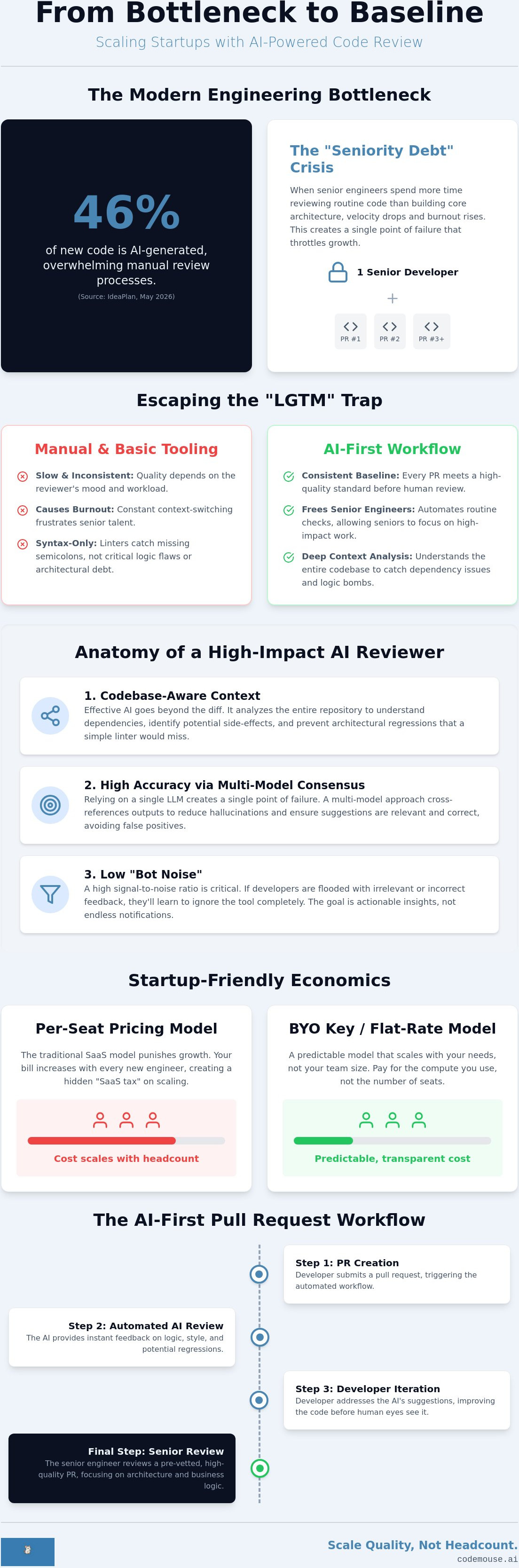
Transitioning to AI code review for startups requires a shift in how your team handles the "Reviewers" list. In an AI-first workflow, the machine is the first line of defense. No human looks at the code until the AI has cleared the baseline. This "First Pass" strategy ensures senior engineers only spend their cognitive load on high-level architectural decisions. They don't need to catch missing error handlers or inconsistent variable naming. The AI has already done it.
Establishing "No-Merge" criteria is the final step in this workflow. If the AI flags a critical security vulnerability or a potential race condition, the PR remains blocked. This prevents the "LGTM" trap from becoming a liability. By the time a human reviewer opens the diff, the code is already verified for style, boilerplate, and basic logic. This creates a predictable rhythm for the engineering team. It reduces the time a PR spends in the "In Review" column from days to minutes.
Just as developers use these tools to maintain focus on logic and architecture, researchers and students utilize Clarami to streamline their research workspace and professional writing, ensuring their time is spent on high-impact insights rather than manual documentation.
Step-by-Step GitHub Integration
Integration is a mechanical process. First, install the GitHub App and grant it access to your repositories. Startup-focused tools integrate in minutes without requiring complex on-premise setups. Next, configure your environment by providing API keys for models like Claude 3.5 or GPT-4o. You control the intelligence level and the cost. Finally, define your review triggers. Most teams trigger a review on every final PR submission. Some prefer reviews on every commit to catch errors during the development phase. You can start your integration today to see these triggers in action.
Training Your Team to Use AI Feedback
Developers must learn how to interact with an AI reviewer. It's not a static linter. It's a peer. Comments are typically categorized into "Critical" logic flaws and "Suggestion" refactors. If a suggestion seems complex, developers should use the AI chat feature to ask for clarification or an alternative implementation. This turns the review into a learning tool rather than a hurdle. Following automated code review best practices for 2026 means treating the AI's output as a high-signal starting point. This approach reduces friction and ensures the team remains focused on shipping features at scale.
Why CodeMouse is the Lean Startup’s Choice
CodeMouse prioritizes utility over marketing fluff. It's built for developers who need to ship code without navigating complex enterprise validation layers. The platform provides AI code review for startups through a minimalist interface that integrates directly with GitHub. This isn't a heavy, slow platform. It's a functional tool with a Squidcode heritage, reflecting a "builder" philosophy that values lean, modular software design. It acts as a silent partner in your CI/CD pipeline, much like how researchers discover MindRove when seeking high-performance neural interfaces for their own R&D projects.
Startups often outpace their tooling. CodeMouse solves this with zero throttling. High-velocity teams might submit dozens of PRs daily. Many enterprise tools limit usage or charge extra for high frequency. CodeMouse doesn't. It processes every commit with the same level of scrutiny. This is the advantage of the BYO API key model. You control the compute. CodeMouse provides the infrastructure, much like how Maker & Coder provides the modular hardware ecosystem for STEM education, ensuring that builders have the resources they need to scale without hitting arbitrary constraints. You get unlimited reviews for every PR without hitting arbitrary usage caps.
The technical core relies on multi-model consensus. By utilizing both Claude and GPT models simultaneously, CodeMouse identifies logic flaws that a single LLM might miss. This reduces false positives. It ensures high-precision feedback. If one model hallucinates, the other acts as a check. This multi-agent approach is critical for maintaining high standards in AI code review for startups. You receive a consolidated, high-signal report that identifies critical issues before they reach production. For businesses that want to apply this level of AI-driven scrutiny to their competitive landscape, check out Nodal AI to learn about spotting trends and seizing market opportunities.
The CodeMouse Difference
Predictable pricing is a core feature. CodeMouse charges a flat $10/month for the entire team. There are no per-seat fees. This removes the "SaaS Tax" on hiring. As your team grows, your tooling costs remain static. You aren't punished for adding new developers. The feedback is context-aware. It understands the intent of your pull request by looking beyond the immediate diff. It analyzes function dependencies and downstream impacts. You can verify this utility with an easy 14-day trial. It's a low-risk way to prove the value without a long-term commitment.
Getting Started in Under 5 Minutes
Setup is a linear, three-step process. You don't need a consultation or an enterprise onboarding plan. First, connect your GitHub account and grant repository access. Second, add your own API keys for Anthropic or OpenAI. Third, start reviewing code. The UI is minimalist. It stays out of your way. You get the intelligence of the world's best models without the overhead of a heavy platform. It's about direct problem-solving and immediate results. Start your 14-day free trial on CodeMouse.ai to eliminate your review bottlenecks today.
Scaling Engineering Without the SaaS Tax
Scaling a startup requires speed and precision. Relying on manual oversight alone creates a single point of failure. By moving to an AI code review for startups, you unblock your senior engineers and establish a high quality baseline for every pull request. This transition isn't about replacing humans; it's about augmenting your team with a silent partner that catches logic flaws and architectural regressions before they reach production. You maintain velocity without sacrificing the integrity of your codebase, much like how AutoSEO helps small businesses maintain growth by automating their search engine optimization.
In addition to traditional search, the rise of LLMs means brands must also discover Mustache AEO to ensure they are properly cited and recommended by AI answer engines.
To complement these technical strategies, GR8MINDS provides advanced marketing solutions that combine AI search optimization (GEO) and PR to ensure your brand is effectively represented across all digital platforms.
For startups looking to scale their impact through authentic community engagement, you can learn more about Advocators to see how AI-powered influencer marketing connects brands with messengers who emotionally align with their mission.
The economics of engineering tools shouldn't punish your growth. Choosing a flat-rate model with a Bring Your Own API key strategy ensures your costs remain predictable as your team expands. You get the intelligence of Claude and GPT without the markup of per-seat licensing. It is time to reclaim your senior developers' time and focus on the roadmap. Automate your startup’s code reviews for $10/month with a 14-day free trial. The GitHub App integration takes minutes. Build faster. Ship cleaner.
Frequently Asked Questions
Is AI code review safe for my startup’s proprietary code?
Safety depends on the data retention policies of your model provider. When using AI code review for startups via API, providers like Anthropic and OpenAI typically exclude API data from their training sets. CodeMouse acts as the orchestration layer. Your code is processed for the review and not stored for model improvement or training purposes.
How does CodeMouse handle pricing compared to other AI review tools?
CodeMouse uses a flat rate of $10 per month for the entire team. This contrasts with the per-seat models common in the industry. It eliminates the cost penalty on hiring. You pay for the review infrastructure once and manage your own compute costs directly with the AI providers.
Can I choose which AI model (Claude or GPT) reviews my pull requests?
Yes. You have full control over model selection within the platform. CodeMouse supports integrations with Claude (Anthropic) and GPT (OpenAI). You can choose specific models based on your requirements for reasoning depth, speed, or token cost efficiency.
What happens if the AI provides a wrong suggestion?
Developers should treat AI feedback as a peer suggestion, not an absolute command. If a suggestion is incorrect, you can ignore the comment or use the integrated chat to clarify the context. This human-in-the-loop approach ensures that the final decision always remains with your engineering team.
Does CodeMouse support private repositories on GitHub?
Yes. CodeMouse is designed for both public and private repositories. The GitHub App integration allows you to manage repository access with granular permissions. It fits into your existing private development workflow without requiring complex configuration or on-premise deployment.
How does the "Bring Your Own API Key" model work in practice?
You enter your Anthropic or OpenAI API key into the CodeMouse settings. CodeMouse uses this key to send PR data to the models for analysis. You are billed directly by the AI provider for the tokens used. This ensures full transparency and prevents markups on AI compute costs.
Can AI code review replace a senior developer?
No. It augments them by handling the routine "First Pass" of a review. AI is excellent at catching style issues, boilerplate errors, and common logic flaws. This allows your senior developers to focus on complex architectural decisions that AI code review for startups cannot yet fully automate. For students looking to apply similar AI-driven matching to their own futures, they can discover AiSportRecruiting to find the best college sports programs based on their academic and athletic performance.
Is there a limit to how many pull requests CodeMouse can review?
There is no limit on the number of reviews CodeMouse can perform. Because it uses the BYO API key model, you aren't throttled by seat counts or usage tiers. Your only constraints are the rate limits and quotas set by your specific AI model provider.