AI for Code Consistency: How to Enforce Standards in the Age of LLMs
AI-generated code is an untrusted contributor. While LLMs excel at generating functional snippets, they often fail to respect the unique architectural patterns of your specific repository. This leads to "vibe coding," a phenomenon where code works but lacks the rigor and style of your existing codebase. For senior developers, this translates to review fatigue and hours spent correcting basic inconsistencies that shouldn't have reached the PR stage. It's a persistent drain on team velocity and mental overhead.
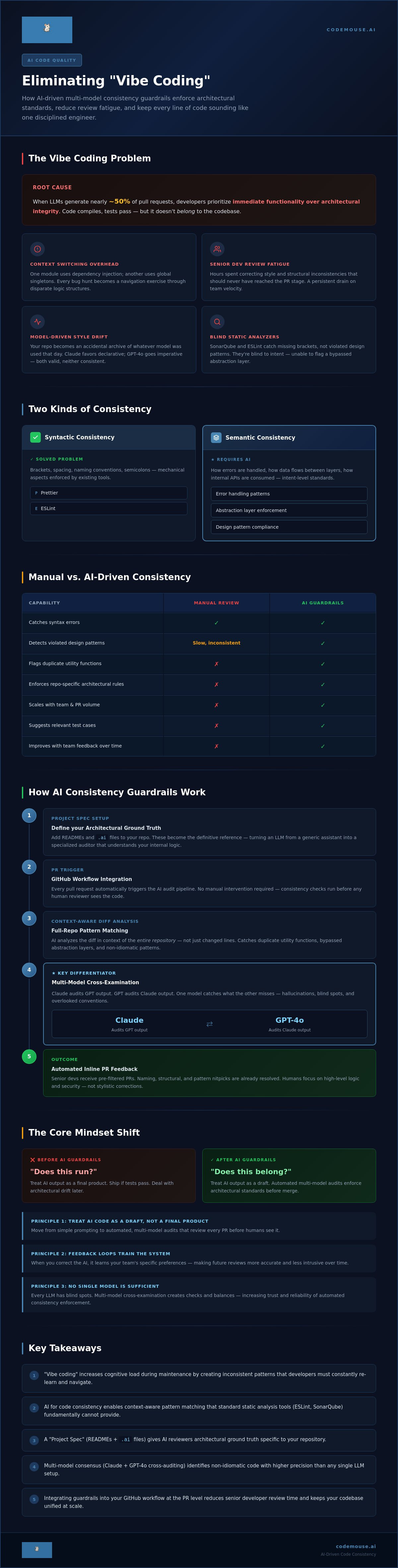
You already know that manual enforcement is a bottleneck. Using AI for code consistency requires shifting from simple prompting to automated, multi-model audits that treat AI output as a draft, not a final product. This guide outlines how to implement guardrails that eliminate stylistic drift and ensure every line of code looks like it was written by a single, disciplined engineer. We'll explore how to automate these standards at the PR level. The result is a unified codebase and a significant reduction in manual review time for your most senior talent.
Key Takeaways
- Identify the hidden costs of "vibe coding" and how it increases cognitive load during maintenance.
- Leverage AI for code consistency to automate context-aware pattern matching that standard static analysis tools miss.
- Establish a "Project Spec" in your repository to provide AI reviewers with a definitive architectural ground truth.
- Use multi-model consensus to identify non-idiomatic code and logic flaws with higher precision than single LLM setups.
- Integrate automated guardrails into your GitHub workflow to reduce senior developer review time and maintain a unified codebase.
Table of Contents
The Inconsistency Crisis: Why AI Assistants Lead to "Vibe Coding"
"Vibe coding" isn't a lack of skill; it's a byproduct of speed. When developers use LLMs to generate nearly half of their pull requests, the focus often shifts from architectural integrity to immediate functionality. If the code compiles and the tests pass, the "vibe" feels right. This mindset prioritizes the immediate task over long-term maintainability. It discards the coding conventions that keep a system readable across multiple years and team rotations.
The hidden cost of this drift is substantial. Inconsistent patterns force developers to switch contexts constantly. One module might use dependency injection while another relies on global singletons. This inconsistency increases the cognitive load for everyone on the team. It turns every bug hunt into a navigation exercise through disparate logic structures. Static analysis tools like SonarQube or ESLint cannot solve this. They are blind to intent. They catch a missing bracket but miss a violated design pattern or a bypassed abstraction layer.
This is why AI for code consistency is becoming a critical layer in the modern CI/CD pipeline. Without it, your repository becomes an accidental archive of whatever model the developer happened to be using that day. The code works, but it doesn't belong. It lacks the unified voice required for a scalable system.
The Drift Phenomenon in AI-Generated Code
LLMs are inherently probabilistic. Claude and GPT-4o often interpret the same prompt through different architectural lenses. One might favor a declarative approach while the other produces imperative code. This creates a "local optimization" problem. The AI solves the specific problem in the prompt perfectly, but it ignores the "global consistency" of the project. Senior engineers lose time acting as human linters. They spend hours in PRs explaining why a specific AI-generated pattern doesn't fit, even if the code is technically correct and performant.
Semantic vs. Syntactic Consistency
Syntactic consistency, such as brackets, spacing, and naming, is a solved problem. Tools like Prettier and ESLint enforce these mechanical aspects with ease. Semantic consistency is the real challenge for growing teams. It covers how errors are handled, how data flows between layers, and how internal APIs are consumed. AI for code consistency provides the only scalable way to enforce these high-level standards. It understands the context behind the code. This allows it to flag structural deviations and "un-idiomatic" patterns that a traditional linter would ignore.
How AI Enforces Coding Standards Beyond Static Analysis
Traditional linters operate on rigid, regex-based rules. They ensure your semicolons are present but fail to understand if your service layer is actually a service layer. AI for code consistency moves beyond these binary checks. It uses context-aware pattern matching to evaluate code against your specific architectural documentation. This "Project Knowledge" turns an LLM from a generic assistant into a specialized auditor that understands your repository's internal logic. It treats your READMEs and .ai files as the definitive ground truth.
AI identifies outlier code by comparing new pull requests against established patterns in your codebase. If your project consistently uses functional components with specific hook structures, the AI flags an imperative class-based approach as a deviation. It automates the "nitpick." Senior developers no longer need to comment on naming conventions or minor structural flaws. The AI handles the feedback. This allows humans to focus on high-level logic and security. It's about moving from "Does this run?" to "Does this belong here?"
The Anatomy of a Context-Aware Review
A context-aware review starts with the diff. The AI doesn't just look at the changed lines. It analyzes the delta in the context of the entire repository. This allows it to catch anti-patterns that static tools miss. For example, it can identify when a developer recreates a utility function that already exists elsewhere. It also helps automate testing strategies by suggesting relevant test cases based on the new logic. Feedback loops are essential. When you correct the AI, it learns your team's specific preferences. This makes future reviews more accurate and less intrusive.
Multi-Model Cross-Examination
Relying on a single model is a risk. Every LLM has specific biases and "blind spots" where it might hallucinate or ignore a project convention. A consensus model solves this. By using Claude to audit GPT and vice versa, you create a system of checks and balances. One model might miss a subtle logic flaw that the other catches. This multi-model approach increases trust. It ensures that automated consistency checks are rigorous and reliable. Teams can achieve this level of depth by using CodeMouse AI Code Review to orchestrate these multi-model audits automatically on every pull request.
Manual vs. AI-Driven Consistency: A Comparison
Manual enforcement of standards is a linear process that scales poorly. Every pull request requires a human brain to context-switch, read the diff, and compare it against mental or written architectural guidelines. This creates a lag. In contrast, leveraging AI for code consistency transforms this into a parallelized, automated task. Reviews happen in seconds rather than hours. While a human might catch a complex business logic flaw, an AI is often better at spotting "un-idiomatic" code. These are the subtle deviations from project-specific patterns that humans overlook during high-volume periods.
Scalability is the primary differentiator. A team handling 100 PRs a day cannot maintain quality without increasing engineering headcount unless they automate the audit. Senior developer hourly rates are high. Spending those hours on stylistic consistency is a poor allocation of resources. AI API tokens cost fractions of a cent per request. By offloading the initial audit to an AI, you ensure that only high-quality, pre-vetted code reaches the human reviewer. It changes the economics of code quality.
The Senior Developer Bottleneck
Senior developers often become "human linters." They spend up to 30% of their review time on consistency nitpicks. This leads to review fatigue. Eventually, "rubber stamping" occurs. PRs are approved just to clear the queue, which introduces technical debt. Automating AI for code consistency reclaims this time. It allows senior talent to focus on architectural decisions and high-level logic rather than correcting the same pattern for the tenth time. It restores the senior role to one of mentorship and strategy rather than janitorial oversight.
Static Analysis vs. AI Reviewers
Static tools like ESLint or SonarQube are necessary but insufficient. They follow hard rules. AI reviewers follow patterns. You need both to build a robust CI/CD pipeline. Linters handle the syntax. AI handles the semantics.
| Feature | Static Analysis (Linting) | AI Reviewer (Pattern-based) |
|---|---|---|
| Logic | Rules-based (if/then) | Context-aware (semantic) |
| Scope | Syntax and basic safety | Architectural alignment |
| Maintenance | Manual rule updates | Learns from repository context |
| Consistency | Binary (Pass/Fail) | Nuanced (Stylistic fit) |
How to Implement an AI Consistency Guardrail on GitHub
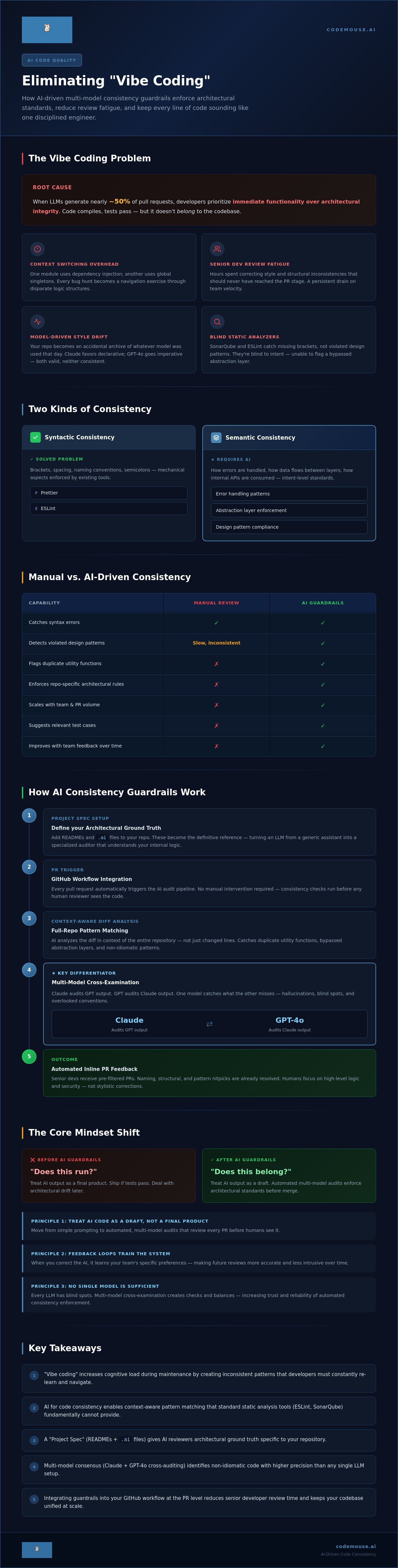
Implementing a guardrail requires moving from manual oversight to automated auditing. It's not just about installing a plugin; it's about defining the rules of the game. A successful setup ensures that your architectural standards are enforced before a human ever opens the PR. This shifts the focus from correcting syntax to validating intent.
Step 1: Define the Ground Truth. The AI needs a reference point. Create a "Project Spec" in your repository using a dedicated .ai file or a specific section in your README. Detail your architectural choices, folder structures, and naming conventions. This file acts as the primary source of truth for AI for code consistency.
Step 2: Selection and Integration. Choose an orchestration tool that integrates with GitHub Webhooks. You need a system that listens for events and triggers reviews immediately. This removes the manual step of requesting a review. Step 3: Automation. Configure the tool to trigger on every Pull Request creation. Early feedback is more effective than late-stage corrections. Step 4: Calibration. Establish a "Review of the Reviewer" phase. For the first few weeks, senior developers should audit the AI's feedback. If the AI misses a pattern, update your Project Spec.
Setting Up the Feedback Loop
Integration usually happens via GitHub Actions or a dedicated GitHub App. Standalone apps often provide lower latency and better context management. System prompts are your primary lever for control. For instance, you can instruct the AI: "Always use TanStack Query for data fetching." This prevents developers from introducing disparate libraries like axios or fetch in new modules. Context is critical. The AI needs access to the surrounding files, not just the diff, to understand how the new code interacts with the existing system.
Handling False Positives
No AI is perfect. Sometimes the model becomes too pedantic or misinterprets a complex abstraction. Develop a protocol for these instances. Allow developers to flag or dismiss incorrect AI suggestions. This human-in-the-loop approach validates the AI for code consistency logic and prevents developer frustration. You can find more on automated code review best practices to refine this workflow.
To start enforcing these standards today without the overhead of per-seat pricing, connect CodeMouse to your GitHub repository.
CodeMouse: Achieving Consistency with Multi-Model Consensus
CodeMouse is the infrastructure for the guardrails described in this guide. It functions as a GitHub App that automates the audit process. By integrating both Claude and GPT, it achieves a level of precision that single-model assistants cannot match. This multi-model consensus treats your code as a high-stakes asset. One model reviews the diff against your repository's context. The second model validates those findings. This reduces hallucinations and ensures AI for code consistency remains the standard for every contributor. It addresses the "echo chamber" problem by using different agents for generation and review.
The integration acts as a silent partner in your workflow. It doesn't demand a total overhaul of your habits. It listens for GitHub webhooks. When a developer opens a pull request, CodeMouse triggers the review automatically. It analyzes the new code against your established patterns and the Project Spec defined in your repository. Feedback appears directly in the PR timeline. This keeps the review loop tight and prevents non-conforming code from reaching the main branch. It turns your architectural documentation into an active, enforceable script.
Pragmatic Pricing for Scaling Teams
Per-seat pricing models often punish growth. Scaling a team from five to 50 developers shouldn't lead to a 10x increase in review costs. CodeMouse offers a flat $10/month fee. You bring your own API keys from OpenAI or Anthropic. This BYO-API-key model is pragmatic. It provides full transparency over your compute costs. You pay for the orchestration and the interface while retaining control over your data and API limits. It's the most efficient way to implement AI code review for GitHub without hidden fees or per-user friction. You only pay for the tokens you actually use during reviews.
Getting Started in Under 5 Minutes
Implementation is linear and fast. Install the app from the GitHub Marketplace. Add your API keys to the dashboard. The system is ready. Your first PR review provides a baseline for your current code consistency. You'll see immediate feedback on design patterns, naming conventions, and structural alignment. This automated layer acts as the first line of defense. It ensures that senior developers only spend time on the logic that matters. Start your 14-day free trial of CodeMouse to eliminate vibe coding from your repository and maintain a unified codebase.
Scaling Architectural Integrity
Maintaining a unified codebase requires a shift from manual oversight to automated audits. You've seen how "vibe coding" erodes architectural standards and how context-aware pattern matching addresses what static linters miss. By implementing a Project Spec and leveraging multi-model consensus, you ensure that every pull request aligns with your established conventions. This approach to AI for code consistency removes the senior developer bottleneck. It allows your team to scale without sacrificing quality or increasing mental overhead.
CodeMouse provides the infrastructure to enforce these standards across every PR. It integrates both Claude and GPT to provide deep context and reliable feedback. There is no per-seat pricing to manage. A flat fee gives your entire team access to unlimited reviews while you maintain control over your API costs. Automate your code consistency with CodeMouse for $10/mo and start your 14-day free trial today. Clean, consistent code is now a baseline requirement that no longer demands a manual chore. Build with confidence.
Frequently Asked Questions
Can AI really understand my team’s unique coding style?
Yes; AI understands unique styles by analyzing your repository context and specific project documentation. It doesn't rely on generic best practices alone. By reading your "Project Spec" or README files, the AI learns your specific architectural choices and naming conventions. This allows it to identify when a contributor deviates from your established patterns, even if the code is technically functional.
Does using AI for code consistency replace my linter?
No, it acts as a complementary layer. Linters like ESLint or Ruff handle syntactic rules such as indentation, semicolons, and basic type safety. AI for code consistency focuses on semantic and architectural alignment. It catches design pattern violations, improper error handling, and un-idiomatic logic that static analysis tools are not designed to detect. You need both for a robust pipeline.
How does CodeMouse handle security and data privacy?
CodeMouse functions as a silent orchestration layer between GitHub and your AI provider. Because you provide your own API keys, your code data remains subject to your existing enterprise agreements with OpenAI or Anthropic. CodeMouse does not store your source code. It processes the diff to generate feedback and then clears the context, ensuring your intellectual property stays within your controlled environment.
Is it expensive to use my own API keys for every pull request?
It is significantly more cost-effective than traditional per-seat pricing models. Most PR reviews consume only a few cents in tokens. By paying a flat $10/month orchestration fee and only paying for the compute you actually use, you avoid the high overhead of "per-user" licenses. This is especially beneficial for scaling teams with high PR volumes but varying review depths.
What happens if the AI gives incorrect advice on a PR?
Humans remain the final authority in every review. Developers can dismiss or flag incorrect AI feedback directly in GitHub. These instances serve as a feedback loop. If the AI consistently misinterprets a specific pattern, you update your project documentation to clarify the standard. This refinement process improves the accuracy of AI for code consistency over time as the model learns your preferences.
Which models are best for catching architectural inconsistencies?
A multi-model approach using Claude 3.5 Sonnet and GPT-4o currently provides the best results. Relying on a single model increases the risk of hallucinations or missed context. Multi-model consensus uses one model to perform the primary review and another to audit the results. This cross-examination is much more effective at catching subtle architectural drift than any single LLM setup.
How do I stop the AI from being too "noisy" in GitHub comments?
You control the signal-to-noise ratio through system prompts and configuration settings. You can instruct the AI to group its feedback into a single summary comment or only flag high-severity architectural deviations. This prevents the PR timeline from being cluttered with minor nitpicks. The goal is to offload the most critical consistency checks while keeping the developer experience friction-free.