Code Quality Metrics for Pull Requests: Calculating the Cost of Technical Debt
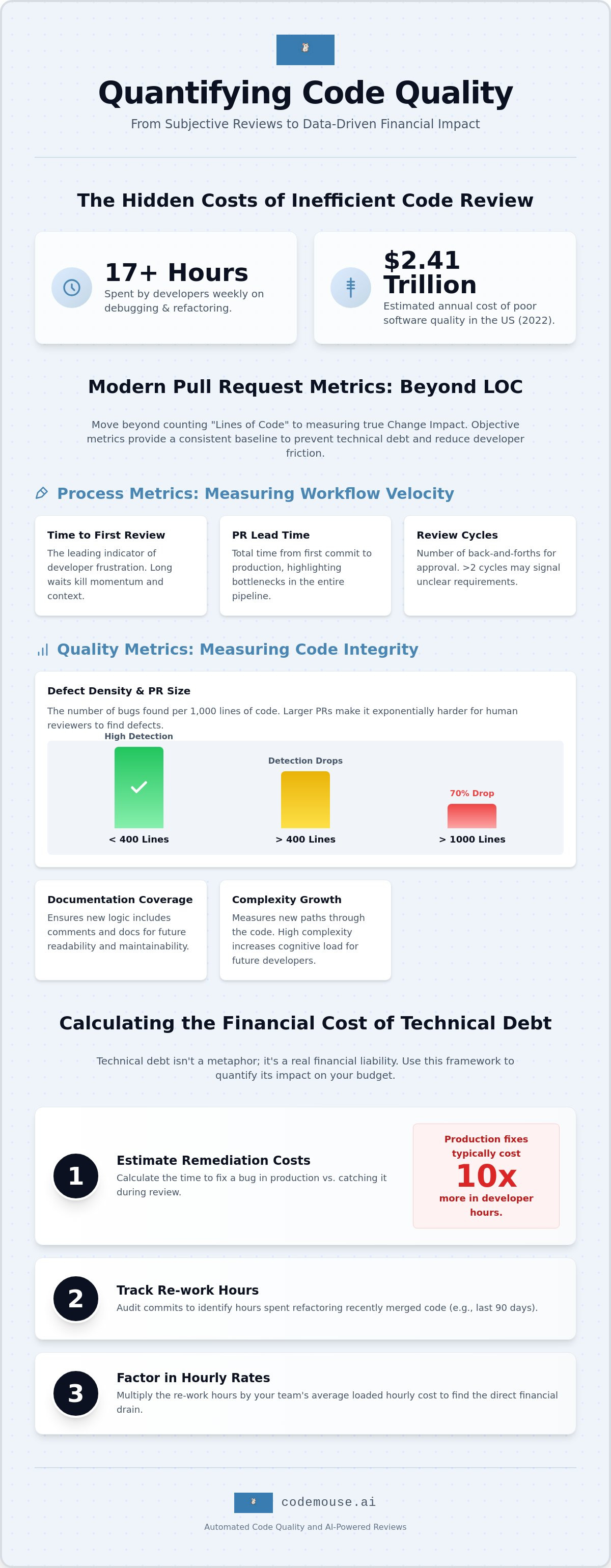
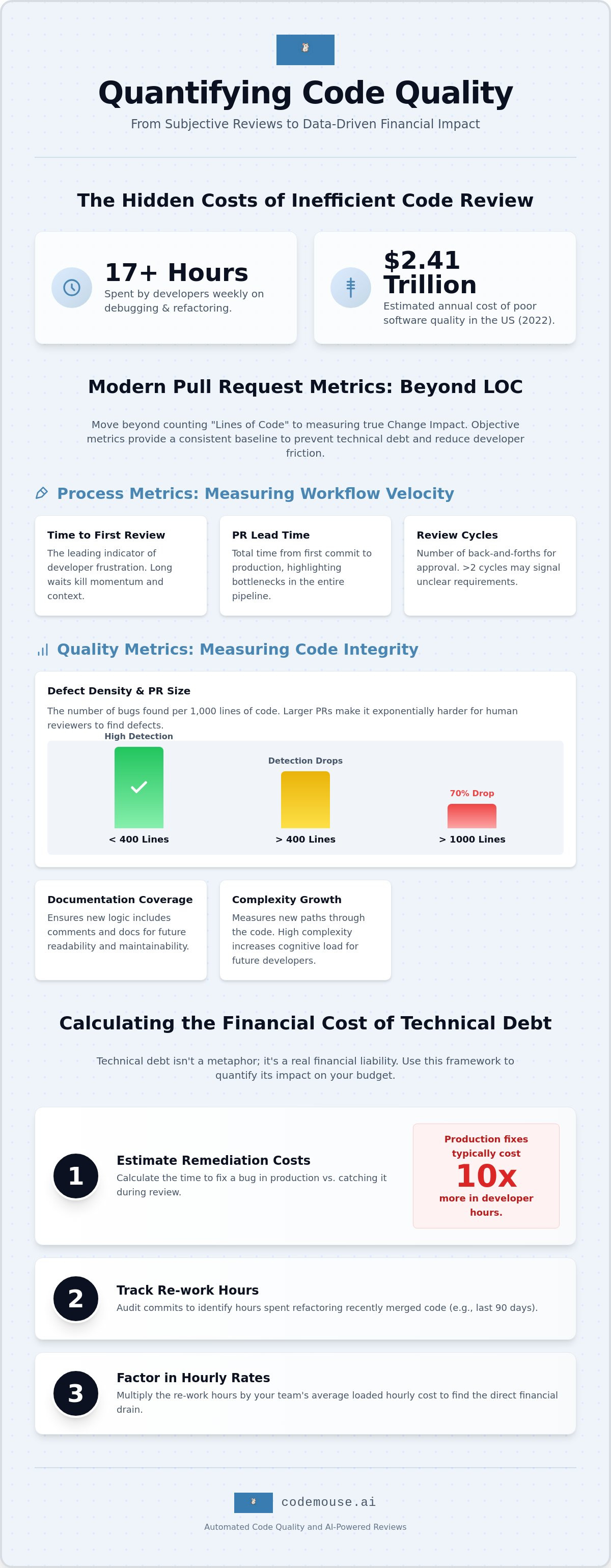
Developers spend over 17 hours every week debugging and refactoring code. That's nearly half a work week lost to maintenance. Most teams view technical debt as a vague concept. In reality, it's the interest rate on every line of code you merge. Tracking code quality metrics for pull requests shifts the conversation from gut feelings to financial facts. Without a clear measurement of what enters your codebase, you can't control the rising costs of poor software quality. The total annual cost of poor quality in the US reached an estimated $2.41 trillion in 2022.
We know the frustration of the review bottleneck. Merge times stall because of minor syntax nitpicks. Critical bugs bypass human reviewers because PRs are too large to audit effectively. Explaining these delays to non-technical stakeholders usually results in blank stares. This article changes that. You'll learn a clear framework to quantify code quality and calculate the financial impact of technical debt in your GitHub workflow. We'll also cover how to measure the ROI of automated code reviews to drive faster cycle times and predictable delivery.
Key Takeaways
- Identify structural, functional, and maintainability pillars to move beyond basic "Lines of Code" tracking and focus on change impact.
- Establish a financial baseline for your codebase by using code quality metrics for pull requests to calculate the "interest rate" of technical debt.
- Solve the "Looks Good To Me" (LGTM) bottleneck by leveraging multi-model AI consensus for objective, data-driven quality scores.
- Integrate automated quality gates directly into your GitHub Actions pipeline to enforce hard thresholds for maximum debt allowed per merge.
- Scale your review workflow with a flat-rate, bring-your-own-key model that provides unlimited PR audits without per-seat pricing constraints.
Table of Contents
Defining Modern Code Quality Metrics for Pull Requests
Measuring code quality is often reduced to a simple count of lines of code. This is a mistake. Lines of code (LOC) measure volume, not value or risk. Modern code quality metrics for pull requests focus on Change Impact. This metric evaluates how a PR alters the existing system architecture and logic. High-quality PRs adhere to three pillars: structural integrity, functional correctness, and long-term maintainability.
Manual reviews are inherently subjective. One reviewer might focus on variable names while another ignores a critical logic flaw. Automated metrics remove this bias. They provide a baseline that stays consistent regardless of who is performing the review. This is essential for scaling teams where "nitpicking" often delays shipping and increases developer frustration. Developers currently spend over 17 hours per week on maintenance issues like debugging and refactoring. Reducing this requires a data-driven approach to every merge.
Process Metrics: Measuring Velocity
Velocity metrics diagnose the health of your workflow. They don't measure the code itself, but the friction in your pipeline. These are the diagnostic tools for your change-based code review process.
- Time to First Review: This is the leading indicator of developer frustration. If a PR sits for 24 hours without feedback, momentum dies. Shortening this time keeps the context fresh in the author's mind.
- PR Lead Time: The total time from the first commit to production. It highlights bottlenecks in testing, staging, or deployment.
- Review Cycles: The number of round-trips required for approval. More than two cycles often suggests poorly defined requirements or a lack of clear coding standards.
Quality Metrics: Measuring Integrity
Quality metrics quantify the technical debt you are about to merge. They protect the production environment from gradual decay and "comprehension debt."
- Defect Density: The number of bugs found per 1,000 lines of code. Research indicates that PRs exceeding 400 lines have a significantly lower defect detection rate. Pull requests over 1,000 lines see a 70% drop in finding bugs.
- Documentation Coverage: Code is read more than it's written. Metrics should track if new logic includes corresponding comments or updated documentation to ensure future readability.
- Complexity Growth: Cyclomatic complexity measures the number of linear paths through your code. If a PR introduces high complexity, it increases the cognitive load for the next developer.
By tracking these code quality metrics for pull requests, teams can set objective gates. You stop guessing if a PR is "good enough" and start using data to prove it. This shift is the only way to combat the 41% increase in code churn often associated with unmanaged AI code generation.
How to Calculate the Financial Cost of Technical Debt
Technical debt is the future cost of current shortcuts. While the term is often used as a vague metaphor for messy code, it represents a real financial liability. To manage it, you must establish a baseline for a "Clean PR" versus a "Debt-Heavy PR." A clean pull request passes all automated checks, maintains low cyclomatic complexity, and follows established patterns. A debt-heavy PR introduces logic that is difficult to test or extend. By applying code quality metrics for pull requests, you can quantify this gap and assign it a dollar value.
Developers spend between 23% and 42% of their work week managing technical debt. This isn't just a loss of time; it's a direct drain on your engineering budget. Managing technical debt requires a shift from qualitative complaints to quantitative financial models. If your team is merging debt-heavy code, you are essentially taking out a high-interest loan against your future roadmap. Automating the detection of these issues with CodeMouse AI Code Review allows you to catch these costs before they hit production.
The 5-Step Debt Calculation Formula
Use this linear progression to determine exactly what your technical debt costs each month.
- Step 1: Estimate Remediation Costs. Calculate the average time required to fix a bug in production versus catching it during the review phase. Production fixes typically cost 10x more in developer hours.
- Step 2: Track Re-work Hours. Audit your past month of commits. Identify how many hours were spent refactoring code that was merged within the last 90 days.
- Step 3: Factor in Hourly Rates. Use the average fully-loaded hourly rate of your engineering team. This includes salary, benefits, and overhead.
- Step 4: Multiply by PR Volume. Calculate the frequency of debt-heavy merges. If 20% of your 100 monthly PRs are sub-standard, that is your primary debt driver.
- Step 5: Calculate the Interest Rate. This is the percentage of your total engineering capacity lost to maintenance. If your team spends 17 hours a week on debugging, your interest rate is approximately 40%.
Visualising the ROI of Code Quality
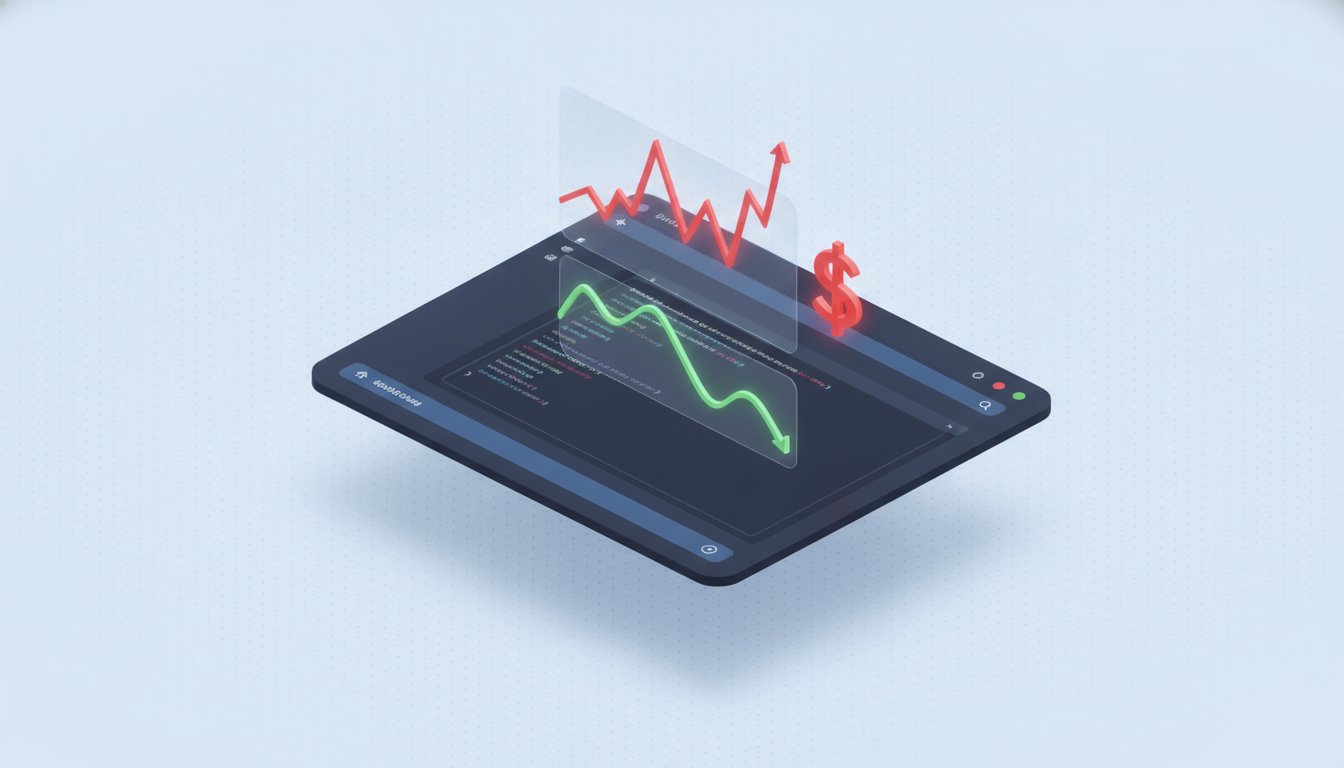
Comparing manual review costs against automated analysis reveals immediate savings. Manual reviews are prone to the "Looks Good To Me" (LGTM) fallacy, where large PRs receive less scrutiny. PRs over 1,000 lines see a 70% decrease in defect detection. Automated code quality metrics for pull requests don't suffer from fatigue. They provide objective data that you can present to non-technical leadership.
Reducing cycle time by 20% through automation does more than just speed up shipping. It increases roadmap predictability. When you present technical debt as a financial interest rate, stakeholders understand why "slowing down to clean up" is a sound fiscal decision. It moves the conversation from "we need to refactor" to "we are saving $50,000 in annual maintenance per engineer."
Review Quality Metrics: AI vs. Manual Analysis
Manual peer review is often the primary bottleneck in the software development lifecycle. The most common failure point is the "Looks Good To Me" (LGTM) problem. As pull request size increases, the depth of human scrutiny decreases. Research shows that defect detection rates drop by 70% for pull requests exceeding 1,000 lines. Reviewers suffer from cognitive fatigue, leading them to approve complex changes they haven't fully parsed. This creates a false sense of security while technical debt accumulates in silence.
To fix this, teams must track "Review Depth" as one of their core code quality metrics for pull requests. Counting the total number of comments is a vanity metric. True quality analysis distinguishes between meaningful logic suggestions and superficial style nitpicks. Context-aware analysis is required to identify if a reviewer caught a potential race condition or merely pointed out a missing semicolon. Automated systems provide the objective consistency that human reviewers lack, ensuring every line receives the same level of attention regardless of PR size or time of day.
The Limitations of Static Analysis
Linters and legacy static analysis tools are necessary but insufficient for modern workflows. They excel at syntax checking and identifying deprecated functions, but they miss architectural debt and logical flaws. These tools often have high false-positive rates. This leads to "alert fatigue," where developers begin to ignore automated warnings entirely. To maintain code integrity, you need tools capable of semantic understanding. You need to know if the code actually does what it's supposed to do, not just if it follows a style guide.
Leveraging AI for Continuous Inspection
Large Language Models (LLMs) have transformed code review from simple pattern matching to sophisticated logic auditing. By generating an objective "Quality Score" for every PR, teams can enforce high standards without increasing manual workload. CodeMouse AI Code Review utilizes a multi-model consensus approach, combining insights from Claude and GPT. This method filters out AI hallucinations and provides a higher signal-to-noise ratio than single-model assistants. It catches bugs that traditional static analysis misses and human reviewers might overlook.
This automated feedback loop acts as a persistent quality gate. It prevents debt from entering the main branch by providing instant, actionable feedback to the author. Because CodeMouse uses a flat-rate, bring-your-own-key model, high-volume teams can scale this continuous inspection without per-seat cost barriers. You get unlimited reviews for $10 per month, plus your direct AI usage costs. This transparency makes it easier to calculate the ROI of your code quality metrics for pull requests by comparing the cost of automation against the saved hours of manual senior developer time.
Implementing a Metrics-Driven PR Workflow
Measurement without enforcement is just noise. To manage technical debt effectively, you must move code quality metrics for pull requests from a dashboard into your active pipeline. This means integrating quality gates directly into your GitHub Actions workflow. A quality gate acts as a circuit breaker. If a PR exceeds a specific complexity score or introduces known security vulnerabilities, the gate prevents the merge. This shift ensures that standards are maintained automatically rather than relying on manual oversight that fails during peak delivery cycles.
Standardizing your workflow starts with review templates. Every PR should include a checklist that matches your core metrics. This forces authors to self-audit before they even ping a reviewer. It also provides reviewers with a consistent framework for evaluation. Using AI code review for GitHub allows you to automate the collection of these metrics, providing a data-driven baseline for every discussion. This transparency removes the "nitpicking" friction that slows down engineering teams.
Automating the Quality Gate
Configuring a GitHub App for immediate feedback is the first step toward automation. You can set up non-blocking reviews for minor issues, such as naming conventions or documentation gaps. Blocking reviews should be reserved for high-debt scores or critical logic flaws. This tiered approach respects the developer's time while protecting the main branch. The goal is to treat AI feedback as a silent partner. It's a tool that catches the obvious errors so humans can focus on high-level architectural decisions. You can start automating your pipeline today with CodeMouse AI Code Review.
Refining Metrics Over Time
Metrics aren't static. As your codebase matures, your thresholds should evolve. Reviewing monthly trends helps identify knowledge silos where only one developer understands a specific module. If one area of the code consistently triggers high-debt scores, it's a signal for a targeted refactor or better documentation. Tracking code quality metrics for pull requests over several months reveals if your team is actually paying down debt or just moving it around. Following automated code review best practices ensures that your gates remain effective without becoming a hurdle to shipping. Adjust your thresholds quarterly to reflect the current state of your project and the rising seniority of your team.
Scaling Quality with CodeMouse AI
Implementing code quality metrics for pull requests shouldn't create a financial bottleneck. Traditional tools often use per-seat pricing models. This makes scaling cost-prohibitive for large engineering teams. CodeMouse AI Code Review removes this friction with a flat-rate subscription. You pay $10 per month for your entire team. You maintain total control over your AI costs through a "Bring Your Own API Key" (BYOK) model. This transparency allows you to scale your review volume without worrying about exploding monthly fees.
Transparency is the core of the BYOK approach. You connect your own keys for providers like Anthropic or OpenAI. You pay them directly for your actual usage. Typical reviews cost between $0.05 and $0.15. This model avoids the hidden markups common in bundled AI services. It gives you the flexibility to choose the specific models (Claude or GPT) that best fit your codebase requirements. You aren't locked into a single provider or a restrictive credit system.
Multi-model consensus is the engine behind these results. Claude and GPT analyze each PR independently. The system then synthesizes their findings. This method filters out noise and AI hallucinations that often plague single-model assistants. You get context-aware feedback that understands your specific architectural patterns. This level of precision helps reduce manual review effort by up to 70%. It ensures your code quality metrics for pull requests reflect actual logic improvements rather than just superficial syntax changes.
Unlimited Reviews for $10/Month
Per-seat pricing models punish team growth. CodeMouse encourages it. Whether you merge 10 or 1,000 PRs, the subscription remains the same. This predictability is essential for managing quarterly engineering budgets. You can test the impact on your workflow with a 14-day free trial. Measure the reduction in cycle time and the increase in defect detection before committing to the subscription. It's a low-risk way to prove the ROI of automated reviews.
Getting Started with CodeMouse
Integration is designed for speed. You can connect your GitHub repository in under 2 minutes via the GitHub App. Configuration is minimal. You define which models to use and set your consensus thresholds. High-stakes codebases can require strict agreement between models for bug detection. This flexibility allows CodeMouse to scale with your project's complexity. It doesn't demand a total overhaul of your current habits. Start your 14-day free trial of CodeMouse to automate your quality gates and start calculating the real ROI of your review process.
Optimize Your Engineering Velocity
Technical debt is a measurable financial liability. Establishing code quality metrics for pull requests shifts your team from subjective reviews to data-driven delivery. Quantifying maintenance hours and implementing automated quality gates allows you to reclaim significant engineering capacity. Transitioning from "Looks Good To Me" to objective analysis is the most effective way to protect your quarterly roadmap.
Scaling these standards is straightforward. CodeMouse AI Code Review provides the infrastructure to enforce quality across unlimited repositories. It utilizes multi-model consensus logic to identify logic flaws that static analysis often misses. You maintain full control over your budget with a flat monthly rate and your own API keys. It's time to stop the cycle of rework and focus on new features.
Automate your PR reviews for $10/month with CodeMouse. Build a codebase that's easier to maintain and faster to ship.
Frequently Asked Questions
What are the most important code quality metrics for pull requests?
Defect density and cyclomatic complexity are the primary indicators of code health. Defect density tracks the number of bugs per 1,000 lines of code, while complexity measures the logic's branching paths. Tracking these code quality metrics for pull requests ensures that each merge contributes to a stable system rather than introducing "comprehension debt." High-impact changes to core modules require stricter thresholds than minor UI updates.
How do you calculate the cost of technical debt in a software project?
You calculate the cost by multiplying the average time spent on maintenance by the engineering team's fully-loaded hourly rate. Developers currently spend between 23% and 42% of their week managing debt. If a team of five developers spends 17 hours each week on debugging and refactoring, that represents a direct loss of nearly half your engineering budget. This interest rate on shortcuts becomes a calculable financial liability.
Can AI really measure code quality as well as a senior developer?
AI provides a consistent, objective baseline that senior developers often lack due to fatigue or time constraints. While a senior engineer understands high-level architectural goals, AI excels at identifying logical flaws and security vulnerabilities across large diffs. By using multi-model consensus, AI reduces noise and catches issues that human reviewers might miss in PRs exceeding 400 lines of code. It acts as a force multiplier for senior staff.
How does cycle time impact the overall cost of a pull request?
Long cycle times increase costs through context switching and delayed value delivery. When a PR sits for 24 hours, the author loses the mental model of the code, making feedback more expensive to process. Faster cycle times reduce the "interest" paid on technical debt by clearing the pipeline quickly. Efficient teams use automation to keep PRs moving, ensuring that high-quality code reaches production without unnecessary idle time.
What is the difference between static analysis and AI-powered code review?
Static analysis tools focus on syntax and predefined rules. They catch missing semicolons or deprecated functions but miss logical errors. AI-powered code review uses semantic understanding to audit the code's actual intent. It can identify complex race conditions, architectural mismatches, and architectural debt that traditional tools ignore. AI moves beyond simple pattern matching to provide context-aware feedback on the logic itself.
Is it worth paying for automated code review tools?
The ROI is found in the reduction of manual review hours and production incidents. Automated tools can reduce manual effort by up to 70%, allowing senior engineers to focus on high-impact architecture. Given that production bugs cost significantly more to fix than those caught during review, the cost of a tool is usually offset by preventing a single major incident. It's a fiscal decision to protect engineering velocity.
How can I reduce the time spent on code reviews without losing quality?
Reducing PR size is the most effective way to maintain quality while speeding up reviews. PRs under 400 lines have the highest defect detection rates. Implementing automated code quality metrics for pull requests handles the repetitive checks, leaving only the most complex logic for human reviewers. This tiered approach ensures high standards without creating a bottleneck in the development lifecycle or exhausting the team's cognitive capacity.
How do I use CodeMouse with my own Claude or GPT API keys?
You provide your own API keys from Anthropic or OpenAI directly within the CodeMouse settings. This "Bring Your Own Key" model ensures you only pay for the AI usage you actually consume, typically costing between $0.05 and $0.15 per review. CodeMouse handles the orchestration and multi-model consensus logic for a flat monthly rate. This setup provides total cost transparency and allows you to choose the models that best suit your requirements.