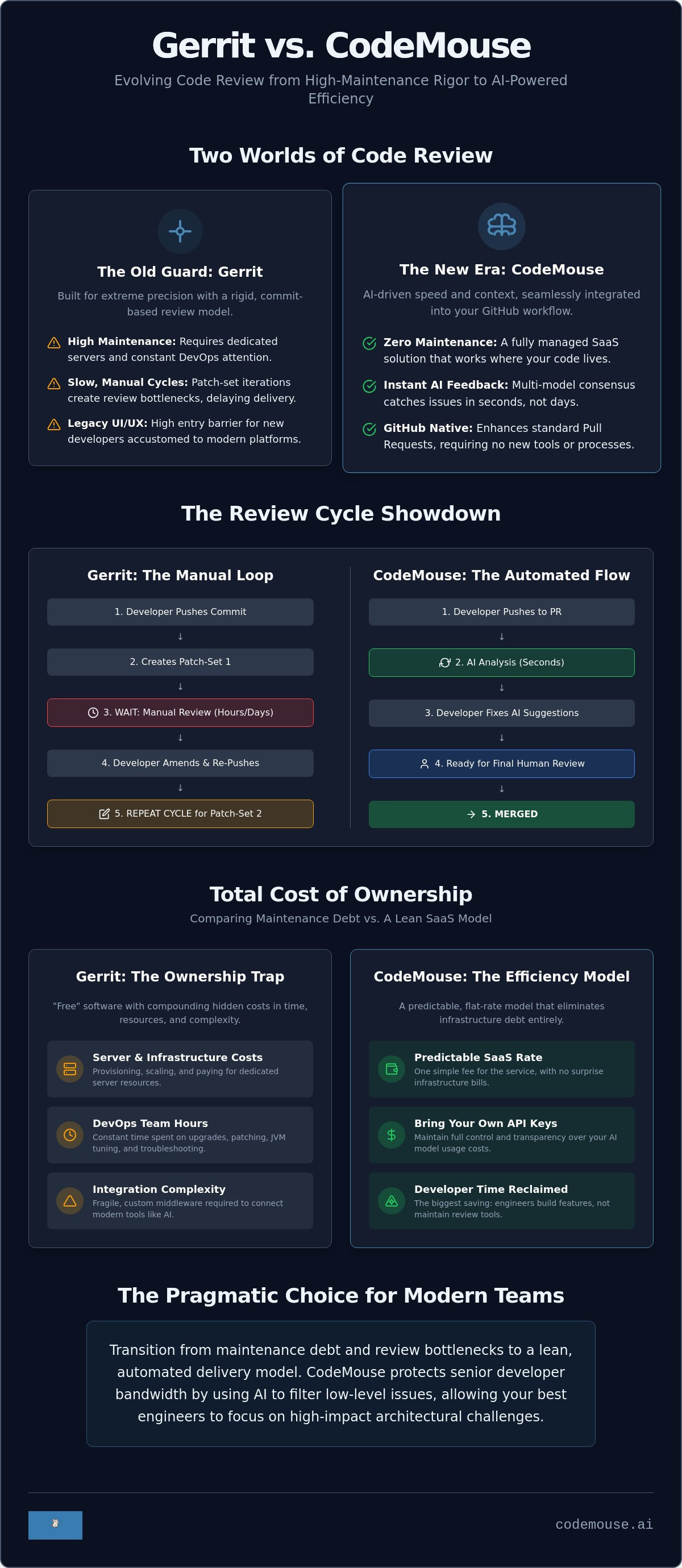

Gerrit vs CodeMouse: Review Logic vs AI Efficiency in 2026
Gerrit is free to download; it's expensive to own. While the patch-set model offers unmatched rigor, the hidden costs of server maintenance and manual review bottlenecks often outweigh the benefits. When comparing Gerrit vs CodeMouse, the choice isn't just about tools. It's about deciding between 2010-era review logic and 2026-era AI efficiency. You need a workflow that catches critical bugs without stalling your delivery pipeline.
We agree that manual oversight is vital for code quality. However, standard GitHub PRs make it difficult to track changes between iterations, and hosting a dedicated Gerrit instance is a significant operational burden. This article compares Gerrit's structural discipline with CodeMouse's AI-driven speed to help you find the right balance for your engineering team. You'll learn how to achieve faster PR turnarounds using zero-maintenance infrastructure. We'll examine how context-aware feedback and AI consensus can replace the manual grind. This guide moves your team from maintenance debt toward a lean, automated delivery model that respects developer time.
Key Takeaways
- Identify why Gerrit’s patch-set rigor creates maintenance debt in modern, high-velocity environments.
- Map the transition from Gerrit’s legacy workflow to AI-enhanced GitHub Pull Requests.
- Evaluate how multi-model consensus using Claude and GPT filters low-level issues to protect senior developer bandwidth.
- Compare the TCO of self-hosting infrastructure against a flat-rate SaaS model using your own AI API keys.
- Execute a pragmatic Gerrit vs CodeMouse migration to maintain deep review logic within the GitHub ecosystem.
Table of Contents
Why Gerrit Still Matters (and Why Teams Are Leaving It)
Gerrit isn't a simple Git wrapper. It is a specialized environment designed for extreme precision. Gerrit is a free, web-based team code collaboration tool that manages reviews at the commit level. Google, Android, and SAP use it to maintain massive codebases with thousands of contributors. Its core logic revolves around the "Change," which is a single commit destined for a specific branch. While GitHub focuses on the Pull Request as a container, Gerrit focuses on the individual delta.
The 2026 development landscape is moving faster than Gerrit's architecture allows. Lean teams are trading manual rigor for automated speed. The comparison of Gerrit vs CodeMouse reveals a growing frustration with legacy interfaces and high entry barriers. Gerrit works well if you have a dedicated team to maintain it. If you don't, it quickly becomes a bottleneck.
The Gerrit Advantage: Change Set Logic
Reviewers in Gerrit don't just look at the final state of a branch. They track Patch Sets. When a developer amends a commit to address feedback, Gerrit creates a new iteration. This allows a reviewer to diff Patch Set 1 against Patch Set 2. You see exactly what was fixed without re-scanning the entire file. This granular visibility reduces the cognitive load on senior engineers. The system uses a unique "Change-Id" in the commit message to track these iterations across rebases. It's a clean, surgical approach to code quality that GitHub PRs struggle to replicate natively. It's precise. It's logical. It's also incredibly slow for high-velocity teams.
The Maintenance Ceiling of Self-Hosting
Open source is only free if your time has no value. Gerrit requires significant DevOps attention to stay performant. You have to manage server resources, handle backups, and navigate complex upgrade paths. For smaller teams, this is a distraction from building features. Gerrit 3.x requirements in 2026 still demand significant JVM tuning and resource allocation. The infrastructure demands are constant.
Integrating modern AI into this environment is difficult. Most AI review tools are built for the GitHub ecosystem first. Trying to hook a modern LLM consensus model into a legacy Gerrit instance usually requires custom middleware and constant patching. The shift in Gerrit vs CodeMouse adoption is driven by this maintenance ceiling. Teams want the zero-maintenance benefits of a SaaS tool that lives where their code already sits. Moving to a managed AI workflow eliminates the server debt while providing the context-aware feedback Gerrit users once had to generate manually.
Workflow Architecture: Patch-Sets vs. AI-Enhanced PRs
Gerrit's architecture is built on the concept of the atomic change. You don't push to a branch; you push to a virtual namespace like refs/for/master. This triggers a review cycle for a specific commit. In the Gerrit vs CodeMouse debate, this is the fundamental technical divide. Gerrit's workflow is rigid and linear. CodeMouse adopts the flexible GitHub Pull Request model and adds an intelligence layer that mimics Gerrit's granular focus without the administrative friction.
The speed comparison is stark. Gerrit requires a manual cycle for every patch-set. A reviewer must log in, compare versions, and provide feedback. This often creates a 24-hour delay per iteration. CodeMouse provides instantaneous feedback. As soon as you push to a GitHub PR, the AI analyzes the changes. It understands the intent behind the code, providing context-aware comments in seconds. This allows developers to fix issues before a human reviewer even opens the PR.
Gerrit’s Granular Review vs. GitHub’s Threaded PRs
The primary complaint about GitHub PRs is that they lose track of incremental changes. If you push five commits to a branch, the reviewer sees a "blob" of changes. Gerrit solves this with patch-sets, but CodeMouse offers a more modern alternative. By analyzing the delta in every PR update, CodeMouse summarizes exactly what changed since the last push. It bridges the context gap that usually makes GitHub feel disorganized compared to Gerrit.
Research into the large-scale industrial application of AI in code review shows that automated systems effectively enforce best practices at scale. CodeMouse applies this by reading existing comments and understanding repository context. You get the depth of a Gerrit review within the familiar GitHub UI. If you want to see this in your own repository, you can start a 14-day free trial of CodeMouse to test the workflow.
AI-Native Integration vs. Legacy Plugins
Integrating AI into a legacy Gerrit stack is a complex engineering task. Most teams end up with fragile, custom-built scripts to pipe code to an LLM. CodeMouse is a native GitHub App. Installation takes one click. It doesn't require you to manage webhooks or server-side plugins.
The Gerrit vs CodeMouse choice often comes down to signal-to-noise ratios. Legacy tools often produce "noisy" automated feedback that developers ignore. CodeMouse uses multi-model consensus, leveraging both Claude and GPT to verify findings. This ensures that the feedback is accurate and actionable. It replaces the manual rigor of a Gerrit patch-set with the automated efficiency of modern AI, allowing your team to maintain high standards without sacrificing velocity.
AI Consensus vs. Manual Rigor: Catching Bugs in 2026
Gerrit's primary value is manual rigor. Senior developers spend hours performing line-by-line verification to maintain code quality. In the Gerrit vs CodeMouse comparison, the shift is from human-first to AI-augmented review. CodeMouse acts as an automated pre-screener. It identifies common errors and logic flaws before a human reviewer even opens the notification. This prevents senior engineers from wasting time on trivial mistakes.
A single LLM can hallucinate or miss nuances. CodeMouse solves this with multi-model consensus. By running code through both Claude and GPT models, it establishes a high-confidence signal. If both models agree on an issue, the feedback is likely accurate. This agreement logic mimics a human peer review process where two senior developers reach a consensus. This approach represents a significant advancement in AI-assisted code review. It filters out the noise that often plagues single-model tools.
Setting up AI code quality gates for GitHub ensures that only high-quality code reaches the human stage. This is the 2026 standard for high-velocity teams. You gain the depth of a Gerrit review without the associated scheduling delays.
Moving Beyond Static Analysis
Gerrit relies on static analysis hooks. These are excellent for finding syntax errors and linting violations. They are blind to semantic bugs and complex logic flaws. CodeMouse identifies context-heavy issues like race conditions or API misuse. It achieves this by analyzing the entire repository context, not just the diff. It also learns team-specific coding standards by reading existing comments and documentation. This allows the AI to enforce subtle architectural rules that static tools miss.
The Role of the Human Reviewer
Gerrit makes the human the first and last line of defense. This is a scalability bottleneck. CodeMouse handles the "boring" checks. It flags styling issues, basic logic errors, and boilerplate mistakes. This frees human reviewers to focus on architecture, security, and high-level design. Review throughput is the optimized output of human-AI collaboration. The goal isn't to remove the human, but to ensure the human's time is spent on problems that require genuine creative logic. Gerrit vs CodeMouse is a choice between a manual bottleneck and a streamlined, automated pipeline.
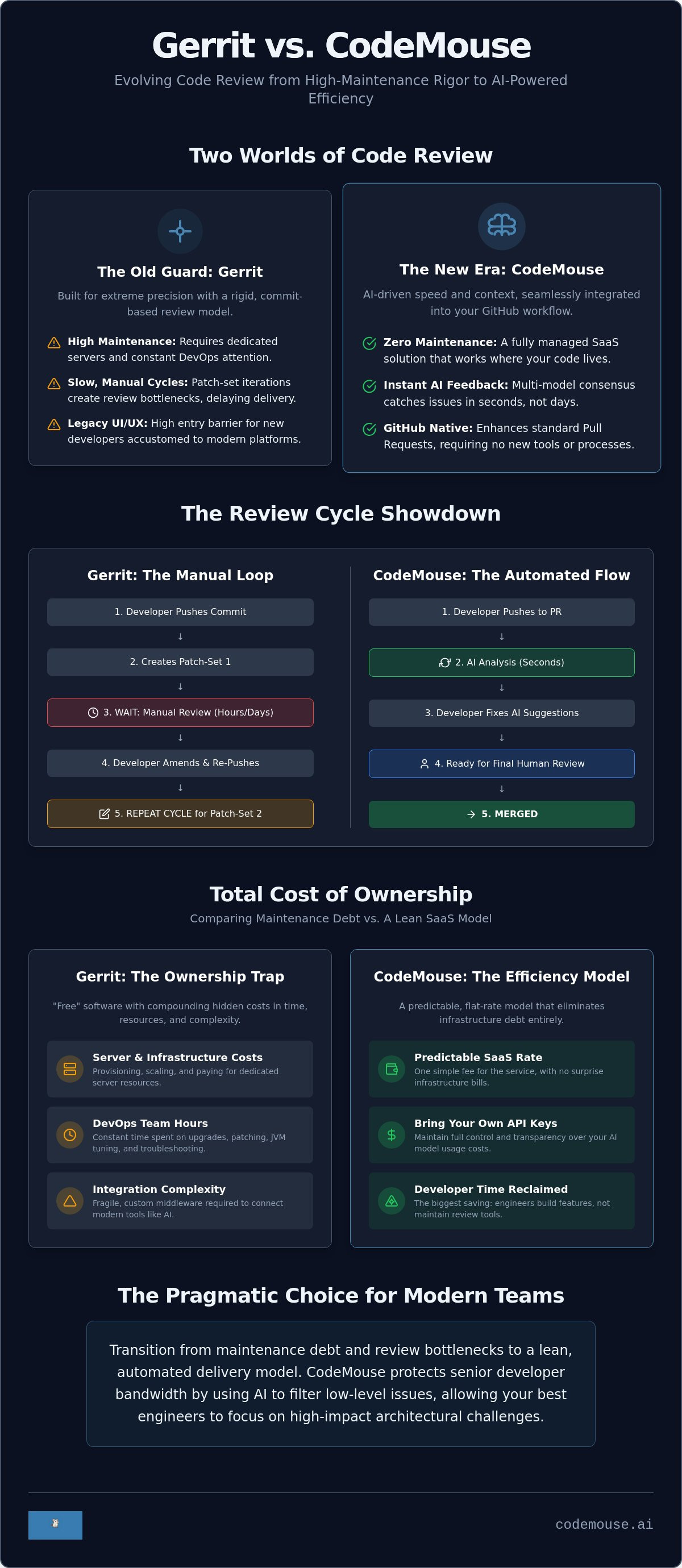
Total Cost of Ownership: Maintenance Debt vs. Lean SaaS
Open-source software is often perceived as a cost-saving measure. For Gerrit, the reality is a persistent maintenance debt. You don't just download the software; you inherit the responsibility of managing its infrastructure. This includes server provisioning, backup orchestration, and navigating complex upgrade cycles. In the Gerrit vs CodeMouse comparison, the primary financial difference is where you allocate your resources. Gerrit consumes engineering hours. CodeMouse consumes a predictable subscription fee.
Scaling a Gerrit instance becomes more expensive as your team grows. More developers mean more patch-sets, higher storage requirements, and increased load on the JVM. Managed Gerrit hosting exists, with prices starting around $11/month in 2026, but this only offloads the hardware. You still own the configuration and user management. CodeMouse operates on a flat-rate model. It scales horizontally without increasing your management overhead. You pay for the utility, not the infrastructure.
Calculating the "Gerrit Tax"
To understand the true cost of Gerrit, you must use a comprehensive formula: Infra Cost + (DevOps Hours x Hourly Rate) + Opportunity Cost. If a DevOps engineer spends four hours a month on Gerrit maintenance, that's time stolen from core product development. The hidden costs of self-hosting include:
- Infrastructure: Server costs and storage for massive patch-set histories.
- Human Capital: DevOps hours spent on JVM tuning and Gerrit 3.x upgrades.
- Reliability: The risk of pipeline stalls during self-hosted outages.
A tool that requires constant attention is a tool that slows you down. Understanding these hidden drains is essential when learning how to reduce code review cycle time. When your self-hosted review tool fails, your entire delivery pipeline stalls.
Why Flat-Rate SaaS Wins for High-Growth Teams
CodeMouse uses a "Bring Your Own Key" (BYOK) model. You pay a flat $10/month fee and provide your own API keys for Claude or GPT. This offers full transparency on AI spend. You aren't paying a "per-seat" tax common in enterprise tools. If your team doubles in size, your subscription cost remains the same. You only pay for the actual AI tokens consumed during reviews. In 2026, this usually averages between $0.05 and $0.15 per review.
This model provides architectural flexibility. You can switch between Claude 3.5 Sonnet and GPT-4o based on performance needs or budget constraints. You aren't locked into a single provider's pricing or roadmap. It's a modular approach that respects your autonomy. You focus on shipping code while the SaaS handles the infrastructure. If you're ready to eliminate maintenance debt, you can get started with CodeMouse today and see the difference in your workflow.
The Pragmatic Choice: Transitioning to CodeMouse
Most engineering teams don't need a total overhaul of their development lifecycle. They need a review process that works without constant intervention. Combining GitHub's familiar interface with CodeMouse's automated intelligence creates a modern "Gerrit-killer" for high-velocity teams. You gain the deep, commit-level scrutiny that once required a dedicated Gerrit instance, but you keep the speed and simplicity of the GitHub ecosystem. It's a transition from managing infrastructure to managing code quality.
The Gerrit vs CodeMouse choice is fundamentally about where you want your senior engineers to spend their time. Transitioning is straightforward. You don't have to migrate legacy databases or retrain your team on a complex new CLI. You install the GitHub App, connect your OpenAI or Anthropic API keys, and the system begins analyzing pull requests immediately. This modular approach respects your existing habits while providing the context-aware feedback necessary for 2026 delivery standards.
Setting Up Your First AI Review Gate
Once installed, you can configure CodeMouse to trigger on every pull request. This creates a consistent quality gate. You can tune the strictness of the feedback to align with your team's internal standards. If you're working on a legacy codebase, you might prioritize logic flaws over styling. For new greenfield projects, you can enforce strict adherence to modern best practices. The multi-model consensus ensures that the comments provided are high-signal and actionable. This filters out the trivial noise that often plagues basic static analysis tools.
The best way to validate this workflow is through a direct comparison on your own codebase. You can start your 14-day free trial with CodeMouse to see how the AI handles your specific repository context. This trial period allows you to measure the impact on turnaround times and identify how much senior developer bandwidth is recovered by automating the initial review pass.
Conclusion: Building a 2026 Workflow
The Gerrit vs CodeMouse debate highlights a shift in industry philosophy. Gerrit represents a legacy of manual rigor that, while effective, introduces significant maintenance debt and scheduling bottlenecks. CodeMouse represents a future of automated efficiency. It provides the same granular oversight through AI consensus without the server-side burden. It's a tool built for builders who value autonomy and speed.
The "Bring Your Own Key" model remains the ultimate pragmatic choice for cost-conscious leads. You maintain full transparency over your AI spend and the flexibility to switch models as LLM performance evolves. You aren't locked into a per-seat pricing trap. You focus on shipping features. We handle the review infrastructure. It's a lean, logic-driven approach to software delivery that scales with your team's ambition.
Upgrade Your Review Pipeline for 2026
Gerrit’s patch-set rigor once defined high-standard code review. In 2026, the operational cost of self-hosting makes it a liability. Manual iteration creates bottlenecks for lean teams. Choosing between Gerrit vs CodeMouse is a decision to prioritize developer velocity over server maintenance. You trade infrastructure debt for a context-aware AI layer that lives where your code does.
CodeMouse provides a surgical review experience using Claude and GPT multi-model consensus. It identifies logic flaws instantly. This preserves senior developer bandwidth for architectural decisions. With a flat $10/month price and no per-seat fees, you maintain full control over your AI spend. You eliminate the "Gerrit tax" on your DevOps team while keeping the depth your codebase requires.
Validating this workflow on your own repository takes minutes. Automate your GitHub PRs with CodeMouse AI by starting a 14-day free trial. Build a delivery pipeline that is as efficient as the code it reviews.
Frequently Asked Questions
Is Gerrit better than GitHub for large-scale projects?
Gerrit is optimized for massive, monolithic codebases like Android or Chromium where commit-level tracking is mandatory. GitHub is better for modular, high-velocity teams using the pull request model. The choice depends on your dependency structure. If you need granular patch-set history, Gerrit wins. If you need integration speed and ecosystem support, GitHub is the modern standard.
Can I use Claude or GPT for code reviews in Gerrit?
You can, but it requires custom engineering or third-party plugins. Gerrit lacks native, first-party AI integrations comparable to GitHub Apps. Most teams build custom scripts to pipe diffs to an LLM. This adds to your maintenance burden. CodeMouse offers these integrations out of the box for GitHub users without requiring custom code.
How much does it cost to run CodeMouse compared to Gerrit?
CodeMouse uses a flat $10/month subscription plus your own AI API costs. Gerrit is free to download but requires server resources and DevOps hours for maintenance. Managed Gerrit hosting starts at approximately $11/month. When comparing Gerrit vs CodeMouse, consider the value of your engineers' time spent on infrastructure versus feature development.
What is the "Bring Your Own API Key" model?
This model allows you to use your own OpenAI or Anthropic API credentials for AI processing. You pay the AI provider directly for the tokens you consume. This ensures total price transparency and prevents vendor markup on AI usage. It also allows you to switch between models like GPT-4o or Claude 3.5 Sonnet as your performance needs change.
Does CodeMouse support multi-model consensus?
Yes, it uses both Claude and GPT models to verify code changes. This multi-model consensus reduces false positives by ensuring two different LLMs agree on a bug or logic flaw. It mimics a human peer review process. This approach provides a higher signal-to-noise ratio than tools relying on a single model.
Is Gerrit still maintained in 2026?
Yes, Gerrit remains active with version 3.14.2 released in July 2026. It continues to receive security patches and performance updates. It is still the primary choice for projects requiring a strict patch-set workflow. However, the ecosystem shift toward AI-native tools has slowed the adoption of new community plugins.
How do I reduce code review cycle time without losing quality?
Use AI to handle the initial review pass. Automated tools catch syntax errors, basic logic flaws, and styling issues before a human reviewer sees the code. This reduces the number of manual iterations. In the Gerrit vs CodeMouse context, automating the first pass recovers senior developer time for complex architectural reviews.
Which is more secure: self-hosted Gerrit or CodeMouse?
Self-hosted Gerrit offers total data sovereignty but requires your team to manage all security patching. CodeMouse is a SaaS tool that integrates via the GitHub App framework. It doesn't store your code on its servers. For teams without dedicated security personnel to manage a private server, a well-configured SaaS often provides better protection against unpatched vulnerabilities.