How to Reduce Code Review Cycle Time: A Pragmatic Guide for 2026
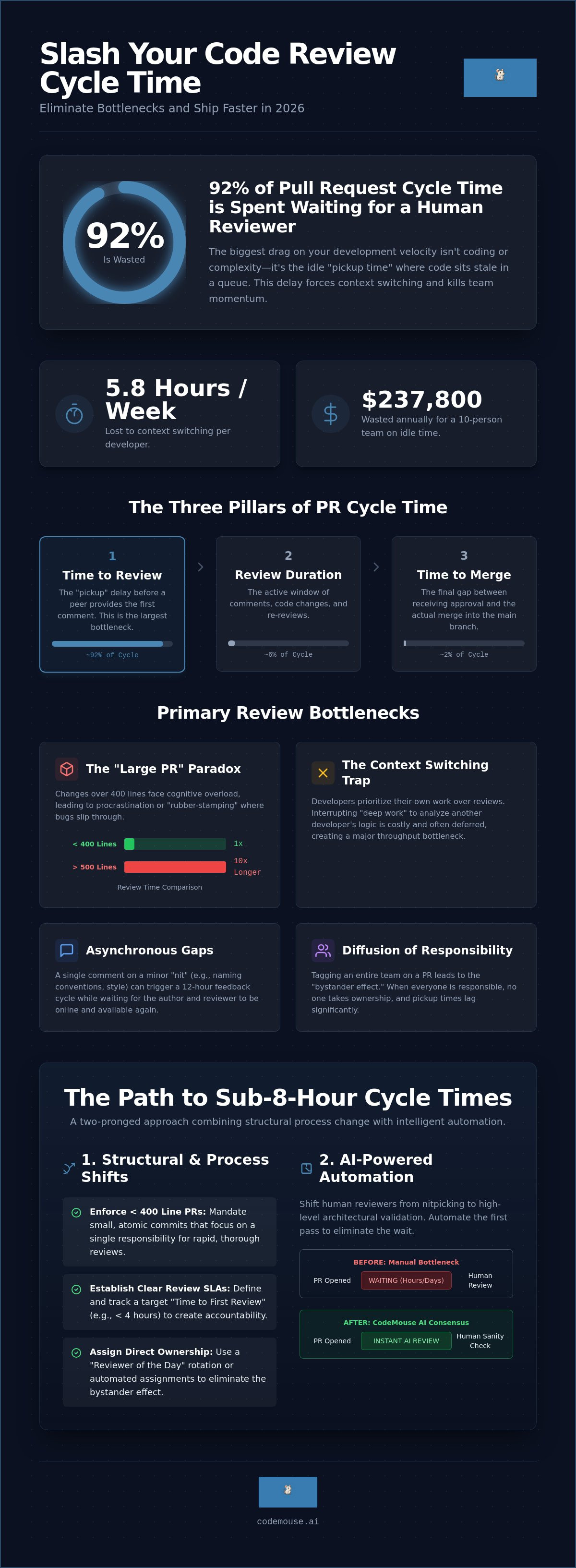
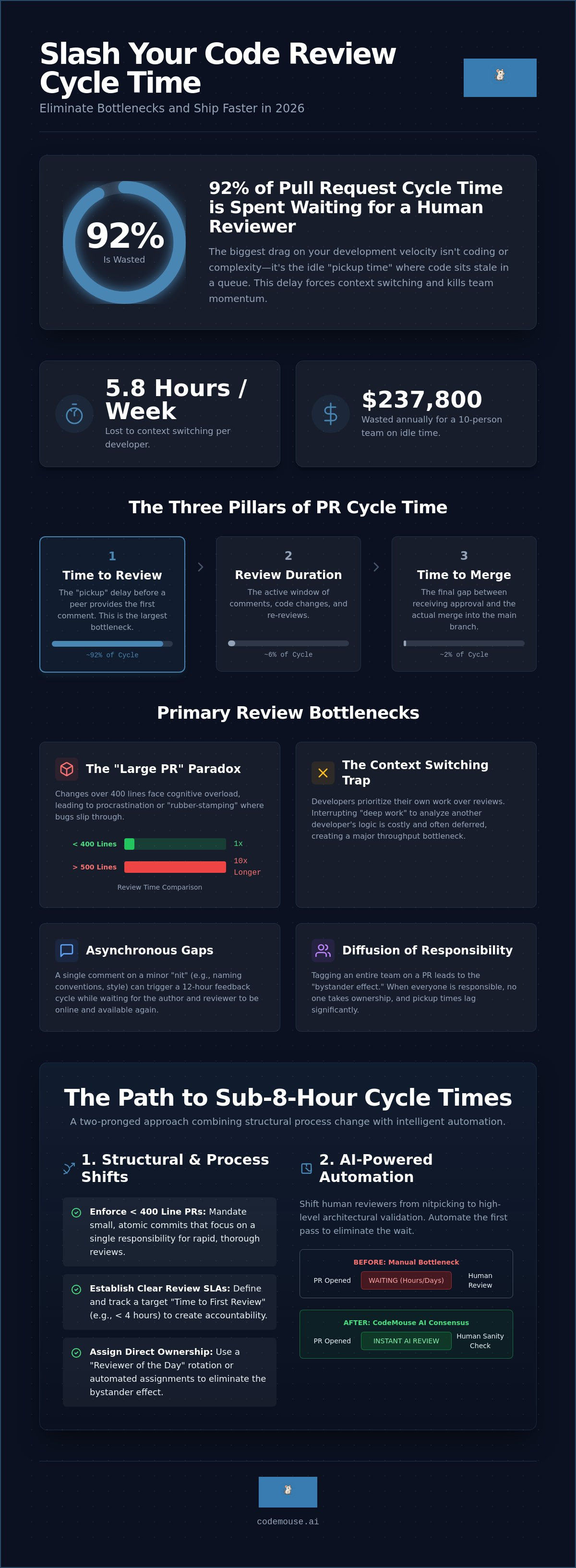
Recent data shows that 92% of pull request cycle time is spent waiting for a human to start the review. It isn't the coding or the logic that kills your momentum. It's the "pickup time." When code sits in a queue for days, it gets stale. Developers are forced to context-switch, losing an average of nearly six hours per week. If you want to reduce code review cycle time in 2026, you must eliminate the idle state where PRs wait for human attention.
We agree that manual reviews have become your primary bottleneck. The tension between speed and quality shouldn't exist. This guide provides the exact structural and technical shifts needed to slash PR wait times and accelerate shipping velocity. Learn how to automate the first pass of feedback, enforce 400-line PR limits, and move human reviewers into a final sanity check role for faster, more predictable deployment dates.
Key Takeaways
- Identify the three pillars of cycle time to isolate the specific bottlenecks between PR creation and the final merge.
- Break the "Large PR" paradox by adopting atomic commits and keeping changes under 400 lines for faster, more thorough reviews.
- Establish clear Review SLAs and structural ownership to reduce code review cycle time and eliminate the diffusion of responsibility.
- Automate the "nitpicking" phase with semantic AI to shift human focus from syntax to high-level logic and architecture.
- Deploy CodeMouse AI Consensus for instant, context-aware feedback that eliminates the initial "waiting for review" idle time.
Table of Contents
Understanding the Components of Code Review Cycle Time
Code review cycle time is the total duration between a developer opening a pull request and that PR being merged. It is a vital indicator of engineering health. For a foundational overview of code review, consider how the process balances defect detection with delivery speed. In 2026, high-performing teams target a cycle time of less than 24 hours. Elite teams often push this below 8 hours by automating the initial feedback loops.
To effectively reduce code review cycle time, you must dissect its three primary pillars:
- Time to Review: The "pickup" delay before a peer or system provides the first comment.
- Review Duration: The active window of back-and-forth communication, commits, and re-reviews.
- Time to Merge: The final gap between receiving approval and the actual merge into the base branch.
Research indicates that 92% of this cycle is spent waiting. This idle time creates a massive context-switching tax. When a PR stalls, the author moves to a new task to stay productive. Returning to the original code later requires a "mental reload" that drains cognitive energy and slows down the entire squad.
The Hidden Cost of Stale Pull Requests
Stale PRs lead to code rot. As the main branch moves forward, the delta between the PR and the base branch grows. This increases the likelihood of complex merge conflicts. Resolving these conflicts is low-value work that frustrates developers and adds zero feature value.
Long cycles also erode team morale. Developers lose momentum when their work sits in a queue. Engineers lose an average of 5.8 hours per week to review bottlenecks. At an average US developer rate of $82 per hour, a 10-person team effectively wastes $237,800 annually on idle time. Speed isn't just about shipping faster; it's about preserving the "flow state" of your engineering talent.
Benchmarking Your Current Review Speed
You can't improve what you don't measure. Use GitHub metadata to extract your median cycle time over the last 30 days. Most teams find their "waiting time" is three to four times higher than their "active review time."
If you want to reduce code review cycle time, start by identifying the median "Time to First Review." If this exceeds 4 business hours, your human reviewers are overloaded. Your 2026 goal should be to shift the burden of the initial pass away from humans. This allows your team to focus on high-level architecture rather than syntax errors or documentation nits. Setting a realistic goal to cut pickup time by 50% usually yields the most immediate impact on overall velocity.
Identifying the Three Major Bottlenecks in Review Workflows
The "Large PR" paradox is the most visible barrier to engineering velocity. Changes exceeding 500 lines of code take 10x longer to review than smaller, atomic updates. Reviewers face immediate cognitive overload when confronting massive diffs. This results in either "rubber-stamping," where bugs slip through, or significant procrastination. Adhering to comprehensive code review best practices requires keeping changes focused on a single responsibility. If you want to reduce code review cycle time, you must first enforce strict size limits to ensure reviewers can provide feedback within minutes, not days.
Asynchronous communication gaps also compound these delays. A single comment about a naming convention often triggers a 12-hour cycle. The author sees the comment, fixes it, and waits for the reviewer to return from their own deep work. This "nits and style" bottleneck is a massive waste of human capital. Human reviewers shouldn't spend their limited cognitive bandwidth on syntax, formatting, or documentation nits that an automated system can catch instantly.
The Context Switching Trap
Developers often prioritize their own active coding tasks over reviewing peer PRs. Reviewing requires a deep dive into foreign logic, which forces a total mental reset. This fragmented focus creates a throughput bottleneck. Teams often struggle to balance "Deep Work" windows with the need for rapid feedback. When a PR sits idle, the author is forced to start new work, creating even more context-switching overhead when the review finally arrives.
The Diffusion of Responsibility in Large Teams
Tagging an entire team or a broad group on a PR often results in no one taking ownership. When responsibility is shared among ten people, the "bystander effect" takes over. This is a primary reason why pickup times lag. Implementing a rotating "Reviewer of the Day" role can help, but manual assignment remains a friction point. Using AI code quality gates for GitHub ensures that every PR meets a baseline standard before a human is even notified. To reduce code review cycle time, you must remove the ambiguity of who should look at the code next. Integrating an automated review tool can provide that immediate first pass, ensuring the human reviewer only steps in when the code is actually ready.
Structural Process Changes to Accelerate Feedback Loops
Speed is a byproduct of structure. If you want to reduce code review cycle time, you must move beyond cultural platitudes and implement technical guardrails. The most effective shift is the adoption of atomic commits. One PR should represent one responsibility. This reduces the cognitive load on reviewers and ensures that feedback remains targeted and actionable. When a change is isolated, the reviewer can validate the logic in minutes rather than hours.
Shift-left testing is a mandatory component of a high-velocity workflow. A human reviewer should never be the first to find a linting error or a failing unit test. Configure your CI/CD pipeline to block reviewer notifications until all status checks are green. This prevents "Reviewer Fatigue" and ensures that human time is spent on architectural logic rather than environmental issues. Standardized PR templates further accelerate this by providing immediate context on "why" a change was made, rather than just "what" was changed.
Implementing Small Batch Development
Breaking down large features requires a specific technical approach using feature flags. Instead of waiting for a feature to be complete, merge smaller components behind a flag. This allows you to reduce code review cycle time by keeping PRs under the 400-line threshold where review quality remains high. When PR size increases, defect detection rates drop from 87% for small changes to only 28% for PRs over 1,000 lines.
The "stacking PRs" workflow is essential for high-velocity teams. If you are waiting on a review for a base branch, don't stop working. Create a new branch from your current PR and continue. While this requires careful rebasing, it eliminates the idle time that usually follows a PR submission. It keeps the developer in a flow state and ensures that the review process never becomes a hard block on individual productivity.
Setting Team Review Agreements
Review SLAs (Service Level Agreements) transform code review from a secondary task into a core job responsibility. A "Review-First" culture dictates that reviewing peer code takes precedence over starting new features. This isn't about rushing; it's about prioritizing team throughput over individual output.
Establish a 4-business-hour response time for PRs under 200 lines. Use automated reminders via Slack or Discord to nudge idle reviewers before the SLA is breached. This creates a predictable rhythm for the entire engineering organization. When developers know exactly when to expect feedback, they can plan their "Deep Work" blocks more effectively, further minimizing the cost of context switching.
Automating the First Pass to Remove Manual Friction
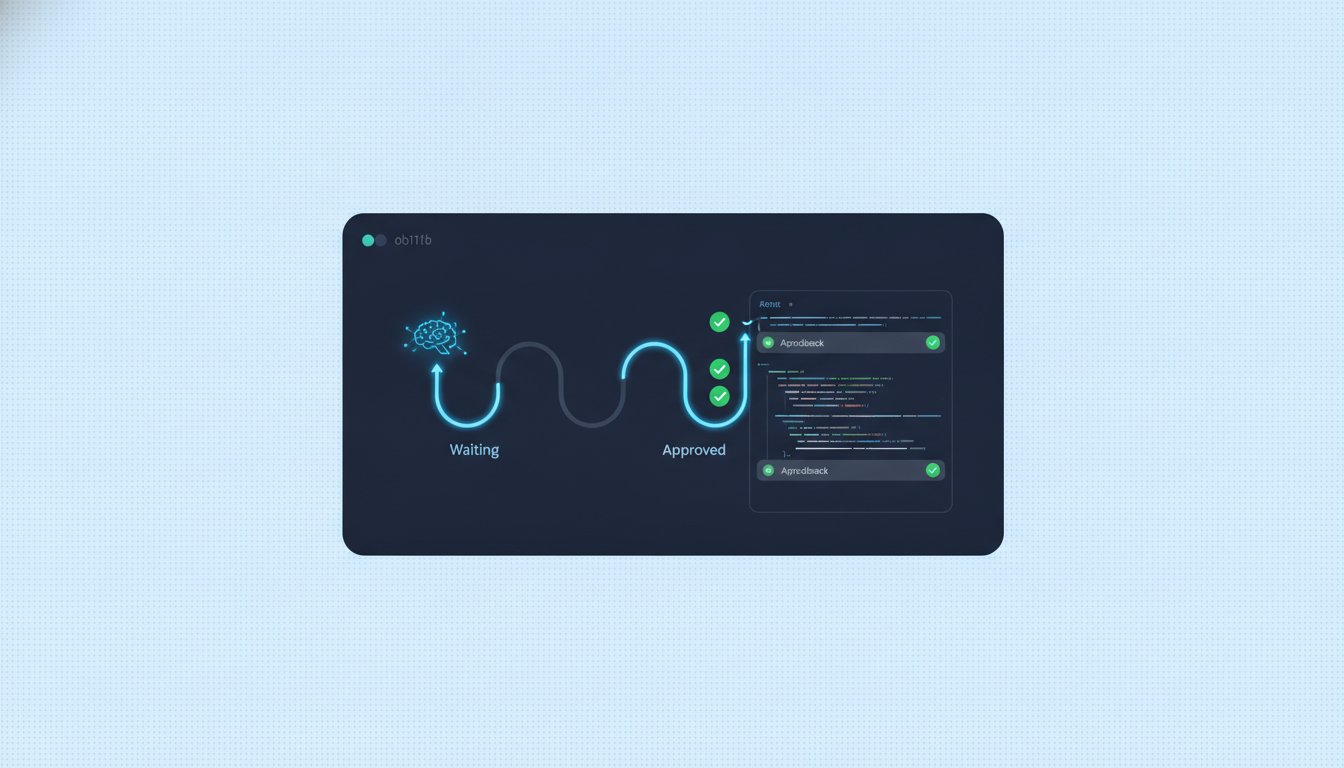
Human reviewers are the most expensive resource in your engineering pipeline. Forcing them to manually check for naming conventions, documentation gaps, or basic syntax is a failure of process. To reduce code review cycle time, you must implement a "Zero-Human" first pass. This involves deploying automated systems that provide comprehensive feedback within 60 seconds of a git push. When the machine handles the nitpicking, human reviewers can focus exclusively on architectural integrity and high-level logic. This shift ensures that the human "pickup time" is spent on value-added analysis rather than trivial corrections.
Automated feedback also removes the emotional friction inherent in code critique. Peer-to-peer reviews can sometimes feel personal, especially when focusing on stylistic choices or minor oversights. An objective AI doesn't have social biases or "bad days." It provides consistent, logic-driven feedback that developers are more likely to accept without defensive posturing. This accelerates the "Review Duration" pillar by shortening the back-and-forth cycles between authors and reviewers. It creates a culture where the code is judged against a standard, not a person's preference.
Static Analysis vs. AI-Powered Logic Checks
Traditional linters are no longer sufficient for modern development speeds. While they catch formatting errors and simple syntax violations, they lack the context to identify semantic flaws or complex security vulnerabilities. Modern teams are moving toward automated code review that utilizes multi-model AI consensus. These systems understand the intent behind the code. They can identify edge cases, potential race conditions, and logic leaks that static analysis tools miss. Integrating these checks into your CI/CD pipeline ensures that only high-quality, logic-sound code ever reaches a human's desk. This eliminates the "ping-pong" effect where PRs are sent back for obvious logic errors.
Continuous Code Inspection
The traditional "Gatekeeper" model is reactive and slow. A developer finishes a task, opens a pull request, and waits for a human to find time. In contrast, the "Continuous Review" model provides instant feedback while the developer is still in the flow state. This significantly shortens the delta between a bug being introduced and it being identified. If a developer receives a logic warning 30 seconds after pushing, they can fix it immediately. This prevents them from moving to a new task and avoids the context-switching tax that stalls momentum. To reduce code review cycle time, you need a system that acts as a silent partner. You can start automating your first pass today to reclaim hours of engineering time and keep your team in a state of constant delivery.
Scaling Review Velocity with CodeMouse AI Consensus
CodeMouse AI Code Review functions as the technical infrastructure needed to sustain high velocity. It provides the immediate, context-aware feedback necessary to reduce code review cycle time without adding to the human reviewer's burden. By acting as a silent partner on every GitHub PR, it ensures that code never sits idle. The system doesn't just look at code diffs; it considers the entire repository context and existing PR comments to provide feedback that mimics a senior engineer's perspective. It can even approve PRs that are clean and have passed CI, moving them directly to the merge stage.
Unlike per-seat tools that penalize team growth, CodeMouse uses a flat-rate model of $10/month for an entire team. This allows for unlimited members, repositories, and reviews. During peak shipping periods or "crunch time," the system doesn't throttle your output. You maintain a consistent feedback loop regardless of the number of active pull requests. It's a scalable solution for teams that value modularity and direct problem-solving. It enhances your existing workflow rather than demanding a total overhaul of your team's habits.
Immediate Feedback on Every PR
The longest delay in any cycle is the "pickup time." CodeMouse eliminates this window by starting a review the moment a PR is opened or updated. Setup requires no complex YAML configurations or CI/CD pipeline changes. You can install the GitHub App and be operational in approximately 2 minutes. This speed prevents developers from switching to new tasks before their current work is validated. It keeps the "mental reload" costs low and maintains the momentum established during the coding phase. Feedback is delivered directly in the GitHub UI, keeping the developer in their existing environment.
Multi-Model Consensus for Accuracy
Accuracy in automated review is achieved through multi-model consensus. CodeMouse leverages the strengths of multiple models, including Claude and GPT, to evaluate every code block. This approach significantly reduces false positives and provides a more comprehensive analysis than single-model tools. One model might flag a style issue while another identifies a logic flaw; the consensus engine filters these into a cohesive, actionable report.
By using your own API keys, you gain unlimited scaling at a predictable cost, typically ranging from $0.05 to $0.15 per review. This "Bring Your Own API Key" model ensures that your review infrastructure scales horizontally with your PR volume. To reduce code review cycle time effectively, you must trust the feedback you receive. Consensus-driven AI provides that reliability. It allows human reviewers to step in only when the architecture requires their specific expertise, ensuring that every human hour is spent on high-value logic.
Accelerating Your Shipping Velocity in 2026
Reducing bottlenecks requires a shift from reactive human gatekeeping to proactive automation. By enforcing strict PR size limits and implementing Review SLAs, you create the structural foundation for speed. The most significant gains come from eliminating the idle "pickup time" that stalls development cycles. Shifting the initial code critique to an automated system allows your team to maintain focus on high-level architecture while machines handle syntax, logic, and style.
To effectively reduce code review cycle time, you must integrate tools that act as silent partners in your workflow. CodeMouse AI Code Review provides instant AI feedback on every PR using multi-model consensus logic from Claude and GPT. It is a pragmatic solution that scales with your team through a flat $10/month pricing model. There are no per-seat taxes or complex YAML configurations to manage. Just immediate, context-aware analysis that keeps your developers in the flow state.
Start reducing your cycle time with a 14-day free trial of CodeMouse and reclaim your team's engineering momentum today.
Frequently Asked Questions
What is a good code review cycle time?
Elite engineering teams target a median cycle time of less than 24 hours. High-performing teams typically maintain a window between 24 and 48 hours. If your median cycle time exceeds 72 hours, your delivery pipeline likely suffers from significant bottlenecks in pickup time or review duration that require structural intervention.
How do you measure cycle time in GitHub?
You measure cycle time by calculating the delta between the created_at timestamp of a pull request and its merged_at timestamp. This data is available through the GitHub REST or GraphQL APIs. For deeper insights, track the "Time to First Review" to isolate how long code sits idle before a peer or automated system provides feedback.
Can AI really replace human code reviewers?
AI functions as a high-speed first pass rather than a total replacement for human architectural judgment. It excels at identifying logic flaws, security vulnerabilities, and syntax errors within seconds of a push. Using AI is a primary strategy to reduce code review cycle time because it eliminates the initial wait for human availability, allowing developers to fix errors while still in the flow state.
What is the most common cause of slow code reviews?
The most common cause is "pickup time," the idle period where a PR waits for a reviewer to begin. Data shows that 92% of pull request cycle time is spent in this waiting state. This bottleneck is usually caused by reviewer overload, large PR sizes that trigger procrastination, or a lack of clear team ownership for incoming reviews.
How do small PRs specifically reduce cycle time?
Small PRs under 400 lines reduce the cognitive load on reviewers, leading to faster pickup and more thorough analysis. Defect detection rates are significantly higher for smaller changes, reaching 87% compared to just 28% for PRs exceeding 1,000 lines. Smaller batches move through the pipeline faster because they are easier to validate and require fewer back and forth comments.
Should I use feature flags to speed up my review process?
Yes, feature flags are essential to reduce code review cycle time by enabling atomic, incremental merges. Instead of waiting for a massive feature to be complete, you can merge smaller logic blocks behind a flag. This prevents the "Large PR" paradox and ensures that your main branch remains stable while you continue to ship code in manageable, low-risk segments.
How does CodeMouse integrate with my existing GitHub workflow?
CodeMouse integrates directly as a GitHub App and requires no complex CI/CD or YAML configurations. Installation takes approximately 2 minutes. Once active, it automatically reviews every pull request using multi-model consensus from Claude and GPT. It functions as a silent partner that provides context-aware feedback and can approve clean PRs, ensuring your team's momentum never stalls.