GitHub PR Automation Tools: Streamlining the Review Lifecycle in 2026
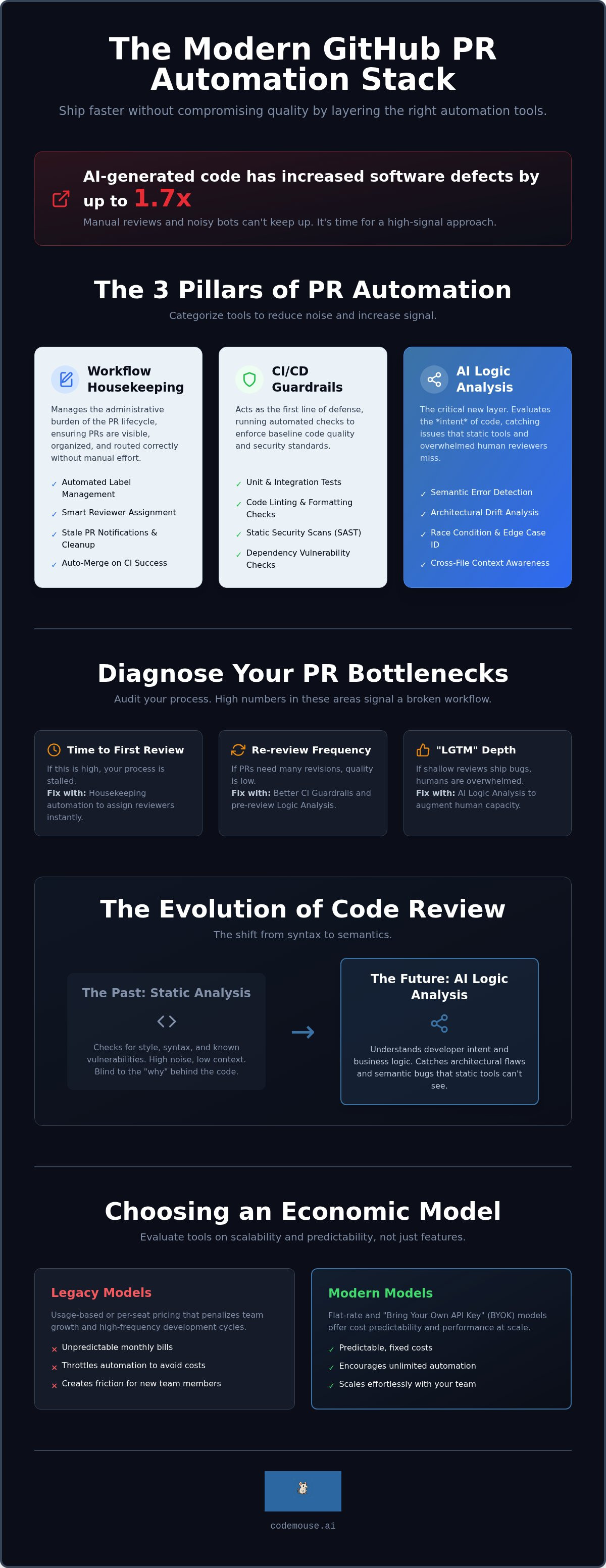
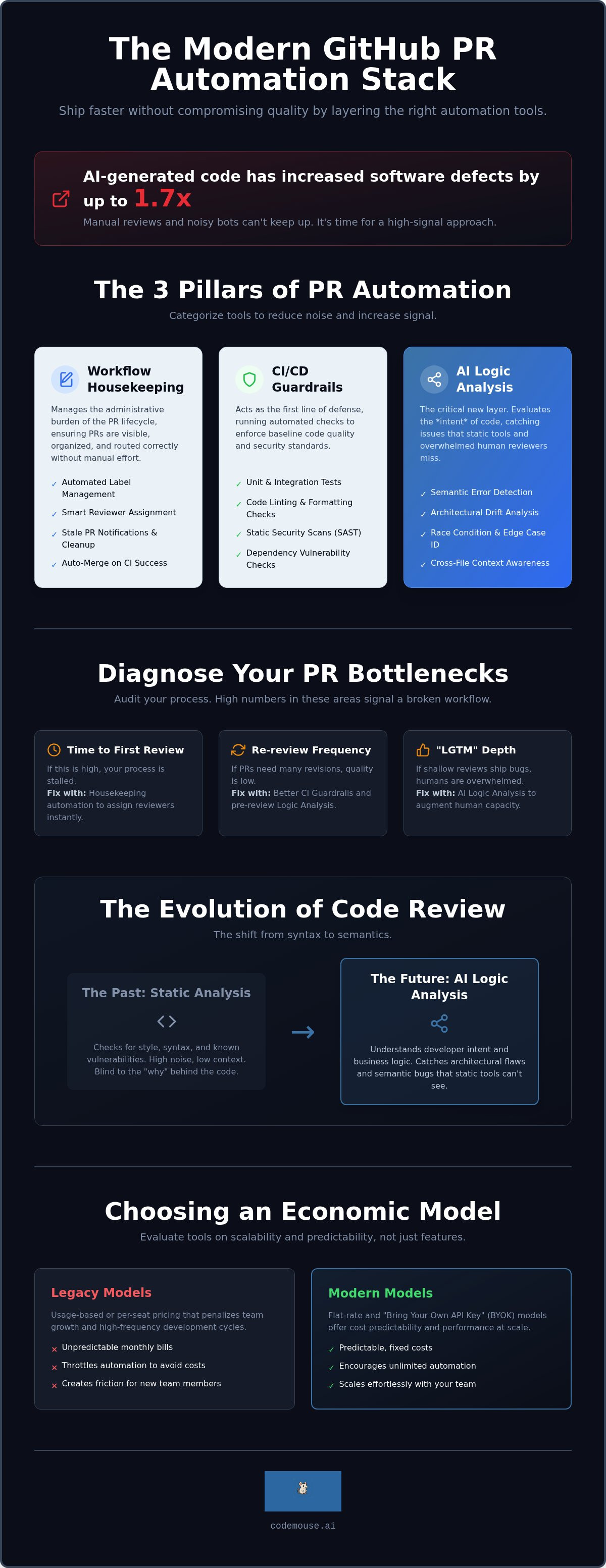
AI-generated code has increased software defects by up to 1.7 times. Despite this, many teams still rely on manual human reviews or noisy, low-signal bots. Finding the right GitHub PR automation tools is no longer about just checking syntax. It's about maintaining architectural integrity in an era of high-velocity output. The objective is to ship faster without compromising the main branch.
It's frustrating when PRs sit unreviewed for days. It's worse when they receive a hollow "LGTM" from a teammate who didn't actually parse the logic. You shouldn't have to choose between a bottlenecked pipeline and a codebase riddled with automated noise or unpredictable usage-based fees. This guide identifies the essential categories of tools required to eliminate these bottlenecks and enforce high-signal code quality. We'll break down the 2026 landscape of housekeeping automation, security scanning, and the logic-aware AI layer that bridges the gap between raw code and developer intent.
Key Takeaways
- Categorize GitHub PR automation tools into three functional pillars: workflow housekeeping, CI/CD guardrails, and logic analysis.
- Automate metadata management and reviewer assignments to reduce manual friction and eliminate lifecycle bottlenecks.
- Identify the shift from static linting to semantic analysis using AI agents that interpret code intent rather than just syntax.
- Evaluate the economic efficiency of flat-rate "Bring Your Own API Key" models compared to usage-based or per-seat billing.
- Learn how to deploy a high-signal logic-validation layer that scales across teams without seat-based throttling.
Table of Contents
Categorising the GitHub PR Automation Landscape
Efficiency in the software development lifecycle requires more than just more automation. It requires the right layers. Most GitHub PR automation tools fall into three distinct categories: Workflow Housekeeping, CI/CD Guardrails, and Logic Analysis. Mixing these up leads to high-noise environments. Developers start ignoring critical alerts because they're buried under label updates and bot spam.
Workflow Housekeeping manages the administrative burden. It handles label management, reviewer assignment, and stale PR notifications. CI/CD Guardrails act as the first line of defense. These tools run unit tests, check linting rules, and perform static security scans. Finally, Logic Analysis evaluates the actual intent of the code. It looks for architectural drift and semantic errors that static tools miss. Single-purpose tools often provide a superior developer experience over monolithic suites. They integrate deeply into GitHub's core functionalities without forcing a total workflow overhaul. This modularity allows teams to swap out a linter or an AI reviewer as technology evolves.
Workflow Housekeeping vs. Logic Analysis
Housekeeping is about metadata. It handles label management, reviewer assignment based on CODEOWNERS, and cleaning up stale branches. It ensures the PR is visible and organized. Logic analysis is different. It evaluates code intent. It asks if the change introduces a race condition or violates architectural patterns. You need both. Housekeeping speeds up the process. Logic analysis ensures the speed doesn't break the product. Without logic analysis, your fast PR cycle just ships bugs more efficiently.
GitHub Actions: The Foundation of PR Automation
GitHub Actions provides the infrastructure for most automation. The marketplace is full of pre-built workflows for standard tasks. You can trigger actions on pull_request, issue_comment, or label events. It's excellent for housekeeping and standard CI tasks. However, Actions have limits. They often lack the cross-file context required for deep code reviews. For context-aware analysis, GitHub Apps are generally more effective. They offer deeper permissions and persistent states that standard Actions struggle to maintain. Start with Actions for simple triggers. Move to dedicated apps when you need logic-heavy validation.
Auditing Your PR Cycle
Before adding more GitHub PR automation tools, identify where your current process fails. Audit your metrics from the last 30 days. High-impact automation points usually hide in these areas:
- Time to First Review: If this is high, you need housekeeping to automate assignments.
- Re-review Frequency: High numbers here suggest poor initial code quality. You need better logic analysis.
- LGTM Depth: If reviews are fast but bugs still reach production, your human reviewers are likely overwhelmed.
Target the bottleneck first. Don't automate a process that's fundamentally broken. Fix the flow, then scale with tools that provide high-signal feedback. This ensures automation serves the developer rather than creating more work.
Workflow Housekeeping: Automating Metadata and Merging
Housekeeping is the plumbing of the review cycle. It doesn't analyze code logic, but it ensures the code reaches the right eyes without manual intervention. Effective use of GitHub PR automation tools starts with offloading metadata management. This includes labeling, triaging, and assigning ownership before a human ever looks at the diff. By automating the administrative layer, you clear the path for high-signal technical reviews.
Labeling automation provides immediate context. Categorize PRs by size (lines of code), impact (files changed), or type (bugfix vs. feature). A 10-line documentation update shouldn't sit in the same queue as a 500-line refactor. Automated labels allow senior developers to triage their review time effectively. This prevents the review fatigue that leads to shallow, low-value comments. It also helps in identifying which PRs require immediate attention and which can wait for a scheduled review block.
Smart Reviewer Assignment
Manual reviewer selection is a frequent bottleneck. Use load-balancing bots to parse CODEOWNERS files and distribute PRs based on current workload. This prevents senior developers from becoming single points of failure. Integrating these assignments with Slack or Microsoft Teams creates immediate feedback loops. When a PR is assigned, the reviewer gets a notification where they already work. Pairing these assignments with automated PR comments AI ensures the reviewer enters a clean, pre-validated environment where the most obvious issues are already flagged.
Auto-Merge and Branch Protection
Machine-driven merging is safe when backed by strict branch protection rules. Configure status checks for CI tests, linting, and security scans. If all checks pass and the required human approvals are met, enable auto-merge. This eliminates the wait time between approval and the final click. Academic research on the impact of GitHub Actions confirms that automating these status checks accelerates the merge cycle by removing human-in-the-loop delays for routine validation.
For high-velocity monorepos, use Merge Queues. These prevent the stale branch error where a PR passes CI but fails after being merged into a fast-moving main branch. Finally, keep the repository clean. Use bots to delete head branches immediately post-merge. This maintains repository hygiene and reduces noise for the whole team. While these housekeeping steps optimize the flow, you still need a logic-aware review layer to ensure the code itself is sound.
Managing stale PRs is the final piece of housekeeping. Set up bots to flag or close PRs with no activity for 14 days. A lean backlog is an actionable backlog. It forces developers to either finish the work or admit it's no longer a priority. This keeps the team focused on shipping current value rather than managing technical debt in the PR queue.
AI Code Review Agents: Logic-Aware PR Analysis
Static analysis is no longer enough. Linters catch syntax errors, but they're blind to logic. Modern GitHub PR automation tools use Large Language Models (LLMs) to interpret code intent. This shift from static to semantic analysis allows tools to identify architectural drift and complex edge cases. It reduces the "first-pass" burden on human reviewers. Instead of pointing out missing semicolons, humans can focus on high-level design. These agents transform the review process from a simple checklist into a deep technical audit.
AI agents provide line-by-line suggestions directly in the PR diff. They perform real-time security auditing and generate concise PR summarisations. This ensures the reviewer knows exactly what changed and why before they start reading the code. It turns the PR from a raw diff into a guided walkthrough. By handling the routine logic checks, these tools ensure that human review time is spent on the most critical parts of the codebase.
The Power of Multi-Model Consensus
Single-model AI tools often suffer from hallucinations. They might suggest valid-looking code that doesn't actually work in specific contexts. Using a multi-model approach, such as combining Claude and GPT-4, creates a consensus layer. One model validates the logic of the other. This cross-verification significantly reduces false positives and catches edge cases that a single model might miss. High-signal, low-noise feedback is essential for developer trust. If an automated tool is consistently wrong, developers will eventually ignore it. Multi-model analysis ensures the feedback is accurate and actionable.
Integrating AI into the Developer Workflow
Effective automation acts as a GitHub PR review assistant. It doesn't just bark orders; it provides context-aware comments. It explains why a change is suggested, referencing related files or historical patterns. This context is critical. Without it, automated comments are just more noise in an already crowded inbox. The assistant should feel like a silent partner that enhances the existing workflow rather than a disruptive force.
Developers should interact with AI comments as they would with a peer. Use the AI's suggestions as a starting point for discussion or code refinement. If the AI flags a potential security vulnerability, investigate the underlying logic. Don't just blindly accept or reject. This collaborative loop refines the codebase and helps developers recognize patterns that lead to bugs. It's about building a better infrastructure where GitHub PR automation tools provide the necessary logic-validation layer before the final human approval.
Economic and Performance Benchmarks for PR Tools
Selecting GitHub PR automation tools involves balancing operational costs against performance gains. Traditional per-seat SaaS models often create friction as teams scale. Every new hire increases the monthly bill regardless of their individual PR volume. This creates a hidden tax on team growth. In contrast, flat-rate infrastructure models decouple the tool's utility from the headcount. This shift allows engineering leads to budget for capabilities rather than seats. It ensures that the entire organization has access to high-quality reviews without the burden of seat-based throttling.
The industry is already shifting toward consumption-based transparency. For example, the transition to usage-based billing models in mid-2026 reflects a broader trend of aligning costs with actual resource consumption. This move forces teams to look closer at the efficiency of their automation stack. ROI is no longer just about the monthly subscription. It's about the cost per high-signal comment and the total reduction in cycle time. If a tool is fast but noisy, it costs more in developer distraction than it saves in review time.
Evaluating the BYOK Advantage
The "Bring Your Own API Key" (BYOK) model offers superior transparency compared to opaque SaaS markups. Most per-seat AI tools bundle API costs with a significant premium. With BYOK, you pay for exactly what you consume at the provider's raw rate. This model provides the flexibility to switch between Claude and GPT models based on the specific needs of a project. It eliminates "seat debt." Growing engineering teams can provide unlimited reviews to every contributor without worrying about escalating subscription tiers or per-user limits. This architecture positions the tool as a silent infrastructure partner rather than a restrictive service.
Performance Metrics for Automation
ROI isn't just about the invoice. It's about cycle time reduction. Data shows that AI-induced bugs have increased software defects by up to 1.7 times in recent years. This makes robust verification more critical than ever. Speed must not come at the cost of noise. Measure the signal-to-noise ratio by tracking the percentage of automated comments that lead to an actual code change. High-signal feedback is defined as automated analysis that identifies actionable logic flaws or security risks while maintaining a negligible false-positive rate. If automation cuts the time to first review but increases the total merge time due to irrelevant comments, the stack is failing.
Latency also plays a role in developer experience. GPT-4o offers low latency for rapid housekeeping and simple logic checks. Claude 3.5 Sonnet provides deeper semantic analysis for complex refactors. A multi-model approach allows teams to optimize for both speed and depth. This ensures that the review happens in the "flow state" rather than becoming a background task that developers check hours later. To optimize your team's economics and quality, you should scale your PR reviews with a flat-rate AI agent that supports your own API keys.
Building a High-Signal Automation Stack with CodeMouse
Integrating GitHub PR automation tools shouldn't complicate your budget or your workflow. CodeMouse functions as the logic-validation layer of your stack. It bridges the gap between static linting and human oversight. By leveraging Claude and GPT models, it provides deep semantic analysis without the overhead of a manual first pass. It's a pragmatic addition to any CI/CD pipeline that values architectural integrity.
The $10 flat rate removes the friction of team-wide adoption. You don't need to count seats or justify individual licenses. It's a predictable infrastructure cost that scales with your output. Connecting your first repository to the CodeMouse GitHub App is a linear process:
- Install the CodeMouse app via the GitHub Marketplace.
- Select the repositories you want to automate.
- Input your OpenAI or Anthropic API key in the dashboard.
- Trigger reviews automatically on every new pull request.
Unlimited Reviews for Scaling Teams
Scaling your engineering team shouldn't be penalized with escalating software costs. Many AI tools throttle performance or increase fees as you add contributors. CodeMouse supports unlimited team members without increasing the monthly subscription. It treats code quality as a fixed infrastructure cost. This ensures every developer receives a consistent "second pair of eyes" on every diff. You can ship more code without worrying about hitting seat-based limits or usage caps.
Security and Autonomy
Autonomy is central to a modern developer experience. By using your own API keys, you maintain direct control over your data and token usage. You decide which repositories are reviewed and which models are utilized. There's no opaque markup on AI credits. You get the transparency of a direct integration with the security of a managed app. It's about providing the infrastructure and then stepping out of the way. You maintain full control over your automation depth and cost.
Ready to eliminate review bottlenecks? Start your 14-day free trial with CodeMouse today.
Optimizing Your PR Lifecycle for 2026
Effective use of GitHub PR automation tools ensures that code quality remains high as shipping velocity increases. You've seen the value of a modular stack. Automate the metadata first. Then, deploy a logic-aware layer to handle the semantic heavy lifting. This approach eliminates the noise that typically plagues automated systems. It respects the reviewer's time and focuses human effort on high-impact architectural decisions.
Economic efficiency is just as critical as technical performance. Avoid seat-based debt and opaque markups. By choosing a flat-rate infrastructure model, you ensure that every contributor has access to deep code analysis without increasing your overhead. This is the most practical way to scale an engineering team in the current landscape.
Automate your GitHub reviews for $10/month with CodeMouse. Start a 14-day free trial and leverage Claude or GPT models with flat pricing for unlimited team members. Build a faster, more reliable pipeline today.
Frequently Asked Questions
How do GitHub PR automation tools differ from standard CI/CD?
Standard CI/CD focuses on functional validation: running unit tests, building binaries, and managing deployments. GitHub PR automation tools operate at the review layer. They manage metadata like labels and reviewers while providing logic-aware analysis of the code diff. While CI/CD tells you if the code runs, PR automation determines if the code is maintainable, secure, and aligned with your architectural patterns.
Can AI automation tools completely replace human code reviewers?
No. AI agents act as a high-signal filter, not a total replacement. They handle routine logic checks, identify edge cases, and catch architectural drift. This eliminates the "first-pass" burden, allowing human reviewers to focus on high-level design and business context. The most effective workflows use automation to ensure that by the time a human opens the PR, the obvious issues are already resolved.
Is it safe to give an AI tool access to my private GitHub repositories?
Security depends on the integration architecture. Using a GitHub App with granular, least-privilege permissions is the industry standard. Tools that utilize a "Bring Your Own API Key" model offer additional sovereignty. This setup ensures that your code is processed within your own provider's environment, preventing your proprietary logic from being used to train public models.
What is the most cost-effective way to implement AI code reviews?
The most scalable approach is a flat-rate subscription paired with your own API keys. This avoids the "seat debt" of per-user pricing where costs escalate with every new hire. By paying raw token rates directly to providers like OpenAI or Anthropic, you eliminate opaque SaaS markups. This model is particularly efficient for teams with high PR volumes or fluctuating contributor counts.
How do I reduce the noise from automated PR comments?
Reduce noise by using tools that prioritize signal over volume. Multi-model consensus, where one AI validates the logic of another, significantly lowers false-positive rates. You should also configure your GitHub PR automation tools to trigger only on specific events or file types. This prevents "comment fatigue" and ensures that every automated suggestion is actionable and high-confidence.
Which AI model is better for code reviews: Claude or GPT-4?
The choice depends on the specific task. Claude 3.5 Sonnet is frequently recognized for its deep reasoning capabilities and lower hallucination rates in complex refactors. GPT-4o is excellent for rapid, high-throughput reviews and general logic validation. A robust automation stack allows you to toggle between these models or use them in tandem to achieve a comprehensive "second pair of eyes."
Do I need to write my own GitHub Actions to automate PRs?
You don't have to start from scratch. While GitHub Actions are excellent for basic housekeeping like labeling, they often lack the cross-file context needed for deep logic analysis. Dedicated GitHub Apps provide a more sophisticated integration. They handle the orchestration of LLMs and maintain the state across the review lifecycle without requiring you to manage complex YAML configurations.
What is the "Bring Your Own API Key" model in PR automation?
This is an infrastructure-first model where you provide your own credentials for AI providers. You pay a flat fee for the automation interface and pay the AI provider only for the tokens you actually consume. This provides full transparency into token usage and allows you to switch models instantly. It’s a pragmatic way to scale GitHub PR automation tools across large organizations without seat-based throttling.