GitHub PR Review Assistant: A Guide to High-Signal AI Automation
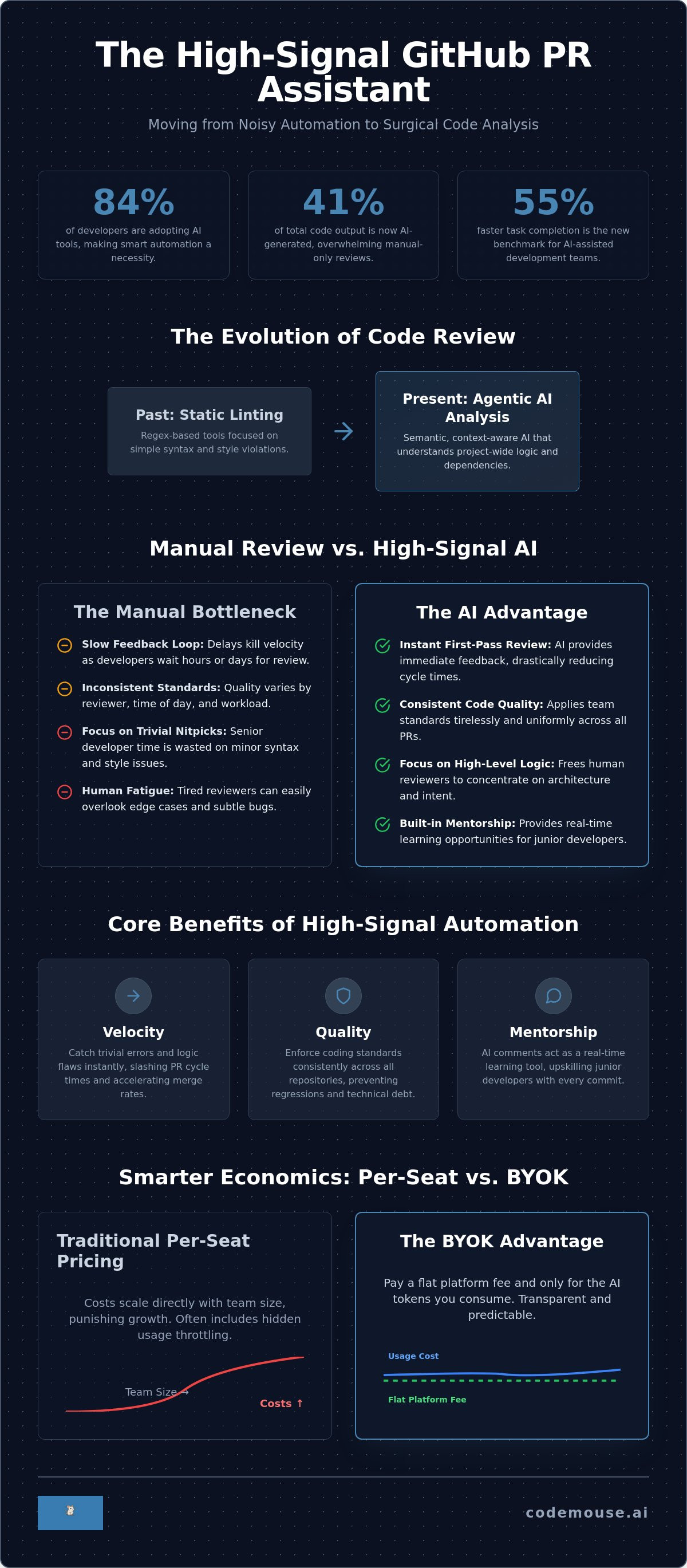
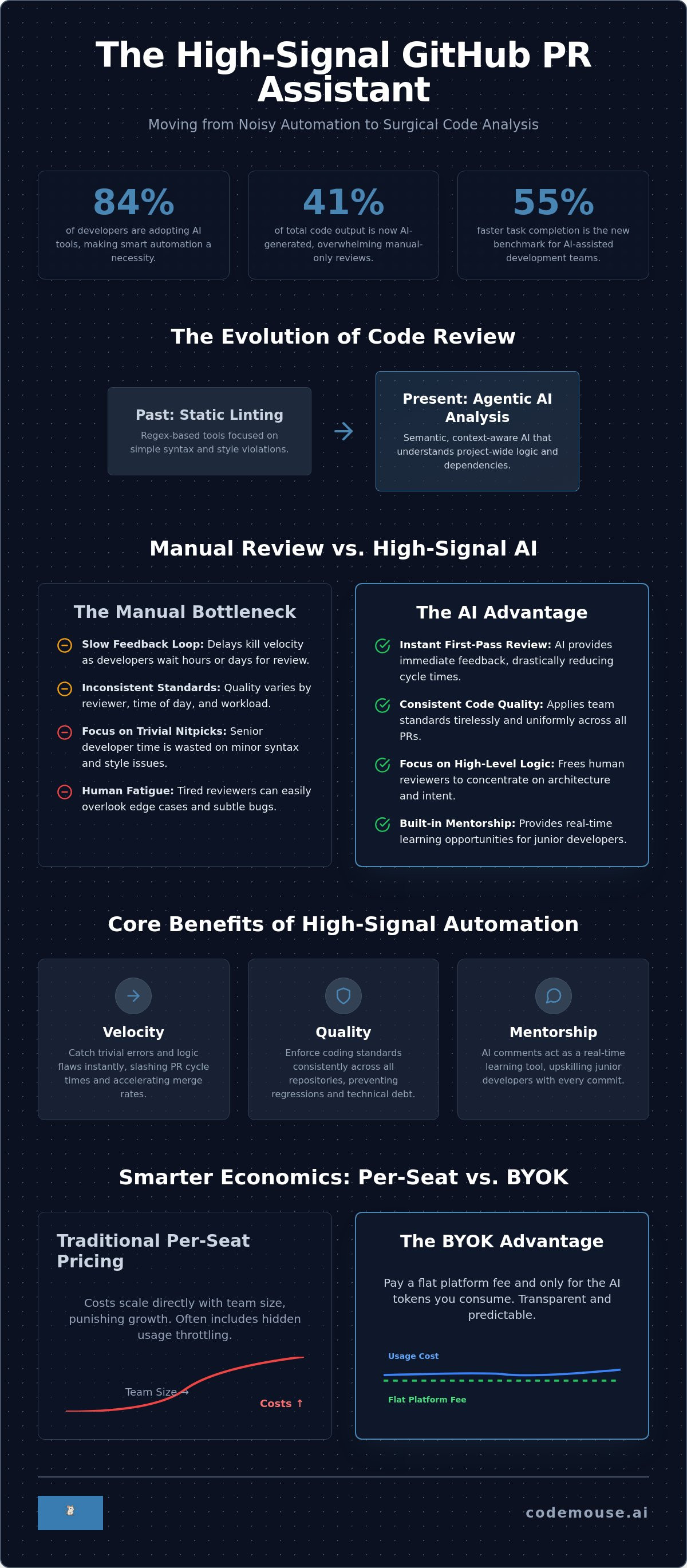
A GitHub PR review assistant should reduce your workload, not increase your notification count. Most teams implement AI automation only to find themselves wading through low-signal comments that ignore architectural logic in favor of trivial syntax nitpicks. With 84% of developers now adopting AI tools according to 2026 industry data, the differentiator isn't whether you use automation, but how much noise you're willing to tolerate. High-signal automation requires a shift from quantity to quality.
We understand the frustration of slow PR cycle times and the hidden costs of per-seat pricing models that punish team growth. You need a solution that integrates into your workflow without adding financial or mental overhead. This guide will teach you how to identify and implement the right GitHub PR review assistant to eliminate manual fatigue and maintain consistent code quality. We'll explore the move toward agentic workflows, the benefits of Bring Your Own Key models for cost transparency, and the specific steps to achieve faster merge times with surgical precision.
Key Takeaways
- Transition from static linting to semantic, context-aware AI reviews that understand project-wide dependencies and logic.
- Learn how to deploy a GitHub PR review assistant using a non-blocking, "human-in-the-loop" model to build team trust and maintain code quality.
- Compare performance metrics between manual and AI-assisted workflows to slash time-to-first-comment and total PR turnaround.
- Leverage custom instructions and multi-model support to align automated feedback with your specific internal style guides.
- Eliminate per-seat pricing hurdles with a pragmatic, flat-fee approach that ensures transparent costs as your team scales.
Table of Contents
What is a GitHub PR Review Assistant?
A GitHub PR review assistant is a specialized GitHub App that leverages Large Language Models (LLMs) to perform deep semantic analysis on code changes. It's more than a simple bot. It functions as a context-aware collaborator that reviews code intent, logic, and security directly within the pull request. By 2026, the volume of AI-generated code has reached approximately 41% of total output. This surge makes manual-only reviews a primary bottleneck for high-velocity teams.
The role of this assistant in the modern developer inner loop is to filter out the noise. It handles the initial pass of every PR, ensuring that human reviewers only focus on high-level architectural decisions. This shift allows teams to maintain a lean, efficiency-first workflow without sacrificing code integrity. It acts as a silent partner that enhances existing habits rather than demanding a total overhaul of your development process.
The Evolution of Automated Code Review
Automated code review has evolved significantly from its origins in regex-based linters. Early tools focused on static analysis, flagging style violations or missing brackets. Today, we've moved to transformer-based logic analysis. Modern assistants provide "agentic" reviews, meaning they can reason about the entire codebase rather than just the isolated diff. They understand how a change in one module might impact a dependency three layers deep. This level of insight is essential for teams aiming for 55% faster task completion, a benchmark now common in AI-assisted environments. Manual reviews alone can't keep pace with this level of output.
Key Benefits: Velocity, Quality, and Mentorship
Implementing a GitHub PR review assistant delivers immediate gains across three core areas. First is velocity. By catching trivial errors and logic flaws before a human ever opens the PR, you drastically reduce cycle times. The AI acts as the first line of defense. Second is quality. AI doesn't get tired or overlook edge cases during late-night deployments. It applies your team's standards consistently across every repository, ensuring that "low-signal" comments don't clutter the discussion.
Finally, there is the benefit of mentorship. AI-generated comments serve as a real-time learning resource for junior developers. Instead of waiting hours for a senior lead to point out a non-performant loop, the developer gets instant feedback. This creates a continuous feedback loop that raises the baseline skill level of the entire organization. For teams using CodeMouse AI Code Review, this utility is delivered through a native GitHub App that supports top-tier models like Claude and GPT while keeping costs transparent through a $10 monthly flat fee.
Essential Features of a High-Signal PR Assistant
High-signal automation is the difference between a tool that helps and a tool that interrupts. A robust GitHub PR review assistant must prioritize context over volume. It shouldn't just comment on every line; it should identify high-risk logic changes and security vulnerabilities. Effective assistants use noise suppression logic to prevent "LGTM" spam and minor syntax nitpicks from cluttering the conversation. This ensures that every automated comment requires developer attention.
Security and privacy are non-negotiable for enterprise-grade tools. A professional assistant must handle source code data with strict adherence to industry standards, ensuring that code is used for analysis but never for training public models. Beyond security, context awareness is the most critical technical requirement. The tool must look beyond the immediate diff to understand project-wide dependencies and how a local change might trigger a regression elsewhere in the codebase.
Multi-Model Consensus vs. Single LLM
Relying on a single model can lead to blind spots. Multi-model support allows teams to toggle between Claude and GPT based on the specific requirements of a codebase. Multi-model consensus is the process of cross-referencing AI insights to validate bug reports. By comparing feedback from different architectures, teams can significantly reduce false positives. This flexibility is vital as models evolve. When new versions like Claude 4.5 are released, a high-signal assistant should allow for an immediate switch without a platform overhaul. For a deeper look at managing these interactions, see this practical guide to reviewing agent-generated pull requests.
The BYOK (Bring Your Own Key) Advantage
The Bring Your Own Key (BYOK) model is the most transparent way to scale AI automation. Most "unlimited" per-seat plans include hidden usage throttling that slows down reviews during peak development cycles. BYOK eliminates this bottleneck. You pay the platform a flat fee for the infrastructure and pay the AI provider directly for the tokens you consume. This decouples the platform fee from the intelligence cost.
This model offers complete transparency. You aren't subsidizing other users' heavy usage. You're paying for exactly what your team uses at the API level. It's a pragmatic approach for growing teams that value predictability and performance. If you want to avoid the complexity of per-seat billing while accessing top-tier models, CodeMouse AI Code Review offers a flat $10 monthly fee that supports this BYOK workflow seamlessly.
Comparing Manual Reviews vs. AI-Assisted Workflows
Efficiency in the software development lifecycle is often measured by cycle time. In a manual-only workflow, the time-to-first-comment can span hours or even days depending on reviewer availability. A GitHub PR review assistant reduces this metric to seconds. This immediate feedback loop prevents developers from switching contexts and losing momentum. According to a large-scale empirical analysis, AI tools significantly enhance the speed of identifying common defects compared to human-only processes.
Consistency is the primary failure point for human reviewers. During a 1000+ line PR, human attention naturally wanes. Reviewers might nitpick the first 50 lines and skim the rest. AI doesn't get tired. It applies the same level of scrutiny to line 1 as it does to line 1,500. This ensures that boilerplate errors and security vulnerabilities don't slip through simply because a senior engineer had a long day. The "Human-in-the-Loop" model positions the AI as the first line of defense, filtering out the noise so humans can focus on intent.
The cost-benefit analysis is clear. Senior engineer time is your most expensive resource. Using that resource to check for null pointers or resource leaks is a poor allocation of capital. Automating these checks allows your most experienced team members to focus on high-level architecture. When you consider the pragmatic $10 flat fee for CodeMouse AI Code Review, the ROI on reclaimed engineering hours is immediate and measurable.
Where AI Wins: Edge Cases and Boilerplate
AI excels at identifying technical debt and security risks that are easily overlooked. It catches null pointer exceptions, resource leaks, and documentation mismatches instantly. It ensures that every code change is accompanied by the necessary updates to READMEs or API docs. This automation frees senior developers from the "janitorial" aspects of code review. This allows them to provide value where it actually matters: architectural integrity and high-level logic.
When to Rely on Human Reviewers
AI is not a replacement for human judgment. Complex business logic requires institutional knowledge that an LLM cannot fully replicate. Humans are still essential for making architectural decisions and considering long-term technical debt. A human must always provide the final approval and take accountability for production deployments. The goal of a GitHub PR review assistant is to augment the human reviewer, not to automate them out of the process.
Best Practices for Integrating a PR Assistant
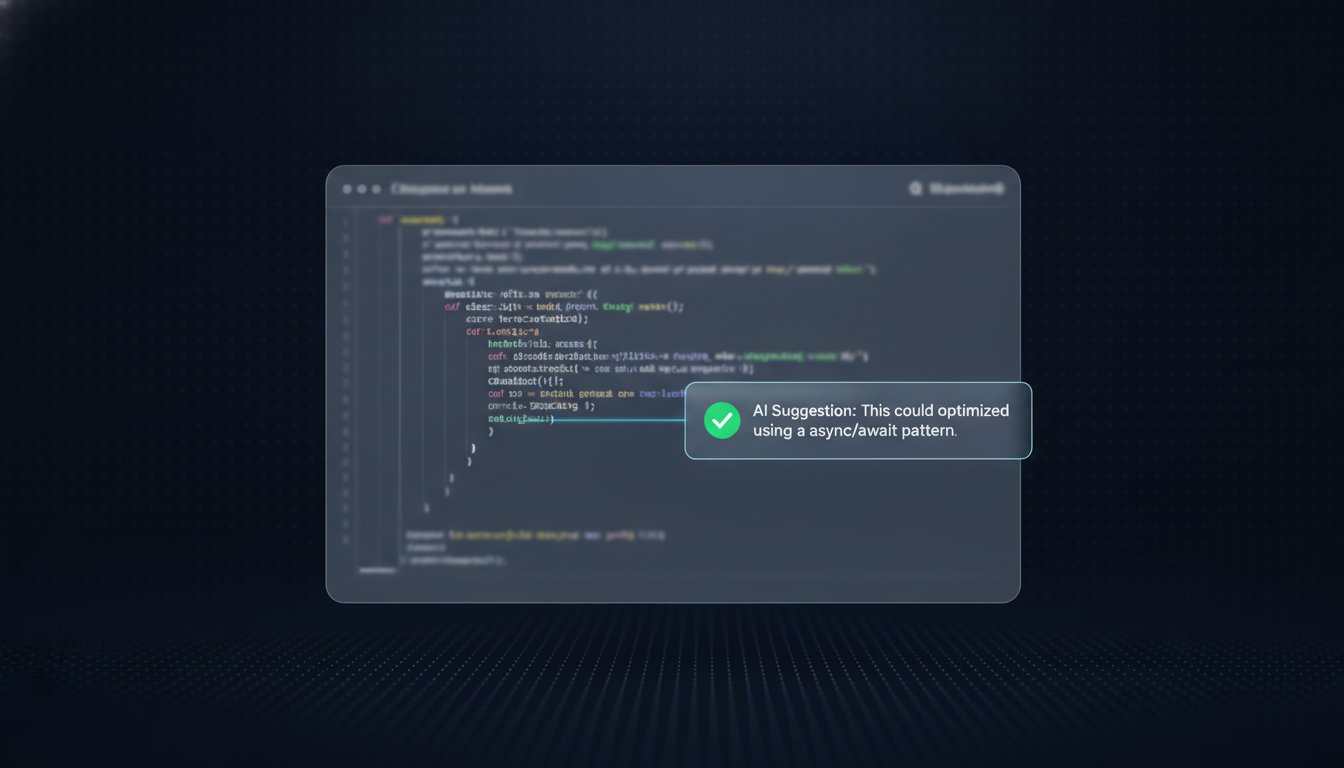
Successful implementation of a GitHub PR review assistant starts with a non-blocking configuration. Trust is your primary currency. If the assistant blocks a merge due to a hallucination on day one, your developers will ignore subsequent feedback. Start by running the assistant in a "comment-only" mode. This allows the team to observe the quality of suggestions without interrupting the deployment pipeline. As confidence grows, you can gradually increase the assistant's authority over specific quality gates.
Integrate the tool early in the lifecycle. The first push is the ideal time for an AI pass. Catching a resource leak minutes after the code is written is far more valuable than finding it three days later during a formal peer review. Regular audits are necessary. Review the AI's comment history every sprint to refine your custom instructions. This iterative approach ensures the assistant evolves alongside your codebase and maintains a high signal-to-noise ratio.
Setting Up Your AI Style Guide
AI requires specific context to be effective. Provide your GitHub PR review assistant with documentation regarding your preferred libraries and architectural patterns. Use "ignore" tags for generated code, minified assets, or third-party vendor directories. This prevents the assistant from wasting tokens on files that don't require human-style scrutiny. Establish a clear feedback loop. Encourage developers to interact with AI comments. This data helps you tune the underlying prompt to match your internal standards and reduces future friction.
Optimizing for Signal over Noise
Noise is the most common reason for AI tool abandonment. Configure your assistant to prioritize "Critical" and "Major" issues during high-velocity sprints. This prevents the discussion from getting bogged down in minor stylistic preferences. Use the assistant to generate concise PR summaries. These summaries help human reviewers understand the "what" and "why" before they dive into the code. When a developer disagrees with an AI suggestion, treat it as a signal. Use that disagreement to update your custom instructions. This ensures the same false positive doesn't recur in future reviews.
For teams seeking a pragmatic setup without per-seat complexity, try CodeMouse AI Code Review to implement these high-signal practices with a flat $10 monthly rate.
Why CodeMouse is the Pragmatic Choice for Teams
CodeMouse AI Code Review is built for teams that prioritize utility over marketing fluff. Most tools in the market force you into per-seat pricing models that scale poorly as your engineering team grows. We've taken a different approach. By charging a flat $10 monthly fee and requiring you to provide your own API keys, we ensure that your costs remain transparent and predictable. You pay for the infrastructure, and you pay for the intelligence you consume. No hidden markups. No usage throttling. This approach respects your budget and your intelligence.
This model provides total model autonomy. Whether you prefer Claude Sonnet for its logical reasoning or GPT-4o for its broad knowledge base, the choice is yours. You aren't locked into a single provider's roadmap. As soon as a new model is released, you can swap your key and benefit from the latest advancements immediately. It's the most scalable way to implement a GitHub PR review assistant without the friction of enterprise-tier negotiations. This flexibility allows you to optimize for specific languages or project requirements without switching platforms.
We designed this tool to be a silent partner. It doesn't demand a total overhaul of your habits. It integrates as a native GitHub App, appearing exactly where your developers already work. There are no external dashboards to monitor and no complex configuration files to maintain. You get high-signal feedback out of the box, allowing you to focus on shipping code rather than managing your tooling. If you're ready to test the workflow, we offer a 14-day free trial to verify the value in your own environment.
Implementing CodeMouse in 5 Minutes
The setup process is designed for speed. You don't need a complex onboarding call or a weeks-long proof of concept. The transition from installation to your first AI-assisted review happens in minutes:
- Install the GitHub App: Select the repositories where you want to automate quality checks.
- Add Your Keys: Input your Anthropic or OpenAI API keys to enable model access.
- Push Code: Receive context-aware feedback on your next push, delivered directly as PR comments.
The Future of AI Code Review
The industry is moving toward Automated Code Review in 2026: Moving Beyond Static Analysis to AI Consensus. CodeMouse facilitates this shift by allowing you to plug in the latest LLMs the moment they hit the API. This ensures your workflow is always backed by the best available intelligence. For teams looking to dive deeper into the technical architecture of these systems, check out AI Code Review for GitHub: Scaling Quality with Multi-Model Consensus. We provide the infrastructure and you provide the keys. It's a pragmatic, no-nonsense solution for the modern developer inner loop.
Ship Better Code with High-Signal Automation
The transition to an AI-assisted workflow is about reclaiming engineering time. You've seen how a GitHub PR review assistant acts as a first line of defense, filtering out boilerplate errors so your senior leads can focus on architecture. By prioritizing signal over noise and adopting a non-blocking integration strategy, you ensure that automation enhances team trust rather than creating friction. It's about moving from simple linting to semantic logic analysis that understands your codebase.
High-velocity teams require tools that scale without financial surprises. CodeMouse provides the infrastructure you need to deploy top-tier models like Claude and GPT across your entire organization. With a flat $10 monthly rate and no per-seat charges, you maintain complete control over your budget and your intelligence stack. It's a pragmatic solution for developers who value immediate utility over marketing overhead. No hidden markups. No usage throttling. Just direct, context-aware feedback on every push.
Ready to eliminate manual review fatigue and improve code quality? Start your 14-day free trial of CodeMouse today. Build a more resilient review process and get back to shipping.
Frequently Asked Questions
What is the best GitHub PR review assistant for small teams?
CodeMouse is the pragmatic choice for small teams. Its flat $10 monthly fee and Bring Your Own Key (BYOK) model eliminate the scaling friction found in traditional per-seat alternatives. Small teams gain access to high-tier models without the overhead of per-user billing or usage throttling.
How does an AI PR assistant differ from a standard linter?
Linters use static analysis to check for syntax and style violations based on predefined rules. A GitHub PR review assistant uses Large Language Models to perform semantic analysis. It understands code intent and logic flow. It identifies architectural flaws and resource leaks that static, regex-based tools frequently miss.
Can an AI assistant catch security vulnerabilities in my code?
Yes. AI assistants recognize common security anti-patterns like SQL injection, hardcoded credentials, and insecure dependency versions. While not a replacement for a dedicated security audit, they act as an immediate automated gate. They catch critical vulnerabilities during the initial PR pass before a human reviewer even opens the diff.
Is it safe to give an AI assistant access to my private GitHub repositories?
Safety depends on the tool's architecture. Professional assistants integrate as native GitHub Apps with scoped permissions. They don't store your source code permanently or use it to train public models. Using a BYOK model ensures your data interactions remain strictly between your environment and your chosen LLM provider.
How much does a GitHub PR review assistant typically cost?
Costs vary by pricing model. CodeMouse charges a flat $10 per month. Other platforms typically use per-seat models where costs scale with team size, which can become unpredictable as you add more developers. BYOK models are generally the most transparent because you pay only for the tokens you consume directly at the API level.
Can I use Claude 4.5 for my GitHub code reviews?
Yes. If you use a tool that supports Bring Your Own Key (BYOK), you can plug in any model supported by Anthropic or OpenAI. This allows you to leverage Claude 4.5 immediately upon its release. You aren't locked into a specific platform's model roadmap or forced to wait for their internal updates.
Does a PR assistant replace human code reviewers?
No. An AI assistant acts as a first line of defense. It handles boilerplate checks and trivial logic errors. This frees human reviewers to focus on high-level architecture and complex business logic. The human-in-the-loop model ensures final accountability and production approval remain with the developer.
What happens if the AI provides incorrect feedback on a pull request?
Developers should treat AI comments as suggestions, not mandates. If feedback is incorrect, you can ignore the comment or use custom instructions to refine future behavior. This feedback loop helps the assistant align with your specific style guide and reduces noise as the team continues to use the tool.