
How to Prevent Technical Debt: A Guide to Calculating Cost and Automating Quality
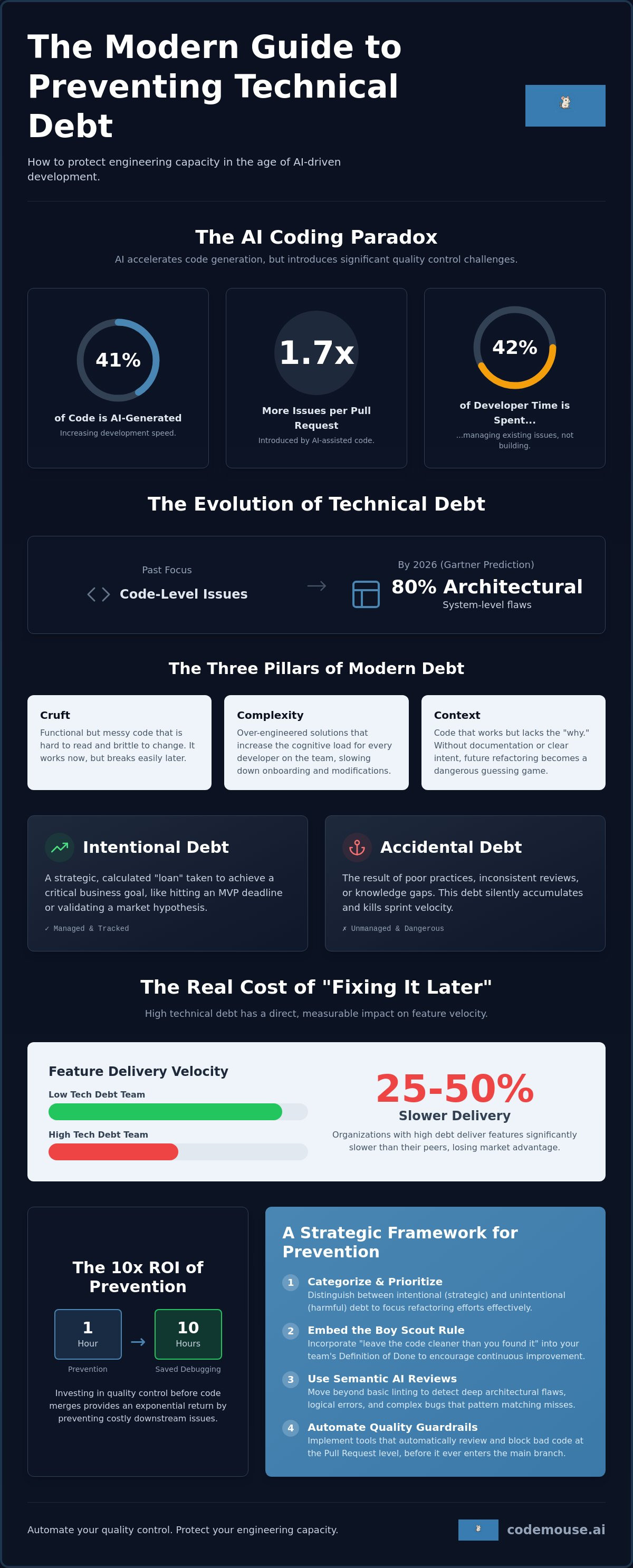
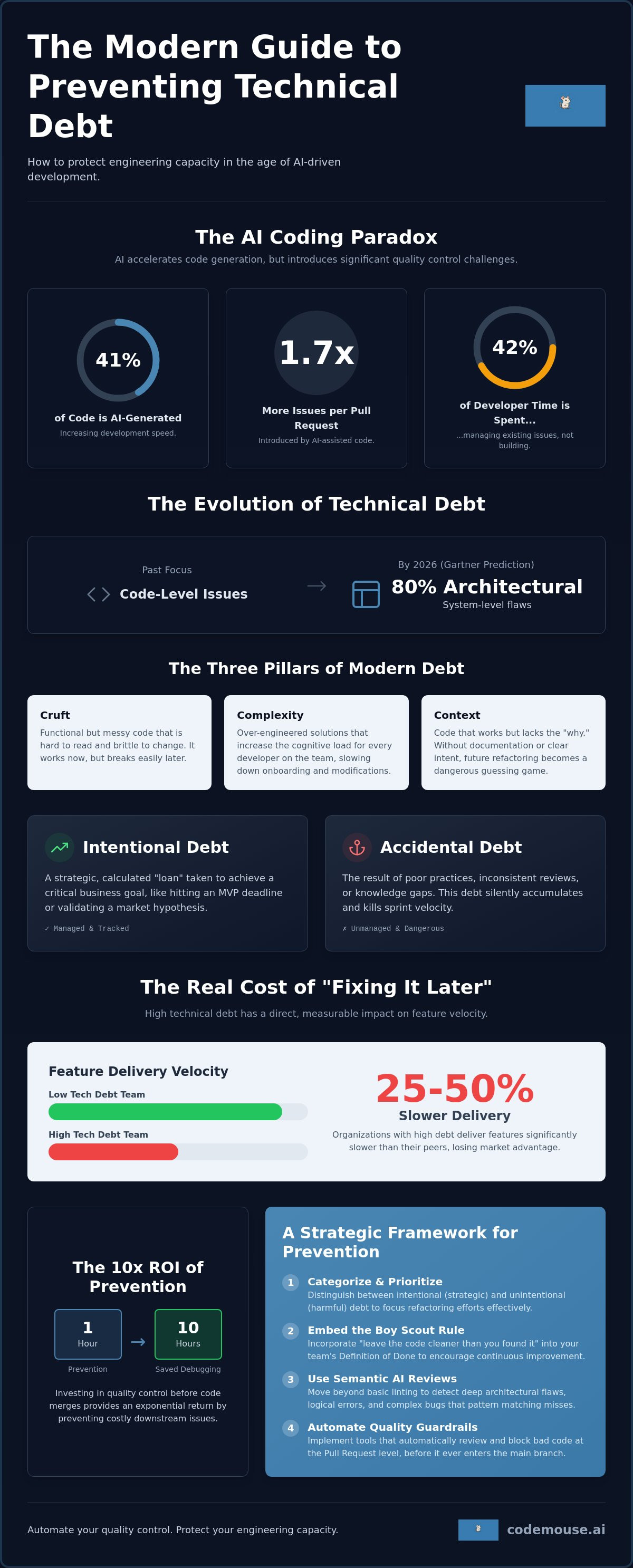
AI now generates roughly 41% of code, but it also creates 1.7 times more issues per pull request. Developers already spend up to 42% of their week managing existing issues. This cycle is the primary reason sprint velocity stalls. Understanding how to prevent technical debt is now the difference between a scaling product and a legacy burden.
You likely recognize the friction. It's the struggle to justify refactoring to stakeholders while bug regressions climb. You want a clean codebase. They want features. We agree that the "ship now, fix later" mentality eventually stops shipping altogether. It's a drain on resources and developer morale.
This guide provides a clear formula to quantify the financial impact of your debt. You'll learn how to implement multi-model AI guardrails that stop bad code before it merges. We'll show you a workflow that lowers maintenance overhead without sacrificing shipping speed. It's time to automate your quality control and protect your engineering capacity.
Key Takeaways
- Categorize debt as intentional speed-to-market or unintentional knowledge gaps to prioritize refactoring efforts.
- Use the "Interest" formula to calculate the exact ratio of maintenance overhead versus new feature development.
- Learn how to prevent technical debt by embedding the Boy Scout Rule into your team’s Definition of Done.
- Move beyond basic pattern matching with semantic AI reviews that detect deep architectural flaws.
- Implement automated guardrails via a flat-rate GitHub integration for unlimited, team-wide code reviews.
Table of Contents
Defining Technical Debt for 2026 Engineering Teams
Technical debt is a financial metaphor for the implied cost of future refactoring. It occurs when you choose an easy solution now instead of a better approach that takes longer. In 2026, engineering teams must view debt as a managed liability rather than just "bad code." If you want to understand what is technical debt in a modern context, you have to look at the friction between current implementation and future requirements.
Modern development cycles are faster than ever. AI tools now generate about 41% of code. This speed comes with a cost. Research shows AI-assisted development creates 1.7 times more issues per pull request. This isn't just about syntax. It's about architectural erosion. Gartner predicts that 80% of technical debt will be architectural by 2026. This shift from code-level to system-level problems makes it harder to fix later. Learning how to prevent technical debt requires a granular understanding of how these issues enter your codebase.
There is also the "Bit Rot" phenomenon. Code rots even if you don't touch it. External dependencies shift. Security standards evolve. APIs deprecate. A perfectly clean module today can become technical debt in six months because the ecosystem around it changed. You aren't just managing your own mistakes. You're managing the entropy of the entire stack.
The Three Pillars of Debt: Cruft, Complexity, and Context
Debt manifests in three specific ways. Cruft is functional but messy code. It's hard to read and brittle to change. Complexity refers to over-engineered solutions. These increase the cognitive load for every new developer on the team. Context is the most dangerous pillar. It represents code that works but lacks documentation for the "why" behind its implementation. Without context, future refactoring becomes a guessing game.
Intentional vs. Accidental Debt
Not all debt is a failure. Intentional debt is a strategic tool. You take it on to hit an MVP deadline or validate a market. It's a calculated loan. Accidental debt is the result of poor practices, inconsistent code reviews, or lack of knowledge. This is where teams lose velocity. To manage this, you must set a "Debt Ceiling." This is a hard limit on how much technical interest your team can afford to pay before feature work stops. Establishing these guardrails is essential for how to prevent technical debt from paralyzing your roadmap.
Calculating the Real Cost and ROI of Code Quality
Measuring debt is the only way to manage it effectively. Without concrete data, technical debt remains a vague engineering complaint that stakeholders ignore. To understand how to prevent technical debt, you must first calculate its drag on your team's output. This drag is your "Interest." A recent SEI study on technical debt highlights that identifying these costs is critical for the survival of large-scale systems. If you don't quantify the friction, you can't justify the fix.
The "Principal" is the estimated hours required to refactor a specific module. When you present this to non-technical stakeholders, focus on velocity loss. Data shows that organizations with high technical debt deliver features 25 to 50 percent slower than their peers. Framing the problem as a 50 percent reduction in shipping speed changes the conversation from "cleaning code" to "increasing revenue." It's about protecting the business roadmap, not just the codebase.
Essential Technical Debt Metrics
- Cycle Time: This tracks how long a PR stays open. High debt leads to endless architectural rework and long review cycles that stall deployments.
- Code Churn: This measures how often the same file is modified. Frequent changes to the same logic suggest instability and poor abstraction.
- Defect Density: This is the number of bugs per 1,000 lines of code. It's a direct indicator of whether your "fast" solutions are actually failing in production.
The ROI of Code Quality Calculation
Calculate the cost of your "debt interest" by multiplying developer hourly rates by the time spent on maintenance versus new features. Developers spend between 23 and 42 percent of their work week managing technical debt. If your team spends 40 hours a week on bug fixes and refactoring, that's thousands of dollars in lost feature development every month. Implementing automated AI code reviews reduces this interest by catching architectural flaws before they enter the main branch.
The ROI of code quality is the ratio of hours saved in maintenance to hours invested in prevention. Investing one hour in a thorough PR review often saves ten hours of downstream debugging. It's a simple trade-off. Spend a small amount on prevention now or pay a massive premium in maintenance later.
Strategic Frameworks for Debt Prevention
Most teams treat debt as a cleanup task. This approach is reactive and expensive. Strategic prevention requires you to embed quality directly into the development lifecycle. No ticket closes without meeting architectural requirements. You must hardcode these standards into your Definition of Done (DoD). It is about identifying and addressing technical debt before it reaches production. This proactive stance protects your sprint velocity from the start.
Adopt the Boy Scout Rule. Leave the code cleaner than you found it. Every PR should include minor refactoring of adjacent logic. This prevents the slow accumulation of cruft. To support this, use Architecture Decision Records (ADRs). ADRs document the "why" behind system design. They provide the context needed to avoid accidental complexity. Without ADRs, developers make assumptions that lead to inconsistent patterns. Consistent patterns are the foundation of how to prevent technical debt across distributed teams.
Balancing speed and quality is a management challenge. High velocity often leads to shortcuts. To counter this, schedule mandatory Quality Sprints. Research suggests allocating 10 to 30 percent of engineering capacity to debt reduction in each sprint. This isn't a "stop work" order. It's a maintenance interval that preserves long-term velocity. It stops the "interest" from compounding. If you ignore this, your feature delivery will eventually drop by 25 to 50 percent as discussed in earlier sections.
Standardizing the Pull Request Workflow
Large PRs hide bugs. Standardize on small, atomic PRs that focus on a single change. This makes debt easier to spot during review. Use PR templates to force developers to share context. Templates should ask about side effects and test coverage. Integrating automated code review as a non-negotiable CI/CD step is the most effective way for how to prevent technical debt at scale. It removes the human bottleneck from basic quality checks and provides instant feedback to the author.
Continuous Inspection vs. Periodic Audits
Quarterly debt cleanups usually fail. They can't keep up with the pace of modern growth. Continuous inspection is the only viable model. Use automated linting and static analysis for low-hanging issues like syntax or style. However, these tools often miss 80 percent of architectural debt. Real prevention comes from a Zero-Debt culture built on peer accountability. Every team member must be responsible for the health of the repository. Peer reviews should focus on logic and design while machines handle the formatting.
Automating Prevention with AI-Powered Code Reviews
Static analysis tools are necessary but insufficient. They excel at identifying syntax errors and style violations. They fail to detect architectural rot or logic flaws. Research shows these traditional tools miss 80 percent of architectural debt. To understand how to prevent technical debt in 2026, you must move from pattern matching to semantic understanding. Large Language Models (LLMs) analyze code intent rather than just structure. They catch the "hidden" complexity that manual reviewers often overlook under pressure.
Automating this process reduces review fatigue. Human reviewers are inconsistent. Their attention fades after the third pull request of the day. They might miss a brittle abstraction or a missing edge case. AI provides a 24/7 preventative guardrail. It handles the repetitive syntax and style checks. This allows your senior engineers to focus on high-level system design. It shifts the review process from a bottleneck to a continuous quality stream. It's the most scalable method for how to prevent technical debt as your codebase grows.
The AI Consensus Model: Claude and GPT
Multi-model consensus is the gold standard for automated quality. Different models have different strengths. Claude 3.5 Sonnet often identifies nuanced logic errors that other models miss. GPT-4o provides broad pattern recognition and industry-standard best practices. By running code through both, you create a feedback loop that minimizes false positives. Consensus logic flags an issue only when multiple models identify a risk. This ensures that developers aren't interrupted by "hallucinations" or trivial suggestions. It provides high-fidelity feedback that teams actually trust.
Step-by-Step: Automating Guardrails in GitHub
Implementing these guardrails is straightforward. First, configure a GitHub App to trigger reviews on every push. This provides immediate feedback before a PR is even opened. Second, set up automated comments to provide actionable suggestions directly in the diff. Finally, use AI code review for GitHub to block merges that exceed complexity thresholds. This creates a hard gate for quality. It ensures that no code enters the main branch without meeting your team's standards. Ready to stop debt at the source? Start your automated AI code reviews for a flat $10/month rate.
Implementing CodeMouse to Block Debt at the PR Level
Prevention must be frictionless to be effective. CodeMouse AI Code Review installs as a GitHub App in under five minutes. It doesn't require a total overhaul of your existing habits. It simply sits at the pull request level as a silent partner. This is the most direct method for how to prevent technical debt without slowing down your shipping cycle. It provides an immediate, 24/7 guardrail for every line of code your team writes.
The pricing model is built for scaling teams. CodeMouse offers a flat $10 per month rate. You bring your own API key from providers like Anthropic or OpenAI. This "Bring Your Own API Key" model gives you full control over your costs and model choices. You can leverage Claude 3.5 Sonnet for deep logic analysis or GPT-4o for broad best practices. Startups can achieve enterprise-level code quality without the burden of per-seat pricing or expensive senior reviewer overhead.
Context-Aware Feedback for GitHub PRs
Most automated tools are too narrow. They look at individual lines in isolation. CodeMouse analyzes the entire PR context. It understands how a change in one module affects the rest of the system. This allows it to detect logic flaws, security vulnerabilities, and maintenance risks that human reviewers might miss. Developers receive actionable refactoring suggestions directly in the PR thread. This instant feedback loop is essential for how to prevent technical debt before it ever reaches your main branch.
Reducing Manual Review Effort
Senior developers are often the biggest bottleneck in a sprint. They spend significant time on syntax, style, and basic logic checks. CodeMouse automates these repetitive tasks. It ensures consistent review quality regardless of team size or time zones. This frees up your senior talent to focus on high-level architecture and complex system design. It moves the review process from a manual chore to an automated quality gate. You can start a 14-day free trial to see the immediate impact on your cycle time and defect density metrics. It's a pragmatic step toward a zero-debt culture.
Ship Faster with Automated Quality
Technical debt is a financial liability. It compounds if ignored. You've seen the formula for calculating interest and the impact of architectural rot on velocity. Strategic prevention isn't about quarterly cleanups. It's about a workflow where quality is non-negotiable. Understanding how to prevent technical debt at the pull request level is now a competitive necessity for engineering teams.
Automation is the only way to scale this process. By utilizing multi-model consensus from Claude and GPT, you catch logic flaws that static analysis misses. This approach frees senior developers from repetitive syntax checks. It protects your codebase from entropy. You can implement these guardrails immediately without a total overhaul of your GitHub workflow. It's a pragmatic solution for teams that value both speed and stability.
Take control of your technical interest today. Start preventing technical debt with CodeMouse AI Code Review. Benefit from a flat $10/month subscription and context-aware feedback from Claude and GPT models. Your 14-day free trial is the first step toward a faster development cycle. Build better software today.
Frequently Asked Questions
What is the most effective way to measure technical debt?
Track your Technical Debt Ratio (TDR) alongside sprint velocity. TDR compares the cost of fixing the system to the cost of building it from scratch. You should also monitor the percentage of engineering hours spent on maintenance versus new feature development. This provides a concrete look at the "interest" your team pays every week.
Can AI really catch architectural technical debt?
Yes. Modern LLMs use semantic analysis to understand the intent and relationship between modules. Unlike static analysis, AI identifies brittle abstractions and violations of design principles like SOLID. By analyzing the entire pull request context, it spots deep logic flaws that lead to long-term maintenance burdens.
How do I convince my manager to prioritize refactoring over features?
Translate technical friction into business risk. Show the decline in shipping speed and the increase in bug regression rates over the last three months. Prove that ignoring debt now will reduce future shipping capacity by a specific percentage. Managers prioritize refactoring when they see it as a way to protect the roadmap.
Is all technical debt bad for a growing startup?
No. Intentional debt is a strategic tool for speed-to-market. It's a calculated loan taken to hit a critical deadline or validate a product. The danger is unintentional debt. This is caused by poor practices and lacks a clear repayment plan. Startups must distinguish between tactical shortcuts and systemic rot.
How does CodeMouse differ from standard static analysis tools?
Standard tools use rigid rulesets to check for formatting and syntax. CodeMouse uses multi-model AI consensus to analyze logic. It leverages Claude and GPT to understand the context of a change. This allows it to catch complex architectural issues that traditional linters completely miss.
What are the common signs that technical debt is becoming unmanageable?
Declining sprint velocity is the primary indicator. You may also notice high bug regression rates where fixing one issue breaks another. If developers are afraid to touch specific modules or if onboarding new hires takes weeks longer than expected, your debt has reached a critical level.
How much does it cost to automate code reviews with CodeMouse?
CodeMouse costs a flat $10 per month. You provide your own API key from providers like OpenAI or Anthropic. This "Bring Your Own API Key" model ensures you only pay for the processing you use while keeping the platform cost predictable for teams of any size.
What is the 'Boy Scout Rule' in software development?
The rule is simple: always leave the code cleaner than you found it. Every time a developer touches a file for a feature, they should perform a small refactor of adjacent logic. This is a primary strategy for how to prevent technical debt from accumulating through minor, continuous improvements.