The Guide to Affordable AI Code Review: Buying Without the Per-Seat Tax
Why are you paying a "growth tax" every time you hire a new developer? Traditional AI code review tools often punish team expansion with per-seat pricing that turns a growing headcount into a financial liability. You shouldn't have to choose between scaling your engineering team and maintaining a predictable budget. Most teams accept opaque credit systems and throttled feedback as the cost of doing business, but these limitations create bottlenecks during critical sprint cycles. It's time to stop paying for seats and start paying for utility.
Securing an affordable AI code review workflow doesn't mean settling for low-quality wrappers or shallow feedback. You can secure high-quality, automated PR feedback without the scaling costs associated with standard SaaS models. This guide demonstrates how to decouple orchestration from token costs to ensure your review process remains unthrottled and cost-effective. We will examine how a bring-your-own-key model allows you to leverage top-tier models like Claude and GPT for unlimited, high-context reviews under a predictable billing structure.
Key Takeaways
- Shift from per-seat SaaS to orchestration-only platforms to improve your value-per-PR ratio.
- Leverage the Bring Your Own Key (BYOK) model to decouple software fees from AI usage costs.
- Ensure tool quality by selecting platforms that ingest entire repository structures for high-context feedback.
- Compare the Total Cost of Ownership between flat-rate plans and traditional per-developer pricing models.
- Deploy an affordable AI code review system in minutes via GitHub App integration using your preferred API keys.
What Is Affordable AI Code Review in 2026?
In 2026, the definition of affordable AI code review has shifted. It is no longer about finding the lowest sticker price on a marketing page. True affordability is measured by the value-per-PR ratio. High-value tools provide deep context and catch architectural flaws rather than just flagging linting errors. Low-value tools might be cheap, but they generate noise that wastes developer time. You need a tool that enhances the workflow without adding cognitive load.
Modern teams are moving away from monolithic SaaS platforms. They prefer orchestration-only tools. These platforms manage the integration and logic but let you provide your own model keys. This transparency is critical. By separating orchestration fees from token costs, you eliminate the middleman markup. Traditional automated code review relied on static rules. Those rules were rigid and often missed the intent. LLM-driven feedback understands the logic. It reads the room and provides suggestions that actually matter to the codebase.
The Problem with Per-Seat Pricing
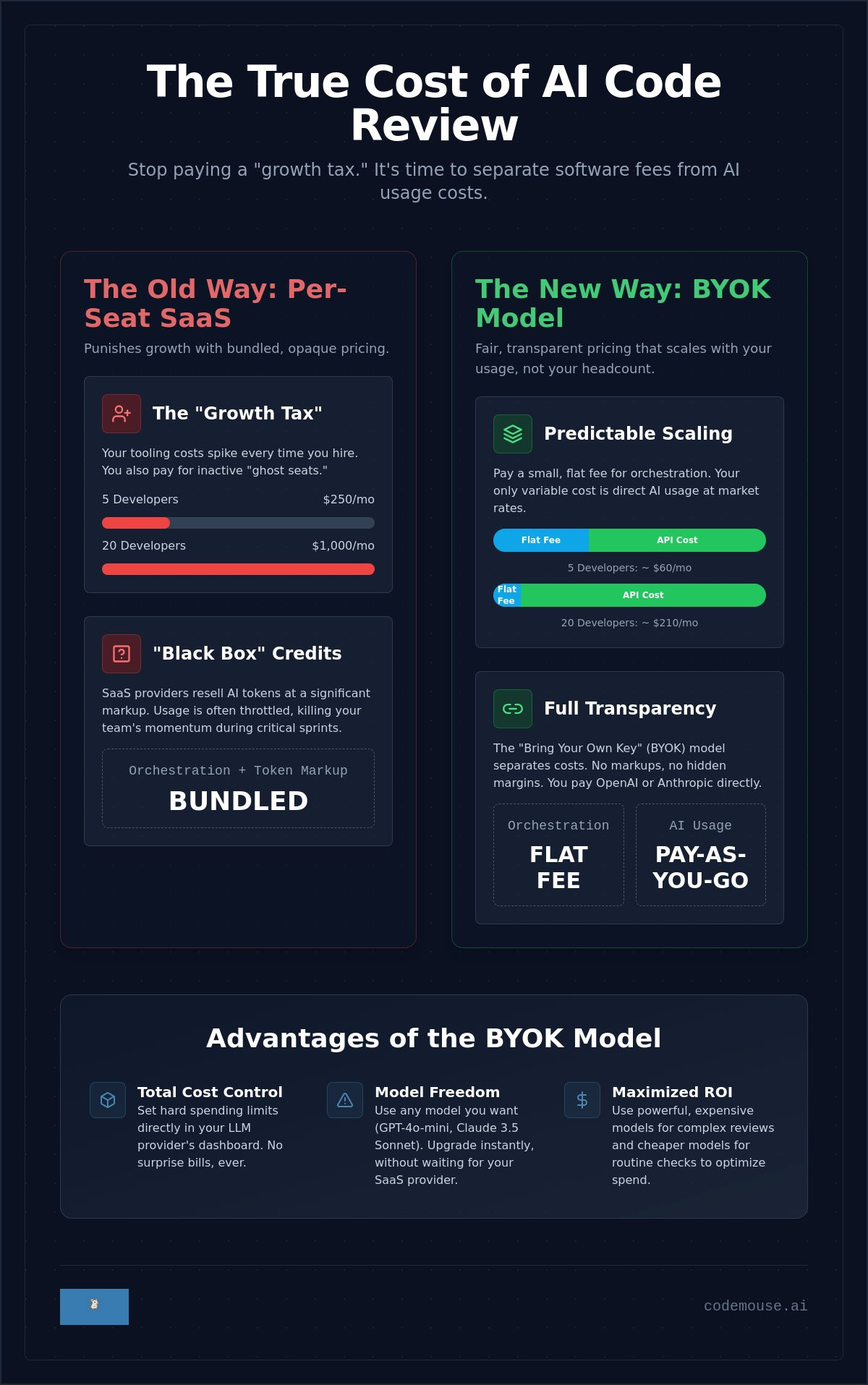
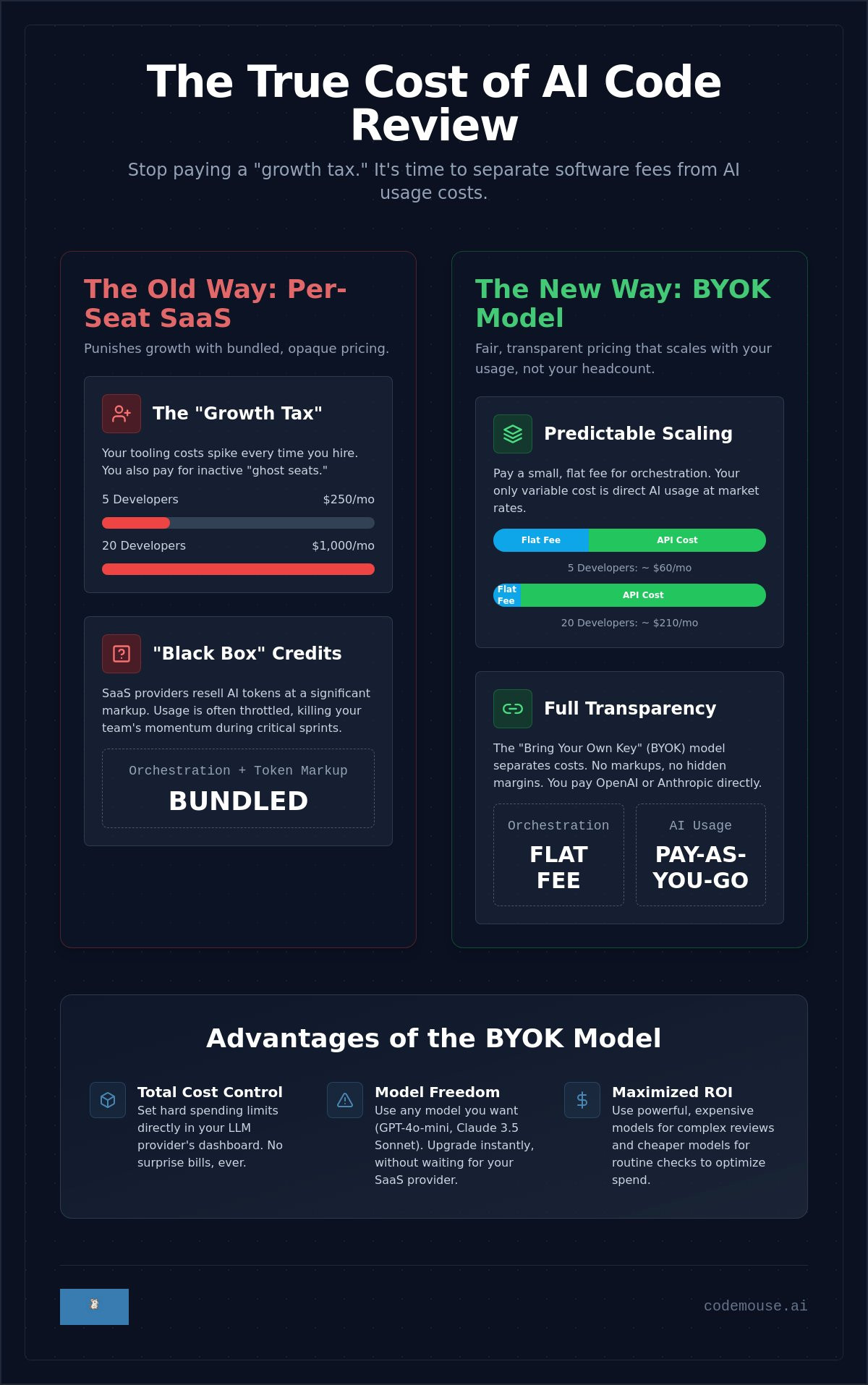
Per-seat models are a growth tax. When you hire a new engineer, your tooling costs shouldn't automatically spike. Many platforms charge for "Ghost Seats." These are users who are part of the organization but rarely push code. You pay for them anyway. This model also creates friction. If a designer or product manager needs to peek at a PR, you're often forced to pay for an extra seat just for visibility. It's inefficient. It punishes teams for being collaborative. Scaling a startup is hard enough without your tool stack fighting your budget.
This search for specialized, cost-effective software is a common trend across all departments; just as a design team might seek out the best alternatives to photoshop to avoid unnecessary overhead, engineering leaders are now prioritizing tools that offer flat-rate pricing and model flexibility.
Bundled Credits vs. Pay-As-You-Go
Bundled credits are a black box. SaaS providers buy tokens in bulk and resell them to you at a significant markup. You're paying for the convenience of a single bill, but the cost is often higher than direct API rates. Then there is the issue of limits. If your team hits a heavy sprint cycle, you might exhaust your "included" credits by mid-week. Throttling kills momentum. In 2026, developers want direct control. Using your own API keys for Claude or GPT means you pay exactly what you use. No markups. No artificial ceilings. You get high-tier models without the SaaS premium.
The BYOK (Bring Your Own Key) Model: The Ultimate Cost-Saver
The standard SaaS model is a black box. You pay a lump sum. The provider decides how much of that goes to actual AI tokens and how much they keep as profit. The "Bring Your Own Key" (BYOK) model breaks this cycle. It separates the orchestration fee from the raw compute cost. This transparency is the foundation of affordable AI code review in a market where token prices are constantly dropping. When you provide the API key, you pay the market rate. No middleman markup. No hidden margins on Anthropic or OpenAI tokens.
Flat-rate orchestration is the new benchmark. A $10 monthly fee covers the infrastructure, the GitHub integration, and the logic. Your actual usage is billed directly by your LLM provider. This allows for granular control. You can see exactly what a specific PR cost to review. Most developers find that direct API billing is significantly cheaper than bundled plans. You aren't subsidizing the heavy usage of other customers. You only pay for your own code.
How CodeMouse Implements BYOK
Security is handled at the integration level. You provide your API keys through the GitHub App. These keys are used exclusively to process your pull requests. You maintain full sovereignty over your data and your spending. You can set hard spend limits directly in your OpenAI or Anthropic dashboards. If you hit a limit, the system stops. There are no surprise bills. It is a lean orchestration layer. It doesn't try to be a bloated project management suite. It just reviews code. You can start a free trial to see how this lean approach integrates with your existing workflow.
Leveraging Tiered LLM Pricing
Not every PR requires a high-reasoning model. Small documentation changes or minor bug fixes don't need the most expensive compute. With BYOK, you choose the model for the job. Use GPT-4o-mini for routine checks to keep costs near zero. Reserve Claude 3.5 Sonnet for complex logic shifts or architectural changes. This tiered approach maximizes your ROI. You get the best performance where it counts without overpaying for simple tasks. Because you own the key, you can upgrade to the latest models instantly without waiting for a SaaS provider to update their backend.
Performance vs. Price: Ensuring Quality in Low-Cost Tools
Low cost often triggers skepticism among engineers. In the software world, "cheap" usually implies a lack of depth. For AI tools, the "cheap wrapper" myth suggests that any tool not charging enterprise rates is just a basic API call. This is incorrect. The value of an affordable AI code review tool lies in its orchestration logic, not just the model it uses. High-tier models are now a commodity. The real differentiator is context. High-quality tools ingest the entire repository structure. They provide the LLM with the necessary context to understand cross-file dependencies and business logic. A basic wrapper sees one file; a professional tool sees the whole system. To better evaluate these types of software services, you can learn more about SuggestMeTech for in-depth comparisons and reviews.
Traditional enterprise tools often rely on a single, proprietary model. This creates a single point of failure for reasoning. If that model has a bias or a specific hallucination, the review fails. Using a multi-model approach ensures that feedback is verified across different architectures. This is the core of modern quality control. You can read more about AI Code Review for GitHub: Scaling Quality with Multi-Model Consensus to understand how this reduces false positives and improves reliability.
The Power of Multi-Model Consensus
Hallucinations are the primary enemy of automated reviews. By comparing feedback from Claude and GPT, orchestration layers can filter out conflicting or illogical suggestions. If both models identify the same potential memory leak, the confidence score is high. If only one flags a minor style preference, the tool can suppress it. This consensus-based logic catches edge-case bugs that single-model enterprise tools often miss. CodeMouse uses this multi-model orchestration to verify every claim before it hits your PR. It turns raw compute into verified intelligence.
Reducing Noise Without Increasing Price
Developers hate noise. Automated tools that flag every missing semicolon are a distraction. Modern AI reviewers focus on architectural flaws and logic errors. They filter out nitpicks by analyzing the signal-to-noise ratio of previous reviews. This is achieved through sophisticated prompting and post-processing. You can also use custom instructions. This allows the AI to follow your team's specific style guide or security protocols. You get tailored feedback without the overhead of manual configuration. This approach keeps the process lean. It ensures that the feedback you receive is actionable and relevant to your specific codebase, maintaining high quality at a lower price point.
Calculating Your ROI: Per-Seat vs. Flat-Rate Pricing
Understanding the Total Cost of Ownership (TCO) for engineering tools requires looking past the initial subscription. Most SaaS vendors hide high margins inside "bundled" token costs. They charge a premium for the convenience of a single bill. An affordable AI code review strategy focuses on decoupling these costs. You need to account for the base platform fee, the raw token usage, and the saved engineering hours. When you control the API key, your TCO drops as token prices decrease. This is the opposite of traditional SaaS, where prices only move upward.
The math changes quickly at scale. Consider a 10-person team. On a standard $30 per-seat plan, you pay $300 every month regardless of activity. With a $10 flat-rate orchestration model, your fixed costs are 96% lower. Even with heavy token usage on high-reasoning models, the total spend rarely approaches the per-seat benchmark. This model shifts the focus from "how many people do we have?" to "how much code are we actually reviewing?". You can explore the technical shift behind this in our guide on Automated Code Review in 2026: Moving Beyond Static Analysis to AI Consensus.
The 12-Month Cost Projection
Cost gaps widen as teams grow. A startup scaling from 5 to 25 developers faces a 5x increase in tooling costs under per-seat models. Flat-rate pricing stays constant. This is vital for microservice architectures where developers might contribute to dozens of different repositories. You shouldn't be penalized for modular code. Flat-rate pricing eliminates the need for budget approvals every time a new intern joins the team. You simply add the user and keep shipping. It removes the administrative friction from engineering growth.
Beyond the Subscription: Time Savings
Subscription costs are only one variable. The real ROI comes from reduced PR cycle times. Automated first-pass reviews act as a force multiplier for senior engineers. They stop spending time on syntax, linting, and basic logic errors. This allows them to focus on high-level architecture and security. Catching a production-breaking bug in the PR stage is worth thousands in avoided downtime. By using an orchestration layer that leverages multi-model consensus, you increase the probability of catching these edge cases without increasing your monthly overhead. It's about maximizing the signal while minimizing the cost.
Ready to stop paying the per-seat tax? Get started with CodeMouse today and secure unlimited reviews for a flat monthly fee.
Getting Started with Affordable AI Review: The CodeMouse Workflow
Onboarding shouldn't require an enterprise sales call or hours of complex configuration. You can deploy an affordable AI code review system in five minutes. Integration starts with the GitHub App. It connects directly to your repositories with granular permissions. It only reads what is necessary to process your pull requests. Once installed, you provide your own API keys for models like Claude 3.5 Sonnet or GPT-4o. This is a one-time setup. It unlocks unlimited potential for your PR workflow. You maintain absolute control over the keys and the spend. There are no hidden configuration files to manage before you see results.
The 14-day free trial is your benchmarking period. Use this time to compare AI feedback against your current manual process. Track how many minor issues the AI catches before a senior developer even opens the PR. You can also customize the review persona. This ensures the AI understands your team's specific coding standards. It doesn't just guess; it follows your logic. You can instruct the AI to be pedantic about security or concise with style suggestions. You get tailored feedback that matches your internal style guide from the very first commit.
Optimizing Your First Review
The initial scan sets the tone for your workflow. Provide the AI with clear repository context for better results. Don't just point it at a single isolated file. Let the system analyze the project structure. This enables the LLM to understand imports, shared utilities, and cross-file dependencies. Context is the difference between a helpful suggestion and a generic hallucination. You should test the consensus logic immediately. Point the tool at a known bug in a draft PR. Observe how it compares feedback from different models to isolate the issue. This verification process proves the tool's utility before it becomes a permanent part of your production branch.
Scaling to the Whole Organisation
Engineering growth doesn't have to change your bill. You can add multiple repositories without increasing your $10 monthly fee. This remains true whether you have five microservices or five hundred. It is the core advantage of the flat-rate model over per-seat competitors. Managing team access is straightforward. You can rotate API keys as needed to maintain high security standards. The system stays lean even as your codebase expands. It functions as a silent partner in your CI/CD pipeline. You focus on shipping code; the orchestration layer handles the review quality. Start your 14-day free trial of CodeMouse to eliminate the per-seat tax today.
Scale Your Engineering Without the Growth Tax
Decoupling AI orchestration from token costs is the only sustainable way to scale. You've seen how the BYOK model eliminates middleman markups. You know that multi-model consensus ensures high-quality feedback without the enterprise price tag. It's about moving from a per-seat liability to a flat-rate utility. This approach gives you the flexibility to use the best models for the job without being locked into a single provider's margin.
Implementing an affordable AI code review workflow shouldn't be a bureaucratic hurdle. It's a five-minute integration that respects your budget and your team's autonomy. You keep your keys. You keep your context. You stop paying for "ghost seats" and start paying for actual code quality. This shift allows your senior engineers to focus on architecture while the AI handles the first-pass logic checks across every repository in your organization.
Get Started with CodeMouse for $10/month to experience a 14-day free trial. There are no per-seat charges ever. It works seamlessly with your own Claude and GPT keys. Build faster, maintain predictability, and ship cleaner code today.
Frequently Asked Questions
Is it really only $10 a month for the whole team?
Yes. CodeMouse charges a flat monthly fee for your entire GitHub organization. There are no per-seat charges or hidden user tiers. This makes it a truly affordable AI code review solution for growing teams. You pay for the orchestration infrastructure, not the number of developers on your payroll. One subscription covers everyone in your organization.
How much will I spend on AI API keys (OpenAI/Anthropic) per month?
API costs vary based on your pull request volume and the models you select. Using GPT-4o-mini for routine reviews keeps costs extremely low, often pennies per PR. High-reasoning models like Claude 3.5 Sonnet cost more but provide deeper architectural analysis. You pay the raw API rate directly to the provider with zero markup from CodeMouse.
Does CodeMouse support private GitHub repositories?
Yes. CodeMouse is built specifically for GitHub and supports both public and private repositories. You grant access through the GitHub App interface. It integrates directly into your existing PR workflow to provide automated feedback on every commit, regardless of repository visibility. This ensures private intellectual property is reviewed with the same rigor as open-source code.
Can I choose which AI model reviews my code?
You have full control over model selection. Because you provide your own API keys, you can toggle between Anthropic's Claude and OpenAI's GPT models. This allows you to prioritize speed, reasoning depth, or cost-efficiency depending on the specific requirements of your project or the complexity of the code being reviewed at any given time.
Is my source code stored or used to train AI models?
CodeMouse does not store your source code or use it for training purposes. The code is processed in memory to generate the review and then discarded. Additionally, major LLM providers like OpenAI and Anthropic do not train their models on data submitted through their professional API tiers. Your intellectual property remains secure and private.
What happens if I forget to set a spending limit on my API key?
Spending management happens at the provider level. You should set hard monthly limits within your OpenAI or Anthropic dashboards to prevent unexpected costs. If your API key hits its limit or expires, CodeMouse will simply stop processing reviews until the key is updated or the limit is increased. There are no surprise bills from the orchestration layer.
How does CodeMouse compare to GitHub Copilot’s built-in review?
GitHub Copilot is a bundled tool focused on individual developer assistance. CodeMouse is a dedicated orchestration layer that uses multi-model consensus to verify feedback. By comparing insights from different LLMs, it reduces hallucinations and provides more context-aware suggestions than a single-model system. It's a specialized tool for teams seeking an affordable AI code review alternative with higher precision.
Do I need a separate subscription for every repository?
No. Your flat monthly subscription covers your entire organization across unlimited repositories. You can add new microservices or legacy projects without increasing your base cost. This encourages comprehensive coverage across your entire codebase rather than forcing you to choose which projects deserve automated oversight based on budget constraints.