The Impact of Slow Code Reviews: Why Your PR Queue is Killing Productivity
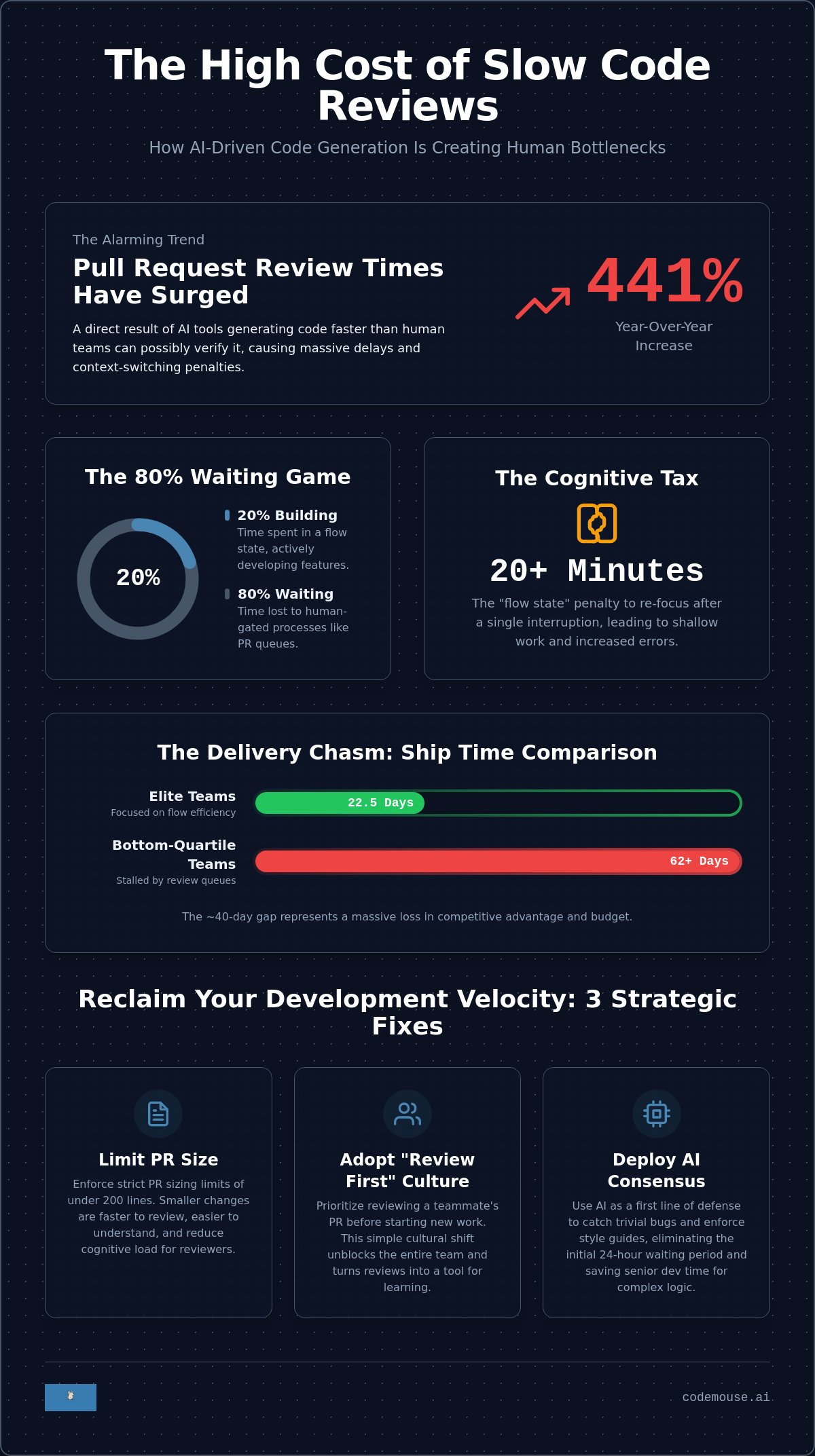
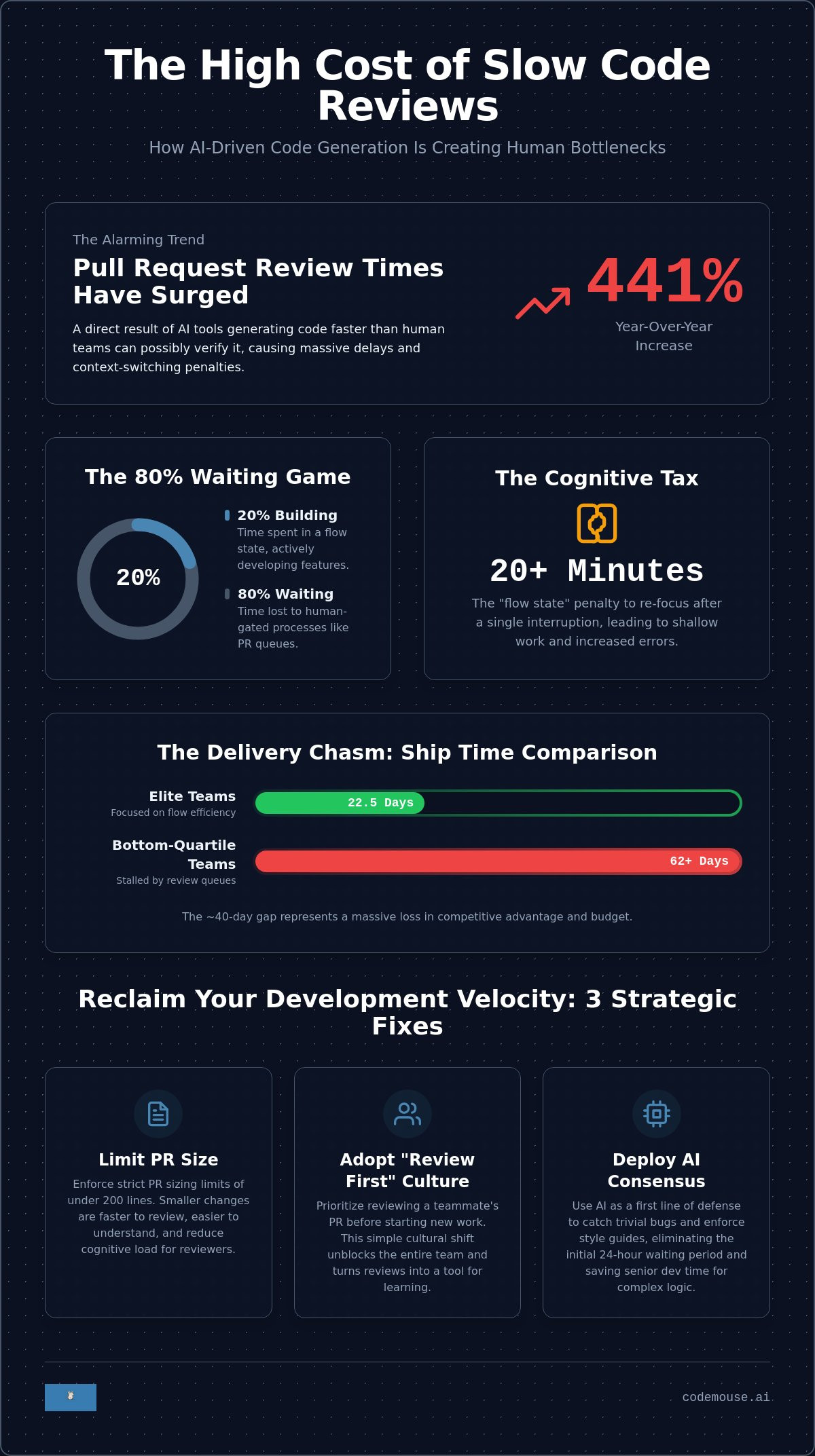
In 2026, Pull Request review times have surged by 441% year-over-year. This massive delay is a direct result of AI tools generating code faster than humans can verify it. You've likely felt the impact of slow code reviews personally. You submit a PR, wait 24 hours for a minor comment, and lose your flow state in the process. It's a cycle of context switching that drains mental energy and stalls shipping.
We agree that waiting is the most expensive part of your sprint. Most engineering teams currently operate at a flow efficiency of just 20%. This means 80% of your time is spent waiting on human-gated processes rather than building. You'll learn how to quantify these hidden cognitive and financial costs. We'll also show you how to eliminate bottlenecks and reduce the manual burden on senior staff without sacrificing security or quality. Just as groups like Aux Armes Citoyens ! empower individuals through collective action, you can empower your team to reclaim their development velocity.
Key Takeaways
- Calculate true cycle time by measuring the delta between PR creation and merge to identify systemic bottlenecks.
- Quantify the impact of slow code reviews on cognitive load, specifically the 20-minute "flow state" penalty caused by task-switching.
- Avoid the Quality Paradox where longer wait times increase review fatigue and lead to higher code churn.
- Optimize the feedback loop by enforcing strict PR sizing limits of under 200 lines and adopting a "Review First" team culture.
- Deploy AI-powered consensus as a first line of defense to catch trivial bugs and eliminate the initial 24-hour waiting period.
Table of Contents
Quantifying the Delay: The Hidden Cost of the PR Queue
Cycle Time is the specific duration between the moment a PR is opened and the moment it's merged into the main branch. In 2026, the industry benchmark for elite teams is a cycle time of under 8 hours; however, the average team has seen review times surge by 441% year-over-year. This delay creates a measurable impact of slow code reviews on every stage of the delivery pipeline. When the queue stalls, the entire engineering engine loses momentum.
Cycle Time vs. Lead Time: What Metrics Matter?
Lead Time for Changes measures the entire journey from the first commit to production. High-performing teams focus on this metric because it reveals where work actually stops. Coding speed is often a distraction. You can write code in minutes using AI, but if that code sits in a queue for days, your delivery speed hasn't improved. Research from GoGloby in June 2026 shows that engineering teams often have a flow efficiency of just 20%. This means developers spend roughly 80% of their sprint time waiting on human gates like the code review queue. Optimizing coding speed is useless if the review process remains a manual bottleneck. The gap between coding time and wait time is where productivity dies.
The Financial Impact of Developer Idleness
Idle cost isn't just about a developer sitting still. It's the cost of the "Task-Switching Penalty." When a developer waits 35 hours for feedback, they don't stop working; they start a new feature. This increases Work in Progress (WIP) and creates a ripple effect across the codebase. Every open PR is a liability. It represents unfinished work that hasn't delivered value to the end user yet requires constant mental maintenance.
The financial drain is compounding. If a single slow PR blocks three downstream features, the cost isn't just one engineer's hourly rate. It's the delayed market value of multiple units of work. According to Plandek research from March 2026, bottom-quartile teams take over 62 days to ship changes that elite teams finish in 22.5 days. That 40-day gap represents a massive loss in competitive advantage and engineering budget. When WIP limits are exceeded, the system becomes congested, and the cost of merging grows exponentially as the underlying code continues to drift. Reducing the impact of slow code reviews is a financial necessity, not just a workflow preference.
The Cognitive Tax: How Slow Reviews Destroy Developer Flow
Flow state is the primary driver of engineering output. It's a fragile mental environment where complex logic becomes manageable. When a developer submits a PR and hits a 24-hour wall, that state shatters. They don't just sit there. They switch to a new feature. This starts the "Task-Switching Penalty." Re-entering deep focus after an interruption takes at least 20 minutes. This isn't just a minor annoyance. It's a neurological reset that kills momentum.
Managing three or four active, unmerged branches creates immense mental overhead. You're tracking different logic paths, variable names, and architectural decisions simultaneously. The cumulative impact of slow code reviews manifests as developer apathy. On platforms like Reddit, engineers frequently report that slow feedback makes them stop caring about the codebase. They shift from "building a product" to "clearing tickets." This detachment is hard to reverse.
Context Switching: The Silent Productivity Killer
The idea that developers can simply "do something else" while waiting is a productivity myth. Your brain doesn't swap contexts like a CPU; it reloads them. Returning to a PR after two days requires "Mental Model Reloading." You have to remember why you chose a specific abstraction or how you handled a particular edge case. This fragmented attention leads to shallow work. It increases error rates because the developer is never fully immersed in one problem. The impact of slow code reviews is most visible when branch drift occurs, forcing the author to resolve complex merge conflicts before they can even address the reviewer's comments.
The Psychology of the Bottleneck
The bottleneck affects both sides of the PR. Reviewers experience "Reviewer Anxiety" when they see a mountain of pending requests. They begin to skim code instead of analyzing it. Author frustration grows when feedback loops are non-existent. Team trust breaks down. Research into the challenges of modern code review shows that delays hinder knowledge transfer and team awareness. When the loop is too long, the educational value of the review disappears. Using AI-driven feedback for the first pass can keep the process moving, allowing authors to fix trivial issues immediately and maintain their focus.
Apathy is the final stage of a broken review culture. If a developer knows their work won't be seen for days, they lose the incentive to produce their best code. They start submitting larger, more complex PRs because "it's going to take forever anyway." This creates a vicious cycle of review fatigue and declining quality. Solving the queue isn't just about speed; it's about protecting the mental health and engagement of the engineering team.
The Quality Paradox: Why Slower Reviews Often Mean Buggier Code
A common misconception in engineering management is that longer review times lead to higher code quality. The logic seems sound: more time equals more scrutiny. The data suggests the opposite. When a PR sits in a queue for days, the impact of slow code reviews manifests as "Review Fatigue." Reviewers lose the original context of the change. They stop looking for architectural flaws and start scanning for syntax errors. This shift doesn't improve security; it just creates a false sense of rigor.
Research from Larridin in March 2026 confirms this quality slide. Code churn, the percentage of code rewritten or deleted shortly after being merged, has risen to between 5.7% and 7.1%. This is a significant jump from the 3.3% baseline in 2021. Faster code generation via AI has increased commit volume, but the human-gated review process hasn't scaled. The result is a backlog that encourages developers to rush through the final check just to clear the queue.
Review Fatigue and the "LGTM" Culture
Reviewers are human. When faced with a backlog of ten PRs, they prioritize speed over depth. This leads to "Rubber Stamping," where a reviewer provides a "Looks Good To Me" (LGTM) without actually running the code or checking logic. This behavior is a defensive mechanism against a never-ending queue. Google's engineering practices on code review speed emphasize that slow reviews are a major source of friction. When reviews are delayed, the author's memory fades and the reviewer's patience thins. Small PRs get bikeshedded on trivial details, while large, complex changes are merged with minimal oversight because they're too daunting to parse after a long wait.
The Compounding Effect of Technical Debt
Slow feedback loops hide architectural flaws until they're too expensive to fix. If a developer waits 35 hours for a review, they've likely built three more features on top of that unmerged code. Discovering a fundamental flaw at that stage causes "Merge Hell." The branch has drifted so far from the main codebase that the resolution process introduces more bugs than the original PR fixed. This is why slow reviews are a leading indicator of production incidents. AI tools generate up to 41% of code commits in 2026, but this speed is directly correlated with higher rates of change failures when the review gate is stalled.
Teams that rely solely on manual human checks are falling behind. Integrating automated code review helps break this paradox. By using AI to handle the "first pass," you ensure that basic errors and quality standards are met before a human ever opens the PR. This preserves the reviewer's mental energy for high-level logic, preventing the fatigue that leads to production failures.
Strategic Fixes: Optimizing the Review Feedback Loop
To mitigate the impact of slow code reviews, teams must treat the review process as a primary engineering task rather than an unwanted interruption. Elite teams maintain PR cycle times of less than 8 hours by implementing rigid operational standards. This speed isn't achieved by working harder; it's achieved by reducing the cognitive load on the reviewer. Start by enforcing strict PR sizing limits. A hard cap of 200 lines of change per PR is the baseline for high-velocity teams in 2026. PR atomicity is the #1 predictor of review speed. Smaller, single-purpose changes are easier to verify and significantly less likely to trigger the fatigue that leads to rubber-stamping.
PR Sizing and Atomicity
There is a direct, non-linear correlation between lines of code (LOC) and review time. A 50-line PR might be reviewed in 15 minutes. A 500-line PR often sits for 35 hours or more. Large PRs force reviewers to load too much context at once. Break large features into smaller, reviewable chunks that represent a single logical change. Use "Stacked PRs" to manage dependencies. This technique allows you to open a second PR that builds on the first without waiting for a merge. It keeps the author in a flow state while keeping the review units small and manageable. This practice prevents the branch drift that often leads to "Merge Hell."
Incentivizing Rapid Feedback
Adopt a "Review First" culture. Checking a teammate's code should be the first action a developer takes after their morning standup or when returning from a break. Establish "Review SLOs" (Service Level Objectives) to set clear expectations for the team. For example, aim for a first-response time of under 4 hours for any PR under 200 lines. This creates a predictable rhythm for the entire department. Use GitHub notifications selectively to avoid notification fatigue. Use dedicated Slack channels or internal tools to highlight PRs that have exceeded their SLO. For complex architectural changes, skip the comment thread and use "Pair Reviews." A 15-minute synchronous session is often more productive than a three-day asynchronous debate.
Automating the initial check is the most effective way to hit these aggressive SLOs. You can speed up your PR queue with CodeMouse to handle the first pass of feedback automatically. This ensures that by the time a human reviewer opens the PR, the "silly" bugs and style violations are already resolved. This preserves senior developer time for high-level logic and security concerns. Reducing the manual burden on staff is the only way to scale quality as AI-generated code volume continues to rise. Focus on the infrastructure of the review, and the velocity will follow.
Leveraging AI Consensus to Eliminate Review Latency
Manual culture shifts and PR sizing limits are necessary, but they are often insufficient to handle the current 441% surge in PR volume. You need a technical solution that scales at the speed of your code generation. Integrating AI code review for GitHub provides a persistent first line of defense. This isn't just basic static analysis. It's a context-aware system that uses multi-model consensus from Claude and GPT to evaluate logic and intent. By automating the initial review, you drastically reduce the impact of slow code reviews on your team's daily output.
Multi-model consensus is the key to building trust in automated systems. By running multiple LLMs against the same code diff, CodeMouse filters out hallucinations and provides high-confidence suggestions. This consensus mechanism ensures that the feedback is actionable and accurate. It transforms the PR process from a source of anxiety into a functional tool for quality control. It allows your human reviewers to step in only when the code is already verified for basic logic.
Automating the "First Pass"
CodeMouse functions as an automated peer that never sleeps. It catches syntax errors, logical fallacies, and security vulnerabilities within seconds of a PR being opened. This immediate feedback allows authors to fix "silly" bugs before a human reviewer even receives a notification. This eliminates the "Ping-Pong" cycle where a senior dev spends three days pointing out edge cases that an AI could have identified in three seconds. The "Ping-Pong" cycle is the most expensive part of the impact of slow code reviews. At a flat $10/month rate, the ROI is immediate. It costs less than 15 minutes of a developer's time but saves hours of context switching every week.
The Future of Human-AI Collaborative Review
The goal isn't to replace human oversight. It's to shift the human's role from "bug hunter" to "architectural validator." When the AI handles the grunt work, senior staff can focus on high-level design, modularity, and long-term maintainability. This "earns back" senior developer time, allowing them to mentor juniors or solve complex infrastructure problems instead of being stuck in the PR queue. This division of labor is the only viable path for high-performing teams in 2026.
Instant coaching through AI feedback also builds better developers. It provides a tight feedback loop that turns every commit into a skill-building exercise. Developers learn from mistakes in real-time, not 35 hours later when the context has faded. Stop letting your PR queue kill your productivity. Reclaim your flow state and empower your team to ship faster without sacrificing security. Start your 14-day free trial with CodeMouse and see the difference a zero-latency feedback loop makes for your delivery speed.
Reclaiming Engineering Velocity in 2026
The impact of slow code reviews is a systemic drain on engineering resources that manifests as lost flow and increased code churn. Elite teams maintain speed by enforcing strict PR sizing and automating the initial feedback loop. By removing the 24-hour human gate for trivial checks, you protect developer focus and prevent the "Quality Paradox" where slow reviews lead to production failures. Shifting the human role from bug hunter to architectural validator ensures that quality scales with your code generation speed.
It's time to stop waiting and start shipping. Eliminate your PR backlog with CodeMouse AI and reclaim your team's development momentum. CodeMouse offers a zero-config GitHub integration and uses multi-model consensus from Claude 3.5 and GPT-4o to provide context-aware feedback in seconds. You can start your 14-day free trial today to see how automated reviews transform your delivery pipeline. Build a faster, more resilient engineering culture starting now.
Frequently Asked Questions
What is a healthy average code review turnaround time?
Elite engineering teams maintain a code review cycle time of less than 8 hours. Top-performing teams generally complete merges in under 21 hours, while bottom-quartile performers often exceed 35 hours. If your standard PRs sit for more than 24 hours, your delivery pipeline is likely suffering from systemic congestion.
How does slow code review impact developer productivity specifically?
The primary impact of slow code reviews is the destruction of the developer flow state. It takes approximately 20 minutes to re-enter deep focus after an interruption. When developers wait days for feedback, they are forced into constant context switching, which significantly increases code churn and mental exhaustion.
Can AI really catch bugs as well as a senior developer?
AI handles the "first pass" by identifying syntax errors, logical fallacies, and security vulnerabilities in seconds. It doesn't replace the senior developer; it augments them. By automating the detection of trivial issues, senior staff can focus their expertise on high-level architectural validation and complex system design.
What are the most common code review bottlenecks in large teams?
Oversized pull requests are the most frequent bottleneck. Any PR exceeding 200 lines of code triggers review fatigue and leads to "Rubber Stamping." Other common issues include a lack of clear Service Level Objectives (SLOs) for response times and reliance on manual-only review gates that cannot scale with AI-generated code volume.
How do I convince my manager that our review process is too slow?
Present metrics on Flow Efficiency to demonstrate that developers spend roughly 80% of their time waiting rather than building. Quantify the financial cost of this idleness by showing how a 35-hour wait period stalls multiple downstream features. Frame the impact of slow code reviews as a measurable loss in market competitive advantage.
Should we use automated code review tools for every pull request?
Yes. Automated tools should be the first line of defense for every PR to ensure baseline quality standards are met before a human reviewer is notified. This prevents senior developers from wasting time on style violations or obvious logic errors, ensuring that human intervention is reserved for high-value architectural feedback.
What is the "Reviewer-to-Author" ratio for optimal velocity?
Velocity depends more on team culture than a specific head-count ratio. Adopting a "Review First" mindset, where developers prioritize checking others' code as their first daily task, is the most effective way to maintain momentum. The goal is to minimize the idle time of the code itself rather than optimizing for individual reviewer workloads.
Does PR size directly correlate to the impact of slow reviews?
PR size is the strongest predictor of review latency and quality. Small, atomic changes under 200 lines are reviewed significantly faster and receive more thorough scrutiny. Large PRs often suffer from the Law of Triviality, where reviewers focus on minor syntax details because the overall logic is too overwhelming to parse efficiently.