AI Code Review Best Practices: A Checklist for Engineering Teams (2026)
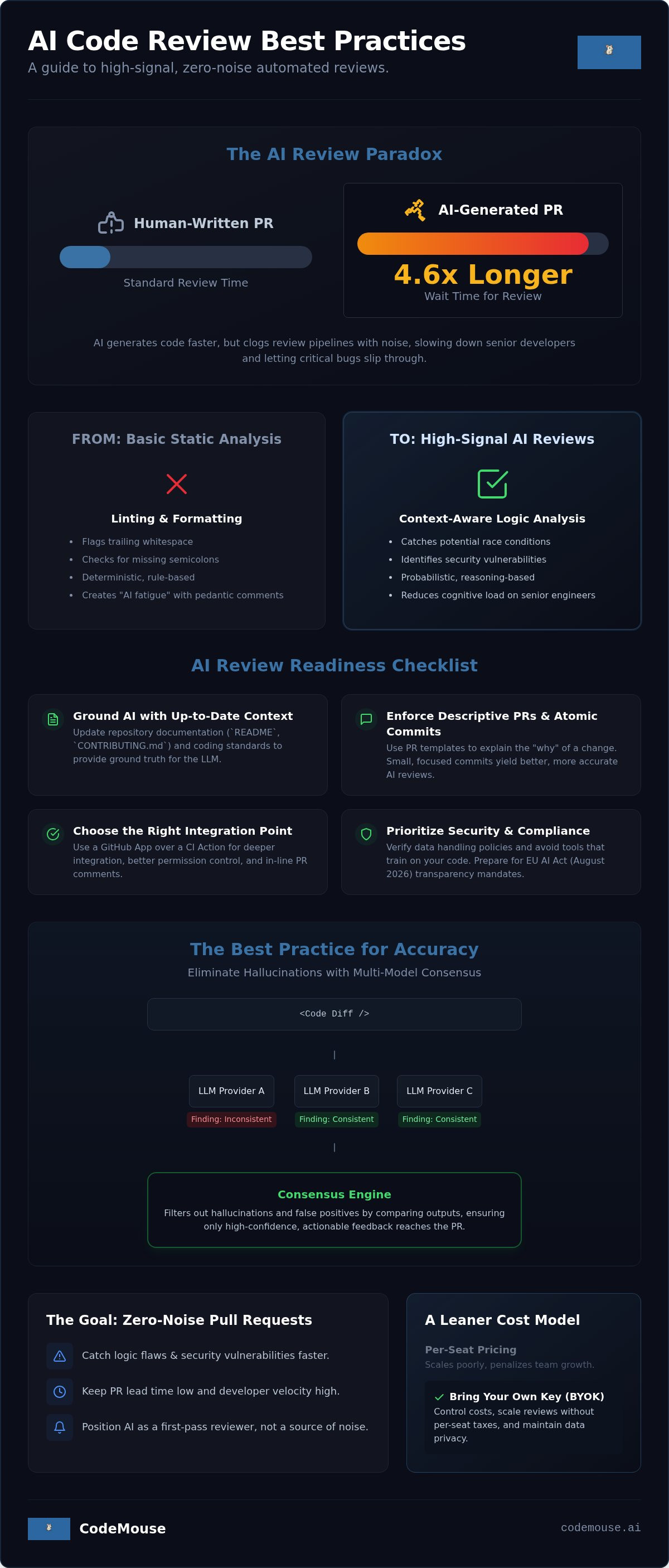
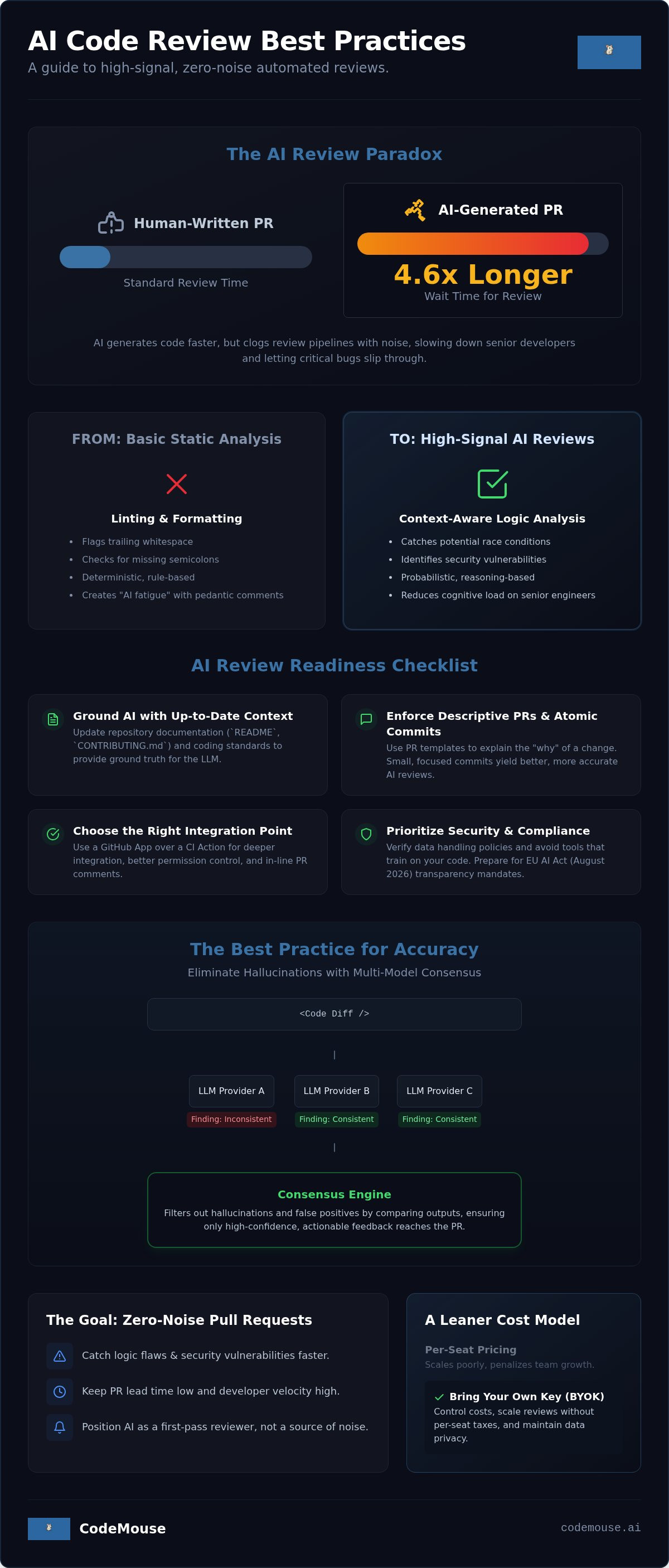
In 2026, AI-generated pull requests wait 4.6 times longer for review than human-written code. It's a paradox. We're generating code faster than ever, but review pipelines are clogged with automated noise and inconsistent feedback. You see it every day. Senior developers waste time on pedantic AI comments while genuine logic bugs slip into the main branch. Implementing AI code review best practices isn't about adding more automation. It's about moving toward a context-aware, multi-model consensus that respects your team's time and intelligence.
You need a system that improves PR turnaround without the burden of per-seat taxes or low-quality hallucinations. This article provides a pragmatic, fluff-free checklist to help your engineering team deploy AI-powered reviews that deliver actual utility. We'll examine how to move beyond basic linting, leverage the "Bring Your Own Key" model for better cost control, and ensure your workflow stays compliant with the August 2026 EU AI Act enforcement deadlines. The goal is simple: catch bugs faster and keep your lead time low.
Key Takeaways
- Shift from basic syntax checking to context-aware logic analysis to reduce cognitive load for senior engineers.
- Ground your AI feedback by updating repository documentation and coding standards before implementation.
- Eliminate hallucinations and false positives by leveraging multi-model consensus across different LLM providers.
- Apply AI code review best practices to position AI as a first-pass reviewer that complements human oversight.
- Adopt a "Bring Your Own Key" model to scale your review stack without the burden of per-seat pricing.
Table of Contents
Beyond Static Analysis: Defining High-Signal AI Code Reviews
Static analysis is a solved problem. Your linters and formatters already handle the surface level. Modern engineering teams don't need an AI to flag trailing whitespace or missing semicolons. They need a tool that understands intent. High-signal reviews focus on business logic and architectural integrity. By 2026, AI code review best practices require moving beyond basic pattern matching toward deep context analysis. The goal isn't just to find errors. It's to reduce the cognitive load on your most expensive resources: your senior engineers.
The role of AI in the modern CI/CD pipeline is that of a gatekeeper. It's no longer just about passing unit tests. It's about passing a logic audit. In an environment where nearly half of all new code is AI-generated, the human reviewer has become the primary bottleneck. High-signal AI reviews unblock that bottleneck by providing the confidence to merge faster without sacrificing quality. A single LLM prompt is no longer sufficient. 2026 standards demand a multi-layered approach that verifies findings before they reach the PR thread.
AI vs. Traditional Static Analysis (Linters)
Traditional Automated code review tools are deterministic. They follow rigid, predefined rules. AI is probabilistic. It reasons through code. A linter catches a syntax error; an AI catches a potential race condition in a complex async loop. You should keep your linters in place. They are fast and computationally cheap. Use them as your first line of defense. Reserve your AI tokens for the "Consensus" layer. This is where the real value lies. By comparing outputs from different models, you filter out hallucinations and ensure feedback is actionable.
The Goal: Zero-Noise Pull Requests
Noise is the enemy of developer velocity. If an AI floods a PR with twenty pedantic comments, developers start ignoring the output. This is "AI fatigue." High-signal feedback ensures every comment justifies a human's attention. It targets logic flaws, security vulnerabilities, or significant performance regressions. Success is measured by PR lead time and bug leakage. If your AI reviews slow down the merge process without reducing production incidents, the system is broken. Aim for surgical precision, not volume.
Incorporate these reviews directly into your GitHub Actions. This ensures every commit is analyzed before a human even opens the PR. It shifts the burden of quality left. When a developer receives feedback within minutes of pushing code, they fix issues while the context is still fresh. This immediate feedback loop is a core component of modern AI code review best practices. It transforms the review process from a stressful hurdle into a silent partner in the development workflow.
The AI Review Readiness Checklist: Pre-Implementation Setup
AI isn't magic. It's a context-dependent reasoning engine. If your repository documentation is stale, your AI feedback will be generic and low-value. High-signal results require a baseline of repository hygiene. Before deploying any tool, audit your README and CONTRIBUTING.md files. These documents serve as the ground truth for the LLM. If your team uses specific architectural patterns or naming conventions, document them clearly. This ensures the AI doesn't flag intentional design choices as errors.
Selecting the right integration point is equally critical. You have two primary options: a GitHub App or a CI Action. GitHub Apps are generally superior for code reviews. They offer deeper integration with the PR interface and more granular control over permission scopes. This setup allows the AI to act as a silent partner, providing feedback directly in the thread without cluttering your build logs. Integrating these Code Review Best Practices ensures your team focuses on logic while the AI handles the repetitive checks.
Repository Hygiene for AI Context
Context-aware review requires up-to-date documentation. AI models use your repo's metadata to understand project intent. Update your PR templates to require descriptive summaries. Tell the AI "why" a change was made, not just "what" changed. Atomic commits are vital here. Large, monolithic diffs confuse the logic engine and lead to hallucinations. Small, focused changes yield better reviews and lower the risk of "AI fatigue" among human reviewers. By keeping diffs manageable, you directly support AI code review best practices and improve overall PR throughput.
Security and Privacy Configuration
Security is a non-negotiable requirement. With the EU AI Act enforcement date of August 2, 2026, transparency and logging are now legal mandates for many organizations. Verify the data handling policies of your AI provider. Avoid tools that use your proprietary code to train their base models. The "Bring Your Own Key" (BYOK) model is the current industry standard for privacy and cost control. It allows you to manage your own API keys from providers like OpenAI or Anthropic. This approach ensures you only pay for what you use, avoiding the "per-seat tax" common in enterprise software. You can implement this lean stack by using CodeMouse AI Code Review, which supports a transparent BYOK workflow for $10/month.
Manage your repository access scopes with surgical precision. Only grant the minimum permissions necessary for the AI to read the diff and post comments. Regularly audit these permissions as your team grows. A secure, well-configured environment is the only way to scale AI code review best practices across a production-grade engineering team.
Multi-Model Consensus: The Best Practice for Accuracy
Single-model reliance is a liability in production environments. Even advanced LLMs can confidently hallucinate logic that doesn't exist. One of the core AI code review best practices for 2026 is the implementation of multi-model consensus. By running a pull request through both GPT-5.5 and Claude 4.0, you create a verification layer that filters out noise. If only one model flags an issue, it might be a false positive. If both agree, the signal is high enough to warrant immediate human attention. This approach moves the needle from "automated guessing" to "verified analysis."
Implementing a "majority vote" logic is particularly effective for detecting critical bugs. You can configure your stack to only post a comment if two or more models reach the same conclusion. This drastically reduces the volume of pedantic comments that lead to developer fatigue. Inference is cheap; developer time is expensive. Spending a few extra cents on tokens to cross-verify a logic flaw is a high-ROI trade-off for any engineering team.
Why One AI Model Isn't Enough
Different models have different blind spots. Claude 4.0 often excels at long-context reasoning and identifying subtle architectural mismatches. GPT-5.5 remains the gold standard for rapid pattern matching in common languages like TypeScript and Python. Some models struggle with specific edge cases in functional programming, while others might miss security vulnerabilities in legacy C++ blocks. You can read more about the specific trade-offs in our guide on GPT-4o vs Claude 3 Opus for Code Review. Using a diverse model set ensures that the strengths of one LLM cover the "weak spots" of another.
Implementing Consensus Logic
To implement consensus effectively, you need a framework for weighing feedback. Not all models are equal for every task. You might weigh Claude more heavily for documentation and architectural reviews, while giving GPT more authority on syntax and performance optimizations. The workflow should look like this:
- Trigger: A new commit is pushed to a GitHub PR.
- Analysis: Multiple models analyze the diff in parallel.
- Consensus Filter: A secondary "judge" model or a script compares the results.
- Action: Only agreement-based comments are posted to the PR thread.
This automated cross-verification ensures that your team only sees high-signal feedback. It aligns with AI code review best practices by treating AI as a probabilistic engine that requires a sanity check. By the time a senior engineer sees an AI comment, it has already passed a rigorous multi-model audit, saving them from the mental overhead of debunking incorrect suggestions.
Integrating AI into the Human Workflow: Reviewer Etiquette
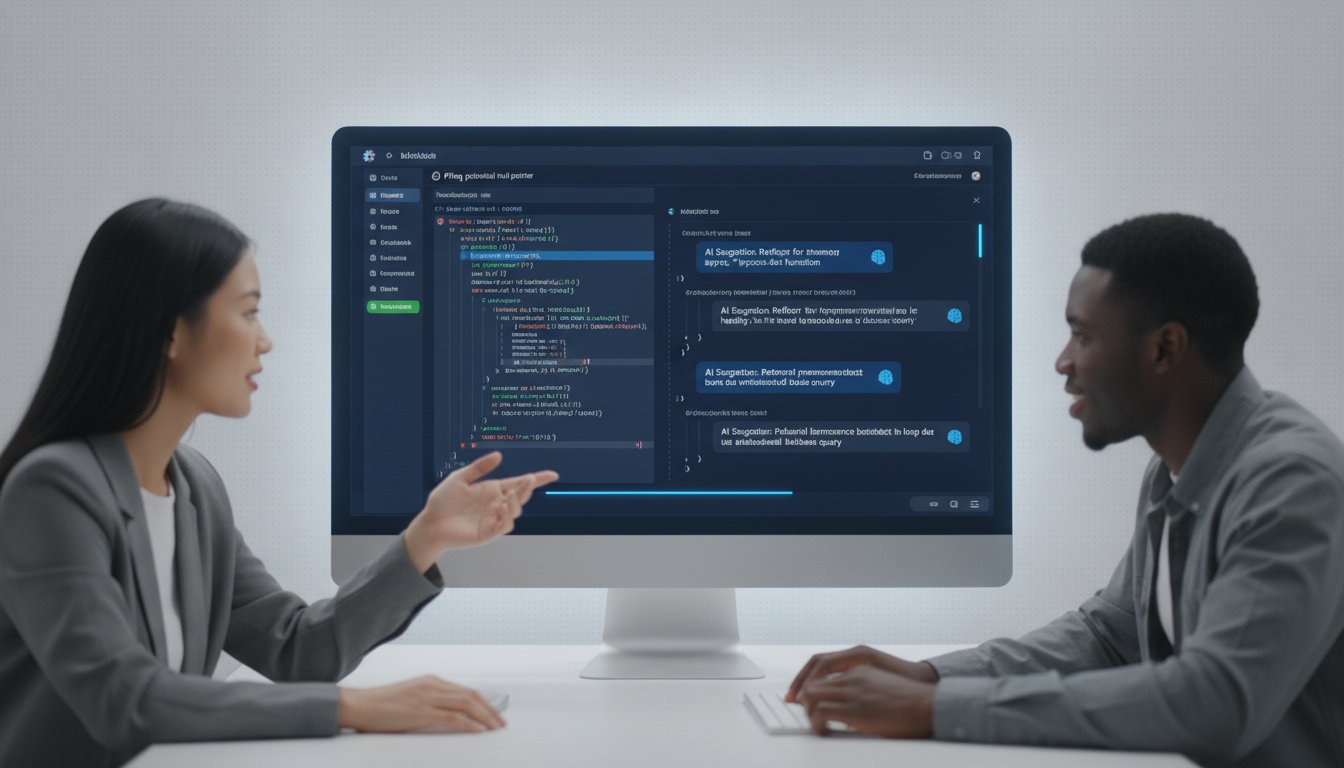
AI is a filter, not a decision-maker. In a 2026 workflow, the AI acts as your first-pass reviewer. It handles the repetitive, high-volume checks before a human ever looks at the diff. This isn't about replacing human eyes. It's about ensuring that when a senior developer opens a pull request, they aren't distracted by syntax errors or documented style violations. Following AI code review best practices means using AI to clear the path for deep architectural discussion.
Differentiate between feedback types. A high-signal AI stack labels comments as "Critical" or "Nitpick." Critical comments focus on logic flaws, security vulnerabilities, or performance regressions. Nitpicks handle style and documentation. Training your team to address critical items first prevents the "comment flood" from slowing down the merge. It's a pragmatic approach to maintaining velocity while ensuring safety. AI should never have the final merge authority. Human accountability is the only way to maintain long-term repository health.
Reviewer etiquette matters. Don't argue with the AI in the PR thread. If the suggestion is wrong, provide a signal to the system and move on. If it's right, apply the fix. Use these automated comments as a learning tool for junior developers. AI can explain complex legacy patterns in real-time, reducing the mentoring burden on senior staff. It transforms the review process into a continuous education platform rather than just a gatekeeping exercise.
The 'Human-in-the-Loop' Requirement
Senior developers must still sign off on architectural changes. AI struggles with high-level design philosophy and cross-service dependencies. It sees the diff, but it doesn't always see the five-year roadmap. Use the AI to handle the tactical; keep the humans for the strategic. This division of labor is essential for scaling teams without losing code quality. For a deeper dive into setup, see our guide on How to Automate Code Reviews for Engineering Teams. Maintaining this balance ensures that AI code review best practices serve the team, not the other way around.
Refining the AI Feedback Loop
Feedback is a two-way street. Encourage developers to provide "thumbs up" or "thumbs down" signals on AI comments. This data helps refine prompt sensitivity based on project maturity. A greenfield project might need strict adherence to standards, while a legacy monolith requires more leniency. Establishing a "no-blame" culture for AI-detected bugs is also vital. The goal is to catch issues before they hit production, not to penalize the author. If you want to implement this workflow today, start a free trial with CodeMouse AI Code Review for a transparent, efficient review process.
Implementing a Lean AI Review Stack with CodeMouse
Technical teams value speed and autonomy. CodeMouse installs as a GitHub App in under two minutes. It integrates directly into your existing PR workflow without requiring complex CI configuration. This rapid deployment is a core component of AI code review best practices in 2026. Once authorized, the tool starts analyzing diffs immediately. It uses the multi-model consensus logic discussed in previous sections to ensure every comment is high-signal. You can read more about this approach in our guide on AI Code Review for GitHub: Scaling Quality with Multi-Model Consensus.
Scaling your review process shouldn't lead to ballooning costs. By separating the platform fee from the model usage, you gain transparency. This architecture respects your existing infrastructure while providing the intelligence needed to catch logic bugs before they hit production. It's a surgical addition to your stack that delivers immediate utility without a total overhaul of your habits.
The Bring Your Own API Key (BYOK) Advantage
Most enterprise AI tools hide model costs behind high per-seat markups. CodeMouse uses a "Bring Your Own Key" (BYOK) model. You provide your own API keys for providers like OpenAI or Anthropic. This approach eliminates vendor markup on AI tokens. You pay only for the raw compute your team consumes. It also grants you full control over model selection and versioning. If you prefer GPT-5.5 for rapid syntax checks and Claude 4.0 for deep architectural reasoning, you can configure that balance yourself. This flexibility is a key differentiator for AI Code Review for Startups where engineering quality must scale alongside a lean budget.
Scaling to Unlimited PRs
Traditional per-seat pricing models create a "growth tax." Every new hire increases your fixed costs. CodeMouse offers a flat-rate $10/month pricing model for unlimited users and repositories. This allows your team to grow without worrying about hitting subscription tiers or per-user limits. It's a predictable cost structure that handles high-volume repositories without throttling or performance degradation. You get consistent, context-aware feedback across every branch and every commit. It's the standard for teams that prioritize efficiency over flashy, expensive enterprise packages.
Don't let manual reviews become your primary bottleneck. Implement AI code review best practices with a tool designed for technical efficiency. Start your 14-day free trial of CodeMouse today. Configure your keys, connect your repos, and start merging higher-quality code in minutes.
Optimize Your Review Pipeline for 2026
Implementing AI code review best practices transforms your PR pipeline from a bottleneck into a competitive advantage. High-velocity teams move faster by focusing on high-signal logic checks rather than syntax nitpicking. Use multi-model consensus to eliminate hallucinations and ensure every automated comment justifies a human's attention. By adopting a "human-in-the-loop" model, you protect architectural integrity while significantly accelerating throughput. It's about clearing the noise so your senior engineers can focus on strategy and complex design.
CodeMouse provides the infrastructure for this efficiency. It's a silent partner used by high-velocity GitHub teams to scale quality without the growth tax of per-seat pricing. You maintain full control over your stack by bringing your own API keys for Claude and GPT models. This ensures transparency, privacy, and cost-efficiency as your repository grows. It's a pragmatic tool for builders who value utility and direct problem-solving over flashy enterprise packages.
Stop letting manual reviews slow down your shipping cycle. Start your 14-day free trial of CodeMouse for $10/month. Connect your repository, configure your consensus logic, and start merging better code today. Build faster with a review process that actually works.
Frequently Asked Questions
Can AI code reviews replace human reviewers entirely?
AI cannot replace human reviewers. It lacks the architectural context and long-term roadmap awareness required for final sign-off. Use it to handle tactical checks like logic flaws and edge cases. This frees your senior staff to focus on strategic design. Human accountability remains the standard for merging code into production environments in 2026.
How do I prevent the AI from posting too many comments on a PR?
Implement multi-model consensus to reduce noise. By requiring agreement between two or more LLMs before posting, you filter out hallucinations. You can also adjust sensitivity based on project maturity. Focus on high-signal feedback that addresses critical logic issues rather than flooding the PR with minor stylistic nitpicks that cause developer fatigue.
Which AI model is best for reviewing code in 2026?
The "best" model depends on the specific task. GPT-5.5 is highly efficient for rapid pattern matching and common languages like Python or TypeScript. Claude 4.0 excels at reasoning through complex, long-context architectural dependencies. A core component of AI code review best practices is leveraging both models simultaneously to cover each other's blind spots and ensure accuracy.
Is it safe to share my code with AI models like Claude or GPT?
Security depends on your provider's data retention policy. Most enterprise APIs, including those used in a BYOK model, offer zero-retention for training. Ensure your setup complies with the August 2, 2026, EU AI Act requirements for transparency and logging. This approach keeps your proprietary logic private while still benefiting from deep automated analysis across your repositories.
How does the 'Bring Your Own API Key' model save money?
The "Bring Your Own API Key" model eliminates the per-seat markup common in traditional SaaS tiers. You pay for the raw tokens you consume directly to providers like OpenAI or Anthropic. Combined with a flat platform fee, this avoids the "growth tax" on new hires. It's the most transparent way to scale AI code review best practices across large engineering teams.
What should I do if the AI provides incorrect feedback?
Treat incorrect feedback as a signal for system refinement. Provide a "thumbs down" or similar feedback to help the AI learn your project's specific context. AI is a probabilistic tool, not a deterministic one. If a suggestion is wrong, ignore it and move on. The goal is to catch logic bugs before production, not to achieve 100% automated accuracy.
Does CodeMouse support private GitHub repositories?
CodeMouse fully supports private GitHub repositories. It integrates as a GitHub App with granular permission scopes. This allows the tool to read diffs and post comments without requiring broad access to your entire organization. It's designed to function as a secure, silent partner within your existing private development workflow, respecting your team's privacy and security protocols.
How do I integrate AI reviews into a team that is skeptical of automation?
Position the tool as a productivity multiplier for senior developers. Focus on how it removes the burden of catching repetitive logic errors and edge cases. When a team sees that AI reduces their manual review time by filtering out low-value noise, skepticism usually vanishes. Start with a 14-day trial to demonstrate immediate utility and faster PR turnaround times.