GPT-4o vs Claude 3 Opus for Code Review: 2026 Engineering Guide
Choosing between GPT-4o vs Claude 3 Opus for code review is a tactical error that limits your team's ability to ship clean code. Relying on a single model to catch critical logic flaws creates a single point of failure in your CI/CD pipeline. You've likely dealt with AI feedback that's either too noisy to be useful or too shallow to catch high-risk bugs before they hit production. It's frustrating to manage shifting API costs while trying to reduce PR cycle times and maintain a standard level of quality across a growing engineering team.
This guide clarifies which LLM actually identifies the most dangerous vulnerabilities and explains why a multi-model approach is the 2026 industry standard for high-performance teams. You'll learn how to leverage the specific reasoning strengths of different architectures to ensure your reviews are both deep and actionable. We'll analyze the latest performance data, compare context window utility for complex refactors, and provide a framework for standardizing code quality without the burden of per-seat licensing. It's time to move past the binary choice and build a resilient, agentic review workflow that respects your developers' time and your production stability.
Key Takeaways
- Understand why deep context analysis is mandatory for modern PRs and how context windows handle large, multi-file diff data.
- Compare GPT-4o vs Claude 3 Opus for code review by evaluating GPT’s multimodal speed against Claude’s specialized reasoning for logic-heavy audits.
- Identify critical security vulnerabilities and logic flaws that single-model reviews often miss due to hallucinations or deprecated API usage.
- Analyze the economics of token density in code to manage API costs while maintaining high-speed, high-fidelity feedback loops.
- Deploy a multi-model consensus workflow to filter out noisy AI feedback and standardize code quality across your entire engineering team.
Table of Contents
- Beyond Benchmarks: Why Code Review is the Ultimate LLM Stress Test
- Architectural Logic: Evaluating Reasoning Depth in PR Analysis
- False Positives vs. Critical Bugs: Accuracy in Real-World PRs
- The Economics of AI Code Review: Tokens, Latency, and API Keys
- Implementing Multi-Model Consensus with CodeMouse
Beyond Benchmarks: Why Code Review is the Ultimate LLM Stress Test
Benchmarks like HumanEval or MMLU provide a baseline, but they don't reflect the daily reality of a pull request. Generating a standalone Python script is a solved problem. Analyzing a complex diff that interacts with three different microservices is a different tier of difficulty. This is why evaluating GPT-4o vs Claude 3 Opus for code review requires looking beyond raw scores. In 2026, engineering teams don't need more code. They need better filters for the code they already have.
Reviewing is harder than generating because it requires a deep understanding of negative space. The AI must identify what is missing, what is redundant, and what violates the specific architectural patterns of your repo. Static benchmarks can't measure how well a model understands your team's unique implementation of a singleton pattern or your specific error-handling wrappers. You need a model that can maintain state across thousands of lines of code without losing the thread of the logic.
The Problem with Static Analysis in 2026
Traditional linters and SAST tools remain useful for catching missing semicolons or obvious buffer overflows. However, they are blind to logic. They can't tell you if a new API endpoint bypasses your authentication middleware. Modern CI/CD pipelines have evolved. The industry has shifted toward Automated code review as a semantic layer above basic linting. By integrating LLMs, teams move from "does this compile?" to "does this make sense?". This transition is explored further in our deep dive on automated code review. It's about catching the bugs that tests miss.
Defining "Quality" in an AI-Driven Review
Engineers value three things in a review: actionability, context, and a high signal-to-noise ratio. If a comment doesn't lead to a constructive change, it's noise. In 2026, context windows are the primary differentiator. While legacy models struggled with 128k limits, the Claude 3 and 4 series handle up to 1 million tokens. This allows the AI to read the entire repository context before commenting on a single line.
High-performing models must also avoid nitpick fatigue. Developers don't want to argue with an AI about variable naming if the logic itself is sound. Ultimately, the goal is moving beyond "it works." A PR might pass all tests but still be unmaintainable or contain subtle security regressions. Choosing between GPT-4o vs Claude 3 Opus for code review comes down to which model consistently identifies these high-risk patterns without slowing down the development cycle.
Architectural Logic: Evaluating Reasoning Depth in PR Analysis
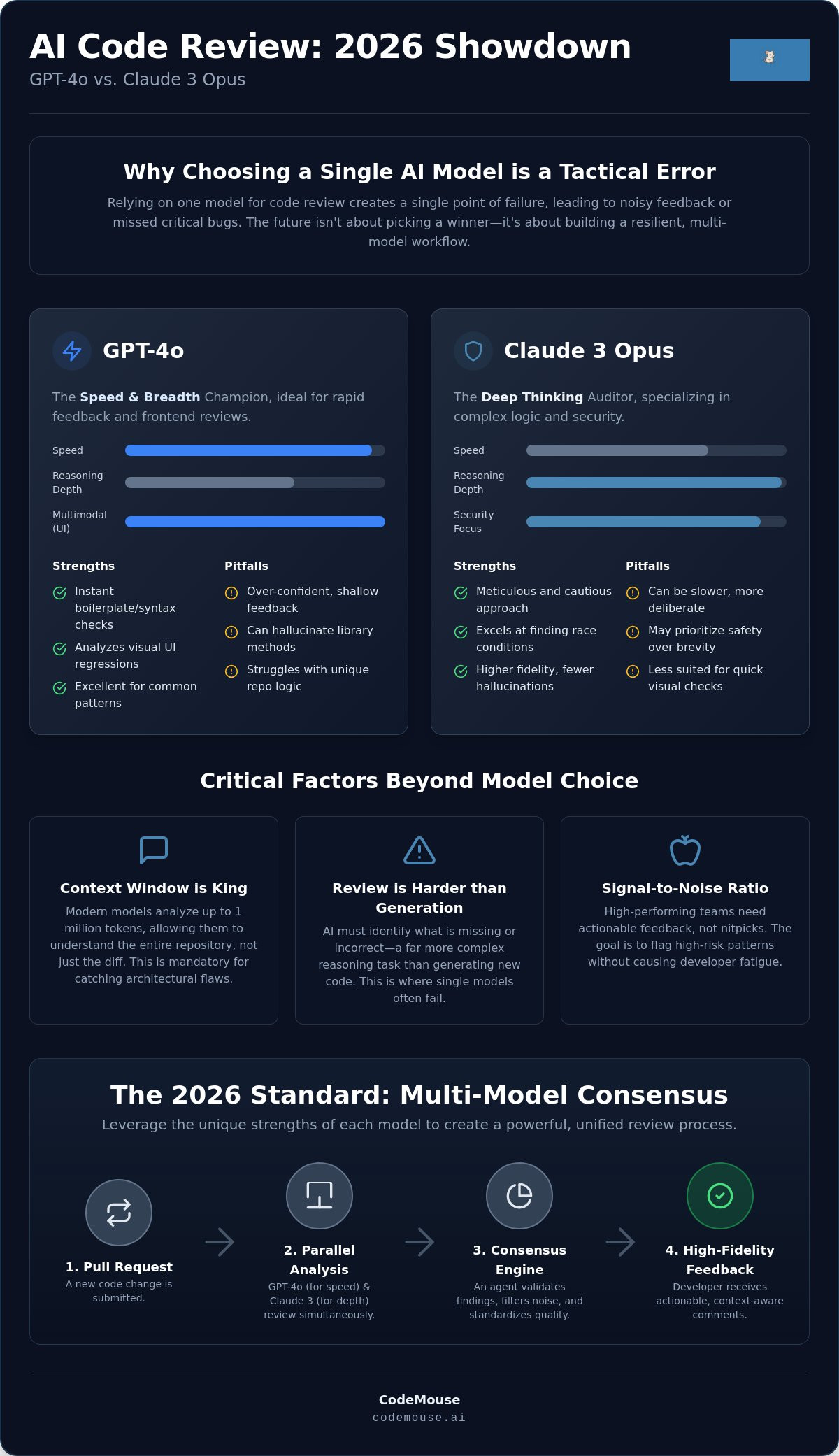
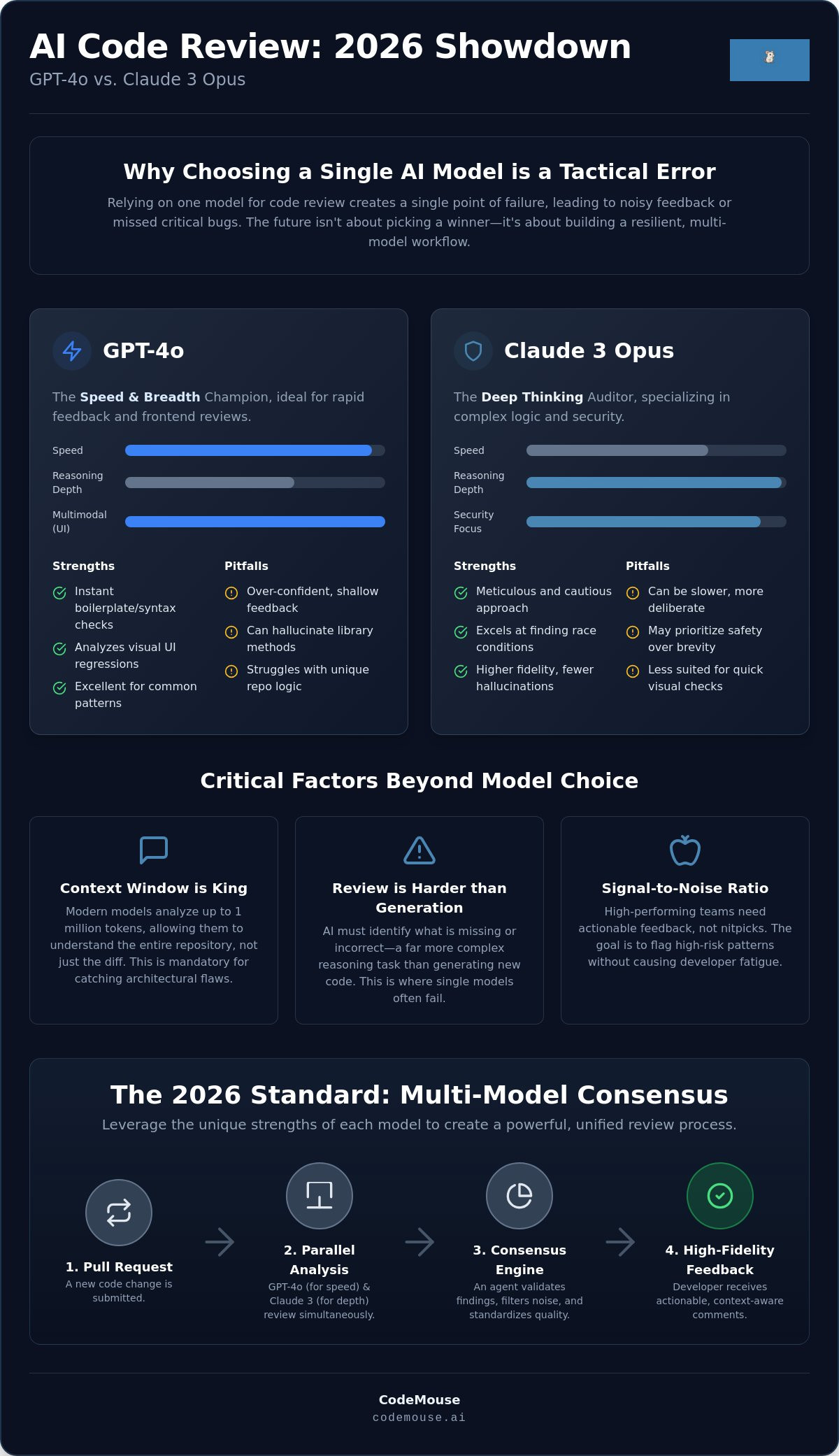
Architectural differences define how these models perceive a pull request. GPT-4o uses an "Omni" architecture. It processes text and vision simultaneously. This is ideal for frontend reviews. Claude 3 Opus relies on "Constitutional AI." It prioritizes safety and logical consistency. When evaluating GPT-4o vs Claude 3 Opus for code review, the choice depends on whether you need a fast generalist or a meticulous auditor. Writing code is a generative task. Reviewing it is an analytical one. Analysis requires a different level of reasoning depth.
GPT-4o: The Speed and Breadth Champion
GPT-4o is built for throughput. It identifies common boilerplate errors and syntax mismatches instantly. If your PR includes UI changes, GPT-4o's vision capabilities analyze CSS and HTML layout shifts effectively. It sees the rendered output. It catches visual regressions that text-only models miss. However, speed introduces a risk. GPT-4o can be over-confident. It frequently assumes a library method exists because it "looks" correct. This leads to shallow feedback that ignores deeper architectural debt. It excels at identifying common patterns but can struggle with unique, repo-specific logic.
Claude 3 Opus: The Deep Thinking Alternative
Claude 3 Opus takes a more cautious approach. It follows complex, multi-step PR templates with higher fidelity. Hallucinations are less frequent. It excels at identifying race conditions in concurrent code. recent academic research indicates that models with larger context windows and higher reasoning scores perform better at identifying logic-based bugs in distributed systems. Claude’s "Constitutional" training makes it more likely to flag a security risk than to offer a "nitpick" about formatting. It understands the "why" behind a change, not just the "what."
Analyzing long-range dependencies is the ultimate test. A change in a service's retry logic might break an upstream consumer. Claude's architectural focus on logical flow makes it superior for these deep-stack reviews. It tracks state across multiple files with higher precision. GPT-4o remains the better tool for high-velocity teams focused on frontend components or standardized microservices. To bridge this gap, many teams use a tool like CodeMouse to automate your review process using both models simultaneously.
Distributed systems introduce edge cases that standard testing often misses. These include partial failures, network partitions, and eventual consistency issues. Claude 3 Opus is generally more adept at simulating these scenarios during a review. It asks the "what if" questions that prevent production outages. GPT-4o is more likely to confirm that the code follows the provided instructions without questioning the underlying assumptions. For mission-critical infrastructure, reasoning depth is non-negotiable.
False Positives vs. Critical Bugs: Accuracy in Real-World PRs
Accuracy in a pull request isn't about how many comments an AI makes. It's about how many of those comments are right. When evaluating GPT-4o vs Claude 3 Opus for code review, the primary metric is the signal-to-noise ratio. A model that flags fifty stylistic nits but misses a single race condition is a liability. GPT-4o often provides high-speed feedback but can hallucinate library methods or suggest deprecated APIs that no longer exist in modern frameworks. Claude 3 Opus tends to be more conservative. It prioritizes logical flow over syntactic volume. This helps teams avoid the "Feedback Fatigue" that occurs when developers start marking AI comments as "resolved" without reading them.
Security auditing remains the highest-stakes test for any LLM. Claude 3 Opus generally performs better at spotting non-obvious SQL injection or XSS vulnerabilities. It analyzes the data flow across multiple lines with higher precision. GPT-4o might catch a missing sanitizer in a simple script, but it often misses subtle vulnerabilities in a complex, multi-file diff. To get the most value, engineers must tune their models to ignore stylistic choices like tabs vs spaces. Directing the AI to focus exclusively on logic and security leads to significant improvements in code quality across the entire organization.
Bug Detection Benchmarks for 2026
Recent data shows a clear performance gap. Claude 3.5 Sonnet currently holds a SWE-Bench score of approximately 49%, while GPT-4o sits at 38%. While Opus is the heavier reasoning model, these figures highlight a general trend in architectural efficiency for coding tasks. In 2026, the hallucination rate for high-tier code review models has dropped below 3% for standard library calls, yet it remains near 12% for internal, repo-specific APIs. GPT-4o remains effective for catching common patterns, but Claude 3 Opus is superior for catching logic flaws in production-grade PRs where state management is complex.
The Cost of Being Wrong
False positives erode developer trust faster than any other factor. If an AI suggests a fix that breaks the build, developers will stop using the tool. This is why AI code review for GitHub requires strict prompt engineering to filter out low-confidence suggestions. Using a single model often results in "hallucinated" style suggestions that waste human review time. High-performance teams implement consensus logic. They only surface a comment if multiple models agree on the fault. This approach standardizes quality and ensures that GPT-4o vs Claude 3 Opus for code review becomes a complementary strategy rather than a binary choice.
The Economics of AI Code Review: Tokens, Latency, and API Keys
Economic analysis of GPT-4o vs Claude 3 Opus for code review requires an understanding of token density. Code isn't prose. A standard pull request diff includes file headers, line markers, and surrounding context that inflate token counts rapidly. Analyzing a 50-line change often consumes thousands of tokens of repository context to ensure logical consistency. In 2026, managing these costs is a core engineering competency. You can't optimize what you don't measure. Choosing the wrong model for high-volume, low-complexity PRs drains your budget without improving code quality.
GPT-4o operates as a high-speed, lower-cost option. It's efficient for catching syntax errors and boilerplate mismatches. Claude 3 Opus remains a premium reasoning engine. You pay a higher rate per million tokens for its logical depth. For scaling teams, the "Bring Your Own API Key" (BYOK) model is the only sustainable path. Standard SaaS providers often charge $20 to $50 per seat. This model scales poorly and forces you to pay for inactive developers. By using your own keys, you pay only for the compute you consume. This transparency allows you to start your 14-day free trial and see the actual cost-per-PR in your specific environment.
Calculating Your Monthly PR Review Budget
Budgeting depends on PR volume and complexity. A small bug fix might consume 5,000 tokens. A major feature release can easily hit 100,000 tokens when repository-wide context is included. Compare the costs:
- SaaS Per-Seat: Fixed monthly cost regardless of usage. Expensive for large teams with varying commit frequencies.
- CodeMouse Flat Fee: A consistent $10 fee plus direct API costs. You capture the falling prices of LLM tokens directly.
- Tiered Reviewing: Use cheaper models like GPT-5-mini for initial passes and reserve Opus for final, high-stakes security audits.
Latency and Developer Experience
Latency kills engineering flow. Feedback must arrive before the developer switches to a new task. In 2026, GPT-4o typically delivers comments within 15 to 20 seconds. Claude 3 Opus, while more thorough, can take 40 to 60 seconds for complex diffs. This delay is the "context-switching tax." High-latency reviews often lead to developers ignoring AI feedback to maintain momentum. Rate limits also pose a challenge for large organizations. If your team triggers a 429 error during a pre-deployment rush, your CI/CD pipeline stalls. Managing multiple API providers ensures redundancy and maintains a 30-second feedback loop across all time zones.
Implementing Multi-Model Consensus with CodeMouse
A single LLM is a single point of failure. In 2026, the most resilient engineering teams use "Consensus AI" to eliminate the hallucinations discussed in previous sections. By comparing GPT-4o vs Claude 3 Opus for code review in parallel, you create a cross-verification layer that filters out noise. If GPT-4o flags a syntax nit but Claude 3 Opus identifies a high-risk logic flaw, the system prioritizes the deeper analysis. This orchestration ensures that only high-confidence, actionable feedback reaches your developers' pull requests. CodeMouse manages this complexity as a silent partner in your GitHub workflow.
Relying on one architecture limits your perspective. Different models have different blind spots. Consensus logic acts as a filter. It requires multiple models to agree on a fault before surfacing it to the human reviewer. This reduces the cognitive load on your team. You stop debating with the AI and start fixing verified issues. It's a pragmatic approach to scaling quality without increasing headcount.
The Case for Multi-Model Verification
Combining models balances speed with reasoning depth. GPT-4o provides broad coverage across common patterns. Claude 3 Opus handles the deep logic verification required for distributed systems. This dual-layered approach significantly reduces the manual effort required from senior reviewers. They no longer spend time filtering out AI-generated hallucinations. Instead, they act as the final arbiter for pre-validated, high-signal comments. For teams migrating from legacy systems, understanding Gerrit vs CodeMouse highlights how modern AI efficiency outpaces traditional rule-based review logic.
Getting Started with Unlimited AI Reviews
Setup is designed for speed. You can integrate the CodeMouse GitHub App in under 2 minutes. There is no infrastructure to manage and no complex onboarding. Start by connecting your OpenAI and Anthropic API keys to take advantage of the BYOK economic model. This allows you to configure review intensity based on the sensitivity of specific repositories. You might prioritize GPT-4o for internal tools while enabling Claude 3 Opus for mission-critical production services. You aren't locked into a single provider's roadmap.
The final workflow is seamless. When a PR is opened, CodeMouse triggers the selected models. It analyzes the diff, applies consensus logic, and posts consolidated feedback directly to the GitHub interface. You maintain full control over the model priority and the frequency of reviews. Leverage the 14-day free trial to find the ideal model mix for your codebase. At a flat $10/month, it provides the necessary infrastructure for standardized code quality without the burden of per-seat pricing. Merge with confidence by letting the best models in the world validate every line of your code.
Standardize Your Code Quality with Multi-Model Logic
The comparison of GPT-4o vs Claude 3 Opus for code review reveals that neither model is a silver bullet. High-performance teams leverage the speed of GPT-4o alongside the deep logical reasoning of Claude 3 Opus to eliminate hallucinations. This multi-model consensus ensures that your CI/CD pipeline catches critical bugs without overwhelming developers with noise. Managing your own API keys allows you to scale this infrastructure efficiently as token costs continue to drop.
CodeMouse offers a pragmatic path to this standard. It's a builder's tool that integrates as a GitHub App in minutes and supports both leading architectures for a flat $10/month fee. You get the power of the world's best LLMs without the friction of per-seat pricing or complex onboarding. Start your 14-day free trial of CodeMouse AI Code Review to automate your consensus logic today. Build faster and ship with confidence.
Frequently Asked Questions
Is Claude 3 Opus better than GPT-4o for Python code reviews?
Claude 3 Opus generally provides deeper reasoning for complex Python logic. Research from 2026 indicates that Claude models, specifically the 4.x series, outperform GPT-4o in executing multi-step refactoring and adhering to existing coding patterns. GPT-4o remains effective for generating quick scripts, but it lacks the logical depth required for identifying subtle bugs in large Python backend architectures. Claude's 1 million token context window also allows for better repository-wide analysis.
How much does it cost to use my own API keys with CodeMouse?
CodeMouse charges a flat fee of $10/month for the orchestration service. You pay the AI providers directly for the tokens you consume. For a cost comparison of GPT-4o vs Claude 3 Opus for code review, GPT-4o costs approximately $2.50 per 1 million input tokens. Claude Opus 4.6 is priced at $5.00 per 1 million input tokens. This "Bring Your Own Key" model avoids the high markups found in per-seat SaaS pricing.
Does CodeMouse support private GitHub repositories?
Yes, CodeMouse integrates as a GitHub App and supports both public and private repositories. It accesses the pull request diff and the necessary repository context to provide accurate feedback. This ensures your proprietary code stays within your controlled GitHub environment and your designated AI providers. The app only processes the data required for the specific review task and does not store your source code permanently.
Can I limit the AI to only comment on high-severity bugs?
You can configure review intensity within the app settings to prioritize critical logic and security flaws. This allows you to silence "nitpick" comments regarding formatting or stylistic choices like tabs versus spaces. By tuning these parameters, you reduce developer feedback fatigue and ensure the AI focuses on high-risk issues. This focus helps maintain a high signal-to-noise ratio across your engineering team's pull requests.
What happens if GPT-4o and Claude 3 Opus disagree on a code change?
CodeMouse uses consensus logic to manage model discrepancies. When you perform a GPT-4o vs Claude 3 Opus for code review analysis, the system compares the findings. You can configure the app to only surface comments where both models agree. Alternatively, it can highlight disagreements for a human reviewer to investigate. This multi-model verification layer is the most effective way to eliminate hallucinations and ensure feedback accuracy.
Is my code shared with OpenAI or Anthropic when using CodeMouse?
The code diffs are sent to the AI providers you have connected via your API keys. CodeMouse acts as the secure orchestrator for these requests. Your data is governed by the specific terms you have with OpenAI and Anthropic. Most enterprise API agreements exclude your data from being used for model training. CodeMouse does not use your code to train any internal models or share it with third parties.
Does CodeMouse support languages like Go, Rust, or TypeScript?
Yes, CodeMouse supports all major programming languages, including Go, Rust, TypeScript, and C++. The underlying LLMs are proficient in identifying language-specific issues, such as memory safety violations in Rust or concurrency bugs in Go. Because the models are trained on vast repositories of technical documentation and source code, they provide context-aware feedback regardless of your team's specific language stack or framework.
Can I use Claude 3.5 Sonnet instead of Opus for faster reviews?
You can select specific models like Claude 3.5 Sonnet or the newer 4.6 Sonnet within your configuration. Sonnet is often preferred for its balance of speed and high reasoning capabilities. It currently holds a SWE-Bench score of approximately 49%, which is higher than GPT-4o's 38%. This choice allows you to maintain a 30-second feedback loop without sacrificing the logical depth required for production-grade code analysis.