AI Code Review for Go: Examples and Patterns for 2026
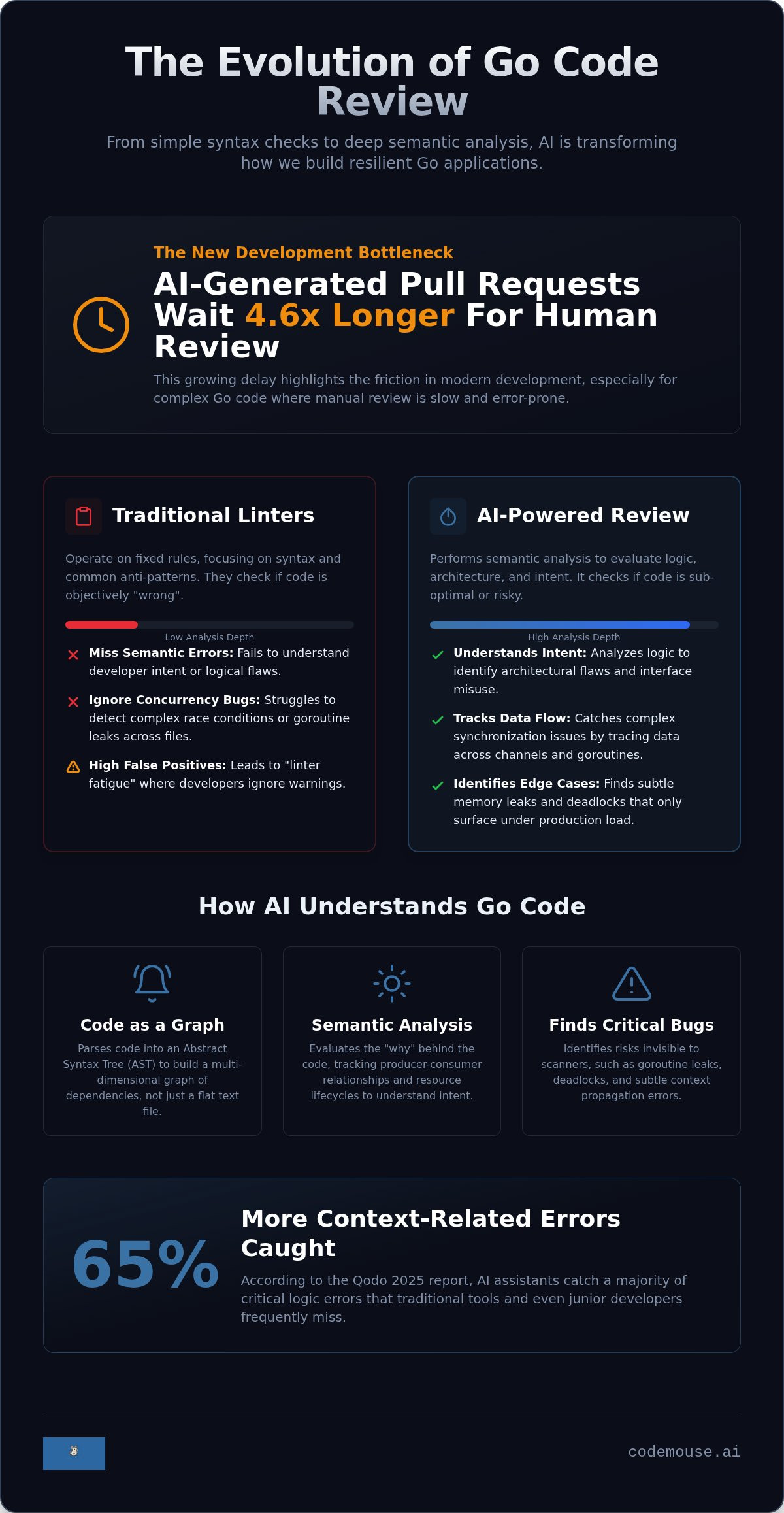
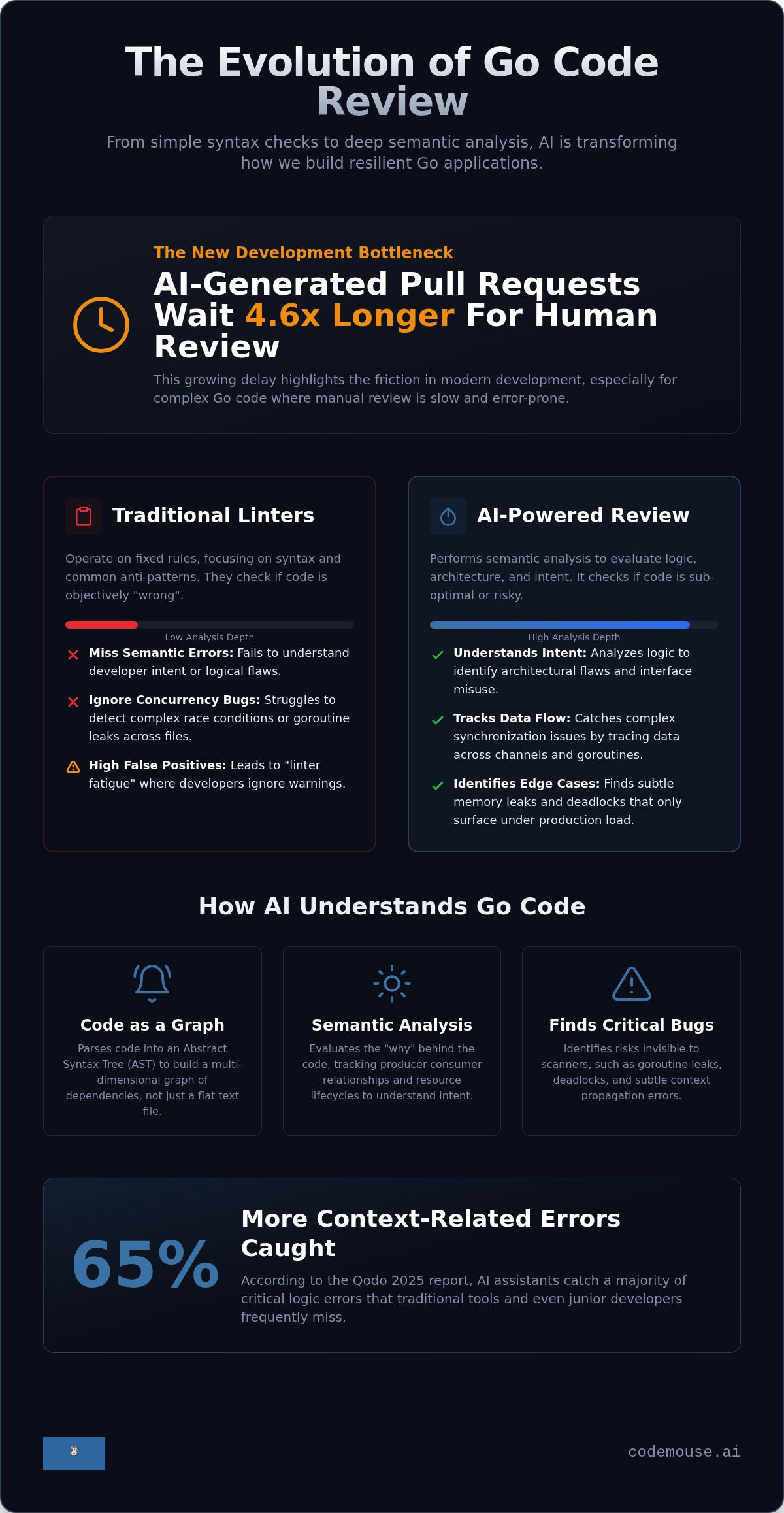
AI-generated pull requests now wait 4.6 times longer for human review than traditional code. This statistic from the 2026 Opsera AI Coding Impact Report highlights a growing bottleneck in the modern development lifecycle. For Go teams, the challenge is even more acute. Reviewing complex goroutine logic and channel communication is a high-cognitive task that drains senior developer time. You've likely seen manual reviews miss subtle memory leaks or interface misuses that only surface under heavy production load.
Traditional linters like staticcheck focus on syntax and basic errors. An effective AI code review for Go goes deeper. It identifies logic-level concurrency bugs and architectural flaws that static analysis tools often ignore. This article provides specific examples and patterns tailored for Go 1.26. You'll learn how AI-powered reviews catch race conditions early and ensure strict adherence to Effective Go. We will cover how to use these tools to achieve faster PR turnaround times and build more resilient production code without increasing the burden on your senior engineers.
Key Takeaways
- Rule-based linters miss semantic errors in Go. Understand why concurrency and memory management require deeper logic analysis than traditional tools provide.
- Modern AI code review for Go analyzes codebases as dependency graphs. It tracks data flow across channels to catch complex synchronization issues.
- Move beyond syntax checks. Semantic reasoning identifies architectural flaws and interface misuses that traditional static analysis often overlooks.
- View practical examples of goroutine leaks and deadlocks. Learn how AI identifies missing context cancellations in long-running processes.
- Implement a high-velocity review pipeline. Use the latest models through a GitHub-integrated infrastructure that supports a bring-your-own-key model.
Table of Contents
Why Go Code Requires More Than Simple Static Analysis
Go is often praised for its simplicity. While the syntax is minimal, the runtime behavior is anything but simple. Managing concurrent execution and memory safety requires deep understanding of the language's internals. Traditional tools rely on Static program analysis to identify syntax errors or common anti-patterns. These tools, like go vet or staticcheck, are effective for catching what is objectively wrong. They fail, however, to understand the developer's intent. AI code review for Go fills this gap by performing semantic analysis. It doesn't just check if code compiles; it evaluates whether the logic follows Go's idiomatic patterns and handles resources safely.
Manual review of Go pull requests remains the primary source of engineering friction. Senior developers often become bottlenecks. They spend hours tracing channel logic and goroutine lifecycles in high-volume PRs. This manual process is slow and prone to human error. Subtle flaws in interface implementation or context propagation frequently slip through to production. Modern teams need a way to automate this cognitive load without sacrificing code quality.
The Limitations of Rule-Based Linting
Linters operate on fixed rules. If a pattern isn't in the database, the linter ignores it. This creates a binary environment where code is either "valid" or "invalid." AI-driven reviews look for what is sub-optimal. They identify logic that may technically work but will cause performance degradation or race conditions under load. Static analysis tools often struggle with complex race conditions in distributed systems because they lack context across multiple files. This leads to linter fatigue. Developers begin to ignore high false-positive rates, which eventually allows critical bugs to pass through the pipeline unnoticed.
Go-Specific Challenges in 2026
By 2026, Go's ecosystem has evolved. Microservices are more complex. Interface-driven design is the standard for decoupled systems. While powerful, these abstractions make tracking data flow difficult. The widespread adoption of generics has added another layer of complexity. Generics improve code reuse but are easy to misuse, leading to bloated binaries or unnecessary heap allocations. High-velocity teams now view automated code review as a core requirement. It provides the depth needed to verify that new Go 1.26 features are used correctly while maintaining the performance standards expected of the language.
How AI Models Understand Go Concurrency and Interface Logic
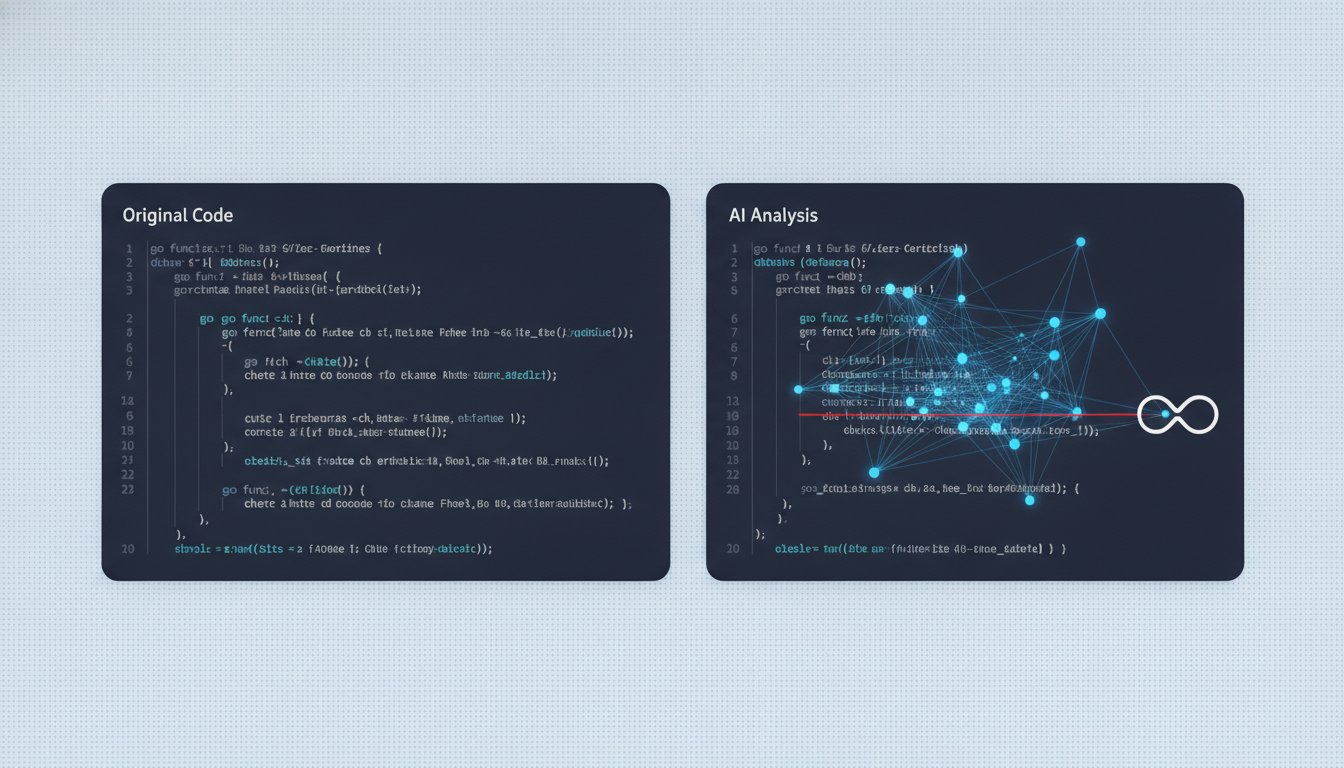
Modern Large Language Models (LLMs) like Claude 3.5 and GPT-4o don't read Go as a flat text file. They parse source code into an Abstract Syntax Tree (AST) to build a multi-dimensional graph of dependencies. This structural understanding is what enables effective AI code review for Go. While a linter sees a channel send, an AI model sees the producer-consumer relationship across goroutines. It tracks the lifecycle of that channel from initialization to closure. This depth is essential for catching the 65% of context-related errors that developers say traditional assistants miss, according to the Qodo 2025 State of AI Code Quality report.
Industry leaders like IBM on AI Code Review emphasize that moving beyond basic syntax is the next evolution in software quality. AI models evaluate the "why" behind the code. They analyze how data flows through complex Go primitives, identifying where a context might be ignored or a mutex might be held too long. This logic-driven approach identifies risks that are invisible to standard regex-based scanners.
Semantic Analysis vs. Pattern Matching
Traditional pattern matching identifies specific "bad" strings of code. Semantic analysis understands intent. In Go, where interfaces are satisfied implicitly, AI determines if a struct implementation aligns with the architectural requirements of the system. It detects shadowed variables that change logic flow without triggering compiler errors. A context aware code review identifies architectural drift by evaluating how new components interact with existing service dependencies over time.
Multi-Model Consensus for Go
No single model is perfect. Claude Fable 5, released in June 2026, currently leads coding benchmarks with an 80.3% score on SWE-bench Pro. However, GPT-4o often excels at identifying edge-case logic. Using a multi-model consensus approach significantly reduces false positives. If both models flag a specific channel deadlock, the developer can trust the feedback is accurate. This cross-validation filters out the noise common in single-model tools. It ensures that AI code review for Go remains a high-signal utility rather than a distraction. You can implement this multi-model approach for your team at codemouse.ai.
AI Code Review for Go vs. Traditional Linters
Traditional linters are reactive. They run within a CI/CD pipeline, often forcing developers to wait several minutes for a failure report. In contrast, AI code review for Go provides near-instant feedback directly in the PR. This shifts the review process left, catching issues before they even reach a human reviewer. Understanding How AI Code Review Works reveals why this speed doesn't compromise depth. While linters flag syntax, AI explains logic. It moves beyond simple error flagging to provide actionable refactoring suggestions that align with the specific intent of your package.
Actionability is the primary differentiator. A standard linter might flag a long function. An AI reviewer will suggest a specific way to decompose that function while maintaining the correct context and channel relationships. This reduces the back-and-forth communication that typically happens during manual reviews. Instead of a senior dev typing out a suggestion, the AI provides the diff. The developer simply reviews and commits the change.
Feature Comparison: AI vs. Static Analysis
Static analysis tools like staticcheck are excellent for identifying unused variables or incorrect format verbs. They struggle with semantic reasoning. AI models identify sub-optimal patterns that aren't technically errors but lead to technical debt. Maintenance is another differentiator. Traditional linters require constant configuration updates to manage false positives in a .golangci.yml file. AI tools are typically zero-config. They use their baseline knowledge of Effective Go to filter noise automatically, ensuring that only high-signal issues reach the developer.
Security and Vulnerability Scanning
Go web frameworks like Gin, Echo, and Fiber are performant but don't prevent logic-based security flaws. AI identifies potential SQL injection or XSS by tracing data flow from request parameters to database queries. It specifically monitors the use of the unsafe package, which bypasses Go's type safety. This AI code analysis for bugs provides a safety net for cryptographic implementations that rule-based scanners often miss. It catches insecure defaults in crypto/tls or improper salt management before the code is merged.
Efficiency also extends to the budget. Open-source linters are free but carry hidden costs in developer time. Manually tuning rules to reduce noise is expensive. A flat-rate AI model provides a predictable cost structure for unlimited reviews. This eliminates the per-seat tax common in legacy enterprise tools. Teams can scale their PR volume without scaling their licensing costs or their manual review overhead.
5 Practical Examples: Go Bugs AI Catches in Pull Requests
Semantic analysis identifies bugs that exist in the logic flow rather than the syntax tree. While a compiler ensures your code runs, an AI code review for Go ensures it runs reliably under load. Here are five practical examples of issues detected during automated reviews.
- Goroutine Leaks: AI flags functions that start goroutines without a mechanism for termination. This often occurs when a
context.CancelFuncis never called or aselectstatement lacks a default case for cleanup. - Channel Deadlocks: Logic errors in producer-consumer synchronization can stall an entire pipeline. AI identifies where an unbuffered channel might block indefinitely because the receiving goroutine has already exited.
- Slice Re-slicing: High-throughput loops that re-slice large datasets can cause significant memory overhead. AI detects when a new slice header still references a large underlying array, preventing the garbage collector from reclaiming memory.
- Error Handling: Beyond checking if an error is nil, AI evaluates if the error is wrapped correctly. It flags anti-patterns where errors are ignored or returned without sufficient context for debugging.
- Interface Pollution: Go favors small interfaces. AI identifies over-engineered packages where interfaces are defined before they are actually needed, violating the "Accept interfaces, return structs" idiom.
Concurrency and Synchronization Bugs
Race conditions are notoriously difficult to debug. A common example involves accessing a shared map across multiple goroutines without a sync.RWMutex. While go test -race catches these at runtime, AI identifies the pattern during the PR phase. It also detects improper use of sync.WaitGroup, such as calling Add() inside a loop that has already started executing. These synchronization flaws often lead to intermittent failures that are impossible to replicate in staging environments. Detecting unbuffered channel blocks that stall the execution pipeline is a core strength of logic-aware analysis.
Memory and Performance Optimization
Performance in Go is often tied to heap allocation. AI identifies "escape to heap" scenarios where variables are moved from the stack unnecessarily, increasing GC pressure. It suggests using sync.Pool in hot paths to reuse objects and reduce allocation overhead. AI identifies inefficient slice growth patterns by analyzing if a slice is being appended to without an initial capacity hint in high-frequency loops. You can start catching these performance bottlenecks today with a 14-day free trial of CodeMouse AI Code Review.
Automating Your Go Review Pipeline with CodeMouse
Theory only matters if it fits into your existing workflow. CodeMouse provides the infrastructure to run AI code review for Go directly within GitHub. It functions as a silent partner in your CI/CD pipeline. Unlike legacy platforms that charge per user, CodeMouse uses a flat-rate model. You pay $10 per month for the organization. This eliminates the "seat tax" that penalizes growing engineering teams. You maintain full control over your data and costs by providing your own OpenAI or Anthropic API keys. This "Bring Your Own Key" (BYOK) model ensures transparency and prevents the vendor lock-in common with bundled AI services.
Integration and Configuration
Setup requires a one-click installation from the GitHub Marketplace. It works with both public and private repositories. Configuration is handled via a simple dashboard where you define your model preferences. You can assign Claude 3.5 Sonnet for complex concurrency logic and GPT-4o for documentation or style checks. This flexibility allows you to leverage the specific strengths of each model as they evolve throughout 2026. You can also customize feedback thresholds for different project types. This ensures the AI remains high-signal for critical microservices while being more relaxed for internal tooling or experimental packages.
The Future of Go Engineering Workflows
Automating the initial review pass changes the economics of software development. Teams implementing these feedback loops often reduce their "Time to Merge" by 40%. The AI handles the repetitive task of catching shadowed variables, goroutine leaks, and improper context usage. This frees senior engineers to focus on high-level architecture and complex business logic. It also creates a continuous learning environment for junior developers. They receive senior-level feedback on every commit, accelerating their mastery of Effective Go patterns and idiomatic interface design.
Testing the system is risk-free. You can run multi-model consensus on your current pull requests to see exactly what your existing linters are missing. Experience the speed and depth of modern semantic analysis without changing your team's habits. Start your 14-day free trial of CodeMouse today.
Scaling Go Quality with Semantic Intelligence
The shift from static analysis to semantic reasoning is no longer optional for high-velocity teams. Traditional linters provide a necessary baseline, but they cannot interpret the complex concurrency patterns that define modern Go 1.26 applications. Implementing an AI code review for Go allows you to catch logic-level flaws, such as synchronization deadlocks and resource leaks, before they reach your production environment. By utilizing multi-model consensus from Claude and GPT, you ensure high-signal feedback that respects Go idioms and your specific architectural intent.
CodeMouse provides this infrastructure without the burden of per-seat pricing. You get unlimited reviews for a flat monthly fee, maintaining full control over your AI spend by bringing your own API keys. This model removes the financial friction of scaling code quality across your entire organization. It is a pragmatic approach to building more resilient systems while respecting your senior developers' time. You can integrate this logic-aware analysis into your workflow today to eliminate bottlenecks and maintain a clean, performant codebase.
Start your 14-day free trial and automate your Go reviews for $10/month. Build better software, faster.
Frequently Asked Questions
Can AI really understand complex Go concurrency like goroutines and channels?
Yes, modern AI models like Claude 3.5 parse Go into an Abstract Syntax Tree to map logical dependencies. This allows the system to track channel communication and goroutine lifecycles across multiple files. It identifies where a context might be missing or a synchronization primitive is misused. This logic-aware approach finds semantic deadlocks that regex-based tools cannot see. It treats your code as a functional graph rather than a flat text file.
Is AI code review more accurate than staticcheck for Go projects?
AI and staticcheck are complementary tools. Staticcheck follows rigid rules to find unused variables or formatting errors with high precision. An AI code review for Go is more accurate for identifying sub-optimal architectural choices and subtle race conditions. Using both ensures you catch both the syntax errors and the underlying logic failures. AI reduces linter fatigue by filtering out irrelevant style nits to focus on production risks.
How does CodeMouse handle large Go monorepos on GitHub?
CodeMouse analyzes the specific diffs within a pull request. It uses the GitHub App integration to understand the context of changed files relative to the rest of the monorepo. This ensures that cross-package interface changes are evaluated for compatibility. The system remains performant because it focuses on the impact of the current PR. It doesn't need to re-scan the entire codebase to provide meaningful feedback on local logic changes.
What is the cost of using AI code review for a Go team in 2026?
Teams pay a flat $10 monthly fee for the CodeMouse platform. This covers unlimited reviews for the entire organization without per-seat restrictions. You also pay for the AI tokens you consume through your own API provider. Based on 2026 rates for models like Claude Fable 5, a typical review costs between $0.05 and $0.15. This is significantly more predictable than legacy enterprise subscriptions that scale with headcount.
Does using my own API key for AI code review save money?
Using your own API key eliminates the markup typically charged by SaaS providers. You pay the raw token rate directly to OpenAI or Anthropic. This model prevents the seat tax where you pay for inactive users. It also provides transparency into exactly how much each review costs. Most teams find this usage-based billing much more cost-effective as their PR volume scales over time.
Will AI code review replace human reviewers for Go pull requests?
AI functions as a first-pass filter rather than a replacement. It handles the repetitive task of catching common Go anti-patterns and concurrency bugs. This allows human reviewers to focus on high-level business logic and system architecture. AI accelerates the cycle by ensuring that by the time a senior dev sees the PR, the obvious issues are already resolved. It empowers the human reviewer to be more effective.
How does CodeMouse ensure my Go code remains private and secure?
CodeMouse does not store your source code. It functions as a secure bridge between GitHub and your chosen AI provider. Because you use your own API keys, your data falls under your existing enterprise agreements with Anthropic or OpenAI. This setup ensures that your proprietary Go logic remains within your controlled environment. Your code is not used for external model training by CodeMouse or the AI providers.
What happens if the AI provides incorrect advice on a Go PR?
Multi-model consensus is the primary defense against incorrect advice. CodeMouse compares findings from different models and only flags issues where they agree. If a suggestion seems wrong, developers can simply ignore the comment. The AI acts as a digital peer, providing suggestions and diffs that require human approval. No code is ever merged automatically without a human developer reviewing the AI's feedback first.