Context-Aware Code Review: Beyond Static Analysis in 2026
Most AI reviewers are just linters with a better vocabulary. They flag trailing commas but miss the architectural drift happening across your services. If your automated feedback ignores project-specific patterns, it's just noise. You need a tool that understands your intent, not just your syntax. Implementing context aware code review is the only way to move beyond basic pattern matching.
You've likely dealt with generic PR comments that feel like they've never seen your codebase before. It's frustrating to filter through irrelevant suggestions just to find one valid logic bug. Automation should reduce your workload, not add a layer of management. This article explains how context-aware AI analyzes entire repositories to provide precise, low-noise feedback on every GitHub pull request. You'll learn how to catch complex logic bugs that standard linters miss and maintain high code quality without increasing headcount. We'll cover how 2026-era models like Claude 5 and GPT-5.5 use massive context windows to act as a true partner in your development workflow.
Key Takeaways
- Understand how semantic analysis replaces regex-based patterns to catch logic bugs across your entire repository.
- Learn how indexing and embeddings enable a context aware code review that mirrors human architectural intent.
- Reduce PR noise by filtering out generic AI feedback that ignores your specific project conventions.
- Compare Claude and GPT models to find the right balance between reasoning depth and processing speed.
- Integrate AI reviews via a GitHub App using a transparent "Bring Your Own Key" model for direct cost control.
Table of Contents
What is Context-Aware Code Review?
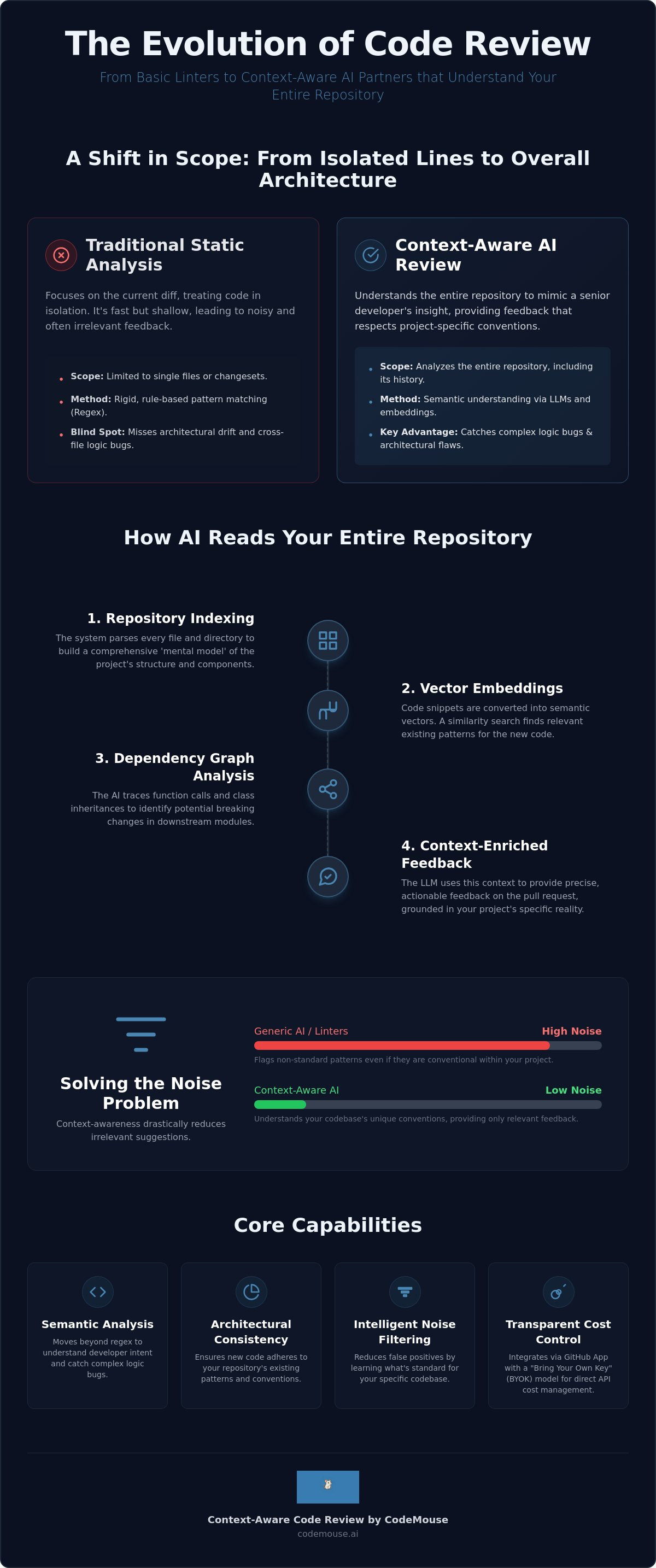
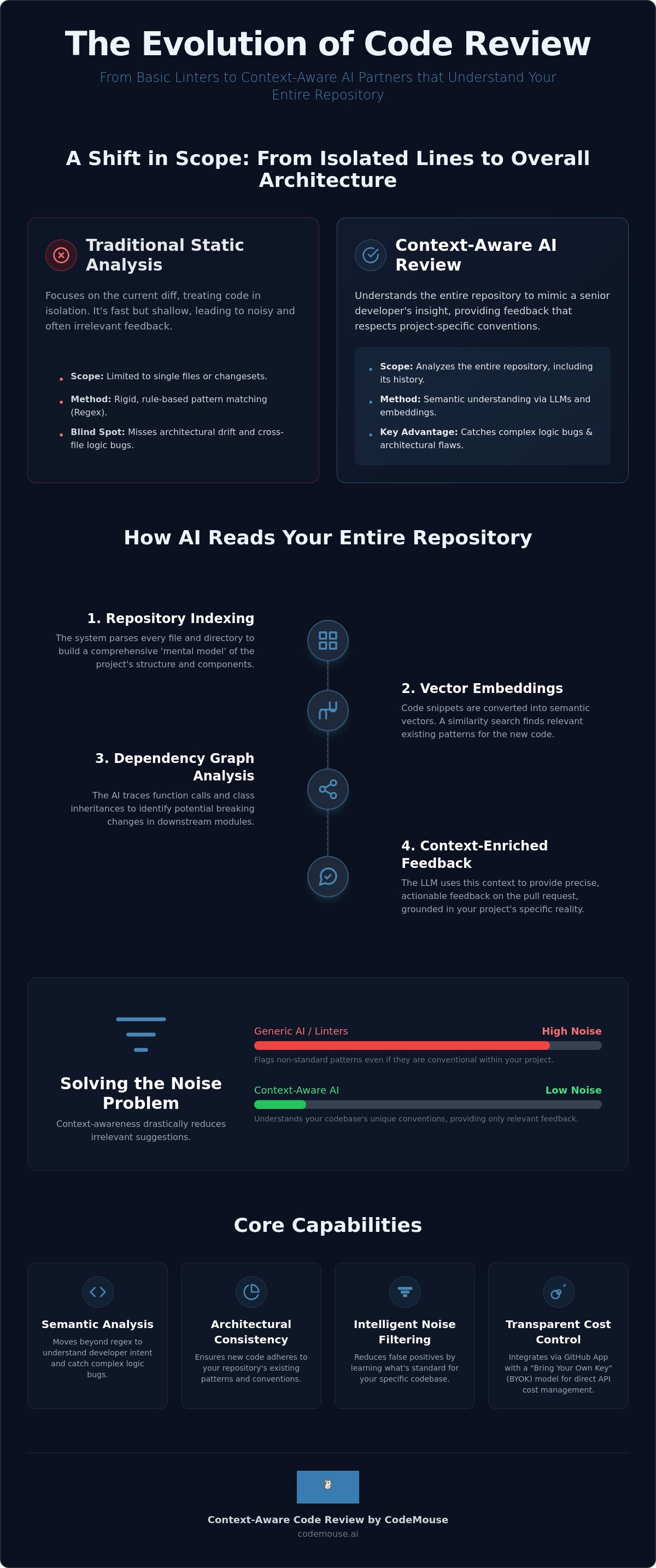
A standard code review usually focuses on the lines changed in a specific pull request. This narrow view is a bottleneck. It ignores how a single function change might ripple through an entire microservice architecture. A context aware code review changes the scope. It doesn't just look at the diff. It indexes the entire repository to understand cross-file dependencies and project-specific logic. This shift from regex-based pattern matching to semantic understanding allows the AI to catch errors that traditional tools miss entirely.
Modern CI/CD pipelines demand speed. Manual reviews often become the primary delay in shipping features. Line-by-line analysis by humans is thorough but slow. Linters are fast but shallow. Context awareness bridges this gap by mimicking a senior developer's mental model. It knows your naming conventions, your state management patterns, and your database schema. It provides feedback that actually makes sense for your specific project. It's the difference between being told you forgot a semicolon and being told your new utility function duplicates existing logic in a different module.
Context vs. Traditional Static Analysis
Traditional static analysis tools are excellent at enforcing style guides and identifying known CVE patterns. They excel at "if-this-then-that" logic. However, they lack an understanding of architectural consistency. A linter might tell you that a variable is unused. It won't tell you that your new API endpoint violates the project's internal security wrapper. A context aware code review reduces false positives by understanding the relationship between different modules. If a specific pattern is standard in your repo, the AI won't flag it as an error just because it's non-standard in a generic library. This specificity keeps developer velocity high.
The Role of LLMs in Semantic Interpretation
The transition to semantic interpretation is driven by Large Language Models (LLMs). Unlike older tools that rely on rigid rules, LLMs use probabilistic reasoning to interpret developer intent. When you use AI code analysis for bugs, the model doesn't just check for syntax errors. It evaluates whether the logic matches the stated goal of the PR. Models like Claude and GPT interpret intent by looking at the surrounding code and documentation. They can identify when a developer has introduced a race condition or a logic flaw that only manifests because of how a separate utility file is structured. This level of depth was previously only possible with manual, time-consuming peer reviews.
The Mechanics: How AI 'Reads' Your Entire Repository
To perform a context aware code review, an AI must move beyond the current PR diff. It requires a comprehensive understanding of the existing codebase. This process begins with repository indexing. The system parses every file, directory, and configuration to create a persistent mental model of the project. It isn't just about reading text; it's about understanding how components interact. By mapping these relationships, the AI can predict how a change in a low-level utility might break a high-level service three directories away.
2026 models like Claude 5 or GPT-5.5 offer context windows exceeding one million tokens. While this allows for massive data ingestion, it isn't always efficient or cost-effective for every PR. Instead, modern tools utilize a Context-Enriched Retrieval-Augmented LLM approach. This framework combines the raw power of large windows with targeted retrieval. The AI identifies the most relevant code snippets, documentation, and historical PRs to inject into the prompt. This ensures the feedback is grounded in your project's specific reality rather than generic best practices.
Vector Databases and Code Embeddings
The core of this "reading" ability lies in vector embeddings. The AI converts code snippets into high-dimensional mathematical vectors. These vectors represent the semantic meaning of the code rather than just the syntax. When a developer opens a PR, the system performs a similarity search within a vector database. It finds existing utilities, constants, or patterns that are relevant to the new code. This real-time indexing keeps the mental map updated with every commit. If you're looking for a way to implement this without a total workflow overhaul, CodeMouse provides this infrastructure as a silent partner in your CI/CD pipeline.
Dependency Graph Analysis
Beyond simple similarity, the AI constructs a dependency graph of your entire project. It traces function calls, class inheritances, and API contracts across the project structure. This allows it to identify breaking changes in downstream modules that a standard linter would never see. The analysis ensures that new code follows existing design patterns. If your project uses a specific error-handling wrapper for all database queries, a context aware code review will flag any new query that ignores that convention. This mapping of file relationships turns the AI from a simple spell-checker into an architectural gatekeeper.
Solving the Noise Problem in Automated Pull Request Reviews
Hallucinated feedback is a velocity killer. When an automated tool flags a perfectly valid pattern because it doesn't understand your project's internal library, it creates unnecessary friction. Developers end up spending more time debunking incorrect AI suggestions than they do writing code. This noise dilutes the value of automation. A context aware code review solves this by grounding every suggestion in the actual state of your repository. It doesn't guess; it verifies against your existing files.
Context-aware systems filter out generic suggestions that don't apply to your stack. If your team uses a custom wrapper for error handling, a standard AI might suggest a native try-catch block. A context-aware system recognizes your pattern and stays silent. This precision ensures that automated code review adds genuine value rather than just increasing the volume of PR comments. You get fewer notifications, but the ones you receive are critical.
Filtering False Positives with Project Specs
READMEs and internal documentation serve as the AI's ground truth. By indexing these files, the AI learns your team's specific "Definition of Done." It understands your architectural constraints and naming conventions. This prevents the AI from flagging non-standard code that is actually required by your project's unique logic. Teaching the AI these specifics reduces the cognitive load on human reviewers. They no longer have to sift through style nitpicks to find actual logic flaws. The system only presents issues that violate your specific project requirements.
The Multi-Model Consensus Advantage
Models like Claude 3.5 and GPT-4o have different strengths. Claude often excels at nuanced reasoning and long-context understanding. GPT-4o is frequently more precise with standard library patterns and syntax. They don't always agree, and that's a feature, not a bug. By running a review through multiple models, you can use a "majority vote" system to verify issues. Consensus logic is the ultimate filter for AI hallucinations. If three different models identify the same logic error, the confidence level is high. Only these high-confidence comments reach the PR, ensuring your team only acts on verified feedback.
Claude vs. GPT-4: Choosing the Best Model for Context
Choosing an LLM for your development pipeline is a trade-off between reasoning depth and execution speed. For a context aware code review, the model's ability to hold repository state in its active memory is non-negotiable. While RAG systems help retrieve relevant snippets, the underlying model must still synthesize that data into a coherent architectural critique. In 2026, the choice usually comes down to Claude 3.5 Sonnet and GPT-4o. Each has distinct advantages depending on your project's complexity and your team's velocity requirements.
Claude's Reasoning Strengths
Claude 3.5 Sonnet is the current leader for nuanced reasoning. Its 200k token context window allows it to ingest larger portions of your codebase simultaneously. This reduces the need for aggressive filtering and allows the model to see subtle, cross-file dependencies that smaller windows miss. Claude shows lower hallucination rates when interpreting complex technical documentation or internal wikis. It also follows custom system prompts with higher fidelity. If your project relies on strict, non-standard architectural rules, Claude is the more reliable choice for maintaining consistency across multi-file refactors.
GPT-4's Utility in Rapid Feedback
GPT-4o remains the standard for speed and precision in common languages like Python and JavaScript. It excels at identifying boilerplate errors and standard library misuse. For small, incremental PRs, GPT-4o provides faster response times without sacrificing quality. It is a highly efficient tool for catching "low-hanging fruit" bugs before they reach human reviewers. You can find more details on AI code review for GitHub to see how these models compare in high-volume production environments.
A hybrid approach is often the most cost-effective strategy. Use GPT-4o for rapid, daily PRs where speed is the priority. Reserve Claude for complex merges that touch multiple modules or core infrastructure. This tiered strategy optimizes your API spend while ensuring high reasoning power where it matters most. Relying on a single model creates a single point of failure in your review logic. Using both ensures that your context aware code review remains robust against model-specific blind spots.
Transparency in model selection is vital for cost control and quality assurance. Many tools hide which model they use, making it impossible to predict your monthly spend or the depth of the analysis. CodeMouse provides absolute transparency by letting you bring your own API keys. You choose the model that fits your budget and your project's specific technical requirements.
Implementing Contextual Reviews with CodeMouse
CodeMouse provides the infrastructure for a context aware code review without forcing a total workflow overhaul. It operates as a lightweight GitHub App. It doesn't require complex deployment or long-term consulting. You connect it to your repositories, and it starts analyzing PRs immediately. The goal is to provide a silent partner that enhances your current process rather than replacing it with a bloated management platform.
Transparency is the core of the CodeMouse philosophy. Most AI tools hide their model usage and mark up token costs. CodeMouse uses a "Bring Your Own Key" (BYOK) model. You provide your own API keys for Anthropic or OpenAI. This means you pay the raw provider costs for every review. It's the most pragmatic way to scale AI across a large engineering team without facing unpredictable monthly bills. You stay in control of which models are used and how much you spend.
Setting Up Your GitHub Workflow
Integration is fast. You can move from the GitHub Marketplace to your first review in about two minutes. The process is linear:
- Install the CodeMouse App on your organization or specific repositories.
- Input your API keys for Claude or GPT in the dashboard.
- Configure custom instructions to tell the AI about your specific project patterns.
- Define which branches or PR labels should trigger the AI assistant.
Custom instructions are vital for a context aware code review. You can instruct the AI to ignore certain legacy directories or to prioritize specific security wrappers. This fine-tuning ensures the feedback aligns with your team's unique "Definition of Done."
Maximizing ROI on AI Spend
The pricing model is built for efficiency. CodeMouse charges a flat $10/month fee regardless of your team size. There is no "per seat" tax. Whether you have five developers or fifty, the subscription stays the same. Compare this to traditional SaaS tools that often charge $24 to $60 per user. For a 10-person team, those costs scale rapidly. With CodeMouse, your only variable cost is your direct API usage.
You maintain full control over your budget. You can monitor token usage through your provider dashboards. If a specific repository is consuming too many resources, you can adjust the triggers or switch to a more cost-effective model. You can scale to unlimited repositories and unlimited team members without increasing your base subscription fee. It's a builder-first approach to maintaining code quality.
Scaling Review Quality with Contextual Intelligence
Static analysis has reached its functional limit. Moving beyond simple syntax checking is now a requirement for engineering teams that value velocity and precision. A context aware code review provides the depth needed to catch complex logic bugs that traditional linters miss entirely. By utilizing repository indexing and semantic embeddings, AI now understands the architectural intent behind every pull request. This shift eliminates irrelevant noise and ensures that automated feedback aligns with your project's specific conventions and documentation.
Efficiency is the priority. CodeMouse offers a pragmatic path to high-quality reviews without the burden of per-seat pricing. You maintain full transparency and control over your AI costs through the bring-your-own-key model. For a flat $10/month, you can support unlimited team members and repositories with multi-model consensus logic. It's the infrastructure you need to maintain high standards without increasing headcount or manual overhead. Start your 14-day free trial of CodeMouse for context-aware PR reviews and stop filtering through irrelevant automated noise. Ship faster with confidence.
Frequently Asked Questions
What makes a code review 'context-aware' vs. standard AI feedback?
Context-aware reviews analyze your entire repository's structure and dependencies instead of just the isolated lines in a pull request. Standard AI feedback often flags generic syntax issues. A context aware code review identifies how changes impact remote modules or violate project-specific architectural patterns. It uses repository indexing to ground every comment in your actual codebase reality rather than guessing based on generic training data.
Does CodeMouse store my code to build its context map?
No, CodeMouse does not store your source code on its own servers to build a permanent database. It indexes your repository temporarily to generate semantic embeddings required for the review process. This metadata allows the AI to find relevant context without keeping a copy of your proprietary logic. Security is handled via the GitHub App permissions model, ensuring access is limited to the review execution phase.
Which AI model is better for context-aware reviews: Claude or GPT?
The choice depends on your specific needs for reasoning depth versus execution speed. Claude 3.5 Sonnet is currently the leader for complex, multi-file reasoning due to its larger context window and lower hallucination rates. GPT-4o provides faster feedback for standard boilerplate and syntax-heavy PRs. CodeMouse supports both, allowing you to use multi-model consensus to verify high-confidence bugs across different architectures.
How do I reduce 'noise' and false positives in automated reviews?
You reduce noise by providing custom instructions and leveraging repository documentation. Teaching the AI your team's specific "Definition of Done" through READMEs and configuration files helps it filter out irrelevant suggestions. Additionally, using consensus logic between multiple models ensures that only issues verified by both Claude and GPT reach your PR. This focused approach prevents the AI from flagging intentional project-specific patterns as errors.
Can context-aware AI understand my project's custom frameworks?
Yes, the AI learns your custom frameworks by scanning your existing implementations and internal libraries. Because it indexes your entire repository, it recognizes the patterns and utility functions unique to your stack. It treats your internal code as the ground truth. This allows it to suggest improvements that utilize your own abstractions rather than generic, third-party alternatives that don't exist in your environment.
Is there a limit to the repository size for context-aware analysis?
There is no hard limit on repository size, but very large codebases are handled through intelligent retrieval. Instead of feeding the entire repo into a single prompt, the system uses RAG (Retrieval-Augmented Generation) to pull the most relevant files for each specific PR. This ensures that even massive monorepos receive a precise context aware code review without exceeding model token limits or inflating your API costs.
How does 'Bring Your Own API Key' work with CodeMouse?
You enter your own Anthropic or OpenAI API keys into the CodeMouse dashboard during setup. CodeMouse then acts as the infrastructure layer that manages the GitHub integration and repository indexing. You pay a flat $10/month fee to CodeMouse and pay your AI provider directly for the tokens consumed. This model provides total transparency and ensures you aren't paying hidden markups on AI usage costs.