AI Code Review for Security Vulnerabilities: Beyond Static Analysis
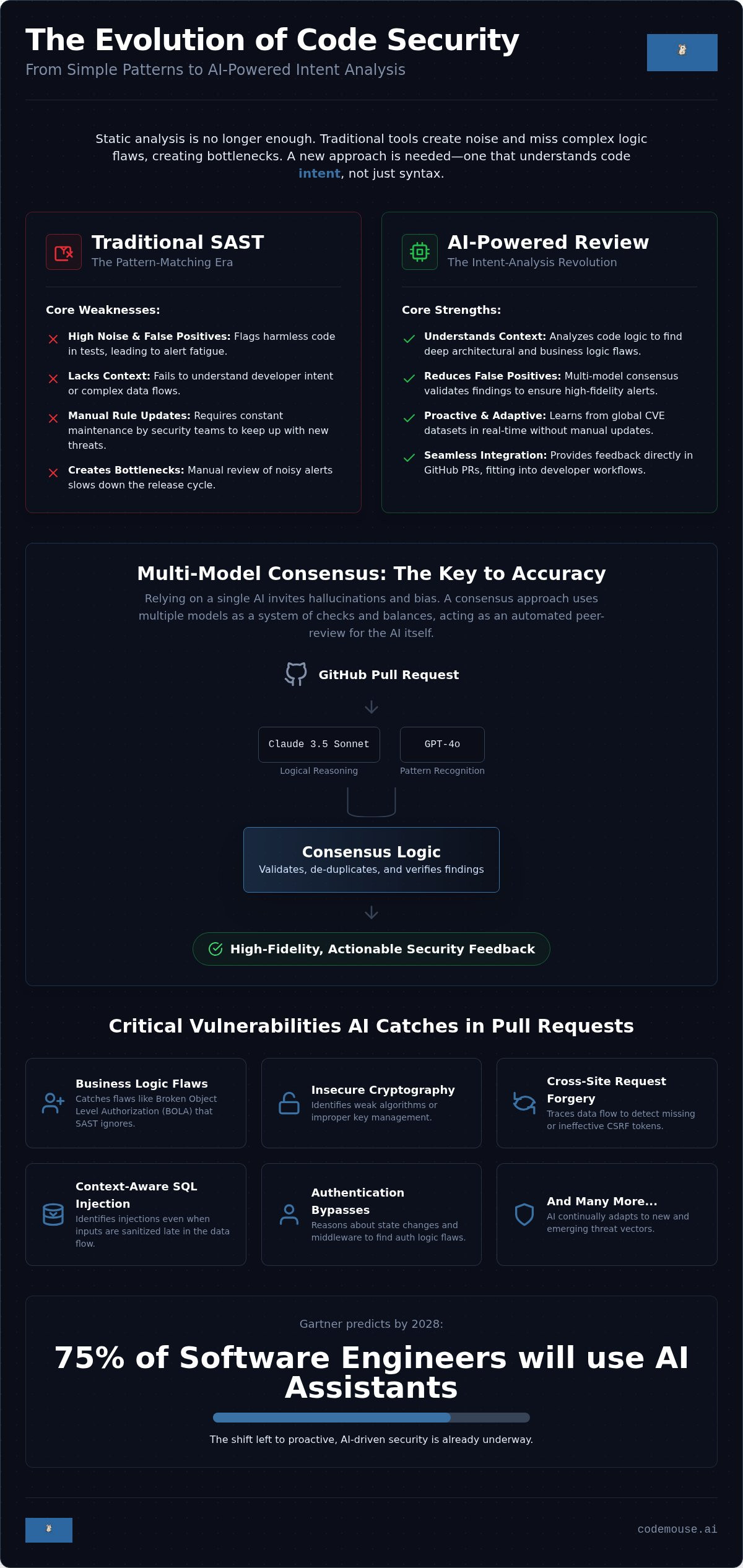
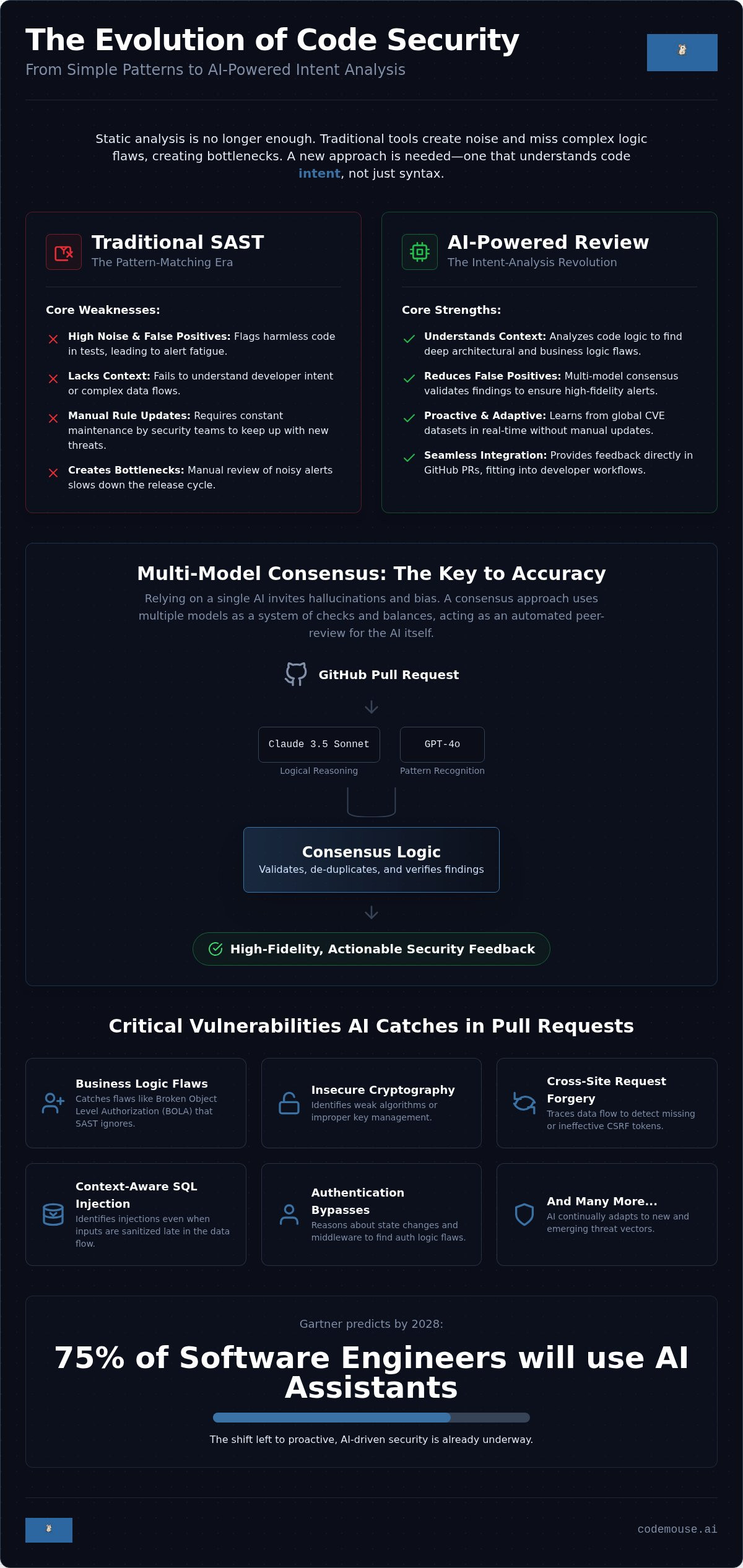
Static analysis is no longer enough to protect a modern codebase. Most logic flaws don't look like broken patterns; they look like valid code that behaves badly in specific contexts. Traditional SAST tools generate too much noise, while manual reviews create massive bottlenecks in your release cycle. Effective AI code review for security vulnerabilities must bridge this gap by understanding intent, not just syntax.
You've likely seen a single LLM hallucinate or miss an edge case that a human would catch. It's a common pain point. Relying on one model often trades one type of noise for another. This article explores how a multi-model consensus approach identifies the deep architectural flaws that standard tools ignore. You'll learn how to automate security feedback on every GitHub PR while significantly increasing your detection rate for business logic vulnerabilities.
By 2028, Gartner predicts 75% of software engineers will use AI assistants. The shift is already happening. We'll examine why a "Bring Your Own Key" (BYOK) model provides the cost-effective scaling needed for high-volume environments. We'll also look at how combining models like Claude 3.5 Sonnet and GPT-4o creates a more resilient security layer for your development workflow. It's time to move beyond pattern matching and treat security as a logic problem.
Key Takeaways
- Understand why AI code review for security vulnerabilities succeeds where regex-based SAST tools fail by focusing on code intent over simple patterns.
- Reduce false positives and hallucinations through multi-model consensus logic that validates security findings across different LLMs.
- Detect complex business logic flaws, such as BOLA and insecure cryptography, directly within your pull request before they reach production.
- Streamline your development cycle with native GitHub integrations that provide actionable security feedback without creating release bottlenecks.
- Optimize your security budget with a flat-rate infrastructure that uses your own API keys for unlimited, context-aware reviews.
Table of Contents
- Beyond SAST: The Evolution of AI Code Review for Security Vulnerabilities
- Multi-Model Consensus: Why Two AI Brains Are Better for Security
- Critical Vulnerabilities AI Catches in Pull Requests
- Implementing AI Security Reviews Without Developer Friction
- CodeMouse: High-Fidelity Security Reviews at a Flat Rate
Beyond SAST: The Evolution of AI Code Review for Security Vulnerabilities
Security isn't a pattern matching game. Traditional tools treat it like one. Static Application Security Testing (SAST) relies on rigid rules and regular expressions to flag suspicious strings. While this catches low-hanging fruit like hardcoded credentials, it fails to understand the developer's intent. AI code review for security vulnerabilities represents a fundamental shift. Instead of checking if code looks wrong, Large Language Models (LLMs) analyze the context to determine if it behaves wrong. This context awareness is what prevents sophisticated security bypasses from reaching production.
The goal is shift-left security. It's significantly cheaper to fix a logic flaw during the pull request phase than to patch a live exploit. AI enables this by providing immediate, high-fidelity feedback directly where developers work. It understands the "why" behind a code change. If a developer modifies an authentication middleware, the AI doesn't just look for syntax errors. It evaluates how that change affects the entire security posture of the application.
Why Traditional Static Analysis Tools Struggle
SAST tools are notoriously noisy. They often trigger alerts on mock data in test suites or ignore vulnerabilities hidden behind complex data flows. Because these tools lack a holistic view of the application, they can't distinguish between a dangerous production flaw and a harmless internal utility. Maintenance is another burden. Security teams must constantly update signature databases to keep up with new exploits. This creates a bottleneck. Developers often start ignoring alerts because the noise-to-signal ratio is too high, allowing critical vulnerabilities to slip through.
The AI Advantage in Vulnerability Detection
LLMs treat code as a language, not just a series of tokens. This allows them to identify semantic inconsistencies that regex-based tools miss. An AI-powered review can reason about complex attack vectors like Cross-Site Request Forgery (CSRF) or authentication bypasses by tracing how data moves through the entire PR. This is the core of Automated Code Review in the modern era. Models learn from global CVE datasets in real-time. They don't just find known patterns; they recognize logic that feels "off" based on the trillions of lines of secure code they've analyzed. It's a proactive approach that scales with your codebase without requiring manual rule updates.
Multi-Model Consensus: Why Two AI Brains Are Better for Security
Reliance on a single AI model for security is a gamble. While LLMs are powerful, they are prone to "hallucinations", which involve confidently stating that a vulnerability exists when it doesn't, or missing a real one entirely. In the context of AI code review for security vulnerabilities, a single model's bias can lead to "phantom" alerts that waste developer time and erode trust in automation. Consensus logic solves this by treating security analysis as a collaborative process rather than a solo task. Research into Generative AI for Software Security Analysis highlights the importance of multi-layered verification. By running multiple models against the same pull request, you create a system of checks and balances. If one model flags a potential SQL injection but another identifies the input as already sanitized, the system can de-duplicate or flag the discrepancy for human review. Consensus logic acts as an automated peer-review for the AI itself, ensuring no single model's blind spot becomes a production vulnerability.
Comparing Claude vs GPT for Security Analysis
Different models bring unique strengths to the security stack. Claude 3 Opus and Claude 3.5 Sonnet excel at logical reasoning and maintaining a large context window. They are better at understanding how a change in one file affects a distant module. GPT-4o, conversely, provides high-speed pattern matching. It's highly effective at spotting known insecure coding practices that follow documented patterns. For a deeper dive into these differences, see our guide on GPT-4o vs Claude 3 Opus for Code Review. Combining these models allows you to catch both obvious errors and subtle logic flaws that a single model might ignore.
The Mechanics of Multi-Model Verification
The verification process follows a linear, three-step progression to ensure accuracy without slowing down the merge:
- Step 1: Initial Scan. A primary model performs an initial sweep of the PR to identify potential vulnerabilities based on general code patterns and syntax.
- Step 2: Context Validation. A secondary model, often with better reasoning capabilities, analyzes the flagged lines within the broader repository context to confirm if the vulnerability is exploitable.
- Step 3: Consolidated Feedback. The system merges the findings, removes duplicates, and posts a single, high-fidelity comment on the GitHub PR.
This tiered approach ensures that your security feedback is accurate and actionable. You can try CodeMouse for free to see this multi-model logic in action on your own repositories. It's a pragmatic way to scale security expertise across your entire engineering team without increasing the manual review burden.
Critical Vulnerabilities AI Catches in Pull Requests
Modern software security relies on complex relationships between data and permissions. Traditional tools often miss these connections because they lack context. AI code review for security vulnerabilities excels here by analyzing the logic of a change rather than just the syntax. It identifies Broken Object Level Authorization (BOLA) in new API endpoints where a user might access resources they don't own. It also detects Insecure Direct Object References (IDOR) within controller logic that standard scanners typically overlook. By understanding the relationship between a user's session and the requested resource ID, AI provides a layer of defense that pattern-matching simply cannot match.
Injection flaws remain a persistent threat in dynamic logic. AI identifies SQLi and NoSQLi risks in complex ORM queries where user input isn't properly scoped. It also catches sensitive data exposure, such as PII or credentials accidentally included in logs or code comments. This proactive detection is essential for maintaining compliance and protecting user trust. Using AI ensures these flaws are caught before they ever reach a production environment.
Authentication and Authorization Logic
Missing middleware on sensitive routes is a common oversight during rapid development. AI identifies these gaps by comparing the security requirements of an endpoint against the implemented logic. It also spots "backdoor" admin parameters or hardcoded bypasses left in production-bound code. For teams using JWTs, AI verifies implementation details like token expiration and signature verification logic to ensure the authentication chain remains unbroken.
Data Integrity and Injection Prevention
AI identifies risky usage of eval() or unsafe functions in modern runtimes like Node.js or Python. It tracks how unsanitized inputs move through your application, flagging potential command injection points. Proper Cross-Origin Resource Sharing (CORS) configurations are also checked to prevent unauthorized domains from interacting with your API. Following the OWASP AI Security and Privacy Guide helps teams build these resilient systems by default.
Cryptographic Best Practices
Deprecated algorithms like MD5 or SHA-1 are flagged immediately for password hashing or data integrity checks. AI ensures secure random number generation for session identifiers and cryptographic salts. While a simple search might miss a variable named secret_key, AI identifies hardcoded keys by understanding the semantic role of a variable within the application's data flow. This prevents weak cryptographic implementations from compromising your entire security architecture.
Implementing AI Security Reviews Without Developer Friction
Security tools often act as gatekeepers. They halt pipelines and demand manual intervention. This friction leads to security fatigue, where developers bypass checks to meet deadlines. Implementing AI code review for security vulnerabilities shouldn't feel like adding a new step to your day. It should be a silent partner. By living where the code lives, it provides feedback without requiring a context switch. It integrates directly into the existing workflow as a native participant in the peer-review process.
Reviews must be non-blocking. A security insight should be treated as a peer-review comment, not a build failure. This allows the team to maintain momentum while addressing risks. AI provides context-aware comments. It doesn't just flag a line; it explains the specific risk based on the data flow changes. For large, multi-file PRs, the AI summarizes the total security impact. This helps reviewers focus on the most sensitive files first. To see how this fits into a broader strategy, explore our guide on GitHub PR Automation Tools.
The GitHub App Workflow
Native integration is the standard. A GitHub App triggers automatically on every PR creation or new commit push. There's no manual setup for each branch. Feedback appears as direct inline comments. This makes fixes actionable. Developers can resolve a security issue as easily as a formatting suggestion. A centralized dashboard still exists, but it's for tracking long-term trends across repositories, not for daily PR management. This keeps the focus on the code.
Balancing Speed and Security
Not all alerts are equal. AI prioritizes 'High' and 'Critical' issues, ensuring human reviewers see the most dangerous flaws first. It reduces fatigue by filtering out trivial style issues or low-risk warnings. Automated PR summaries highlight security-sensitive file changes, such as modifications to auth or config directories. This surgical precision ensures that security doesn't come at the cost of velocity. It's about finding the right signal in the noise without slowing down the merge.
You can install CodeMouse on GitHub to start automating your security reviews today. It provides the infrastructure you need to scale security expertise without adding developer friction.
CodeMouse: High-Fidelity Security Reviews at a Flat Rate
Engineering teams often face a dilemma: scale security or save budget. Traditional tools force a choice between high costs or limited coverage. CodeMouse is built for engineers who value utility over marketing fluff. It provides high-fidelity AI code review for security vulnerabilities without the typical enterprise overhead. It's a builder's tool that integrates into your workflow, provides the necessary infrastructure, and then steps out of the way. No sales calls. No opaque pricing.
The pricing model is intentionally transparent. CodeMouse charges a flat $10/month fee. This ends the "per-seat tax" that often penalizes growing teams. By removing the cost-per-developer barrier, you can encourage your team to push small, frequent pull requests safely. Every PR gets a high-quality security check, regardless of how many developers are on the project. This approach treats security as a standard part of the development lifecycle, not an expensive add-on. You can learn more about how we're ending the per-seat tax on engineering quality in our detailed guide.
Total Control Over AI Security Costs
CodeMouse uses a "Bring Your Own Key" (BYO-key) model. You provide your own API keys for OpenAI or Anthropic. This gives you absolute transparency. You see exactly what you spend on API usage without hidden markups from a middleman. It's cost-effective for high-volume environments where PR frequency is high but logic remains focused.
- Flexibility: Switch between Claude 3.5 Sonnet and GPT-4o. Use the model that best fits your specific security reasoning requirements.
- No Throttling: Your review speed is determined by your own API tier. You aren't limited by a tool provider's shared infrastructure or artificial rate limits.
- Scalability: Control your costs by setting usage limits directly with your AI provider.
Getting Started with CodeMouse
Setup is designed for speed. Connect your GitHub account. Provide your API key. The app starts reviewing immediately. There's no complex onboarding or long-winded configuration. A 14-day free trial is available, allowing you to test the multi-model consensus logic on your most complex repositories. It's the most direct way to bring high-quality AI code review for security vulnerabilities to every developer on your team. Start small, scale as needed, and keep your code secure without the friction of traditional enterprise software.
Securing Your Development Velocity
Transitioning from pattern-based SAST to context-aware AI is the only way to catch deep logic flaws at scale. Multi-model consensus ensures high-fidelity feedback while reducing the manual burden on your senior engineers. By implementing automated security checks directly in GitHub PRs, you eliminate bottlenecks without compromising on code quality. It's about finding the right signal in the noise before code ever reaches production.
CodeMouse provides the infrastructure for this evolution. It offers a $10/month flat rate for unlimited GitHub PR reviews. You bring your own API keys to maintain full control over costs while leveraging the combined reasoning power of Claude and GPT. This pragmatic approach ensures that AI code review for security vulnerabilities remains a sustainable, high-performance part of your workflow. It's time to treat security as a logic problem, not a regex match.
Ready to automate your security feedback? Start your 14-day free trial of CodeMouse AI and begin catching complex flaws today. Building secure software should be a standard part of your process, not a release bottleneck. Secure your code at the speed of development.
Frequently Asked Questions
How does AI code review differ from traditional SAST tools?
AI analyzes the semantic intent of your code while traditional SAST tools rely on static regular expressions. Traditional tools often trigger high false-positive rates because they don't understand context. AI code review for security vulnerabilities identifies how data flows through your application, which allows it to catch complex logic flaws that regex-based systems simply miss. It's a shift from pattern matching to logical reasoning.
Can AI really find zero-day security vulnerabilities in my code?
AI identifies zero-day risks by recognizing insecure logic patterns rather than searching for specific CVE signatures. It reasons about how an attacker might exploit a specific code structure, such as a missing authorization check on a new API route. Because it doesn't rely on a database of known bugs, it can catch unique vulnerabilities specific to your application's business logic before they're ever documented.
Will using CodeMouse expose my source code to AI model training?
CodeMouse doesn't use your code to train AI models. When you use your own API keys for OpenAI or Anthropic, your data is subject to their standard API privacy terms, which typically exclude API-submitted data from model training. This BYO-key approach ensures you maintain full ownership and control over your intellectual property while leveraging frontier models for security analysis. Your code remains your own.
How much does the AI API usage cost on top of the CodeMouse subscription?
You pay for AI usage directly to your provider based on their current token rates. Costs depend on your PR volume and the specific models you select, such as Claude 3.5 Sonnet or GPT-4o. This expense is separate from the $10/month CodeMouse flat fee. It's a transparent model that ensures you only pay for the compute you use without extra markups from a tool provider.
Does CodeMouse support security reviews for monorepos?
Monorepos are fully supported. The GitHub App analyzes the specific changes within each pull request, regardless of your repository's internal directory structure. It maintains context for the files being modified, ensuring that security feedback is relevant to the specific service or module being updated. This makes it a pragmatic choice for teams managing large, complex codebases with multiple interconnected projects and services.
What happens if the two AI models in the consensus disagree on a bug?
Disagreements are handled through a consolidation layer. The system merges findings from both models to remove duplicates and filter out hallucinations. If one model identifies a risk that the other disputes, the logic prioritizes the most context-aware reasoning to ensure you receive high-fidelity feedback. This consensus-driven approach is the core of effective AI code review for security vulnerabilities, significantly reducing the noise of traditional tools.
Can I customize the security rules or prompts used by the AI?
You can't modify the internal prompts, but you can control the reasoning style by selecting your preferred models. Switching between Claude 3.5 Sonnet and GPT-4o allows you to prioritize either deep logical reasoning or rapid pattern matching. This flexibility lets you adjust the review's focus based on your project's specific security needs without needing to manage complex prompt engineering or custom rule sets yourself.