
Flat Rate AI Code Review: Ending the Per-Seat Tax on Engineering Quality
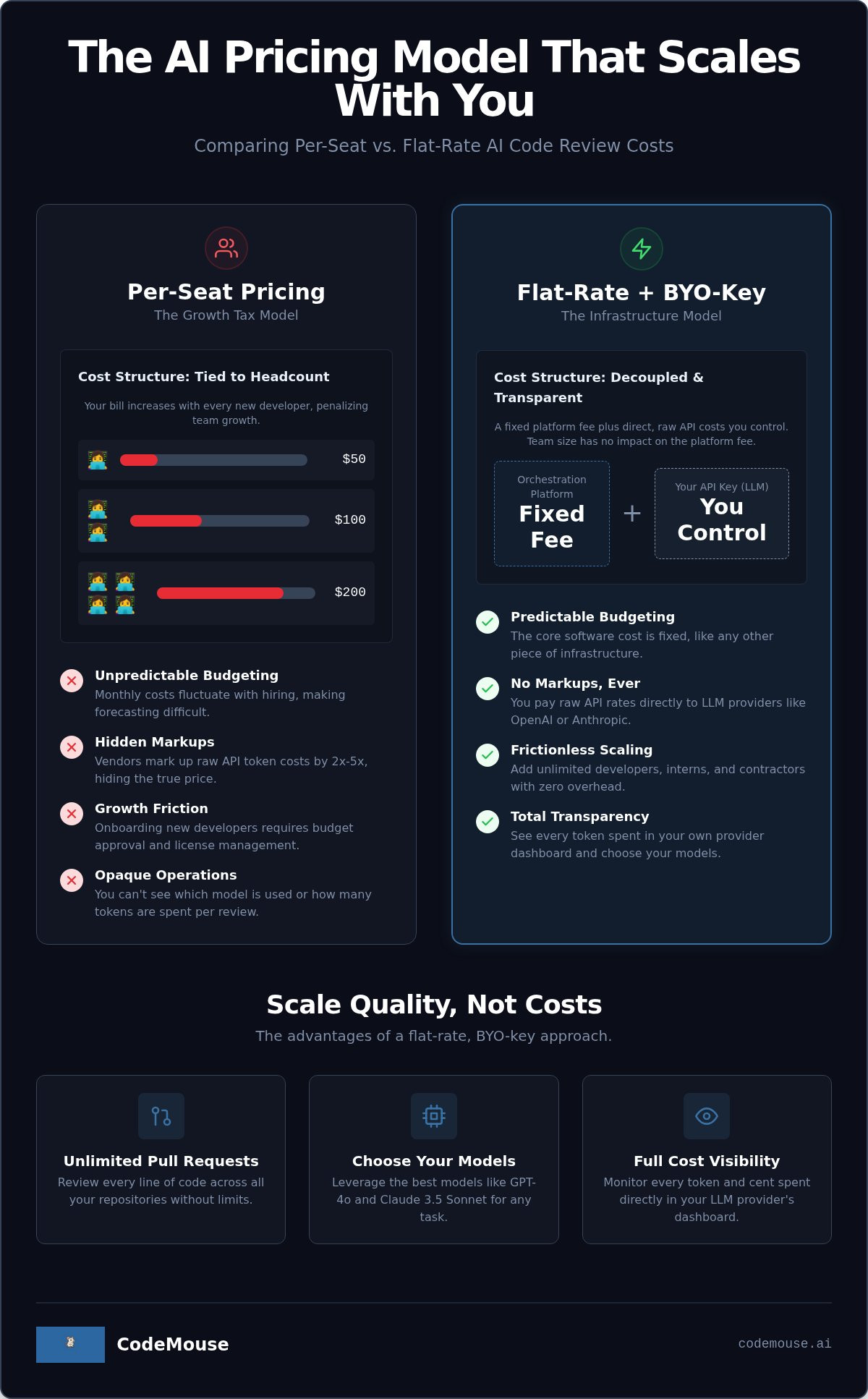
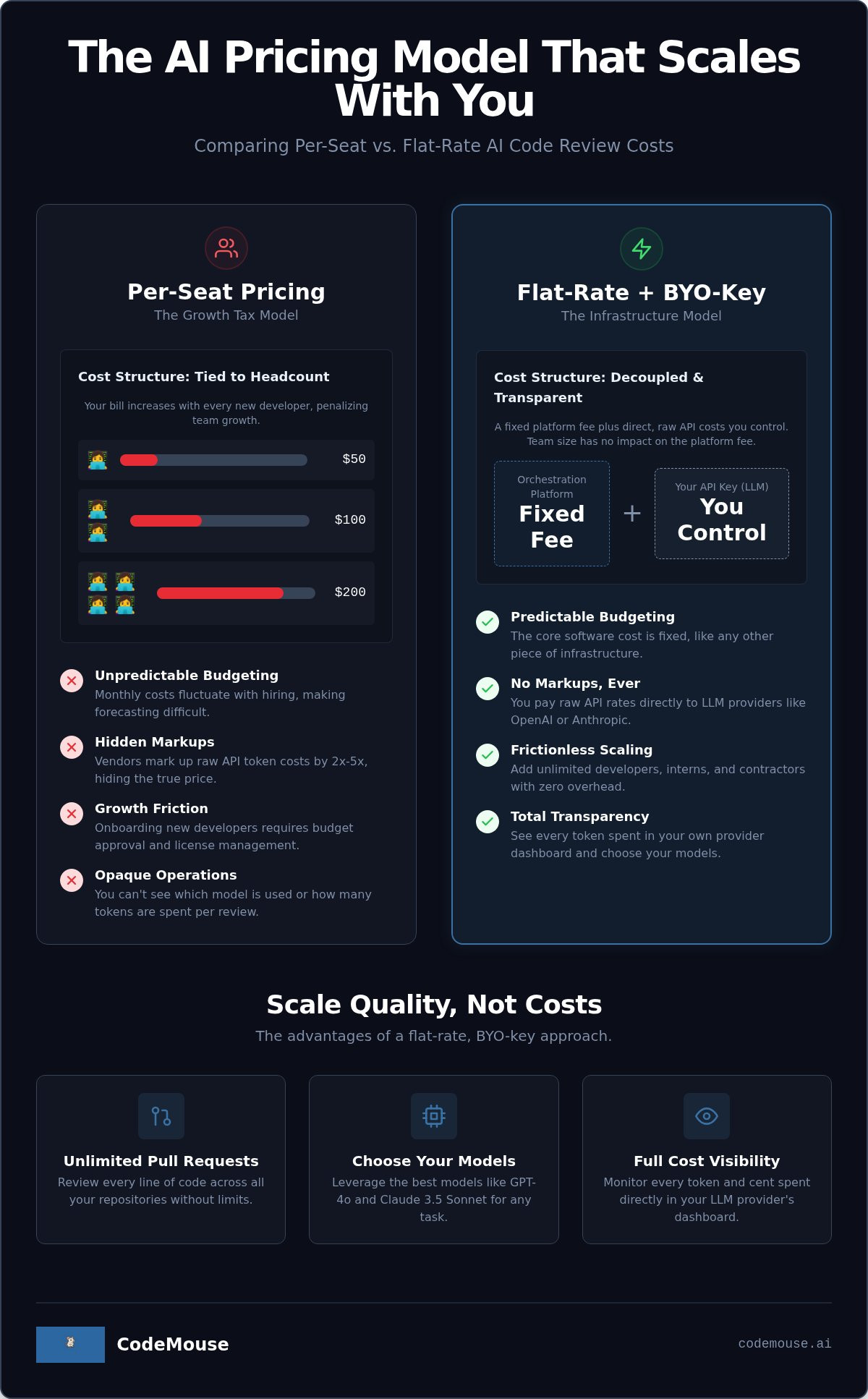
Per-seat pricing for AI tools is a tax on your team's growth. Most engineering leaders face a recurring frustration: adding a new developer shouldn't require a budget renegotiation. When your code quality tools charge by the head, you're penalized for scaling your department. Adopting a flat rate AI code review model eliminates this friction. It removes the hidden markups on compute costs that often hide behind a per-user fee, allowing your budget to reflect actual technical needs rather than headcount.
You already know that consistent feedback is essential for maintaining a healthy codebase. However, unpredictable monthly bills and opaque orchestration make it difficult to forecast expenses. You can scale your engineering quality by decoupling orchestration costs from your developer count. This guide explains how a fixed-cost infrastructure provides the transparency your budget requires. We'll look at the advantages of bringing your own API keys and how to achieve unlimited pull request reviews across all your repositories.
Key Takeaways
- Per-seat pricing models act as a growth tax by penalizing engineering teams for adding new developers.
- Adopting a flat rate AI code review model ensures predictable monthly expenses by decoupling orchestration costs from headcount.
- A BYO-key strategy allows you to pay raw API rates directly to LLM providers like OpenAI or Anthropic while maintaining control over usage.
- Scale quality across unlimited repositories and pull requests without the administrative overhead or friction of seat-based licensing.
- Leverage context-aware feedback from advanced models like Claude 3.5 and GPT-4o through a single, streamlined GitHub integration.
Table of Contents
The Problem with Per-Seat AI Pricing in Modern Engineering
Traditional SaaS pricing models don't align with modern development workflows. Most tools charge per developer, treating human headcount as the primary driver of cost. This is a "per-seat tax." It creates friction during onboarding. When a new engineer joins the team, they shouldn't wait for a procurement cycle just to access automated quality tools. A standard code review process should be universal. It shouldn't be gated by license availability. This model forces engineering leaders to choose between their budget and their standards.
Adopting a flat rate AI code review strategy changes the math. It shifts the focus from managing users to managing output. In seat-based models, you often see under-utilization. Teams might limit AI reviews to specific repositories or senior devs to keep costs down. This defeats the purpose of automation. Automation should be pervasive. It should scale as your codebase grows, not just as your team grows. When you decouple costs from headcount, you allow the tool to function as a silent infrastructure partner rather than a metered service.
The Hidden Markups in Bundled AI Plans
Bundled AI plans are rarely transparent. Vendors often buy tokens at wholesale rates and sell them back to you at a significant markup. You might pay 2x to 5x the raw API cost for compute that is "included" in your plan. You also lose control over model selection. Is the tool calling GPT-4o or a cheaper, less capable model? You don't know. These plans also profit from your quiet periods. If your team has a low-activity month, you still pay the full seat price. The vendor keeps the margin on the unused tokens. This lack of transparency makes it impossible to calculate the true ROI of your AI tooling.
Why Seat-Based Licensing Stifles Team Growth
Every new hire becomes a budget hurdle. Instead of focusing on technical onboarding, managers spend time chasing seat approvals. This creates a paradox. You pay for "unlimited" reviews, but you're actually capped by how many seats you can afford. It's an artificial bottleneck. Implementing AI code review for small teams helps remove this overhead. By removing the per-user cost, you treat quality as a fixed infrastructure cost. It becomes as predictable as your CI/CD pipeline. You gain the freedom to add developers, interns, or contractors to the platform without checking the remaining balance on your subscription.
How Flat Rate AI Code Review Models Actually Work
A flat rate AI code review model separates the orchestration software from the AI compute costs. You pay a fixed monthly fee for the infrastructure. This infrastructure handles the GitHub integration, the logic for parsing diffs, and the delivery of comments. It doesn't matter if you have five developers or fifty. The platform cost remains static. This decoupling is the core of the "Bring Your Own API Key" (BYO-key) philosophy. It's a modular approach to engineering quality. The platform acts as the "Review Body," while your chosen LLM serves as the "Review Brain."
The process starts with a GitHub App. It listens for pull request events in real time. When a developer opens a PR, the app triggers a review cycle automatically. It fetches the code changes and prepares the context. It doesn't perform the analysis within its own opaque environment. Instead, it sends the data to your specific AI provider. This ensures your data stays within the boundaries you've already defined with providers like Anthropic or OpenAI. Once the AI generates the feedback, the orchestration platform formats it and posts it directly back to the pull request.
Orchestration Fees vs. Raw Compute Costs
You pay the platform for integration and logic. You pay the AI provider for the tokens. There is zero vendor markup on the compute. This is critical for long-term budget predictability. You avoid the "black box" pricing found in bundled SaaS plans. You also gain the freedom to switch between models. You might use Claude 3.5 Sonnet for its deep reasoning on complex logic changes. For simpler refactors, you might opt for a faster model. You control the cost and the quality level for every repository. If you want to see how this separation of concerns works in practice, you can connect your first repository to CodeMouse in minutes.
The Technical Transparency of BYO-Key
Transparency is a requirement for modern AI standards and governance. With a BYO-key model, you have full visibility into your operations. You see every token spent in your own provider dashboard. There are no hidden prompts managed by a third party. You own the logs. This level of control is essential for teams moving toward automated code review that requires high consensus and auditability. You aren't just buying a tool. You're building a transparent quality pipeline. You eliminate the risk of vendor lock-in while maintaining a lean, efficient workflow that scales without increasing the price per developer.
Comparing Flat Rate vs. Token-Bundled AI Review Tools
Scale brings complexity to budget management. For a team of 20 developers, seat-based pricing creates a linear cost curve that ignores actual usage. A flat rate AI code review model breaks this link. Traditional tools bundle token costs into a high per-user fee. They often throttle performance if your PR volume spikes. Flat-rate tools don't care about your volume. They provide unthrottled access because you're using your own infrastructure. This allows for more frequent feedback loops. Developers get reviews on every commit, not just the final merge request.
Cost Comparison: CodeMouse vs. Enterprise Suites
Enterprise suites often hide their true cost behind complex tiers. You pay for the maximum potential usage of every developer. If you have 20 devs and 1,000 pull requests a month, the per-PR cost in a bundled plan is high. By using raw API keys, you pay exactly what the LLM provider charges. There is no middleman tax. You're paying for orchestration logic, not a resale of compute. A 10-person team switching to a flat-rate model eliminates the per-user markup entirely and gains direct control over their AI spend.
Quality and Depth: The Consensus Logic Advantage
Most bundled tools lock you into a single model. This creates a single point of failure in logic detection. Using multiple models like Claude 3.5 and GPT-4o creates a "consensus" effect. One model might miss a subtle race condition that the other catches. This cross-model verification aligns with AI standards and trustworthiness frameworks for high-stakes software environments. It reduces false positives. When two independent models agree on a bug, the developer is more likely to trust the feedback.
You can see how this stacks up against traditional players in our Codacy vs CodeMouse feature breakdown. Unlike platforms that prioritize seat sales, flat-rate tools focus on feature parity and technical depth. You get context-awareness and deep repository integration without the enterprise baggage. This model encourages teams to use the tool more, not less. It removes the fear of wasting expensive tokens on minor refactors or documentation updates. Every change gets the same level of scrutiny. It's about maintaining a consistent standard across the entire organization.
Best Practices for Implementing BYO-Key AI Reviews
Transitioning to a flat rate AI code review workflow is a straightforward technical task. It requires shifting from a passive consumer mindset to an active infrastructure owner. You start by generating API keys from your preferred providers. OpenAI and Anthropic both offer granular control over these credentials. Once the keys are ready, you install the GitHub App to bridge your code with the AI brain. This setup ensures that your orchestration costs remain flat while your usage scales naturally with your PR volume.
- Step 1: Create restricted API keys. Limit their scope to specific models like Claude 3.5 Sonnet or GPT-4o.
- Step 2: Install the GitHub App. Grant access only to the repositories requiring automated oversight.
- Step 3: Define your review scope. You can trigger reviews for every PR or limit them to critical production branches.
- Step 4: Audit the output. Check if the AI catches relevant logic errors or if it's focusing too much on style. Adjust your system prompts accordingly.
Managing Security and API Quotas
Security is non-negotiable. Use restricted API keys to ensure the review platform only accesses the models you authorize. This prevents accidental exposure of other services in your provider account. You should also set monthly spending limits in your AI provider dashboard. This acts as a circuit breaker for your budget. By managing your own keys, you gain the ability to catch bugs in pull requests more effectively. High-context models perform better when they aren't throttled by a middleman's shared quota. You own the throughput. You decide which models get the most traffic based on project priority.
Integrating AI Feedback into the Developer Workflow
Automation shouldn't replace human eyes; it should empower them. Use AI to handle the first pass of every pull request. This identifies low-hanging fruit like missing null checks or inefficient loops before a human reviewer even opens the link. It reduces review fatigue. Human reviewers can then focus on architectural decisions and business logic. For junior developers, this constant stream of feedback acts as a secondary mentor. They learn best practices in real-time through consistent, objective critiques. This builds a culture of quality that doesn't depend on the availability of senior staff. If you're ready to automate your quality checks, you can start your 14-day free trial with CodeMouse today.
Scaling Pull Request Quality with CodeMouse
CodeMouse provides the infrastructure for high-velocity engineering teams. It's built for those who value autonomy over enterprise complexity. By offering a flat rate AI code review subscription, it removes the financial barriers to scaling code quality. You pay a single monthly fee regardless of how many developers you hire or how many repositories you manage. This eliminates the per-seat tax entirely. There is no throttling. There are no hidden markups on AI tokens. You get pure orchestration efficiency that allows your team to focus on shipping code.
The platform integrates with the most advanced models on the market. You can leverage the reasoning capabilities of Claude 3.5 and the speed of GPT-4o through a single GitHub integration. This flexibility is core to the builder-friendly philosophy. You aren't locked into a single provider's roadmap. Instead, you use the best tools for each specific task. The 14-day free trial provides full access to these features. It allows you to test the consensus logic on your actual pull requests before committing to a plan. It's a pragmatic way to verify the ROI without an upfront investment.
Why CodeMouse is the Builder’s Choice
We designed the interface to be minimalist and no-fluff. It prioritizes utility and speed. You don't need a complex dashboard to manage your reviews. The tool acts as a silent partner. It enhances the github pr automation tools you already use. It's context-aware. This means it understands the relationships within your entire codebase, not just the isolated diff. This leads to more accurate feedback and fewer distractions for your senior engineers. It fits into your existing workflow without requiring a total overhaul of your habits. It's about building better software, not managing more tools.
Getting Started with Flat Rate Reviews
Installation takes less than 2 minutes. You can find CodeMouse on the GitHub Marketplace and grant it access to your repositories immediately. Once connected, the impact on your review cycle is instantaneous. You'll see automated comments on your next pull request. You can invite your entire team to the platform right away. There's no need to calculate seat costs or request additional budget for new developers. You gain the predictability of a fixed bill and the power of unlimited AI-driven oversight. It's the most efficient way to maintain a high standard of engineering quality as you grow. Start small or go all-in; the price remains the same.
Modernize Your Engineering Quality Pipeline
Scaling a development team shouldn't trigger a budget crisis. By shifting to a flat rate AI code review model, you remove the artificial barriers created by seat-based licensing. You've seen how decoupling orchestration from raw compute costs provides total transparency and eliminates the middleman markup on tokens. This approach allows you to focus on code quality rather than headcount management. It turns your review process into a fixed, predictable piece of infrastructure that grows alongside your codebase.
Using a BYO-key strategy ensures you maintain absolute control over your data and your AI spend. You gain the technical advantage of multi-model consensus from Claude and GPT without the administrative overhead of traditional enterprise suites. It's about efficiency, transparency, and technical utility. If you're ready to end the per-seat tax and implement a predictable monthly subscription, it's time to switch to a builder-first platform. Start your 14-day free trial of CodeMouse flat-rate AI code review and see the results on your next pull request. Build better, faster.
Frequently Asked Questions
What is a flat rate AI code review model?
It's a pricing structure where you pay a fixed monthly subscription for the orchestration platform rather than paying per developer seat. It decouples the cost of the software integration from the number of users on your team. This allows for unlimited developers and repositories without increasing your monthly bill. You gain budget predictability while ensuring every pull request receives consistent automated feedback.
How does the "Bring Your Own API Key" model save money?
This model removes the markup that bundled SaaS vendors apply to AI tokens. You pay raw API costs directly to providers like Anthropic or OpenAI. Since you aren't paying a middleman for compute, you only pay for what you actually use. It prevents the per-seat tax that often inflates engineering budgets as teams grow or when contractors join temporary projects.
Is flat rate AI code review as secure as enterprise tools?
Yes, it offers high security because you maintain direct control over your API keys and data boundaries. Flat rate AI code review through CodeMouse uses restricted keys that you manage in your own provider dashboard. Your code is processed according to the enterprise agreements you already have with LLM providers like OpenAI or Anthropic, ensuring total data sovereignty.
Can I use multiple models like Claude and GPT at the same time?
The platform supports multi-model orchestration. You can configure the system to use a consensus logic where both Claude 3.5 and GPT-4o analyze the same pull request. This approach catches subtle bugs that a single model might miss. It provides a more robust review by leveraging the unique strengths of different LLM architectures, giving you deeper technical insights into every commit.
Does a flat rate plan limit the number of pull requests I can review?
No, the flat-rate model specifically allows for unlimited pull request reviews across all your repositories. There are no artificial caps or throttling based on your activity volume. The platform scales with your development throughput. Your only limiting factor is the usage quota you set with your individual AI API provider, which you control directly through their dashboard.
What happens if I hit my API quota with my AI provider?
If you reach your provider's limit, the review process will pause until the quota resets or you increase the cap. You have full visibility into these limits within your OpenAI or Anthropic accounts. This gives you direct control over your spending. The orchestration platform will resume reviews immediately once the API key is active again, ensuring no long-term workflow disruption.
Is CodeMouse compatible with private GitHub repositories?
CodeMouse is fully compatible with both public and private GitHub repositories. It installs as a GitHub App, granting it the necessary permissions to read diffs and post comments on your pull requests. You control exactly which repositories the app can access. It integrates seamlessly into your existing private development workflows without requiring complex on-premise deployment or manual configuration steps.
How does flat rate pricing compare to per-developer monthly fees?
Flat rate AI code review provides a predictable monthly cost that doesn't change when you hire new engineers. In contrast, per-developer fees create a linear cost increase that becomes expensive for large or growing teams. By switching to a flat subscription, you eliminate the friction of requesting new budget approvals for every developer you onboard to the quality platform.