How to Catch Bugs in Pull Requests: The 2026 AI-Enhanced Checklist
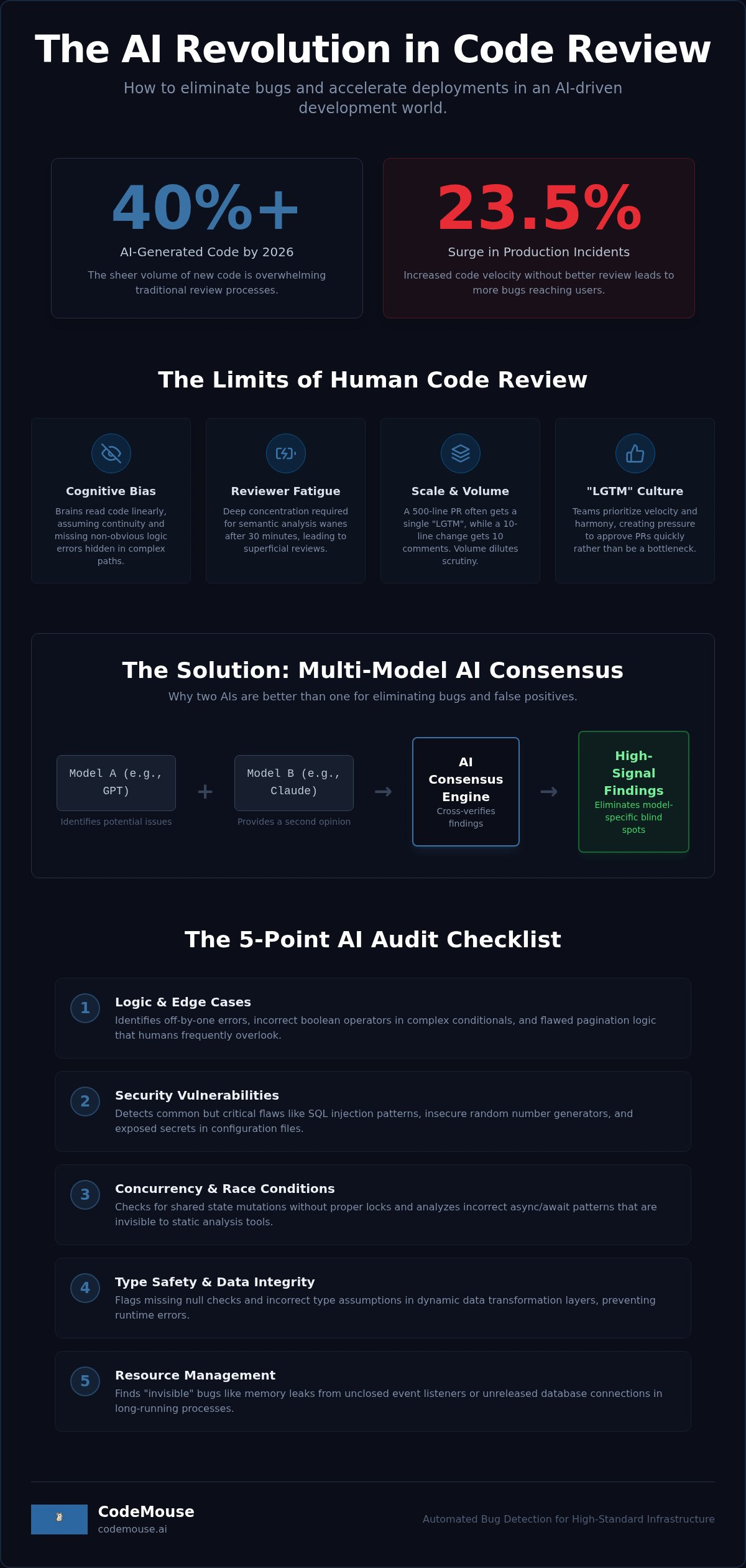
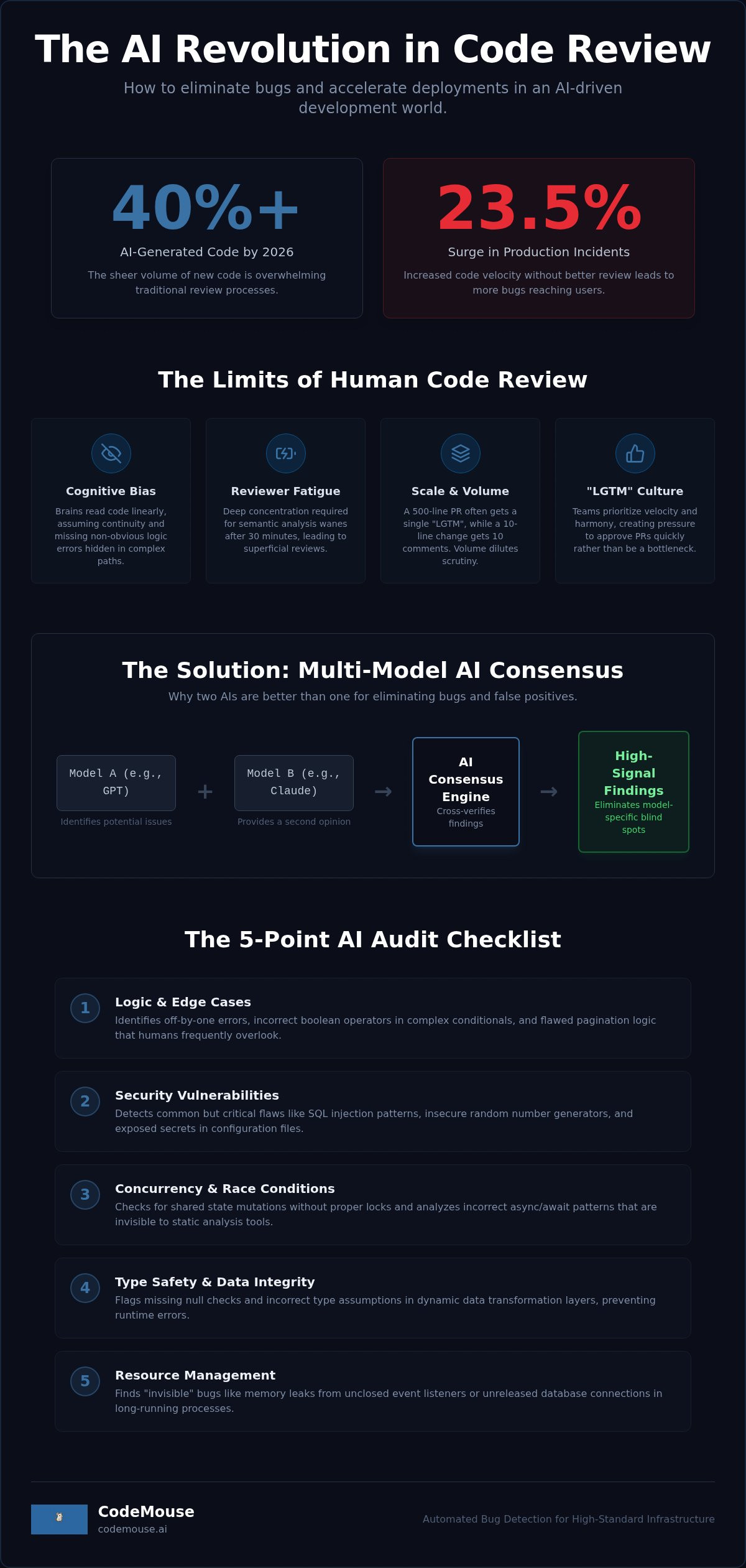
AI tools generate over 40% of all code in 2026, yet production incidents have surged by 23.5% this year. If your team relies solely on manual reviews, you're fighting a losing battle against volume. Manual review fatigue leads to missed edge cases. High-risk security vulnerabilities slip through. PR turnaround times stall. You need a systematic way to catch bugs in pull requests that scales with your output without sacrificing system stability or developer sanity.
We've developed a pragmatic, technical framework to solve this. This guide moves beyond basic linters to a multi-model AI consensus workflow. You'll learn how to eliminate logic errors, security flaws, and race conditions before they ever reach production. We provide a 2026-ready checklist designed for zero-incident deployments and faster approval cycles. We'll look at how integrating tools like CodeMouse into your GitHub workflow allows you to leverage models like Claude and GPT as a silent partner. This isn't about replacing the developer. It's about building a high-standard infrastructure that catches what human eyes miss and keeps your deployment pipeline moving at speed.
Key Takeaways
- Identify complex logic errors and race conditions that manual "forward pass" reviews frequently overlook.
- Leverage multi-model consensus between Claude and GPT to cross-verify findings and eliminate model-specific blind spots.
- Implement a systematic checklist to catch bugs in pull requests, focusing on security vulnerabilities and functional edge cases.
- Maintain a high signal-to-noise ratio by tuning AI instructions to prioritize logic over stylistic preferences.
- Automate the review process with native GitHub integration while retaining control over model selection and API usage costs.
Table of Contents
Why Manual Reviews Fail to Catch Bugs in Pull Requests
Manual code review is often a performative ritual rather than a rigorous technical audit. Most reviewers perform what is known as a "forward pass." They read code linearly, from top to bottom. This mimics the way we read prose. It is fundamentally the wrong way to analyze logic. Human brains are optimized to fill in gaps and assume continuity. We see what we expect to see, not what is actually written on the screen. This cognitive bias makes it incredibly difficult to catch bugs in pull requests when those errors exist in the intersections of complex, non-linear logic.
The scale of modern development exacerbates this problem. As of 2026, AI generates approximately 41-42% of all new code. This massive influx of pull requests has contributed to a 23.5% increase in production incidents. Human reviewers simply cannot keep up with the volume. There is a direct, measurable correlation between PR size and the probability of missed vulnerabilities. A ten-line change typically receives ten comments; a five-hundred-line change often receives a single "LGTM." Reviewer fatigue sets in after roughly 30 minutes of focus. When you combine this with constant context switching between meetings and coding tasks, the deep concentration required for semantic analysis evaporates.
Social dynamics further degrade review quality. Teams value velocity. Pointing out a subtle race condition or a potential memory leak might delay a critical release. The "LGTM" culture prioritizes social harmony and project momentum over technical scrutiny. This creates a environment where high-risk vulnerabilities slip through because reviewers feel pressured to merge quickly rather than act as a bottleneck.
The Cognitive Limits of Human Code Review
Human reviewers naturally gravitate toward "surface" issues because they are easy to identify. We spend time debating naming conventions, indentation, and architectural style. We frequently miss "invisible bugs" hidden in pagination logic, complex filter conditions, or state management. These errors do not break the build. They do not trigger basic compiler warnings. They simply produce incorrect results in specific edge cases. The cost of these bugs surviving CI/CD and QA passes is substantial. They often reach production and remain undetected until a user reports a failure.
Static Analysis vs. Semantic Understanding
Traditional linters and static analysis tools are simple pattern matchers. They check for syntax errors and style violations. They cannot understand developer intent. An off-by-one error looks like perfectly valid syntax to a linter. A complex race condition is invisible to a static analyzer because it lacks an understanding of the temporal flow of the program. To effectively catch bugs in pull requests, you need semantic understanding. AI represents a shift from pattern matching to intent-based analysis. It acts as a persistent, context-aware auditor that never suffers from fatigue, social pressure, or time constraints.
The AI Bug-Catching Checklist: 5 Critical Categories
To effectively catch bugs in pull requests, you need a systematic approach that targets specific failure modes. While a famous Microsoft research paper titled Code Reviews Do Not Find Bugs argues that traditional peer reviews are often ineffective at identifying functional defects, AI-enhanced audits change the math. By using high-context models, you can scan for errors that linters miss and humans overlook. This checklist focuses on the five areas where manual review failure rates are highest.
- Logic and Edge Cases: Identifying off-by-one errors in loops and incorrect boolean operators in complex conditional trees.
- Security Vulnerabilities: Detecting SQL injection patterns, insecure random number generators, and exposed secrets in configuration files.
- Concurrency and Race Conditions: Checking for shared state mutations without locks and incorrect async/await patterns.
- Type Safety and Data Integrity: Flagging missing null checks and incorrect type assumptions in dynamic data transformation layers.
- Resource Management: Identifying memory leaks and unclosed database connections in long-running processes.
Implementing this checklist manually for every PR is impossible. It's too slow. Using a tool like CodeMouse AI Code Review automates these checks on every commit; it acts as a silent partner that executes the checklist while you focus on high-level architecture.
Deep Dive: Logic and Concurrency Errors
AI analyzes loop boundaries and conditional branches more effectively than humans because it doesn't assume the "happy path." It treats every branch as equally likely. When reviewing concurrency, ensure the AI verifies that all shared state mutations are protected by appropriate locks. You should also audit async functions for missing awaits. A single missing await in a complex execution chain can lead to non-deterministic behavior that is nearly impossible to debug in production.
Security and Data Integrity Checks
A 2025 Veracode study found that 45% of AI-generated code introduces a vulnerability from the OWASP Top 10. Automated detection of string formatting in SQL queries is mandatory to prevent injection. Your checklist must also scan for sensitive data exposure in logging statements. Don't let credentials or PII leak into your monitoring stacks. Finally, validate type coercions in data transformation layers. Incorrect assumptions about incoming JSON payloads are a frequent source of runtime crashes.
Multi-Model Consensus: Why Two AIs Are Better Than One
Relying on a single Large Language Model (LLM) to catch bugs in pull requests is a strategic error. Every model has inherent biases and blind spots. A model might be excellent at identifying Pythonic syntax but struggle with complex state management in React. According to the 2025 Stack Overflow Developer Survey, 46% of developers actively distrust AI output. This skepticism is justified when using a single-model approach. Multi-model consensus addresses this trust gap by requiring two or more independent models to agree on a finding before it's presented to the reviewer.
This approach moves beyond simple redundancy. It functions as a bias mitigation strategy. If GPT-4o flags a potential race condition and Claude 3.5 verifies the logic, the probability of a false positive drops significantly. Conversely, if one model flags an issue that the other identifies as valid code, the system can deprioritize the comment. This creates a high-signal environment where developers only interact with high-confidence reports. It's a pragmatic way to scale code quality without increasing the noise that leads to reviewer burnout.
Claude vs. GPT for Code Analysis
Different architectures offer different strengths. Claude 3.5 and 4.0 are recognized for their superior handling of long-context windows and architectural patterns. They excel at understanding how a change in a utility function might ripple through a microservices architecture. GPT-4o and the emerging GPT-5 models are often faster and more precise at identifying syntax-level logic flaws and off-by-one errors. For a detailed breakdown of these differences, see our guide on GPT-4o vs Claude 3 Opus for Code Review. Leveraging both allows you to capture architectural risks and granular logic errors in a single pass.
Implementing a Multi-Model Workflow
Effective orchestration is the key to using multiple models without increasing manual effort. You don't want to copy-paste code into two different windows. You need an automated layer that triggers parallel reviews. This layer should categorize feedback into "High Confidence" and "Nitpick" levels based on model agreement. High-confidence bugs are those where multiple models identify the same failure mode. Nitpicks are stylistic suggestions or warnings where models disagree. This distinction is critical for maintaining developer velocity. You can learn more about this in our article on AI Code Review for GitHub: Scaling Quality with Multi-Model Consensus. By automating this consensus logic, you ensure that the final PR comments are accurate, actionable, and technically sound.
Optimization: Reducing Noise and False Positives
AI reviewers can be overly talkative. If a tool generates fifty comments for a minor refactor, developers will stop reading them. This is "AI Fatigue." It's a productivity killer that causes teams to overlook the very issues they are trying to find. To effectively catch bugs in pull requests, you must maintain a high signal-to-noise ratio. High-quality feedback prioritizes functional correctness over stylistic preferences. If your team already uses a linter for formatting, your AI should be instructed to ignore it entirely. Focus the model's compute on logic, security, and performance.
Filtering by severity is the most direct way to combat noise. A missing docstring is a minor inconvenience; a potential race condition is a deployment blocker. Your workflow should surface critical vulnerabilities at the top of the PR timeline while grouping minor refactoring suggestions into a single, expandable summary. This ensures that the most dangerous logic errors receive immediate attention from the human reviewer. CodeMouse AI Code Review provides the infrastructure to manage this signal, allowing you to focus on the logic that matters.
Fine-Tuning the AI Reviewer
Precision starts with configuration. Use project-level config files to define clear boundaries for the AI. Exclude directories that don't require semantic analysis, such as tests, documentation, or auto-generated vendor code. Reviewing a 10,000-line auto-generated protobuf file is a waste of API credits and developer time. You should also define the tone of the feedback. If your team values direct, blunt technical assessments, configure the prompt to strip away conversational fluff. This results in faster reading times and clearer action items.
The Interactive Feedback Loop
Treat the AI reviewer as a junior engineer, not a static script. Encourage your team to "chat" with the bot directly within the PR comments to clarify complex suggestions. If the AI flags a false positive, use "Ignore" tags to suppress it. This interaction does more than resolve a single PR; it refines the system's understanding of your specific codebase. Continuous interaction allows the AI to calibrate its detection logic to the unique architectural nuances and patterns of your repository over time. This feedback loop is essential for moving toward a zero-incident deployment cycle.
Implementing CodeMouse for Automated Bug Detection
CodeMouse transforms the theoretical checklist into an automated workflow. It functions as the infrastructure that executes the multi-model consensus strategy discussed in previous sections. You don't need to build a custom pipeline or manage complex scripts. You install the GitHub App. You connect your repositories. The system starts to catch bugs in pull requests immediately. It integrates natively into your existing environment. Comments and suggestions appear directly in the PR timeline, maintaining your team's current rhythm.
The Bring Your Own API Key (BYOK) model is a significant advantage for technical teams seeking transparency. Most competitors hide their margins inside expensive per-seat subscriptions that scale poorly. CodeMouse charges a flat $10/month fee for the entire organization. You provide your own keys for models like Claude and GPT. This ensures you only pay for the compute you consume. This model eliminates the "AI tax" and prevents provider throttling. You choose the specific models. You control the costs. You maintain total autonomy over your data and toolchain.
Setting Up Your First AI-Powered PR Review
Getting started is a linear process that takes minutes. Install the CodeMouse app from the GitHub Marketplace. Select the repositories you want to monitor. Add your OpenAI or Anthropic API keys in the secure dashboard. These keys power the consensus engine, allowing the system to cross-reference logic across different architectures. You can then define your review parameters in a configuration file to match your team's standards. This setup allows you to scale quality across every repository without adding headcount. For a deeper look at this process, read our guide on AI Code Review for Small Teams: Scaling Quality Without the Overhead.
The ROI of Automated Bug Catching
The value of automated reviews is measured in time saved and risk reduction. Automating the "first pass" saves senior engineers hours of manual scrutiny every week. It catches the obvious logic errors and security flaws before a human reviewer ever looks at the code. This reduces "Senior Debt." Junior developers receive immediate, context-aware feedback on every commit. They learn your team's standards in real-time. This accelerates the PR approval cycle and ensures higher code quality across the board. The goal is zero-incident deployments. Stop letting manual fatigue dictate your system stability. Start your 14-day free trial with CodeMouse and automate your bug-catching workflow today.
Achieving Zero-Incident Deployments with AI Consensus
Manual reviews are no longer sufficient to manage the volume and complexity of code in 2026. Cognitive biases and reviewer fatigue create gaps that inevitably lead to production incidents. By implementing a multi-model consensus workflow, you eliminate these blind spots. Using Claude 3.5 for architectural context alongside GPT-4o for granular logic ensures a high-signal review process. This systematic approach is the only way to reliably catch bugs in pull requests before they reach your users.
You can deploy this infrastructure in minutes. CodeMouse provides native GitHub integration and supports the latest models while giving you total cost control through your own API keys. This setup allows small teams to execute enterprise-grade inspections without the overhead of per-seat pricing. Stop wasting senior engineering time on basic logic audits. Focus on building features while your AI partner handles the scrutiny. Automate your bug detection with CodeMouse for $10/mo. Take advantage of our 14-day free trial and start shipping with total confidence.
Frequently Asked Questions
Can AI really catch logic bugs that humans miss?
Yes. AI models analyze every execution branch with equal weight, avoiding the "forward pass" bias common in human reviewers. While humans often read code linearly and assume the "happy path," models like Claude 3.5 and GPT-4o identify off-by-one errors and race conditions in complex conditional trees. This persistent focus allows teams to catch bugs in pull requests that typically survive manual audits.
How does CodeMouse integrate with my existing GitHub workflow?
CodeMouse installs as a native GitHub App. It triggers automatically whenever a developer opens a pull request or pushes new commits. Review comments and technical suggestions appear directly within the GitHub PR conversation. This native integration ensures your team stays within their existing environment without needing to manage external dashboards or manual review triggers.
Does using AI code review tools pose a security risk to my codebase?
CodeMouse prioritizes transparency by using a Bring Your Own Key (BYOK) model. Your code is sent to the model providers you already trust, such as OpenAI or Anthropic, under your existing API agreements. This ensures you maintain control over data retention policies. CodeMouse itself acts as the infrastructure layer, using industry-standard encryption to secure your configuration and API keys.
How do I reduce false positives in AI-generated PR comments?
Implement multi-model consensus to verify findings across different architectures. If both GPT and Claude flag the same logic error, the confidence level is high. You can also use project-level configuration files to exclude specific directories, such as auto-generated code or documentation. Direct interaction with the bot allows you to "ignore" specific suggestions, which helps the system calibrate to your codebase over time.
Why does CodeMouse require me to provide my own API keys?
Providing your own keys ensures total cost control and prevents provider throttling. You pay a flat $10/month for the CodeMouse infrastructure and pay the model providers directly for the compute you consume. This model avoids the significant markups and restrictive limits found in per-seat pricing. It also allows you to switch between model versions as soon as they are released.
What is the difference between CodeMouse and a standard linter?
Linters perform static analysis to find syntax errors and style violations based on rigid rules. CodeMouse performs semantic analysis to understand developer intent. It identifies functional defects, such as incorrect data transformations or insecure random number generation, that linters cannot see. It is a necessary layer to catch bugs in pull requests that are syntactically valid but logically flawed.
Can I use CodeMouse for private repositories?
Yes. CodeMouse is designed to support both public and private repositories. The GitHub App integration respects all repository visibility settings and organizational access controls. You have full authority to select which specific private repositories the AI is allowed to analyze, ensuring your sensitive source code remains within your defined security boundaries.
Does CodeMouse support languages like Rust, Go, or TypeScript?
Yes. CodeMouse is language-agnostic because it leverages large language models trained on virtually every modern programming language. It is particularly effective at reviewing Rust, Go, and TypeScript. The system understands the specific concurrency models and type systems of these languages, allowing it to identify subtle memory management issues and type-safety violations that occur during complex refactors.