AI Code Review for Small Teams: Scaling Quality Without the Overhead
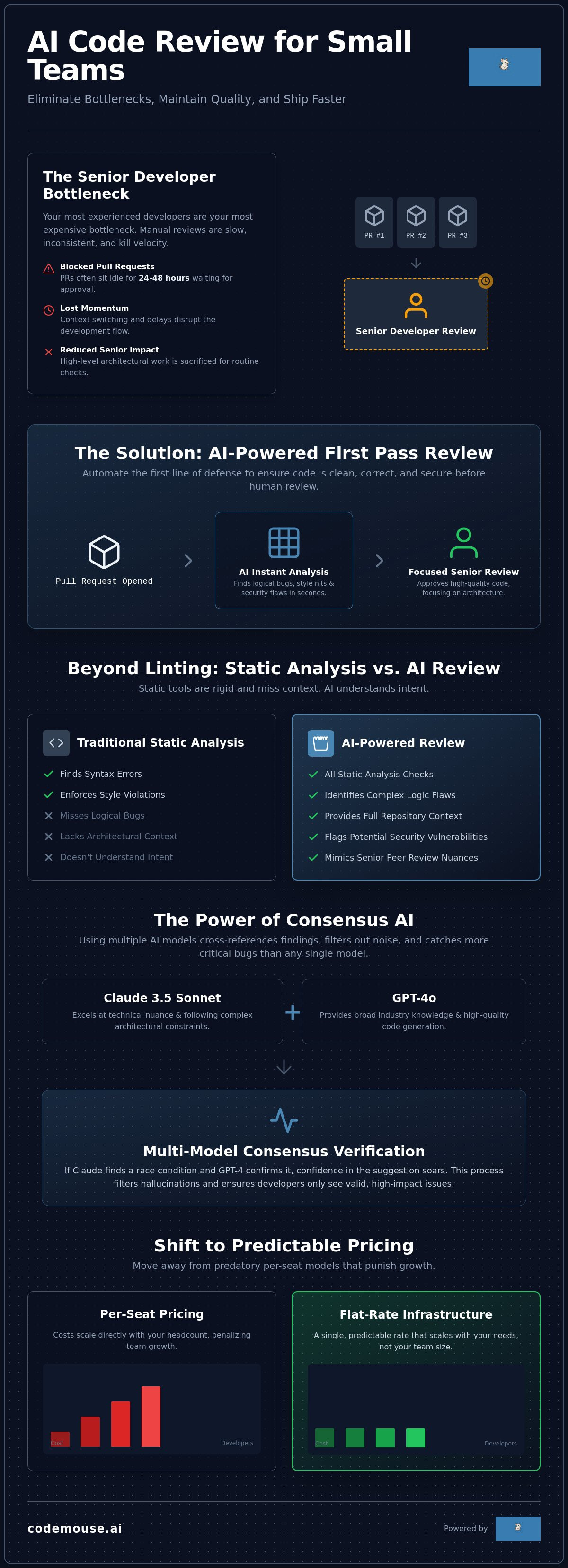
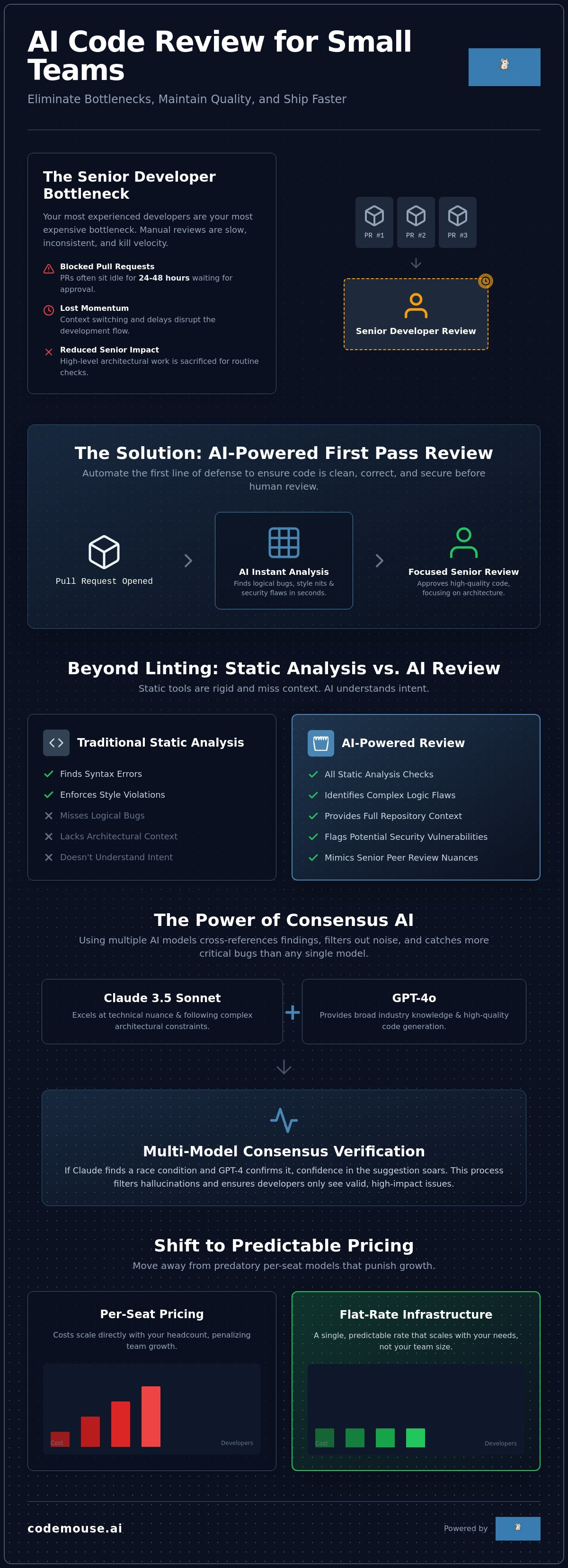
Your senior developers are likely your most expensive bottleneck. Every hour they spend squinting at a pull request is an hour they aren't shipping core features. Manual reviews have become a slow, inconsistent ritual that kills velocity. Implementing an AI code review for small teams changes this dynamic by automating the first line of defense. It isn't about replacing the human element; it's about ensuring that by the time a person looks at the code, the logical bugs and style nits are already solved.
You've likely felt the friction of existing tools that demand predatory per-seat pricing or miss deep logical errors. You need context-aware feedback that scales without a massive bill. This article explains how small engineering teams use AI to automate GitHub reviews, maintain high standards, and eliminate the senior developer backlog. We'll cover the shift toward predictable flat-rate infrastructure, the power of multi-model consensus, and how to achieve faster merge times without sacrificing quality.
Key Takeaways
- Automate GitHub PR analysis to eliminate senior developer bottlenecks and maintain high code quality without manual overhead.
- Deploy an AI code review for small teams to provide immediate, context-aware feedback that mimics a senior peer review.
- Compare the reasoning capabilities of Claude with the generation strengths of GPT-4 to choose the right model for your specific codebase.
- Transition from predatory per-seat pricing to a flat-rate infrastructure that scales alongside your contributor list without increasing costs.
- Integrate automated reviews into your workflow in minutes by connecting your own API keys for total cost transparency and control.
Table of Contents
What is AI Code Review for Small Teams?
AI code review for small teams is the automated analysis of GitHub Pull Requests using Large Language Models (LLMs) like Claude and GPT-4. It goes beyond simple pattern matching. These tools examine the diff against the existing codebase to provide context-aware feedback. This feedback mimics the nuances of a senior developer peer review. Integration happens directly through GitHub Apps. The bot comments on lines of code just like a human contributor. It focuses on logic, security vulnerabilities, and code maintainability rather than just syntax nits.
These systems function as a silent partner in the development process. When a developer pushes a branch, the AI instantly scans the changes. It understands the relationships between files. If a change in a utility function breaks an assumption in a controller, the AI flags it. This level of reasoning was previously only possible with human intervention. By deploying this infrastructure, small teams maintain a rigorous review standard that usually requires a much larger headcount. It's about scaling quality without adding more engineers to the payroll.
The Senior Developer Bottleneck
Small teams typically rely on one or two senior engineers to review every line of code. This creates a massive bottleneck. Pull requests often sit idle for 24 to 48 hours waiting for a lead's approval. This delay kills momentum. AI provides immediate feedback the moment a PR is opened. It identifies edge cases and potential bugs in seconds. This first-pass review allows the junior or mid-level developer to ship better code before a senior even sees it. It reduces the number of review cycles required to reach a merge-ready state. The senior dev can then focus on high-level architecture instead of fixing basic logic. It keeps the pipeline moving.
Static Analysis vs. AI-Powered Review
Standard Static program analysis is a staple in most CI/CD pipelines. Tools like ESLint or SonarQube find syntax errors and style violations effectively. But they are rigid. They don't understand what the code is trying to achieve. AI understands intent. It spots architectural flaws, such as a missing database index or a potential race condition, that static tools overlook. For a small team, this is critical. You can't afford to let logical bugs reach production. Implementing an AI code review for small teams alongside static analysis ensures that your velocity stays high without sacrificing the integrity of your codebase. It provides a safety net that scales with your output.
Choosing the Right AI Model: Claude vs. GPT-4
Selecting an LLM for code analysis requires balancing reasoning depth with output speed. Small teams don't have time to sift through false positives. Claude 3.5 Sonnet is recognized for its technical nuance and ability to follow complex architectural constraints. It identifies subtle logic flaws where other models might fail. Conversely, GPT-4o provides broad industry knowledge and high-quality code generation. Using these models in isolation can lead to blind spots. When an AI code review for small teams relies on just one provider, the risk of hallucinations increases. You need a system that cross-references findings across different architectures.
CodeMouse leverages both Claude and GPT models to provide a consensus view on every pull request. As more teams move toward reviewing AI-generated code, multi-layered verification becomes essential. You shouldn't trust a single source for critical security or logic checks. You can test this multi-model feedback on your own repo to see the difference in comment quality. It provides the depth of a senior developer without the high salary requirements.
Why Consensus AI Reviews Catch More Bugs
Single LLMs occasionally produce generic advice or hallucinate non-existent methods. Multi-model verification ensures that feedback is technically sound before it reaches your team. AI consensus is a cross-verification of pull request data by multiple models to confirm the validity of a suggestion. If Claude identifies a potential race condition and GPT-4o confirms the logic, the confidence score for that comment increases. This process filters out the "noise" common in basic static tools. It ensures your developers only focus on valid, high-impact issues.
Context-Awareness and Pull Request Depth
Effective reviews require more than just scanning a git diff. The AI must understand the entire repository context to provide useful insights. Models like Claude 3.5 Sonnet and GPT-4o excel at long-context analysis. They track variable definitions and logic flow across multiple files simultaneously. This depth is vital for catching breaking changes in downstream dependencies that a human might miss during a quick scan. For a deeper look at scaling these workflows, see our guide on AI code review for GitHub. High context-awareness prevents the shallow "nits" found in legacy tools and provides the architectural insight small teams need to ship with confidence.
Evaluating Costs: Flat Rate vs. Per-Seat Pricing
Small teams operate on tight burn rates where every SaaS subscription is scrutinized. Traditional developer tools often utilize per-seat pricing models. This creates immediate friction. Adding a new contributor, an intern, or a part-time contractor shouldn't trigger a pricing tier jump or increase your monthly overhead. When you implement an AI code review for small teams, the goal is to reduce friction, not add administrative hurdles. CodeMouse provides a flat $10/month plan for your entire organization. This ensures your costs remain static even as your contributor list grows.
The industry standard of charging $15 to $30 per user monthly penalizes growth. It forces leads to decide who "deserves" access to automated feedback. In a high-velocity environment, everyone needs these checks. By decoupling the cost from the headcount, you treat code quality as a fixed infrastructure expense rather than a variable tax on your engineering team. This predictability allows you to allocate more budget toward actual development rather than seat management.
The "Bring Your Own Key" (BYOK) Advantage
The core of this pricing efficiency is the BYOK model. You connect your own OpenAI or Anthropic API keys directly to the dashboard. You pay the AI providers at cost for the tokens you actually consume. Most platforms bundle AI credits with a significant markup to cover their own margins. They also frequently impose throttling or "usage limits" that slow down your pipeline during busy sprint cycles. BYOK removes the middleman. You get unlimited reviews without platform-imposed restrictions. If your team has a quiet week, your API bill reflects that. You maintain total transparency and control over your data and your spend.
Predictable Monthly Budgeting
Administrative overhead is a hidden drain on senior developer time. Managing seats and auditing permissions is a distraction from shipping features. CodeMouse eliminates this burden by offering a single, flat-rate subscription. You can scale from 2 to 20 developers without ever changing your billing settings. This transparency is vital for early-stage startups and lean engineering departments. When comparing Gerrit vs CodeMouse, the efficiency gains are obvious. One requires complex management of on-premise resources and licenses; the other provides a lightweight, flat-rate infrastructure that stays out of your way. You focus on the code, while the infrastructure handles the quality checks.
How to Implement AI Code Review in 5 Minutes
Deploying a robust AI code review for small teams shouldn't involve a complex migration or hours of configuration. The process is designed to be as lean as the teams it serves. You start by installing the CodeMouse GitHub App directly from the marketplace. This grants the necessary permissions to read pull request data and post comments on your behalf. Once installed, you'll be redirected to a minimalist dashboard where you connect your infrastructure.
Integration relies on your existing AI provider accounts. You input your Anthropic or OpenAI API keys into the dashboard. This ensures you maintain direct control over your token usage and costs. After the keys are verified, you select the specific repositories you want the AI to monitor. There's no need for complex YAML files or CI/CD pipeline modifications. The next time a developer opens a pull request, the system triggers automatically. You'll receive context-aware feedback within seconds of pushing your code. It's a silent partner that starts working immediately.
Configuring Review Logic for Your Team
Every team has a different philosophy regarding code style and strictness. You can configure the review logic to match your internal standards through the dashboard settings. Choose between a pragmatic tone for rapid prototyping or a strict tone for mission-critical systems. You should also define specific directories to ignore, such as vendor folders, large binaries, or generated assets. This prevents the AI from wasting tokens on code your team didn't write. You can also toggle between different models to balance review depth with API costs. Start your 14-day free trial to configure these settings for your repositories today.
Integrating with GitHub Workflows
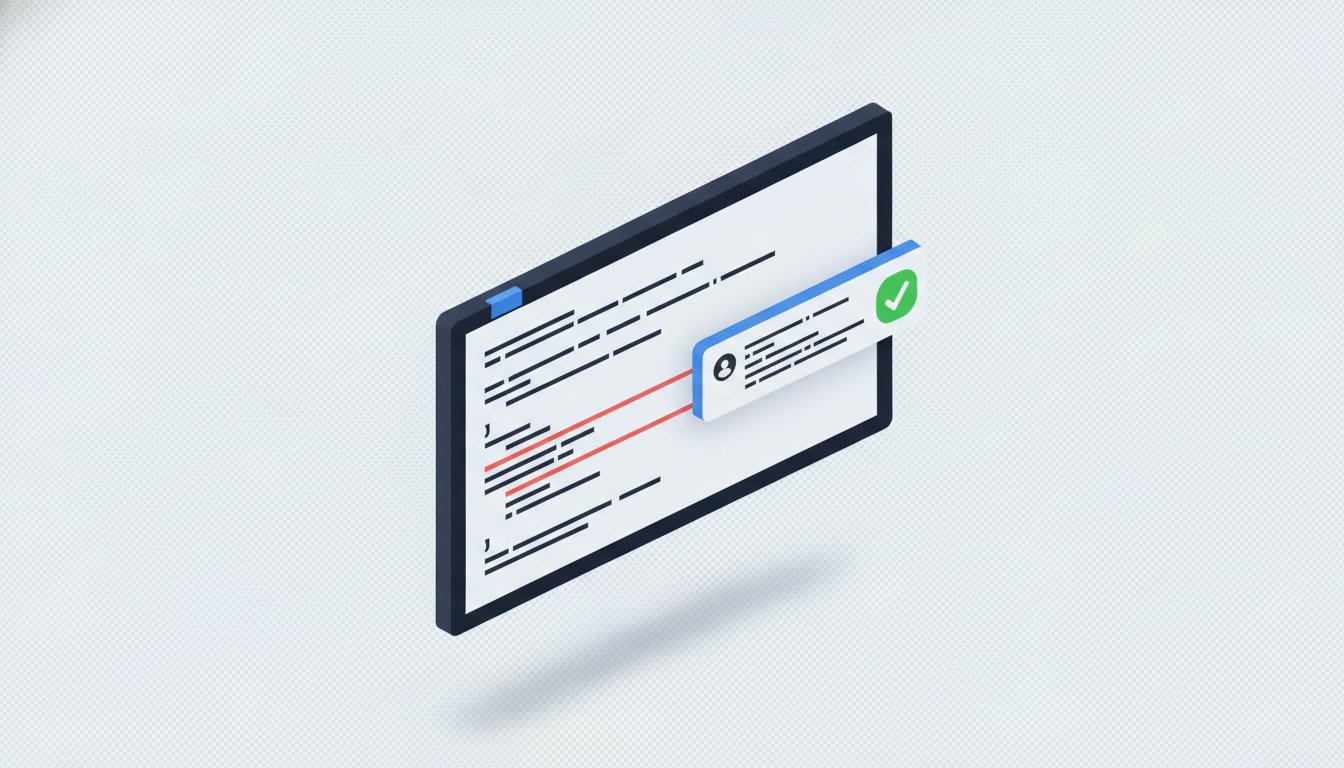
The feedback loop is integrated directly into the tools you already use. AI comments appear exactly where they matter: on the specific lines of code in the GitHub PR view. This mirrors the experience of a human peer review. Developers don't need to leave the browser or check a separate dashboard to see suggestions. They can reply to AI comments to clarify intent or ask for alternative implementations. This interactive flow turns the review into a collaborative session rather than a static report. For more details on optimizing these interactions, explore our guide on automated code review workflows. It explains how to move beyond basic linting toward a sophisticated consensus-based approach that catches logical errors before they reach production.
CodeMouse Resources: The Affiliate Program and Support
Adopting a new tool requires confidence in its long-term viability and the support structure behind it. CodeMouse provides a 14-day free trial to allow you to test multi-model feedback on your actual production code. You can verify the accuracy of the consensus logic without any upfront financial commitment. During this period, you have full access to detailed documentation. This includes specific guides for optimizing LLM prompts to ensure the AI aligns with your team's unique coding standards. If you encounter technical hurdles, you don't talk to a generic support bot. You get direct support from the Squidcode engineering team.
Effective implementation of an AI code review for small teams depends on transparency. We don't hide our roadmap or our logic. The goal is to provide a functional utility that respects your time. By providing the infrastructure and then stepping out of the way, we allow your developers to focus on shipping. The documentation is written by engineers for engineers. It prioritizes technical requirements and integration steps over marketing fluff. It's a resource designed for quick consumption by busy professionals who need to extract facts and move on to implementation.
Joining the CodeMouse Affiliate Program
Many early adopters are consultants or agencies who manage multiple codebases for various clients. The CodeMouse Affiliate Program allows you to earn recurring commission by referring other lean engineering teams to the platform. This is an ideal setup for open-source maintainers or devtools influencers who already advocate for efficient workflows. You'll have access to a simple dashboard to track referrals and payouts in real-time. It's a straightforward way to offset your own tool costs while helping other teams solve the senior developer bottleneck. There's no complex application process. You can start referring peers immediately after setting up your account.
Continuous Improvement and Updates
The AI landscape moves fast. We ensure your workflow remains current by providing automatic updates to the latest models as they release. Whether it's Claude 4.5 or the newest GPT iteration, the integration happens on the backend without requiring manual changes to your repository settings. Our feature roadmap is community-driven and focused strictly on utility. We avoid the feature bloat common in enterprise SaaS. The flat fee supports long-term infrastructure stability without the need to manufacture unnecessary complexity. You get a tool that evolves with the industry while remaining simple to manage. This allows your team to stay focused on the codebase instead of the tools surrounding it.
Ship Faster with Automated Quality Checks
Scaling an engineering department shouldn't mean drowning your leads in pull requests. Implementing an AI code review for small teams decouples your quality standards from your headcount. You've seen how multi-model consensus logic catches logical bugs that static analysis misses. You also know how the "Bring Your Own Key" model protects your burn rate from predatory per-seat pricing. This infrastructure ensures that your senior developers focus on architecture while the AI handles the first-pass review.
By moving to a flat-rate model, you eliminate the administrative friction of seat management. Your team gets immediate, senior-level feedback on every PR. This allows you to maintain high velocity without sacrificing the integrity of your codebase. It's a pragmatic shift toward a more modular, automated development lifecycle. You gain total transparency over your AI spend while providing your contributors with the tools they need to ship with confidence.
Start your 14-day free trial of CodeMouse AI Code Review to access unlimited reviews for $10/month and leverage our GitHub App integration. It's time to remove the bottleneck and let your builders build.
Frequently Asked Questions
Is AI code review safe for private repositories?
AI code review is safe when implemented through official GitHub App integrations and secure LLM APIs. CodeMouse processes your pull request data to generate feedback but doesn't use your private code to train base models. By using your own API keys, you maintain direct control over data retention policies set by providers like Anthropic and OpenAI. This ensures your intellectual property remains within your controlled environment.
How does flat-rate pricing work for a team of 10 developers?
CodeMouse charges a flat $10 per month regardless of your team size. Whether you have 2 developers or 10, your subscription cost stays the same. You connect your own API keys to cover the actual token usage from AI providers. This model makes AI code review for small teams highly predictable. It eliminates the administrative burden of seat management and prevents costs from scaling linearly with your headcount.
What is the benefit of using both Claude and GPT for reviews?
Using multiple models enables consensus-based logic that significantly reduces hallucinations. Claude 3.5 Sonnet excels at reasoning and technical nuance, while GPT-4o provides broad architectural knowledge. When both models identify the same issue, the confidence in that feedback is much higher. This multi-layered approach ensures your team receives technically sound advice that a single model might overlook or misinterpret during a deep scan.
Can I use my own OpenAI or Anthropic API keys with CodeMouse?
Yes, using your own API keys is the core requirement for our Bring Your Own Key (BYOK) model. This setup allows you to pay for AI tokens at cost directly to the providers. It removes SaaS markups and ensures you aren't subject to platform-imposed throttling or credit limits. You maintain full transparency over your usage and can switch between different model tiers as your project needs evolve.
Does the AI review catch security vulnerabilities?
AI reviews identify complex security flaws that traditional static analysis tools often miss. It detects logical vulnerabilities, race conditions, and improper data handling by understanding the intent behind the code. While it doesn't replace specialized penetration testing, it acts as a constant, first-line security audit. This is critical for small teams who need to maintain high security standards without a dedicated SecOps department.
How do I join the CodeMouse Affiliate Program?
You can join the affiliate program through the main dashboard after setting up your account. It's designed for consultants, agencies, and open-source maintainers who want to refer other lean engineering teams. You earn a recurring commission on every active subscription you refer. The dashboard provides a simple interface to track your referrals, monitor conversions, and manage payouts without complex application hurdles.
Will AI replace the need for senior developers in my team?
AI functions as a force multiplier rather than a replacement for senior talent. It handles the repetitive aspects of code review, such as catching edge cases and enforcing style consistency. This frees your senior engineers to focus on high-level architecture and mentoring. AI code review for small teams ensures that by the time a human lead looks at a PR, the low-hanging fruit is already resolved.
What happens if the AI provides incorrect feedback?
The human developer always remains the final authority on every pull request. If the AI provides a suggestion that doesn't align with your intent, you can simply ignore the comment or reply to it to clarify the logic. The system learns from these interactions to improve future feedback. It's built to be a collaborative partner that enhances your workflow rather than a rigid gatekeeper that blocks your progress.