Claude and GPT Code Review Consensus: The 2026 Engineering Reference
A single LLM is a single point of failure in your CI/CD pipeline. Relying on one model leads to hallucination hunting. It's a drain on your engineering velocity. To ship faster, you need a Claude and GPT code review consensus that filters noise and validates logic across different architectures. You've likely spent too many hours manually debunking AI feedback that doesn't actually work. It's frustrating to treat an automated tool like a junior developer who needs constant supervision.
This guide shows you how to leverage multi-model consensus to eliminate hallucinations and deliver production-grade PR feedback. You'll learn how to orchestrate parallel reviews, catch complex logic errors, and reduce manual overhead. We'll cover the orchestration layers, the BYOK economic model, and the specific steps required to achieve zero-hallucination automated reviews. This is the 2026 standard for high-velocity engineering teams.
Key Takeaways
- Identify why single-model reviews fail and how multi-model voting eliminates confident hallucinations.
- Implement a Claude and GPT code review consensus to ensure logic validation across different model architectures.
- Combine Claude’s architectural reasoning with GPT’s syntax-specific optimizations for balanced PR feedback.
- Optimize your CI/CD budget by calculating the cost-to-accuracy trade-off for multi-model analysis.
- Automate the orchestration process using CodeMouse to integrate multi-model reviews directly into your GitHub workflow.
Table of Contents
Why Single-Model AI Reviews Fail in Complex Pull Requests
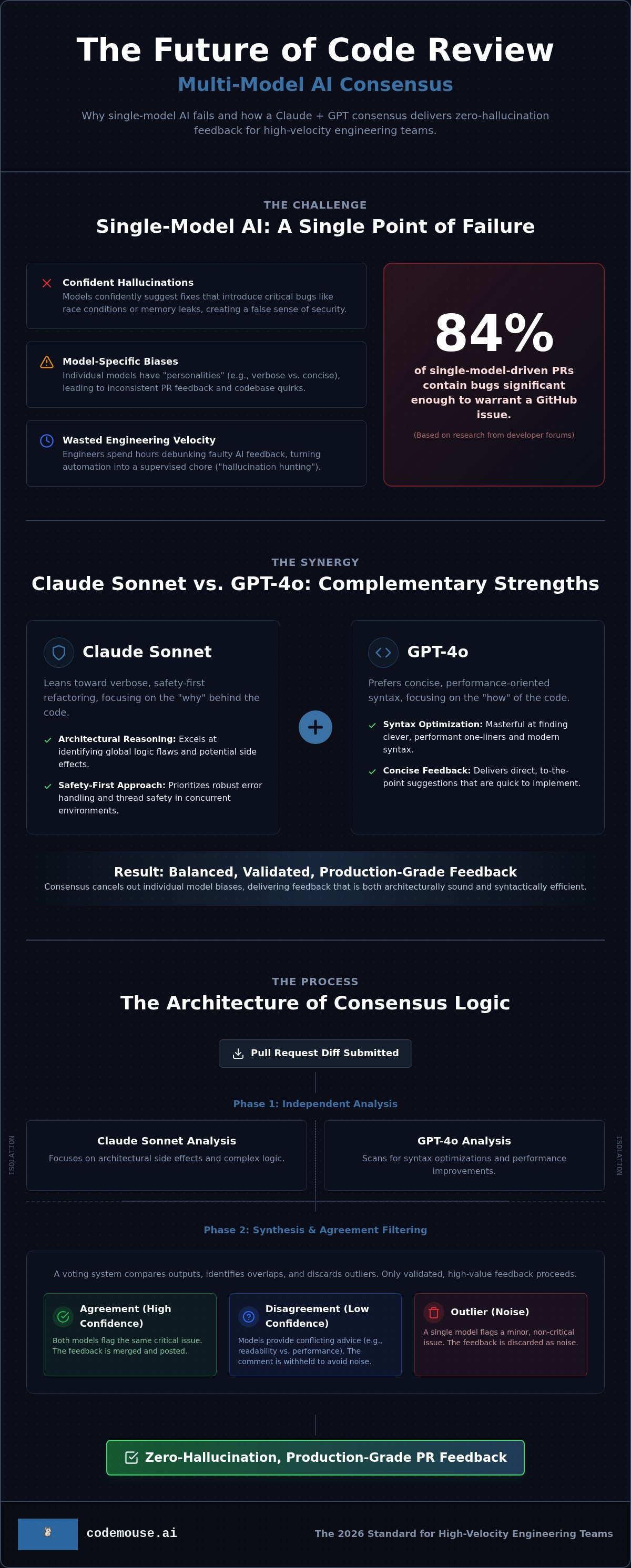
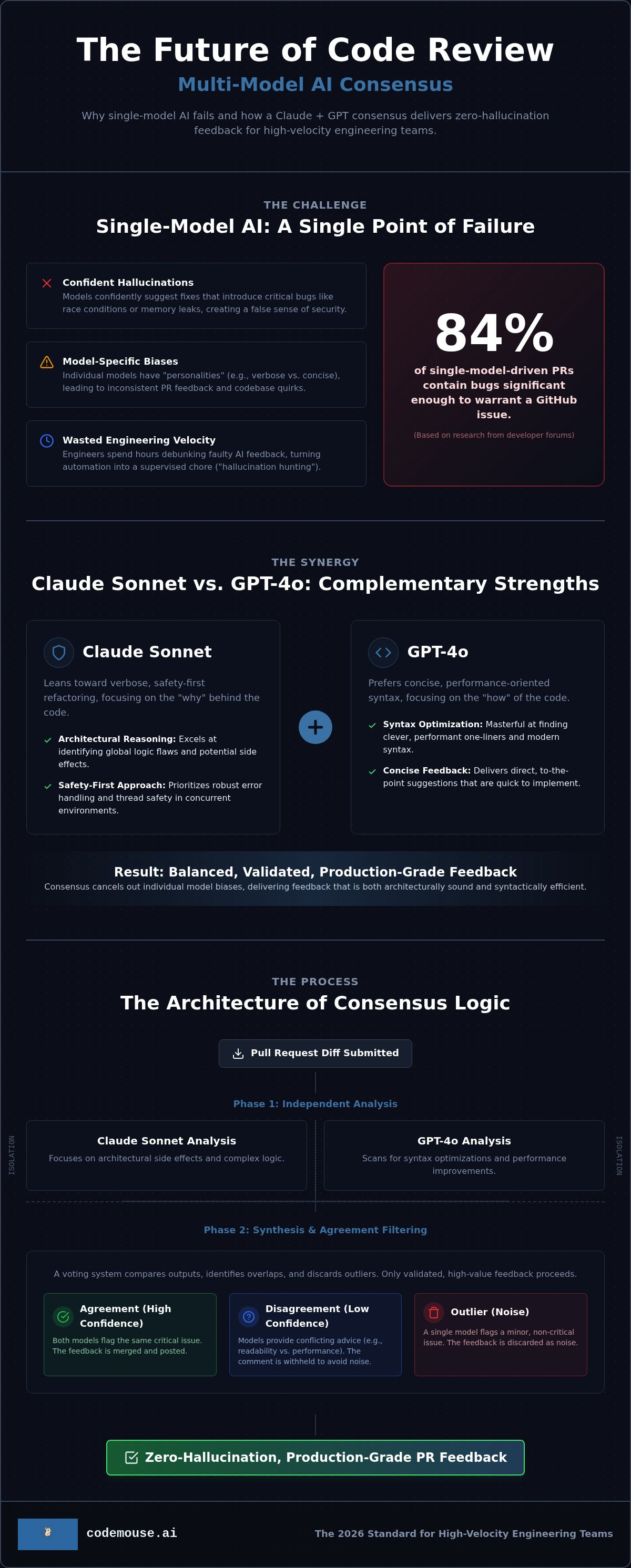
Single-model AI code reviews are a gamble. They suffer from what engineers call model myopia. This is a structural blind spot where an LLM's specific training data and architecture limit its ability to perceive logic flaws. Even with the advanced semantic understanding of 2026 models, a single model lacks the "second opinion" necessary for production-grade reliability. If your automation requires a human to verify every comment, it isn't automation. It's a chore. It drains your team's velocity rather than accelerating it.
Traditional automated code review tools used static analysis to find syntax errors. Modern AI models attempt to understand intent, but they often fail at scale. Research shared on developer forums indicates that roughly 84% of Claude-driven PRs contain bugs significant enough to warrant GitHub issues. This happens because single models prioritize local patterns over global architectural logic. They see the "how" but miss the "why." Relying on a Claude and GPT code review consensus is the only way to mitigate these individual failures before they hit your main branch.
The Risk of Single-LLM Hallucinations
LLMs are designed to be helpful, often at the expense of being right. They prioritize valid syntax over sound architectural logic. You'll see this when a model confidently suggests a fix that introduces a race condition or a memory leak. These "false positives" waste engineering time. A single model might identify a clean-looking refactor but miss the fact that it breaks thread safety in a high-concurrency environment. Without a cross-check, these hallucinations look like valid advice. They create a false sense of security that leads to production outages.
Model-Specific Biases in Code Feedback
Every model has a distinct personality. Claude Sonnet often leans toward verbose, safety-first refactoring. It might suggest wrapping every operation in complex error handling that obscures the primary logic. GPT-4o, conversely, prefers concise, performance-oriented syntax. It might suggest a clever one-liner that's difficult for a human team to maintain. These biases lead to inconsistent PR quality. When you don't have a Claude and GPT code review consensus, your codebase adopts the quirks of whichever model you triggered that day. Consistent feedback requires multiple perspectives to cancel out individual model noise.
The Architecture of Claude and GPT Consensus Logic
Achieving a Claude and GPT code review consensus requires a structured orchestration layer. It isn't enough to just send a diff to two different APIs. You need a system that compares outputs, identifies overlaps, and discards outliers. This multi-model voting system acts as a high-pass filter for code quality. By the time a comment reaches your PR, it has been vetted by two distinct neural architectures. This process drastically reduces the noise associated with single-model feedback. It transforms AI from a source of messy suggestions into a reliable gatekeeper for your codebase.
Independent Analysis Phase
Isolation is critical. Claude and GPT must analyze the pull request diff in parallel without knowing the other's findings. This prevents cross-contamination. Each model receives the same diff but operates within its own context window. We use distinct system prompts tailored to each model's strengths. Claude might focus on architectural side effects while GPT scans for syntax optimizations. This separation ensures that the final consensus isn't just a repetition of the same mistake. Recent research on the performance of LLMs in code review suggests that even the best models have an error rate that makes solo deployment risky. Capturing raw metadata from both models allows the synthesis engine to weigh their confidence levels during the merge. This metadata includes token count, probability scores, and specific rule violations found during the scan.
Synthesis and Agreement Filtering
The synthesis round is where the Claude and GPT code review consensus happens. If both models flag an unhandled exception on line 42, the system marks it as a high-confidence issue. It merges the comments into a single, coherent suggestion. When they disagree, the logic must handle the conflict. For example, if Claude suggests a refactor for readability but GPT claims it hurts performance, the system labels this as "Low Confidence." It might then trigger a third-party tie-breaker model or simply withhold the comment to avoid wasting developer time. For a deeper look at setting up these workflows, see our guide on multi-model AI code review configuration. This logic ensures that only high-value, validated feedback reaches your developers. You can build these scripts yourself, or use a tool like CodeMouse to manage the orchestration automatically. The goal is to move beyond raw output and toward a unified, production-ready review.
Claude Sonnet vs. GPT-4o: Complementary Strengths in 2026
The "Logic-Syntax Gap" is the primary reason single-model reviews fail. In 2026, even the most advanced LLMs possess distinct architectural biases based on their training objectives. A Claude and GPT code review consensus capitalizes on these differences. It pairs Claude’s deep reasoning with GPT’s broad library knowledge. This creates a feedback loop where one model’s blind spot is the other’s specialty. Relying on one model is like having a specialist who ignores the bigger picture. You need both perspectives to ensure a PR is both syntactically perfect and architecturally sound.
Language-specific performance also dictates the need for a multi-model approach. In 2026, GPT-4o remains the benchmark for Pythonic idioms and PEP 8 compliance. It catches subtle performance regressions in standard library usage that other models miss. Conversely, Claude Sonnet 4.5 shows superior performance in TypeScript and Rust. It handles complex type inference and ownership logic with higher precision. Using them together ensures that regardless of your stack, the review remains rigorous and context-aware.
Claude Sonnet 4.5 for Deep Reasoning
Claude Sonnet 4.5 is the heavy lifter for architectural analysis. It excels at tracking long-range dependencies across multiple files. If a change in your API layer breaks a downstream consumer, Claude is likely to flag it. It doesn't just look at the diff; it analyzes the implementation plan against the actual code changes. This prevents "logic drift" where the code works but violates the intended design pattern. For a detailed breakdown of these capabilities, see our Claude Sonnet 4.5 guide. It’s particularly effective for reviewing large-scale refactors where the risk of breaking side effects is high.
GPT-4o for Standards and Optimization
GPT-4o provides the high-speed validation layer. It is exceptionally good at identifying edge cases in standard library usage and suggesting micro-optimizations. While Claude focuses on the architecture, GPT scans for performance bottlenecks and security vulnerabilities in specific code blocks. It offers benchmarking suggestions directly in the PR comments, helping developers optimize hot paths in real-time. For those looking at how this compares to previous iterations, our analysis of GPT-4o vs Claude 3 Opus provides historical context on this performance evolution. This model ensures your code meets the highest standards of efficiency and modern best practices.
The Claude and GPT code review consensus works because these models approach the same problem from different angles. Claude asks if the logic makes sense for the system. GPT asks if the code is the most efficient way to express that logic. By merging these two viewpoints, you get a review that is comprehensive, accurate, and ready for production.
Implementing Multi-Model Reviews: Cost vs. Accuracy Trade-offs
Accuracy has a price tag, but it's lower than you think. Catching a single logic error pays for thousands of pull requests. A Claude and GPT code review consensus adds a small marginal cost, typically around $0.05 per pull request depending on the diff size. This is a negligible expense compared to the engineering hours lost to manual double-checking or production hotfixes. You trade cents for certainty. Token management is the key to scaling this across enterprise repositories with thousands of PRs. By stripping non-essential files and using cached inputs, you keep the review process lean without sacrificing depth.
Scaling for enterprise requires a tiered approach. You don't need a full consensus review for every README update or CSS tweak. Implement logic that triggers the dual-model scan only for high-impact directories like your core logic or API layers. This targeted application of the Claude and GPT code review consensus ensures high accuracy where it matters most while keeping API costs under control. It prevents your CI/CD pipeline from becoming a cost center while maintaining high-velocity shipping cycles.
The Economics of BYOK (Bring Your Own Key)
Flat-fee SaaS models offer the most predictability for growing engineering teams. Traditional per-seat pricing models penalize you for hiring more developers. With a Bring Your Own Key (BYOK) model, you pay for exactly what you consume at the API level. This transparency allows you to manage Anthropic and OpenAI API quotas effectively based on your internal priorities. You aren't paying a middleman's markup on tokens. This approach avoids the "Per-Seat Tax" that often bloats engineering budgets. It keeps your costs linear with your actual development activity rather than your headcount.
Latency Optimization for Real-Time Reviews
Speed matters in CI/CD. Parallel execution is mandatory. Claude and GPT analyze the code simultaneously rather than in sequence. Once both models finish, a synthesis model merges the results into a single comment. We define consensus latency as the delta between individual model response and final synthesized feedback. This usually adds less than three seconds to the total review time. You can optimize this by using smaller models like GPT-4o-mini for initial triage. This smaller model filters out trivial changes before they hit the more expensive reasoning models. You get the best of both worlds: high-speed syntax checking and deep architectural analysis. Automate your consensus logic today and try CodeMouse for free to manage your multi-model review pipeline efficiently.
CodeMouse: Automated Consensus Reviews for GitHub
Building a custom orchestration layer for code reviews is a distraction from your core product. CodeMouse serves as the dedicated engine for achieving a Claude and GPT code review consensus without the maintenance overhead of manual scripts. It handles the parallel execution, synthesis, and deduplication logic required to filter out model-specific hallucinations. You get production-grade feedback directly in your pull requests via a seamless GitHub App integration. There are no complex CLI tools to configure or brittle GitHub Actions to maintain. It’s a plug-and-play solution for high-velocity teams.
The pricing model is built for engineering efficiency. CodeMouse operates on a flat $10 per month fee regardless of your team size. This eliminates the "per-seat tax" common in enterprise software. By using a Bring Your Own API Key (BYOK) approach, you maintain full transparency over your token usage and avoid vendor markups on AI compute. You pay only for the orchestration service and the raw tokens you consume. This transparency ensures that your Claude and GPT code review consensus workflow remains cost-effective as your PR volume scales.
Setting Up Your Multi-Model Workflow
Configuration takes less than five minutes. First, connect your OpenAI and Anthropic API keys through the secure dashboard. You then select which models participate in the consensus round. Most teams choose a combination of Claude 3.5 Sonnet and GPT-4o for the best balance of reasoning and speed. You can also customize the feedback tone to match your team’s existing culture, ensuring that automated comments feel like peer reviews rather than robotic interjections. Finally, set your consensus threshold to define how many models must agree before a comment is published to GitHub. This granular control prevents low-confidence noise from cluttering your PRs.
Why Teams Choose CodeMouse Over Manual Scripts
Manual scripts are difficult to scale across multiple repositories. CodeMouse provides centralized management for your entire organization's PR feedback. You get detailed statistics and cost tracking per project, allowing you to monitor exactly how much your consensus workflow costs in real-time. This visibility is impossible to achieve with fragmented internal tools. Teams often find that the 14-day free trial provides enough data to prove the accuracy gains over single-model setups. It’s a low-risk way to validate the multi-model approach on your own production code. Start your 14-day free trial of CodeMouse and automate your consensus logic today.
Standardize Your Pipeline with Multi-Model Logic
Transitioning from single-model reviews to a multi-model architecture is the most effective way to eliminate confident hallucinations in your pipeline. A Claude and GPT code review consensus provides the structural redundancy needed for production-grade code analysis. It allows you to leverage Claude’s architectural reasoning alongside GPT’s optimization strengths, creating a filter that only surfaces validated issues. This approach moves AI from a noisy experiment to a reliable gatekeeper for your main branch. You no longer have to choose between speed and accuracy; the consensus model delivers both by verifying logic across independent neural architectures.
CodeMouse makes this transition immediate. It integrates with GitHub in under two minutes and supports unlimited reviews and team members for a flat fee. With no markup on AI API costs through the BYOK model, you scale your review process without scaling your overhead. Automate your PR consensus reviews for $10/mo. Start shipping faster with the confidence that your automated reviews are accurate, noise-free, and ready for production.
Frequently Asked Questions
How does Claude and GPT consensus reduce AI hallucinations?
Consensus logic acts as a cross-verification layer where only overlapping findings are promoted to the final review. If Claude flags a logic error that GPT ignores, the system treats it as a potential outlier. This Claude and GPT code review consensus ensures that comments reflect high-confidence issues validated by two distinct architectures. It eliminates the "confident wrongness" of a single model by requiring agreement before surfacing feedback to the developer.
Is it significantly more expensive to run two models for every code review?
The cost increases linearly with token usage but remains manageable under a BYOK model. Using GPT-4o and Claude 3.5 Sonnet typically costs less than $0.10 per standard pull request. Because CodeMouse doesn't mark up these API costs, you pay the raw rate directly to the providers. For most teams, the cost of extra tokens is far lower than the engineering hours spent manually filtering single-model hallucinations.
Can I choose which models are used for the consensus logic?
Yes, you can select specific models within the CodeMouse dashboard. You have the flexibility to pair Claude 3.5 Sonnet with GPT-4o or use lighter models like GPT-4o-mini for less critical repositories. This modularity allows you to tailor the Claude and GPT code review consensus to your specific project needs and budget. You control the reasoning depth by choosing the models that best fit your codebase architecture.
Does CodeMouse store my code or API keys?
CodeMouse does not store your source code. It acts as a stateless orchestration layer that processes the pull request diff and then discards the data. Your API keys are encrypted at rest and only used to trigger the reviews you authorize. This architecture ensures that your intellectual property remains within your controlled environments. The focus is on providing infrastructure while respecting the security requirements of professional engineering teams.
How long does a multi-model consensus review usually take to post a comment?
Most reviews complete within 30 to 60 seconds. Because CodeMouse executes the model calls in parallel, the total latency is determined by the slowest model's response time plus a few seconds for synthesis. This is significantly faster than a manual human review. It fits seamlessly into modern CI/CD pipelines without blocking the development workflow. You get high-fidelity feedback almost immediately after opening a pull request.
What happens if Claude and GPT disagree on a code change?
Disagreements result in the comment being withheld or marked as low confidence. The system prioritizes precision over recall to avoid wasting developer time with conflicting advice. If one model suggests a refactor that the other model deems unnecessary, the consensus logic filters it out. This ensures that every comment posted to your GitHub PR is actionable and has been verified by both reasoning engines.
Is CodeMouse compatible with private GitHub repositories?
Yes, CodeMouse integrates with both public and private GitHub repositories. It operates as a GitHub App, providing the necessary permissions to read diffs and post comments within your private organization. You maintain granular control over which repositories the app can access. This makes it suitable for enterprise environments where code privacy is a mandatory requirement for any third-party tool integration.
Do I need a paid OpenAI or Anthropic account to use consensus reviews?
You need active API access from OpenAI and Anthropic to provide your own keys. CodeMouse uses a Bring Your Own Key (BYOK) model to ensure transparency and prevent usage throttling. You'll need to maintain a balance on these platforms to cover the raw token costs. This setup gives you full control over your AI spending and allows you to benefit from any volume discounts or credits you already have.