Multi-Model AI Code Review Configuration: Implementing Consensus Logic in 2026
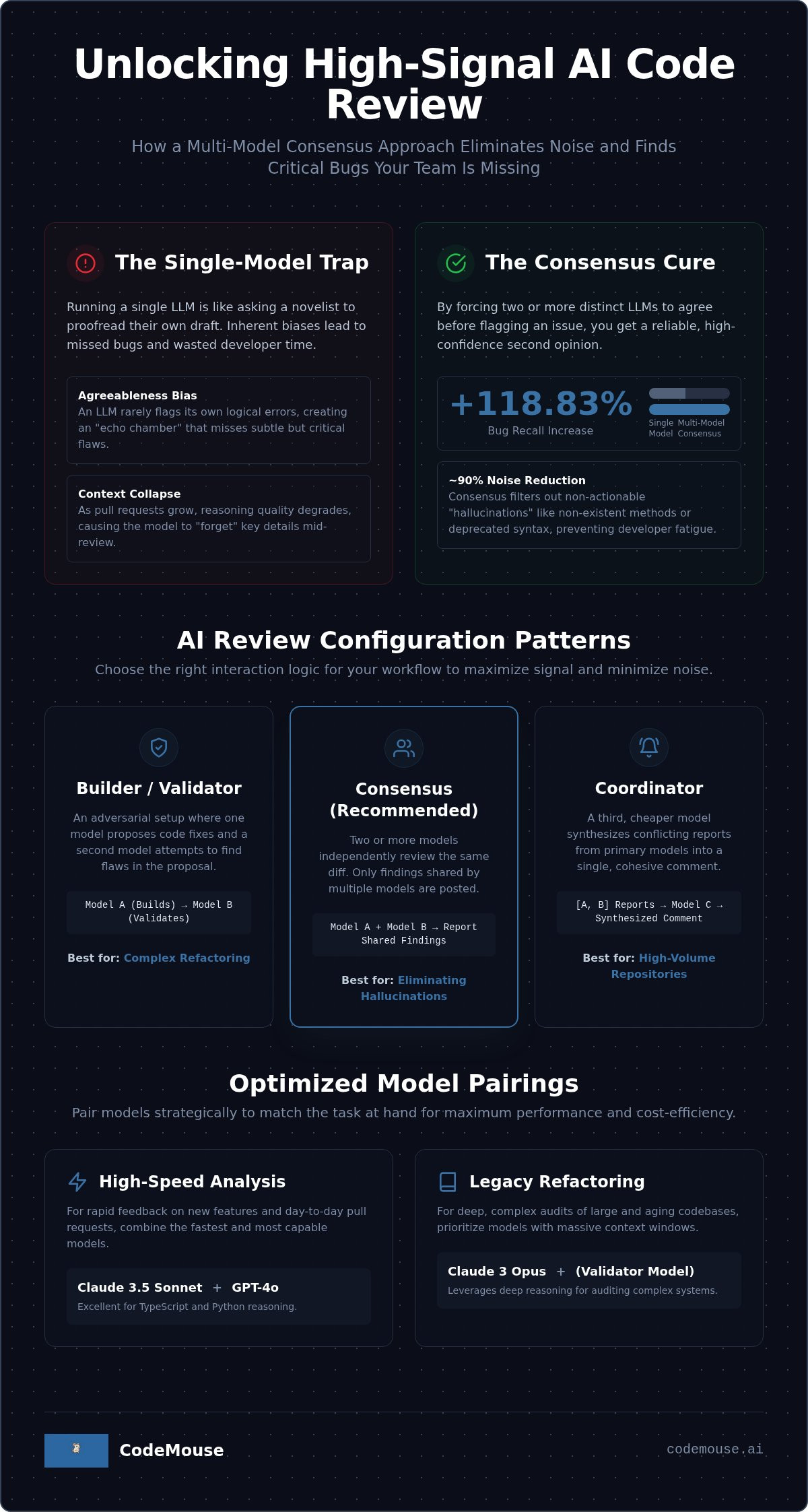
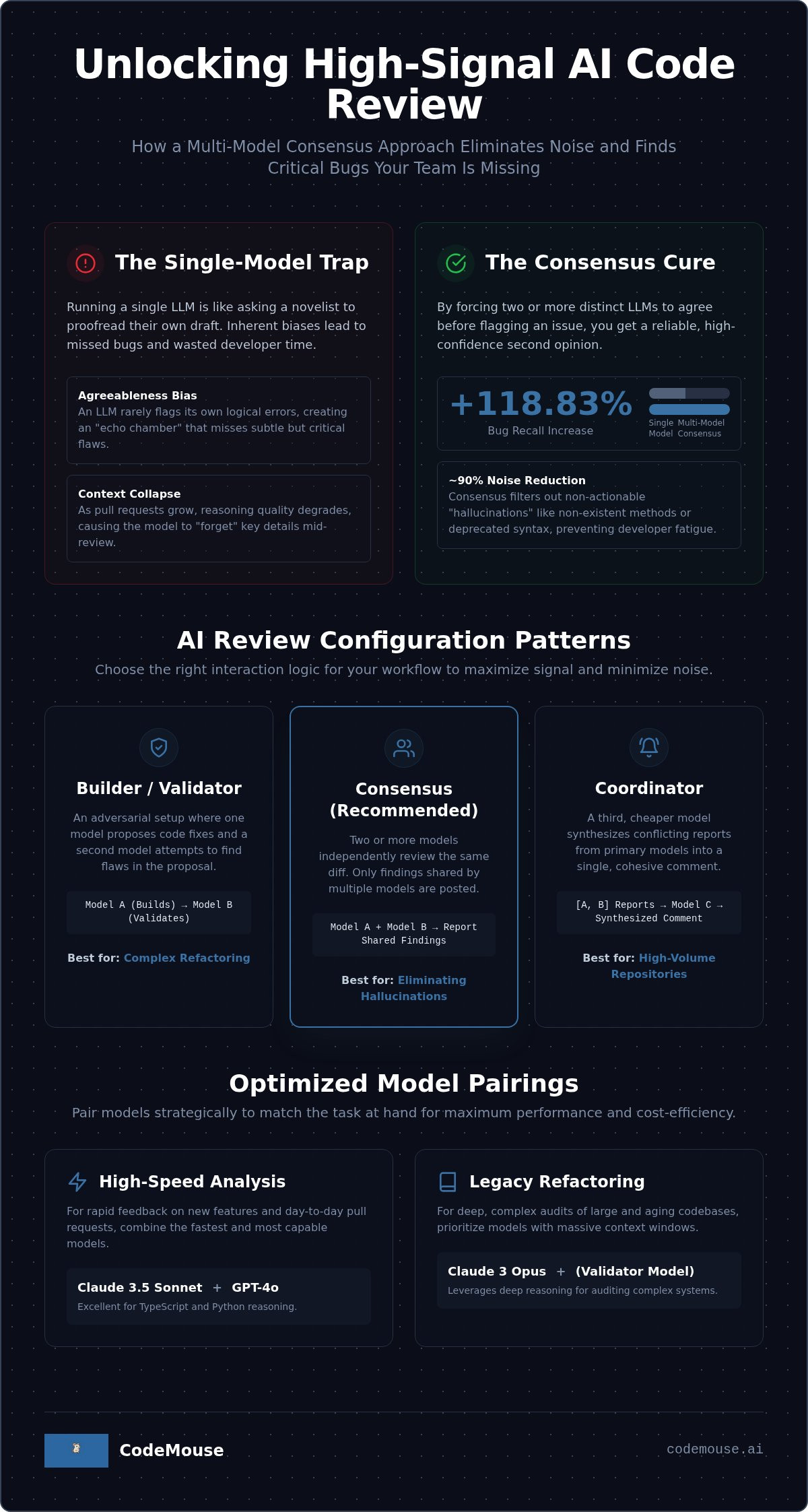
Running a single LLM to review code is like asking a novelist to proofread their own draft. You're going to miss the obvious errors. Recent studies show that multi-model aggregation improves bug recall by 118.83% compared to a single-pass system. Despite this, most teams haven't optimized their multi-model AI code review configuration to handle the resulting noise. You've likely seen the "agreeableness bias" where a model ignores flaws in code that looks like its own output, leading to missed edge cases and wasted developer time.
Consensus is the cure for AI hallucination. By forcing different models to agree before flagging an issue, you can transform a chatty bot into a reliable second opinion. This guide teaches you how to configure a multi-model pipeline that uses Claude and GPT to catch critical bugs while keeping your costs flat. We'll cover the logic needed to de-duplicate findings, manage context window saturation, and implement a workflow that prioritizes high-signal feedback over automated fluff. It's time to build a review process that respects your team's time and intelligence.
Key Takeaways
- Eliminate context collapse and single-model bias by deploying independent AI agents to audit complex pull requests.
- Implement a multi-model AI code review configuration using the Consensus pattern to suppress hallucinations and report only verified bugs.
- Optimize review performance by pairing Claude 3.5 Sonnet with GPT-4o for high-speed analysis or Claude 3 Opus for legacy refactoring.
- Build automated pipelines via GitHub Actions and encrypted secrets to maintain full control over your review environment.
- Reduce overhead by utilizing flat-rate orchestration tools that offer Bring-Your-Own-Key (BYOK) transparency and cost control.
Table of Contents
The Limits of Single-Model Review: Why Consensus Matters
Single-model reviews fail because of inherent bias. An LLM rarely flags its own logical errors. This self-referential blind spot is a major hurdle in a standard multi-model AI code review configuration. When one model generates code and the same architecture reviews it, the "echo chamber" effect takes over. It misses subtle logic flaws that a diverse model architecture would catch immediately. You need a second, independent set of weights to break this cycle.
Context collapse is the second failure point. As pull request threads grow, the token count increases. High context usage often leads to "middle-of-the-window" forgetfulness where reasoning quality degrades. A fresh, secondary model doesn't inherit this baggage. It provides a clean audit of the current state without the noise of previous iterations. This prevents the AI from losing the thread during complex refactors.
Consensus AI Code Review is the practice of cross-verifying findings between two or more distinct LLMs. It operates on the principle of Ensemble learning, where multiple learners work together to produce a single, high-confidence output. This creates an adversarial advantage. Forcing models to justify critiques to one another ensures that only the most defensible bugs reach the developer. If GPT-4o and Claude 3.5 Sonnet both flag a memory leak, it's almost certainly a real issue.
Understanding Model Hallucinations in PRs
Hallucinations in PRs often manifest as non-existent library methods or deprecated syntax suggestions. These false positives aren't just annoying. They create developer fatigue. When a tool cries wolf too often, teams start ignoring all AI feedback. Consensus logic filters out roughly 90% of this non-actionable noise by requiring independent verification before a comment is posted. It turns a "maybe" into a "definitely."
The Architecture of a Multi-Model Pipeline
A robust multi-model AI code review configuration requires decoupled context windows. You must keep the "Builder" (code generator) and the "Validator" (reviewer) separate. Using git diffs as the primary source of truth ensures all agents work from the same baseline without polluting each other's reasoning. For teams looking to scale, implementing AI code review for GitHub effectively requires this multi-agent separation to maintain high signal-to-noise ratios across the entire organization.
Configuring Your Multi-Model Logic: Builder vs. Validator vs. Consensus
The multi-model AI code review configuration you deploy determines how your agents communicate and filter findings. Most teams start with a single agent, but 2026 workflows require more sophisticated interaction patterns. Choosing the right logic prevents your PR comments from becoming a landfill of conflicting advice. You can deploy agents in three primary ways: Builder/Validator, Consensus, or Coordinator.
The Builder/Validator pattern uses one model to propose code fixes while a second model attempts to find flaws in those proposals. It's an adversarial setup that works best for complex refactoring. In contrast, the Consensus pattern runs two or more models independently on the same diff. Only findings shared by multiple models are posted to the PR. This is the most effective way to eliminate hallucinations. Research in Evaluating Large Language Models for Code Review demonstrates that model performance varies by language; Claude often leads in TypeScript reasoning, while GPT models remain highly effective for Python and backend infrastructure.
For high-volume repositories, the Coordinator pattern adds a third, cheaper model like GPT-4o-mini. This agent doesn't review the code itself. Instead, it synthesizes conflicting reports from the primary models and formats them into a single, cohesive comment. It removes the burden of "deciding" from the developer when two AI agents disagree.
Consensus Logic: Handling Model Disagreements
You need a defined threshold for reporting. A consensus threshold is the minimum number of agents required to flag a line. For high-velocity teams, a 2-of-2 requirement (unanimous agreement) ensures that only the most certain bugs reach the developer. If you're working on security-critical modules, you might lower this to 1-of-2 to ensure no potential vulnerability is missed. Categorize feedback early. Critical logic bugs should require consensus, while style nits can be delegated to a single, low-cost agent to keep the noise floor low.
Model Routing for Cost Efficiency
Don't waste high-tier compute on simple tasks. Route basic refactors and documentation checks to smaller, faster models. Use Claude Sonnet 4.5 as your primary engine for mid-tier PRs. It offers a high-performance middle ground for reasoning without the latency of larger models. Trigger the "Dream Team" of Claude Opus and GPT-4o only for high-risk files like authentication logic or financial transactions. Automating this logic through a native GitHub app for code reviews allows you to maintain these complex workflows without managing custom scripts or YAML files.
Comparison: 2026 Model Pairings for Code Analysis
Your multi-model AI code review configuration is only as effective as the diversity of its underlying agents. Using two models from the same family, such as GPT-4o and GPT-4o-mini, often leads to redundant feedback. These models share similar training data and architectural biases, making them likely to miss the same logical flaws. For a resilient audit, you must mix model families. Combining Anthropic's Claude with OpenAI's GPT creates a stronger "second opinion" because these models approach code structure and reasoning differently.
The industry standard for 2026 is the Claude 3.5 Sonnet and GPT-4o pairing. This combination balances high-speed execution with deep logical reasoning. For legacy codebase refactoring, the Claude 3 Opus and GPT-4o pairing provides maximum reasoning depth, though it comes with higher latency. Teams prioritizing cost can utilize DeepSeek-V3 alongside GPT-4o-mini. This budget-friendly setup still provides the benefits of consensus, ensuring that a single model's hallucination doesn't derail your PR. Data from 2025 indicates that aggregating results from multiple models can improve recall by 118.83% over a single-pass system, justifying the additional compute spend.
Claude vs. GPT: Complementary Strengths
Claude models excel at architectural patterns and long-context reasoning. They are less likely to lose track of global variables in files exceeding 10,000 lines. GPT models often show higher precision in syntax-specific bug detection and standard library usage. By running both, you cover the "big picture" logic and the "nitpicky" syntax errors simultaneously. For a deeper dive into these specific trade-offs, read our GPT-4o vs Claude 3 Opus engineering guide to see which pairing fits your stack.
Latency and Throughput Trade-offs
Orchestrating multiple models introduces a "Review Cycle Time" penalty. If you run models sequentially, your PR feedback loop might stall for several minutes. Parallelization is essential for maintaining developer velocity. By triggering all models concurrently, you can keep total feedback time under 2 minutes. This strategy aligns with academic research on multi-agent code review, which highlights that concurrent execution minimizes context switching for the developer. You must also manage rate limits across providers. Distributing your multi-model AI code review configuration between Anthropic and OpenAI ensures that a rate limit hit on one provider doesn't block your entire CI/CD pipeline. This redundancy is a key operational advantage of a multi-model approach.
Step-by-Step: Implementing Consensus Review via GitHub Actions
Manually building a multi-model AI code review configuration requires a precise orchestration of API calls and data parsing. You need a workflow that triggers on every code change without introducing significant latency to your CI pipeline. GitHub Actions provides the necessary infrastructure to run these agents in parallel. Follow these five steps to deploy a custom consensus engine.
Step 1: Secure your credentials. Store your Anthropic and OpenAI API keys in GitHub Secrets. Use clear identifiers like ANTHROPIC_API_KEY and OPENAI_API_KEY. Never hardcode these in your YAML files. 2026 security standards demand that these keys remain encrypted at rest and only accessible during the runtime of the specific Action.
Step 2: Define trigger events. Set your workflow to trigger on pull_request events. Specifically, use opened and synchronize. This ensures the AI audits the initial code and every subsequent commit. Avoid triggering on every comment to save on API costs and prevent noise.
Step 3: Script parallel calls. Use a script (Python or Node.js) to hit both model endpoints concurrently. Sequential calls will double your review time. Parallelization keeps your feedback loop under two minutes, maintaining developer momentum. Ensure your script handles timeouts gracefully to avoid blocking the PR merge if one provider is down.
Step 4: Implement comparison logic. Direct your models to return findings in JSON format. Your script must parse these outputs to identify overlapping findings. If both models flag the same line number with a similar error category, mark it as a consensus bug. This de-duplication is the core of a reliable multi-model AI code review configuration.
Step 5: Post a unified comment. Use the GitHub REST API to post a single, consolidated comment to the PR. Avoid posting individual comments for every model finding. A summary view is easier for developers to digest and prevents notification fatigue.
Managing API Keys and Security
Bring Your Own Key (BYOK) is the most transparent way to scale AI usage across a team. It allows you to set hard usage limits and monitor spend directly in your provider dashboards. Transitioning to automated code review with AI consensus replaces the brittle, rule-based static analysis of the past with dynamic reasoning that adapts to your codebase. Rotate your keys quarterly to maintain a high security posture.
Formatting Unified PR Comments
Keep your PR conversations focused on blockers by collapsing "nitpicks" and style suggestions into a details tag. Only leave critical logic errors expanded. Attributing feedback to the consensus—for example, "Both Claude and GPT identified this memory leak"—builds immediate trust with the reviewer. Include "Apply Suggestion" blocks in your JSON output to allow for one-click fixes directly in the GitHub UI. If you want to skip the complex YAML maintenance and script hosting, configure your multi-model review with CodeMouse for a flat monthly rate.
Simplifying Configuration with CodeMouse
Custom multi-model AI code review configuration often requires a dedicated platform engineer to maintain. You have to manage model versioning, API error handling, and complex JSON parsing logic yourself. CodeMouse replaces this custom orchestration with a native GitHub App. It manages the "handshake" between Claude and GPT models automatically. This allows you to deploy consensus logic without writing YAML scripts or managing GitHub Actions runners. It's a functional shortcut for teams that prioritize shipping over infrastructure maintenance.
The service operates on a transparent, bring-your-own-key (BYOK) model. You pay a flat $10/month for the orchestration platform and use your own Anthropic or OpenAI keys for the actual compute. This setup ensures you only pay for the tokens you consume. It eliminates the "black box" pricing typical of enterprise AI tools. You retain full control over usage limits and model selection while benefiting from a pre-built, production-ready pipeline that handles the heavy lifting of multi-agent coordination.
Zero-Maintenance Multi-Model Reviews
CodeMouse handles the technical debt of AI integration. When frontier models like Sonnet 4.5 are released, the platform updates the integration automatically. You don't need to refactor your CI/CD scripts to take advantage of improved reasoning or larger context windows. This approach provides a flat rate AI code review experience that scales with your growth. You can add unlimited repositories and users without hitting a per-seat tax. It's a modular tool designed for engineering leaders who value cost predictability and user autonomy.
Getting Started with the 14-Day Trial
Integration is immediate. You can connect your first repository and configure your consensus review logic in under 2 minutes. Simply install the GitHub App, input your provider API keys, and select your preferred model pairing. The system begins auditing pull requests immediately, merging findings from multiple agents into the unified, de-duplicated view discussed in previous sections. Start your 14-day free trial of CodeMouse today.
Scaling Quality with Automated Consensus
Single-model reviews are no longer sufficient for high-velocity teams. Transitioning to a multi-model AI code review configuration ensures that your automated audits provide actionable signal rather than hallucinated noise. Diverse model architectures like Claude and GPT improve bug recall by 118.83% compared to single-pass systems. The goal is to reduce manual review time and catch critical logic flaws before they reach production. You can achieve this by building custom pipelines or deploying a streamlined orchestration layer.
CodeMouse offers a functional, low-maintenance path to implement these workflows. For a flat $10/month, you can orchestrate unlimited reviews across all your repositories and users. The platform supports your existing Claude and GPT keys, giving you transparent control over your AI spend without the burden of a per-seat tax. It's a modular tool that integrates directly into your existing GitHub environment, allowing you to focus on shipping code instead of maintaining YAML scripts.
Scale your code quality with CodeMouse for $10/mo and start your 14-day free trial today. Build a more resilient review process that respects your team's time and intelligence.
Frequently Asked Questions
What is consensus AI code review?
Consensus AI code review is the process of cross-verifying findings between two or more distinct LLMs before posting a comment to a pull request. It ensures that only bugs identified by multiple independent models reach the developer. This logic effectively filters out hallucinations and bias that occur in single-agent systems.
How many models do I need for a reliable code review?
Two models are the baseline for a functional consensus logic. A 2-of-2 agreement threshold is the industry standard for high-signal feedback. While adding a third model can increase reasoning depth, it also adds latency and compute costs. Most teams find the pairing of Claude and GPT provides the best balance of accuracy and speed.
Does multi-model review significantly increase API costs?
Costs scale linearly with the number of agents used. Running two models doubles the token consumption per pull request compared to a single-model pass. However, using your own API keys keeps these costs manageable. A typical review costs between $0.05 and $0.15, which is negligible compared to the cost of developer time spent on false positives.
How do I handle conflicting feedback from different AI models?
Set a consensus threshold to determine which comments are posted. If models disagree on a specific line, you can configure the system to suppress the finding or label it as "low confidence." This prevents the PR from becoming a debate floor for different AI architectures and keeps the conversation focused on verified issues.
Which models are best for reviewing TypeScript or Python code in 2026?
Claude 3.5 Sonnet is currently the leader for TypeScript architectural patterns and long-context reasoning. GPT-4o remains the standard for Python syntax precision and standard library usage. Mixing these two families in your multi-model AI code review configuration provides the most comprehensive audit for modern full-stack codebases.
Can multi-model AI reviews replace human senior developers?
No, these tools are designed to augment senior developers, not replace them. They act as an automated second opinion that catches "low-hanging fruit" and logical errors. This frees your senior engineers to focus on high-level architecture, security implications, and business logic that AI cannot yet fully grasp.
How does CodeMouse handle security and data privacy with my API keys?
CodeMouse utilizes encrypted secret storage to protect your credentials. The platform doesn't train on your code or store it long-term. By using a Bring Your Own Key (BYOK) model, you maintain direct ownership of your data and usage limits with providers like Anthropic and OpenAI.
Is there a performance penalty for running multiple models on every PR?
Parallel execution prevents significant latency in your CI/CD pipeline. By triggering all agents concurrently within your multi-model AI code review configuration, you can keep total feedback time under 2 minutes. This ensures that the automated audit doesn't block developer velocity or disrupt the shipping rhythm.