Claude Sonnet 4.5: 2026 Code Review & Workflow Guide
The latest frontier model isn't always the right tool for a production-grade CI/CD pipeline. Even with the Claude 5 series now available, claude sonnet 4.5 remains the pragmatic benchmark for teams that value stability and predictable reasoning. While models like Fable 5 offer experimental depth, Sonnet 4.5 delivers the reliability needed to automate pull request feedback at a lower price point. Most engineering teams still struggle with the same bottleneck: senior developers spending hours on repetitive manual reviews while junior feedback remains inconsistent. It's a scaling problem that headcount alone won't solve.
We agree that manual review cycles are the primary friction point in your delivery pipeline. This guide analyzes why Claude Sonnet 4.5 remains a benchmark for automated code reviews and how to integrate its reasoning capabilities into your GitHub PR workflow. You'll learn to build a cost-effective, automated review stack that catches logic errors before they reach production. We'll examine the specific configurations needed to reduce PR turnaround times and ensure every line of code meets your quality standards through surgical, automated feedback.
Key Takeaways
- Evaluate why claude sonnet 4.5 remains the preferred benchmark for stable, production-grade code reviews in 2026.
- Leverage the 1M context window to provide AI reviewers with repository-wide awareness, reducing logic-based hallucinations.
- Follow a linear implementation guide to connect your Anthropic API key to GitHub for immediate PR automation.
- Eliminate the "seat tax" by scaling automated reviews via a flat-fee orchestration layer.
- Compare reasoning performance across models to determine the optimal balance between cost, speed, and accuracy.
Table of Contents
What is Claude Sonnet 4.5? The 2026 Coding Benchmark
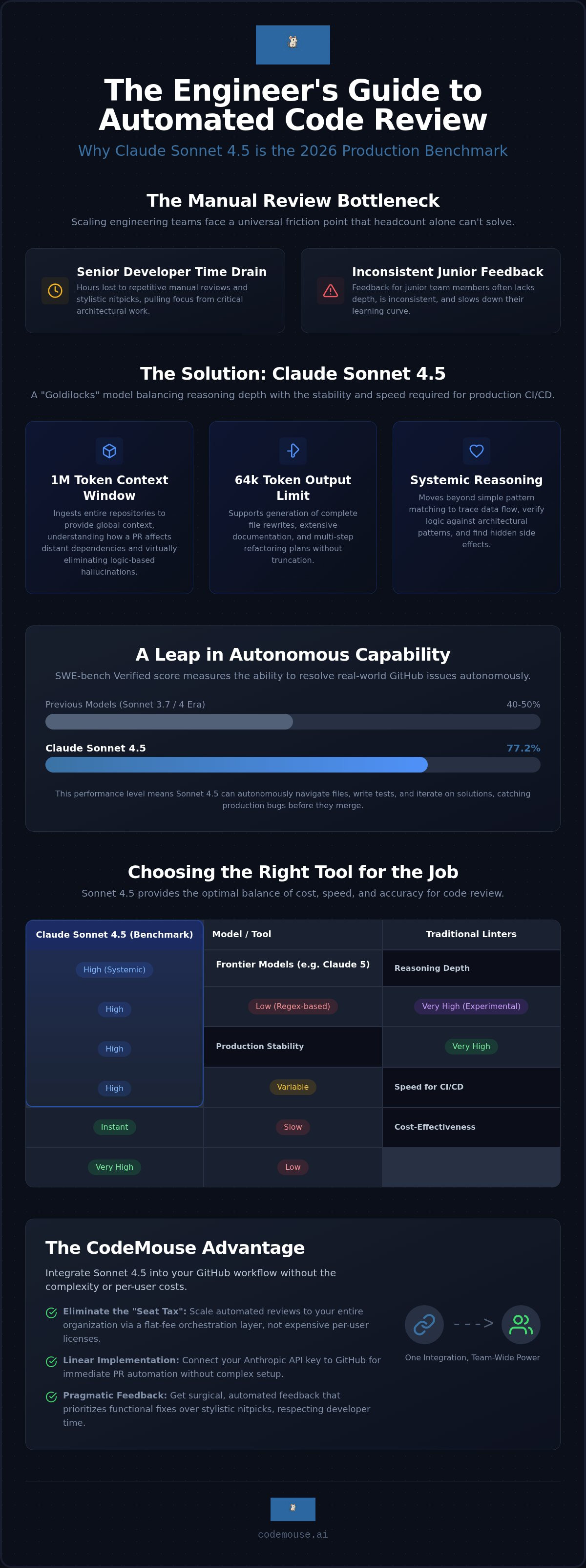
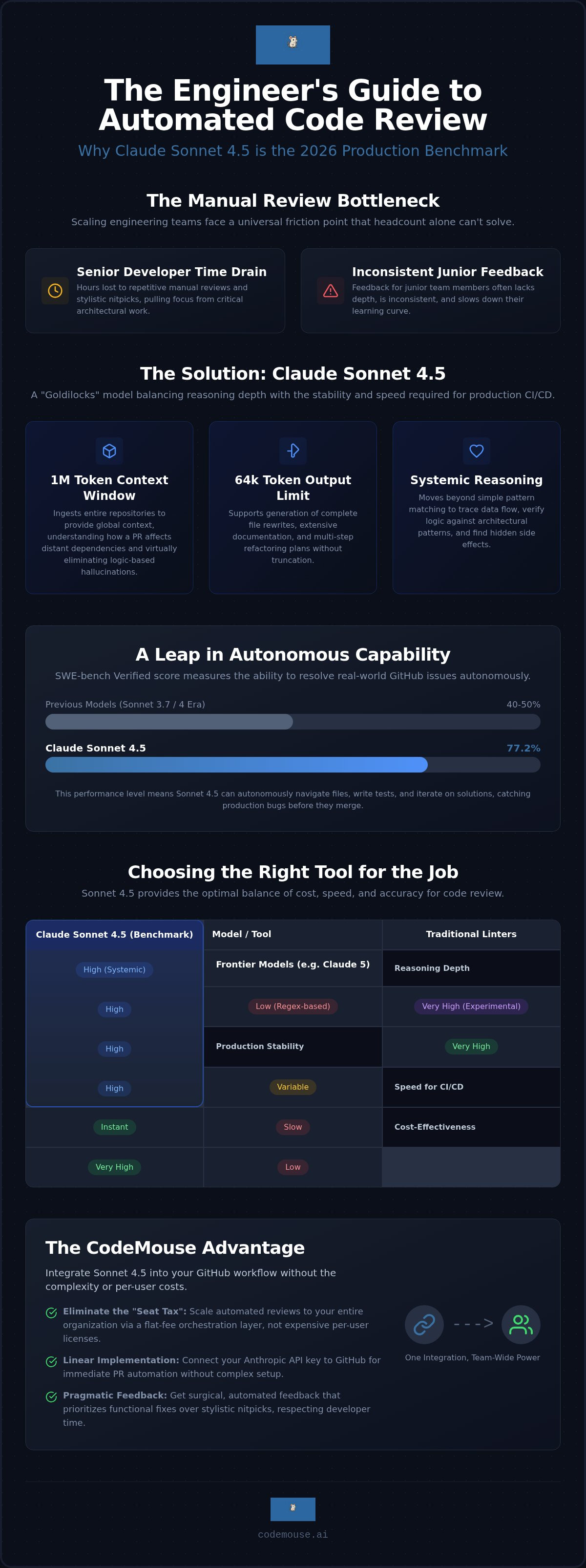
In 2026, the AI landscape prioritizes reliability over raw parameter counts. While the Claude 5 generation has introduced frontier capabilities for autonomous agents, claude sonnet 4.5 remains the industry workhorse for production environments. It occupies a specific "Goldilocks" zone: deep enough for complex logic, yet fast enough for real-time CI/CD feedback. Engineering teams treat it as the baseline for automated code review because it balances reasoning depth with operational stability.
The technical specifications define its utility. A 1M token context window allows the model to ingest entire repositories, providing the "global" context required to understand how a single PR affects distant dependencies. The 64k output limit supports the generation of complete file rewrites or extensive documentation without truncation. This isn't just a text generator. It's a high-precision tool for agentic code manipulation. It moves beyond predicting the next token to planning multi-step refactors and verifying logic against existing architectural patterns.
Core Architecture and Reasoning Gains
The architecture of claude sonnet 4.5 focuses on systemic reasoning rather than pattern matching. It excels in math-heavy and logic-dense code analysis, areas where previous iterations often stumbled. In 2026, this translates to specific domain expertise in cybersecurity and finance. The model identifies race conditions, memory leaks, and complex authorization flaws that traditional linters miss.
- Systemic Analysis: It traces data flow across multiple modules to find hidden side effects.
- Long-running Tasks: The model maintains focus during massive PR reviews, ensuring the tenth file receives the same scrutiny as the first.
- Pragmatic Feedback: It prioritizes functional fixes over stylistic nitpicks, respecting developer time.
The SWE-bench Verified Legacy
The primary metric for 2026 dev teams is the SWE-bench Verified score. Claude Sonnet 4.5 achieved a 77.2% score on real-world software tasks, a significant leap from the 40-50% ranges seen in the Sonnet 3.7 and 4 eras. This score isn't just a number. It represents the model's ability to resolve GitHub issues autonomously by navigating files, writing tests, and iterating on solutions.
For a code review workflow, this performance level means catching production bugs before they merge. It understands the difference between a breaking change and a safe deprecation. By comparing Sonnet 4.5 to earlier versions, teams see a drastic reduction in "hallucinated" syntax errors. It knows the modern frameworks of 2026 because it was trained on the transition. Using this model in your workflow provides a tier of quality control that previously required a senior staff engineer's manual intervention.
Why Sonnet 4.5 Dominates Automated Code Analysis
The transition of claude sonnet 4.5 from a general-purpose model to a dedicated code analysis engine stems from its massive context window. Traditional linters and older LLMs operate on a per-file basis, often missing the broader architectural intent. With a 1M token capacity, this model ingests the entire repository state before reviewing a single line of a pull request. This holistic visibility virtually eliminates the "hallucination" of non-existent APIs or deprecated patterns that plague smaller models. It understands your specific implementation of a design pattern, not just the generic version found in training data.
Dependency analysis is where this model shows its true utility. It doesn't just check for syntax. It evaluates the logical flow between disparate services. If a change in a shared utility class breaks an edge case in an unrelated microservice, the model flags it. This level of multi-file awareness was previously reserved for manual senior-level reviews. You can automate this oversight to maintain high velocity without sacrificing code integrity.
Context-Aware Pull Request Feedback
Static analysis tools rely on rigid regex rules, which often lead to false positives and "linter fatigue." Sonnet 4.5 provides semantic understanding, distinguishing between an intentional architectural shift and a genuine mistake. It identifies when a developer bypasses a standard internal wrapper or introduces a security vulnerability through a seemingly benign library update. By mapping dependencies across the entire 1M token context window, Claude Sonnet 4.5 identifies how local changes in a pull request trigger regression risks in distant modules.
Handling Complex Agentic Workflows
The release of the Agent SDK transformed claude sonnet 4.5 from a passive reviewer into an active participant. It now supports speculative parallel execution, where the model runs multiple review threads simultaneously to reduce latency on large PRs. It orchestrates external tools, such as running unit tests or triggering a build to verify its own suggested fixes. If a review session is interrupted, the model uses its 64k output limit to checkpoint progress, ensuring it doesn't lose track of its reasoning chain across long-running tasks. This agentic behavior allows teams to treat the AI as a junior developer capable of self-correction and tool-assisted verification.
Comparison: Sonnet 4.5 vs. GPT-4o and Newer Claude Models
In the 2026 market, newer isn't always better for automated pipelines. While the Claude 5 series offers frontier reasoning, claude sonnet 4.5 remains the production standard for high-volume GitHub organizations. It offers a superior cost-to-performance ratio compared to the newer Fable 5 or Opus 5 models. With input costs at $3 per million tokens, it allows for deep repository analysis without the premium price tag of the newest releases. Many teams prioritize this established reliability over the novelty of the 5-series, which can sometimes introduce unexpected prompt drift in legacy CI/CD scripts.
Speed is the primary differentiator when comparing Sonnet 4.5 to GPT-4o. OpenAI's model typically offers lower latency, making it suitable for real-time chat. However, code review isn't a chat session; it's a diagnostic process. Sonnet 4.5 provides a deeper reasoning chain that excels at finding race conditions and logic flaws that GPT-4o often overlooks. For organizations managing thousands of PRs monthly, the extra seconds of latency are a fair trade for the reduced hallucination rate and more precise feedback.
Claude Sonnet 4.5 vs. GPT-4o for PRs
Feedback tone matters for developer adoption. GPT-4o tends toward verbosity, often providing long explanations for simple syntax fixes. In contrast, claude sonnet 4.5 maintains a pragmatic, peer-to-peer register that mirrors senior developer feedback. It catches complex edge cases in Python, TypeScript, and Go by understanding language-specific idioms rather than just applying general logic. For a deeper dive into how these models stack up against older frontier versions, see our GPT-4o vs Claude 3 Opus for Code Review: 2026 Engineering Guide. The choice often comes down to whether you value a quick "look good to me" or a surgical analysis of your logic.
The Multi-Model Consensus Strategy
High-risk production code requires more than a single perspective. Implementing a multi-model consensus strategy allows you to use Sonnet 4.5 as a primary reviewer while cross-referencing its findings with other models. This "majority vote" system drastically reduces false positives in security-sensitive areas like authorization logic or data encryption. By running 4.5 alongside a faster model for syntax, you create a robust quality gate that balances speed with accuracy. Learn how to implement this at scale in our guide on AI Code Review for GitHub: Scaling Quality with Multi-Model Consensus. This approach ensures that no single model's bias dictates your production standards.
How to Implement Claude Sonnet 4.5 in Your GitHub Workflow
Deploying claude sonnet 4.5 into a production environment requires a structured orchestration layer. You aren't just sending text to an API; you're building a feedback loop that interacts with live code. Follow this linear progression to move from a raw API key to an automated reviewer that understands your codebase.
- Step 1: Provisioning your Anthropic API key. Access the Anthropic Console. Generate a dedicated key for your CI/CD environment. Set usage limits to prevent unexpected overages during heavy sprint cycles.
- Step 2: Connecting to a GitHub App orchestration layer. Install a specialized GitHub App to handle the webhooks and PR comments. This layer acts as the bridge between your repository events and the Claude API.
- Step 3: Defining review triggers. Configure the app to trigger on
pull_request.openedandpull_request.synchronizeevents. This ensures every new PR and every subsequent commit receives an automated audit. - Step 4: Setting up feedback loops. Enable line-level comments. This allows developers to see exactly where logic fails and reply to the AI to request a refactored snippet.
Setting up this infrastructure manually is time-consuming. You can connect CodeMouse AI Code Review to your repository in minutes to start using Sonnet 4.5 without building the orchestration layer from scratch.
Optimizing the Feedback Loop
Effective automation requires noise reduction. Use custom prompt templates to align the model with your internal style guides. Configure the reviewer to ignore stylistic nitpicks like trailing commas or indentation if your linter already handles them. Focus the model's reasoning on high-impact areas: security vulnerabilities, performance bottlenecks, and architectural consistency. For agentic tasks, ensure the model has "read-only" access to the full repository context to maintain the 1M token awareness discussed in previous sections.
Security and Privacy Considerations
Enterprise teams must prioritize data residency. When using claude sonnet 4.5, utilize the BYO-API key model to maintain full transparency over your data flow. This approach ensures your code isn't used for training future public models. For US-only workloads, route your API calls through enterprise-grade inference providers like AWS Bedrock or Google Cloud Vertex AI. These platforms offer the compliance certifications required for sensitive financial or healthcare codebases. Monitor your API rate limits closely; large teams may need to request a tier increase from Anthropic to handle hundreds of concurrent PR reviews during peak hours.
The CodeMouse Advantage: Scaling Sonnet 4.5 Without the Seat Tax
Implementing claude sonnet 4.5 at scale requires an orchestration layer that doesn't penalize growth. Most enterprise AI tools utilize a per-seat pricing model. This creates a "quality tax" where organizations limit AI access to a few senior developers to control costs. CodeMouse removes this bottleneck by offering a flat $10/month fee for the entire organization. You pay for the infrastructure, not the headcount. This allows every developer on the team to receive automated, high-precision feedback on every pull request without increasing your monthly SaaS spend.
Transparency is a core requirement for 2026 engineering teams. CodeMouse operates on a Bring Your Own API (BYO-API) key model. You connect your own Anthropic account directly to the platform. This ensures you pay exactly what Anthropic charges for tokens, with zero hidden markups or bundled "credits" that expire. You maintain full control over your data residency and rate limits. By using claude sonnet 4.5 as your primary engine, you leverage its 1M token context window to catch architectural bugs that surface only when analyzing cross-file dependencies.
Consensus logic further strengthens your quality gate. CodeMouse allows you to run Sonnet 4.5 and GPT-4o simultaneously. When both models identify the same logical flaw, the confidence level for that finding is near absolute. This multi-perspective analysis identifies race conditions and security vulnerabilities that a single model might miss. It provides a surgical level of detail that traditional static analysis tools cannot match.
Unlimited Reviews for One Flat Fee
Scaling to 100 or more repositories shouldn't require a budget renegotiation. CodeMouse eliminates the financial friction of expanding AI code reviews across multiple teams and projects. You get unlimited reviews for one flat fee, regardless of how many pull requests your team generates. This model encourages frequent, smaller PRs, which is a proven industry best practice for reducing deployment risk. Read more about our philosophy on Flat Rate AI Code Review: Ending the Per-Seat Tax on Engineering Quality.
Getting Started with CodeMouse
Setup is designed for immediate utility. You can initiate a 14-day free trial in under two minutes by connecting your GitHub account and providing your Anthropic API key. The platform automatically detects your repository structure and begins applying Sonnet 4.5 reasoning to new pull requests. There's no complex configuration or long-winded onboarding process. You get senior-level code analysis integrated directly into your existing workflow, allowing your team to focus on building features instead of catching repetitive bugs. Start your automated code review with CodeMouse today to see the difference in your PR turnaround times.
Modernize Your PR Pipeline
Claude Sonnet 4.5 has solidified its position as the reliable engine for automated code analysis. It provides the reasoning depth required to navigate complex dependencies without the overhead of experimental frontier models. By leveraging the 1M token context window, teams move beyond surface-level linting to catch deep logic errors before they reach production. This stability makes it the pragmatic choice for 2026 engineering workflows that value consistency over novelty.
The shift toward automated reviews shouldn't be gated by per-user pricing or opaque credit systems. Scaling your quality control requires a model that respects both your budget and your data privacy. Maintaining transparency through a BYO-API model ensures you only pay for the tokens you actually use. This approach allows you to deploy claude sonnet 4.5 across every repository in your organization without the friction of a per-seat tax.
Automate your GitHub PR reviews with Claude Sonnet 4.5 on CodeMouse. Our platform provides a flat $10/month fee and integrates directly as a GitHub App for immediate deployment. You'll benefit from context-aware, multi-model feedback that cross-references findings to eliminate false positives and ensure production readiness. It's time to stop wasting senior developer hours on repetitive manual audits and start shipping cleaner code faster.
Build a more resilient delivery culture today.
Frequently Asked Questions
Is Claude Sonnet 4.5 better than GPT-4o for coding?
Claude Sonnet 4.5 is generally superior for complex architectural review and logic-heavy tasks. While GPT-4o offers lower latency, Sonnet 4.5 provides a deeper reasoning chain that identifies race conditions and logic flaws more reliably. It follows language-specific idioms more closely, making it the preferred choice for production-grade code audits.
How much does it cost to use Claude Sonnet 4.5 for PR reviews?
You pay for token usage directly to Anthropic via your API key. Current rates for claude sonnet 4.5 are $3 per million input tokens and $15 per million output tokens. CodeMouse adds a flat $10/month fee for the orchestration layer, which eliminates the per-seat costs typically found in enterprise AI tools.
Does Claude Sonnet 4.5 support tool calling in GitHub?
Yes. The model utilizes the Agent SDK to interact with external environments. It can orchestrate tools to run unit tests, check build statuses, or suggest refactored snippets. This agentic behavior allows the model to verify its own logic before posting a final review comment on your pull request.
Can I use my own Anthropic API key with CodeMouse?
Yes. CodeMouse is built on a transparent BYO-API key model. This ensures you maintain full control over your token spending and data privacy. Using your own key means your code isn't used for training public models and you pay exactly what the model provider charges with no markup.
What is the context window of Claude Sonnet 4.5 in 2026?
The model features a 1-million-token context window and a 64k output limit. This massive capacity allows claude sonnet 4.5 to ingest your entire repository state. It understands the global impact of local changes, identifying how a PR might break dependencies in distant modules or services.
How do I reduce hallucinations in AI code reviews?
Provide the model with full repository context using its 1M token window. You should also implement a multi-model consensus strategy. Cross-referencing findings between Sonnet 4.5 and GPT-4o filters out false positives and ensures that only verified logic errors are flagged for human review.
Does Claude Sonnet 4.5 support Python and TypeScript reviews?
Yes. It has extensive training on 2026-era frameworks for Python, TypeScript, Go, and Rust. The model identifies language-specific vulnerabilities, performance bottlenecks, and deprecated patterns. It handles modern asynchronous patterns and complex type definitions with high precision compared to general-purpose models.
What happens if I exceed my API rate limits during a review?
The review process will typically pause or return an error if limits are hit. You should monitor your usage in the Anthropic Console to ensure your tier supports your PR volume. High-growth teams often request a rate limit increase to handle concurrent reviews across hundreds of active repositories.