Automated Code Review for Go: Beyond Static Analysis in 2026
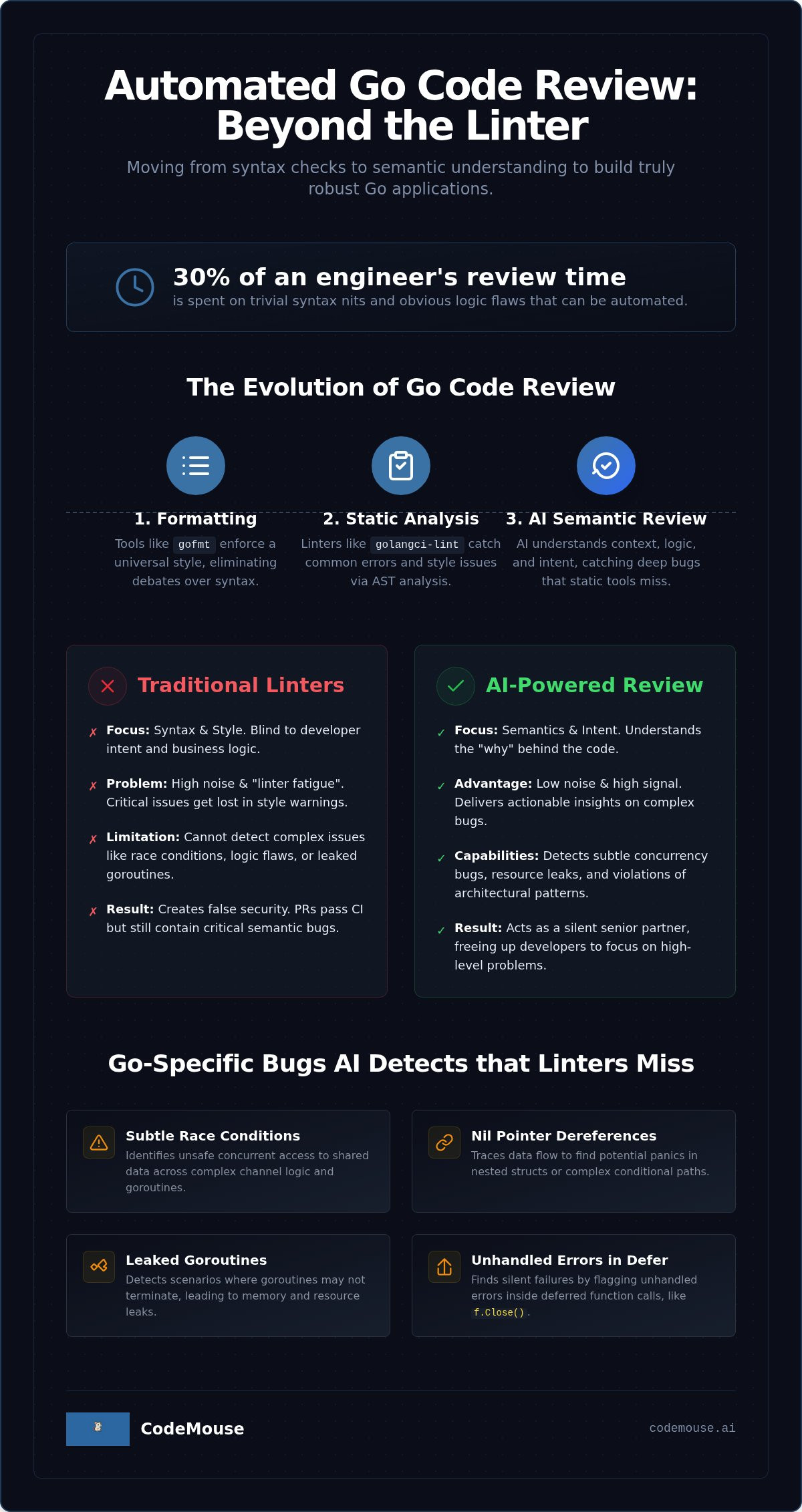
Why are your most expensive engineers still spending 30% of their review time on trivial syntax nits and obvious logic flaws? Traditional linters like golangci-lint are essential, but they hit a ceiling when it comes to deep semantic understanding. In 2026, implementing an effective automated code review for go requires moving beyond simple pattern matching. You need a system that understands the intent behind your goroutines and the specific context of your interfaces.
It is a common pain: a PR passes every CI check only for a senior developer to find a race condition five minutes later. You already know that static analysis alone cannot solve the semantic side of code quality. This article shows you how to supplement standard Go linters with AI-powered, context-aware reviews. We will preview how consensus-based AI models catch logic errors and concurrency bugs that static tools miss. You'll learn to build a workflow that delivers faster PR approvals and clean, idiomatic code without the manual overhead. We'll explore how to move from basic linting to a system that acts as a silent partner in your development cycle.
Key Takeaways
- Learn why AI-powered automated code review for go is necessary to catch semantic logic errors that standard AST-based linters ignore.
- Identify the limitations of traditional static analysis, specifically regarding linter fatigue and undetected race conditions in complex channel logic.
- Discover how to detect subtle Go-specific bugs like nil pointer dereferences in nested structs and unhandled errors in deferred functions.
- Set up a pragmatic GitHub workflow that triggers AI-driven reviews automatically on every PR to reduce senior developer manual effort.
- Implement a cost-effective review pipeline using flat-rate pricing and private API keys to ensure high-quality feedback without per-seat taxes.
Table of Contents
The Evolution of Go Code Review: From Linters to AI
Go has always prioritized tooling. From its inception, gofmt set a standard for consistency that other languages still struggle to match. Automated code review for Go started here, focusing on the mechanical aspects of the language. These early tools transformed how teams read code by removing arguments over tabs versus spaces. But as Go systems grew in complexity, teams needed more than just formatting. They needed to ensure code was actually correct, not just pretty.
Modern automated code review for go has reached a critical turning point. We are moving from strict, rule-based checking to deep semantic analysis. In 2026, the baseline is no longer just "does this compile?" or "is this formatted correctly?" The industry has shifted toward "does this logic make sense in this specific context?" This evolution allows developers to catch errors that previously required a senior engineer's intuition.
The Role of Static Analysis in Go
Static analysis is the foundation of any Go pipeline. golangci-lint is the industry standard for a reason. It aggregates dozens of specialized linters into a single, high-speed runner. Tools like govet and staticcheck use Abstract Syntax Tree (AST) analysis to find unused variables, shadowed variables, or unkeyed literals. These are non-negotiable baselines. They keep the codebase clean and prevent common syntax-level mistakes. However, they are rigid. A linter cannot tell if your business logic has a fundamental flaw. It sees the structure of the code but ignores the developer's intent. It flags the "how" but misses the "why."
The Emergence of Context-Aware AI
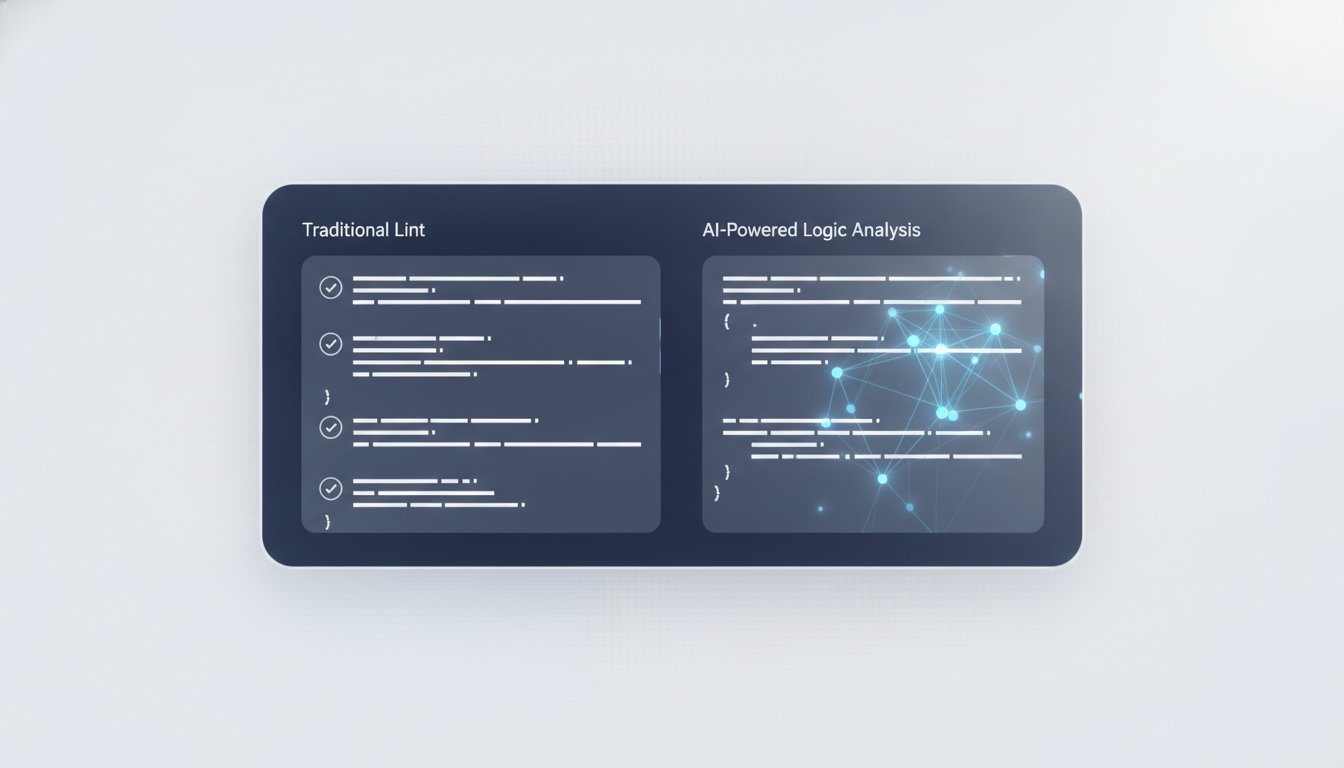
Large Language Models (LLMs) changed the landscape by introducing context aware code review. Unlike static tools, AI doesn't just parse tokens. It interprets the intent behind the code. It understands when a function violates a project-specific architectural pattern or when a specific channel usage might lead to a deadlock. AI-powered automated code review for go bridges the gap between syntax and semantics. It asks: "Does this function handle the empty slice case correctly for this specific API?" It detects when a developer uses a mutex incorrectly across different packages. This isn't just about finding bugs; it's about maintaining idiomatic Go patterns at scale without the manual nagging.
Why Standard Go Linters Aren’t Enough in 2026
Standard linters are exhausting. Most teams reach a point where golangci-lint produces so much noise that senior developers stop looking at the output. When a Pull Request contains 50 style warnings but one critical logic flaw, the signal-to-noise ratio is broken. This leads to "LGTM" culture. Reviewers skim the code, see the green checkmark from the CI, and hit approve without spotting the subtle deadlock in a new channel implementation. This is the primary failure of shallow automation.
Static analysis tools are blind to project architecture. They can tell you if a variable is shadowed, but they can't tell you if that shadowing breaks your custom error-handling strategy across three different packages. While the official Security Best Practices for Go recommends tools like govulncheck, these focus on known vulnerabilities in dependencies. They don't analyze the semantic flow of your proprietary business logic. Effective automated code review for go requires understanding how data moves through your specific system, not just how it looks on the page.
The False Positive Problem
Rigid rules often flag perfectly idiomatic Go as errors. This forces developers to litter their source code with //nolint comments. It's a maintenance tax. Every suppression comment is a technical debt item that obscures the original intent of the code. AI-driven systems solve this by understanding developer intent. Instead of flagging every "magic number," an AI review determines if the number is a legitimate constant or a hardcoded value that needs refactoring. This reduces noise and keeps senior engineers focused on high-level architecture. You can explore how AI handles Go nits to see how this reduces manual nagging.
Missing the "Why" Behind the Code
Static tools see variables; they don't see data flow. A linter might confirm that a goroutine is started, but it cannot guarantee that the goroutine eventually terminates. Leaked goroutines are a classic Go failure mode that static analysis rarely catches in complex, conditional logic. Context matters here. If your code initiates a background task based on a specific configuration flag, a standard linter has no way of knowing if that flag is ever actually set or if the cleanup logic is reachable. AI bridges this gap by simulating the execution path and identifying where the "Why" of the code fails the "How." Modern automated code review for go must account for these semantic nuances to be truly useful.
Examples of Logic Errors AI Catches in Go PRs
Traditional static analysis struggles with deep semantic context. It can flag a variable that isn't used, but it can't always predict a panic caused by a nil pointer dereference in a deeply nested struct. AI-powered automated code review for go excels here. It traces data through multiple layers of abstraction to identify where a pointer might be nil before it reaches a critical execution point. This prevents runtime crashes that unit tests might miss if the specific edge case isn't covered. It looks at the logic, not just the syntax.
Efficiency matters in Go. Inefficient slice allocations in high-frequency loops are a common performance bottleneck. A standard linter won't flag a missing make([]T, 0, capacity) call because the code is technically valid. AI identifies these patterns by analyzing the loop's intended scale and suggesting pre-allocation to reduce GC pressure. It also spots missing context cancellation in long-running goroutines. If a context isn't passed or listened to, your application will leak resources. Automation should catch these resource leaks before they hit production.
Improper error handling in deferred functions is another area where static tools fail. If you call defer file.Close() without checking the returned error, you might miss a disk write failure. AI flags these instances and suggests using a named return variable or a wrapper function to handle the error correctly. This attention to detail separates a functional codebase from a resilient one. It ensures that every cleanup operation is as robust as the main execution path.
Concurrency and Goroutine Leaks
Concurrency is Go's greatest strength and a primary source of subtle bugs. A frequent error is starting a goroutine without a clear exit condition or a way to signal termination. Static tools rarely detect these leaks because they require understanding the lifecycle of the entire process. AI identifies potential channel deadlocks where a sender and receiver are stuck in a logical loop that linters miss. AI detects unbuffered channel blocks by simulating the interaction between concurrent routines to ensure a receiver is always available when a send occurs.
Error Handling and Idiomatic Patterns
Go's explicit error handling is prone to variable shadowing. In nested blocks, it's easy to accidentally re-declare err := ... and lose the original error state. AI monitors the scope of these variables to ensure the correct error is checked and returned. It also suggests when a function should return a wrapped error using fmt.Errorf("...: %w", err) to provide better debugging context. You can find more details in this AI code analysis for bugs reference guide. These semantic checks ensure your automated code review for go maintains idiomatic standards without requiring constant human oversight.
Setting Up an Automated Go Review Pipeline on GitHub
Moving from manual oversight to an automated pipeline requires a shift in how you integrate tools into your workflow. Traditional CI/CD jobs often run linters as pass/fail gates. While effective for enforcement, this doesn't provide the interactive feedback loop necessary for complex logic reviews. To implement a modern automated code review for go, you should start by installing a dedicated GitHub App. Unlike generic scripts, an app-based approach allows the system to interact directly with the Pull Request UI, placing comments on specific lines of code where they are most relevant.
Configuration should be minimal. You want a system that triggers automatically on every PR sync without requiring a custom YAML overhaul for every repository. The goal is to offload the cognitive burden of review logic from your CI runners. By delegating the heavy lifting to a specialized review service, you keep your build pipelines fast and focused on compilation and testing. This architecture ensures that your automated code review for go remains a silent, high-speed partner rather than a bottleneck.
Integrating GitHub Apps vs. Actions
GitHub Actions are excellent for task execution, but they often fall short in the PR review experience. Apps provide a superior UI integration, allowing for richer formatting and better management of comment threads. Using an app also reduces CI/CD overhead. You don't need to burn your Action minutes on compute-heavy LLM processing. Instead, the app handles the analysis externally and posts the results back to GitHub. This separation of concerns is a core principle of GitHub PR automation tools. It allows your team to focus on the code while the infrastructure manages the quality checks.
Configuring Multi-Model Consensus
Hallucinations are the primary risk when using AI for code analysis. A single model might occasionally suggest non-existent Go packages or incorrect syntax. To solve this, you should implement a multi-model consensus strategy. By using both Claude 3.5 and GPT-4o, the system can cross-reference findings. If both models identify a potential race condition in a goroutine, the confidence level is high. If they disagree, the system can either suppress the comment or flag it as a low-confidence suggestion. This consensus logic is critical for maintaining a clean PR with zero spam. You can set up your own multi-model review pipeline to see this in action.
Finally, define a strict feedback threshold. Not every minor suggestion needs a PR comment. Configure your pipeline to only surface high-impact logic errors and concurrency bugs. Trivial style nits should be left to your local gofmt or goimports. By focusing automation on the hardest-to-catch bugs, you protect your senior developers' time and keep the review process efficient.
CodeMouse: Pragmatic AI Code Review for Go Teams
CodeMouse is built for Go teams who value efficiency and deep technical clarity. It doesn't aim to replace your existing workflow; it enhances it. By integrating directly as a GitHub App, it provides a high-confidence layer of automated code review for go that focuses on the semantic bugs linters miss. It treats your code as a logical system rather than a collection of text strings. This approach ensures that your senior engineers spend less time on basic feedback and more time on high-level architectural decisions.
The system is designed with a lean, developer-first mindset. It stays out of your way until it identifies a bug that actually matters. There is no corporate fluff or unnecessary UI clutter. You receive clear, actionable feedback directly within your Pull Request threads. This creates a fast-paced review cycle where the transition from identifying a bug to fixing it happens almost instantaneously. CodeMouse acts as a silent partner that ensures your Go code remains clean, idiomatic, and robust.
Ending the Per-Seat Tax
Per-seat pricing models are a tax on engineering growth. They create a financial barrier that often prevents teams from giving every developer access to quality tools. CodeMouse eliminates this with a flat $10 per month pricing model. This ensures that your costs remain predictable even as your team scales. We utilize a Bring-Your-Own-Key (BYOK) model, which means you provide your own API keys for Claude and GPT. This gives you full transparency and control over your LLM spending. You pay for the compute you actually use, not for the number of people on your GitHub organization. This commitment to fairness is why we advocate for flat rate AI code review. It allows you to prioritize engineering quality over budget constraints.
Leveraging Claude and GPT for Go
Go is a language that demands precision, especially when handling concurrency and interfaces. CodeMouse uses a multi-model consensus strategy to ensure that precision. We leverage Claude for its superior ability to understand context and idiomatic Go patterns. Claude's large context window allows it to analyze how different parts of your package interact. GPT provides a secondary check, catching edge cases and logic flaws through a different analytical lens. When both models agree on a bug, the confidence level is high. This dual-model approach is a core part of an effective automated code review for go, as it significantly reduces the risk of AI hallucinations.
Starting is straightforward. You can initiate a 14-day free trial on GitHub to see the results on your own PRs. The setup involves integrating the app and providing your keys. Once configured, you'll immediately see deep, context-aware feedback on your next commit. It's a pragmatic way to catch nil pointer dereferences, channel deadlocks, and resource leaks before they reach production. CodeMouse provides the infrastructure, then steps out of the way so you can focus on building.
Scaling Go Quality with Semantic Automation
Modern Go development moves too fast for manual oversight to catch every subtle concurrency bug or logic flaw. You've seen how automated code review for go has evolved from simple syntax linting to deep, context-aware analysis. By moving beyond the limitations of AST-based tools, you can eliminate linter fatigue. This ensures your senior engineers focus on high-level architecture rather than repetitive nits. Implementing a multi-model consensus strategy provides the reliability needed to trust automated feedback without the noise of hallucinations.
CodeMouse offers a pragmatic path forward. It integrates as a GitHub App. It uses a consensus between Claude and GPT to deliver precise, idiomatic feedback. With flat $10/month pricing and a bring-your-own-key model, you gain unlimited reviews without the per-seat tax. You can start your 14-day free trial of CodeMouse on GitHub today. Catch semantic bugs early. Maintain a cleaner codebase with minimal overhead. Build with confidence.
Frequently Asked Questions
Does automated code review replace human reviewers for Go?
No; it serves as a high-speed filter for your engineering team. AI identifies logic flaws and concurrency issues before a human reviewer even opens the Pull Request. This allows senior developers to focus on architectural decisions rather than catching nil pointer dereferences or unused variables. It's a pragmatic partner tool that reduces the manual burden of basic feedback while keeping human oversight in the loop.
How does CodeMouse handle Go-specific features like goroutines?
It utilizes multi-model consensus from Claude and GPT to analyze execution paths. Unlike static tools, it understands the lifecycle of a goroutine and can flag potential leaks or channel deadlocks. This context-aware automated code review for go ensures that your concurrent code follows idiomatic patterns and remains thread-safe. It looks at the semantic flow of data rather than just the syntax on the page.
Is my Go source code stored by the AI review tool?
No. CodeMouse processes your code for analysis but does not store it on internal servers. The review logic happens in real-time as your PR syncs with GitHub. You maintain full control over your intellectual property while leveraging the analytical power of external models via your own API keys. This ensures that your proprietary business logic remains private and secure throughout the entire review process.
Can I use my own OpenAI or Anthropic API keys?
Yes. CodeMouse is built on a Bring-Your-Own-Key model. You provide your own keys for Claude and GPT, ensuring full transparency over compute costs. This approach eliminates the per-seat tax common in enterprise software and allows for unlimited usage based on your existing API limits. It's designed for teams that value autonomy and want to avoid restrictive, tiered pricing structures for their tooling.
How much does it cost to run automated reviews on a large Go project?
CodeMouse costs a flat $10 per month. Your total expenditure also depends on your specific API usage with Anthropic or OpenAI. Large projects benefit from this model because you don't pay extra for every new developer on the team. It remains cost-effective even as your codebase and team size grow, providing a predictable infrastructure cost for high-quality engineering feedback.
Does CodeMouse support private GitHub repositories?
Yes. The tool integrates directly as a GitHub App and works with both public and private repositories. You control access permissions during the installation process on GitHub. It's built to fit into professional enterprise environments where code privacy is a non-negotiable requirement. Once installed, it automatically triggers reviews on every new PR sync within your private organization.
How do I reduce noise in automated PR comments?
You should define clear feedback thresholds in your configuration. Direct the AI to focus on high-impact areas like logic errors, security vulnerabilities, and complex concurrency bugs. Let your local gofmt or staticcheck handle trivial formatting nits to keep your PR threads clean and actionable. This ensures that the automation provides value without overwhelming your developers with low-priority style warnings.
Can I link the AI review to my existing golangci-lint setup?
Yes. They work best as a layered defense. Run golangci-lint for rapid syntax enforcement and style consistency in your CI/CD pipeline. Use automated code review for go for the deeper semantic analysis that static tools can't provide. This combination ensures full coverage from basic formatting to complex business logic, creating a robust quality gate that catches bugs before they reach your production environment.