Automated Python Code Review: 2026 Best Practices
Your Python linter doesn't actually understand your code. It sees trailing whitespace and PEP 8 violations, but it's blind to the race condition in your async loop or the logic flaw in your dependency injection. You're likely exhausted by manual PR checks that stall for days because senior reviewers are bottlenecked by trivial feedback. It's a common frustration in high-velocity teams where manual oversight can't keep pace with deployment cycles.
Modern automated code review for python must move beyond simple syntax checking to catch the architectural flaws that cause production outages. In 2026, the industry standard is shifting toward semantic consensus. This article demonstrates how AI-driven reviews identify complex bugs that traditional tools miss, specifically in async and concurrent Python environments. You'll learn implementation strategies to speed up PR turnaround, reduce reviewer fatigue, and maintain high code quality with minimal manual effort through real-world examples.
Key Takeaways
- Move beyond PEP 8 with automated code review for python that understands logic and intent, not just syntax.
- Learn how LLMs build temporary mental models of your project to distinguish between valid syntax and correct logic.
- Identify complex Python traps like mutable default arguments and hidden asyncio race conditions before they reach production.
- Optimize your CI/CD pipeline by integrating AI reviews directly into GitHub PRs with configurable verbosity levels.
- Scale your engineering team without per-seat taxes using a flat-rate multi-model consensus approach.
Table of Contents
- Beyond Linting: The Evolution of Automated Code Review for Python
- Semantic Analysis vs. Rule-Based Review in Python Workflows
- 5 Real-World Examples of Python Bugs Caught by AI Reviews
- Architecting a Zero-Friction Python CI/CD Review Pipeline
- CodeMouse: Multi-Model AI Consensus for Python Pull Requests
Beyond Linting: The Evolution of Automated Code Review for Python
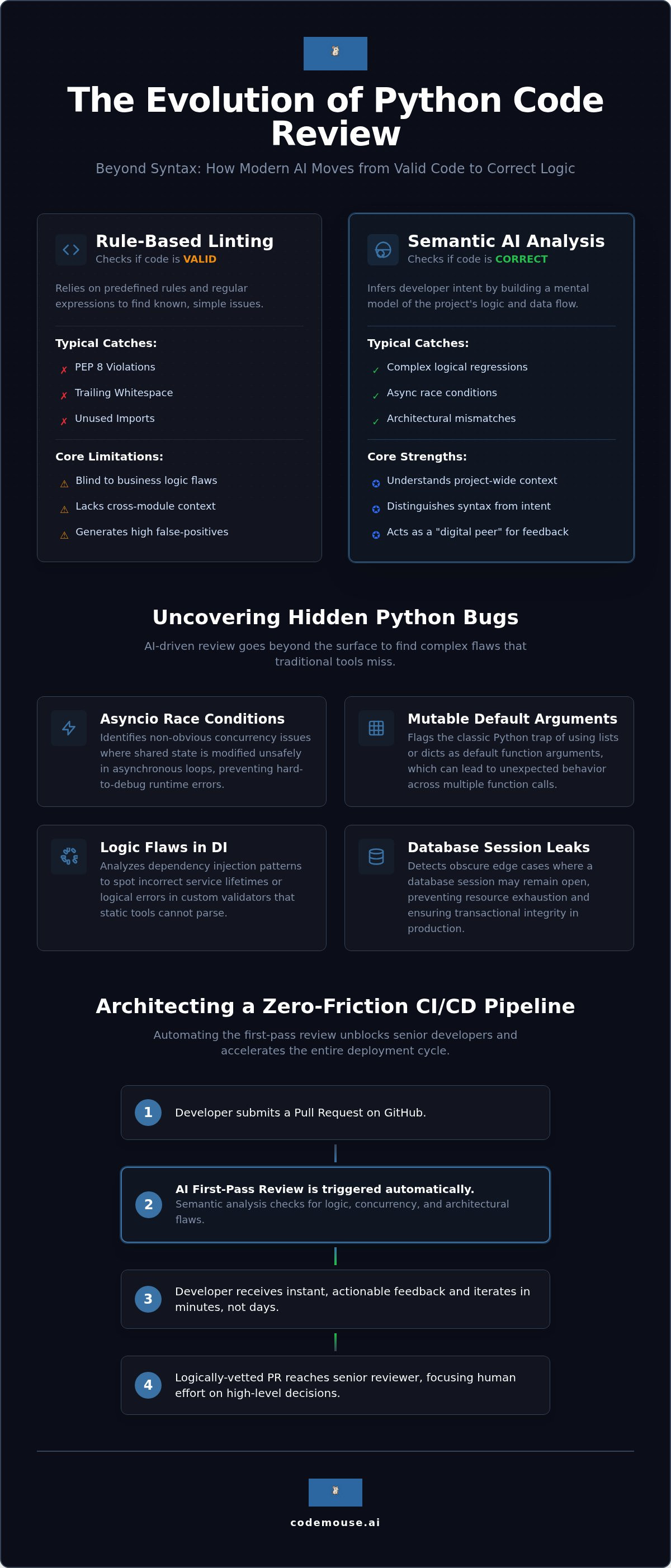
Python development has changed. For years, "automated review" meant running Pylint or Flake8 to catch indentation errors and unused imports. These tools are necessary. They aren't sufficient. Modern Python applications involve complex asynchronous patterns and deep dependency injection that static rules simply cannot parse. Relying solely on syntax checkers leaves your codebase vulnerable to logical regressions that only appear at runtime.
In 2026, automated code review for python has evolved into a semantic process. It focuses on logic and developer intent rather than just syntax. Traditional tools check if code is valid. Modern AI-driven reviews check if the code is correct. This shift defines the new standard for high-performing teams. It's a continuous, context-aware feedback loop that acts as a digital peer, providing insights that go deeper than a standard compiler check.
The Limits of Static Analysis in Python
Traditional Static program analysis relies on predefined rules and regular expressions. These tools excel at finding "dead" code or PEP 8 violations. They fail when bugs depend on execution state or cross-module logic. They can't see the "why" behind a specific implementation.
Consider a FastAPI endpoint using Pydantic models. A linter won't flag a logic error in a custom validator if the code is syntactically perfect. It won't see that a database session remains open in an obscure edge case. Developers often ignore linter output because of high false-positive rates. When a tool flags 50 "errors" that are actually stylistic preferences, the one critical bug gets lost in the noise. Static tools lack the context to understand library-specific patterns, making them blind to the architectural flaws that actually break production.
Why 2026 Engineering Teams are Automating the First Pass
Senior developers are the primary bottleneck in most release cycles. They spend hours pointing out obvious logic flaws or suggesting minor refactors that an automated system should have caught. This manual oversight slows down the entire pipeline. By the time a senior reviewer looks at a pull request, it should already be functionally sound and logically verified.
Automating the first pass allows teams to standardize quality across distributed environments. It ensures that every PR meets a baseline of logical integrity before a human ever sees it. This significantly improves code review cycle time. Instant feedback loops mean junior engineers fix their own logical errors in minutes, not days. The result is a faster, leaner development process where human intelligence is reserved for high-level architectural decisions and complex business logic.
Semantic Analysis vs. Rule-Based Review in Python Workflows
Rule-based systems are deterministic. They check code against a static checklist. Semantic systems are probabilistic. They infer intent. When implementing automated code review for python, the distinction is critical. A linter checks if your code is valid. An LLM checks if your code is correct. It builds a temporary mental model of your project structure. It doesn't just read the diff; it reads the object graph.
Context is the primary differentiator. Traditional tools see a function in isolation. Modern AI sees the relationship between that function and its callers. It recognizes that changing a return type in a core utility script might break a dozen downstream microservices. This prevents the "hidden breakage" that often bypasses local testing and static analysis gates. It turns the review into a proactive safety net.
How AI Interprets Python Context
AI models analyze imports and global state to predict side effects. They look beyond the current file to understand how data flows through the application. This depth of context aware code review allows the system to flag architectural mismatches. If your team uses a specific pattern for database transactions, the AI notices when a new PR deviates from that convention. It integrates with established Software Quality Assurance (SQA) techniques by adding a layer of logical verification that static tools miss.
The Power of Multi-Model Consensus
No single AI model is perfect. Claude 3.5 and GPT-4o have different strengths in Python optimization. Claude might excel at identifying modern syntax improvements or idiomatic refactors. GPT might be better at spotting concurrency issues in asyncio or complex logic gates. Using a single model risks hallucinations or overly pedantic suggestions that frustrate developers and slow down the pipeline.
The 2026 standard relies on multi-model consensus. A "Consensus Agent" runs the code through multiple LLMs and synthesizes the feedback into a single, actionable PR comment. If both models flag an issue, it's highly likely to be a genuine bug. If they disagree, the system filters out the low-confidence noise. This process ensures that PR comments are accurate and relevant. You can set up a multi-model workflow to experience this precision without increasing your manual review load.
5 Real-World Examples of Python Bugs Caught by AI Reviews
Syntax checks catch typos. Logic checks catch regressions. Modern automated code review for python identifies the subtle errors that pass local unit tests but fail in production. These bugs often stem from the flexible nature of the language, where valid syntax doesn't always equal intended behavior. AI models identify these patterns by simulating execution flow and analyzing project context.
- The Mutable Default Argument Trap: Linters catch
def func(x=[]). AI catches it when a shared state is buried in a complex class hierarchy where a class attribute is used as a default in a subclass method. - Hidden Asyncio Race Conditions: A PR might use
asyncio.gather()correctly from a syntax perspective, but the AI identifies two tasks modifying the same global dictionary without a Lock or Semaphore. - Resource Leaks in Context Managers: AI detects when a custom
__exit__method fails to handle specific exceptions, potentially leaving file handles or database connections open during a crash. - Type Hinting Inconsistencies: Static tools often miss errors when
Anyis used as a fallback. AI traces the data flow to predict a runtimeAttributeErrorbefore the code is even deployed. - Inefficient ORM Querying: AI identifies N+1 query problems in Django or SQLAlchemy loops. It suggests
select_relatedorprefetch_relatedwhen it sees an attribute access that will trigger a new database hit.
Logic Errors vs. Syntax Errors
Consider a function designed to calculate a discount. It's perfectly linted. There are no PEP 8 violations. No unused variables. However, the logic fails to account for a zero-value input in a division operation. A linter sees return total / count as valid. An AI review understands the context of count. It flags the potential ZeroDivisionError and explains that the edge case occurs when the shopping cart is empty. This prevents production outages that unit tests might have missed if the test suite wasn't exhaustive. Logic is about intent; syntax is about rules.
Security and Performance Optimization
Security requires deep inspection. AI provides AI code analysis for bugs by detecting unsafe string formatting in SQL queries that could lead to injection attacks. It goes beyond simple regex matches to understand how user input flows into a query string. Performance is equally critical. AI detects O(n) operations that should be O(1), such as searching a list when a set would be more efficient. It also suggests modern Python 3.12 features like match statements or itertools to improve both readability and execution speed. These optimizations keep the codebase lean and maintainable as the project scales.
Architecting a Zero-Friction Python CI/CD Review Pipeline
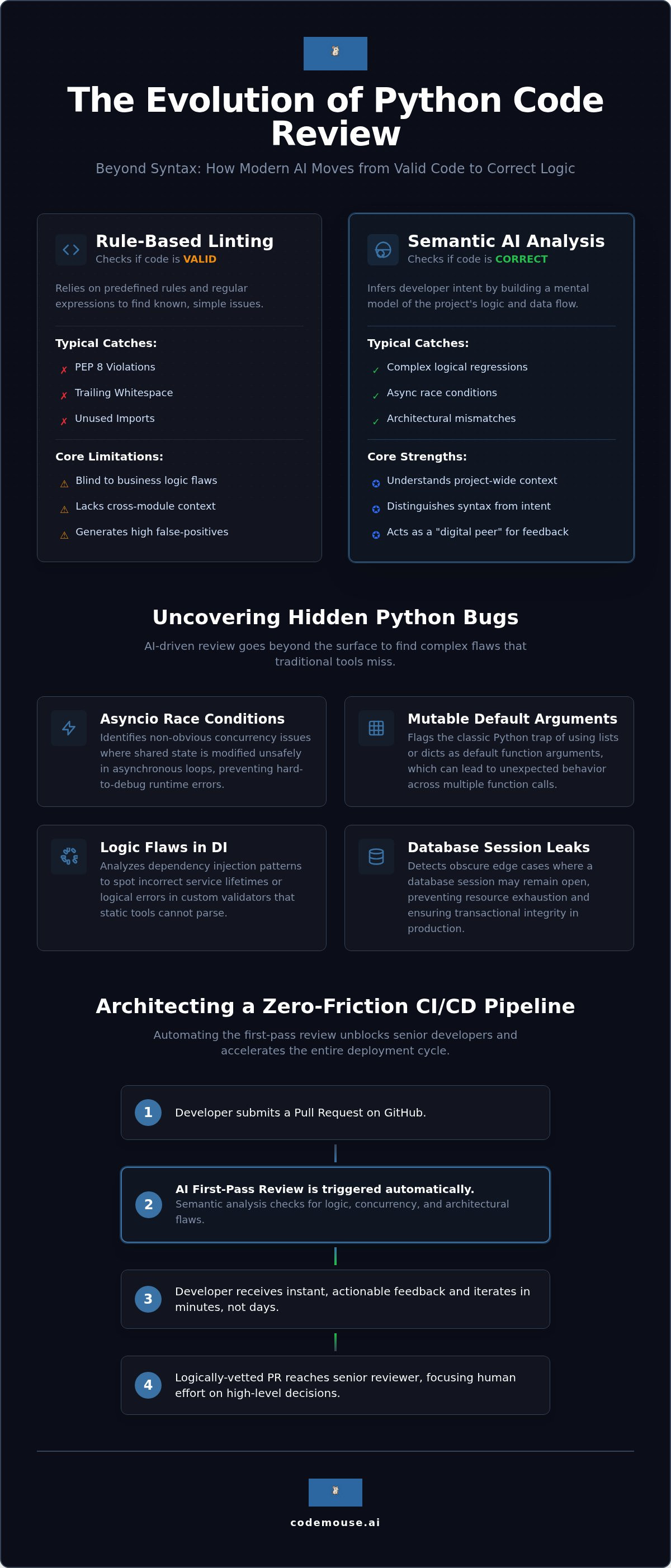
The best automated code review for python happens where you already work. Developers shouldn't have to leave the GitHub interface to view feedback or fix bugs. Integrating automated code review directly into the Pull Request workflow ensures that feedback is immediate and actionable. This setup moves the review process from a scheduled event to a continuous background task.
Efficiency requires flexibility. Not every PR needs the same level of scrutiny. Setting up 'Quiet Mode' for small documentation changes or minor refactors prevents notification fatigue. Conversely, 'Verbose Mode' should trigger for large diffs or changes to critical paths like asyncio loops or database schemas. Configuring branch protection rules to require an AI-pass before a human reviewer is even notified ensures that senior developers only spend time on logically sound code. This gatekeeping reduces the manual workload and accelerates the entire release cycle.
Cost and privacy management are central to a 2026 pipeline. Managing the 'Bring Your Own API Key' model gives your team total control over usage limits and data privacy. It eliminates the "per-seat" tax common in legacy SaaS tools. This approach allows you to scale your Python team without increasing your fixed overhead. You can integrate CodeMouse into your CI/CD pipeline today to start catching logical flaws before they reach production.
Best Practices for AI Feedback Loops
Review bots should be treated as partners, not authorities. Encourage your team to view AI comments as suggestions rather than commands. You can improve the accuracy of the review by 'prompting' the bot within the PR description. If a PR is focused on performance optimization, stating that intent helps the AI prioritize its analysis. Modern systems also support automated re-reviews. When an author pushes new commits to address feedback, the AI should automatically re-evaluate the code to clear the flagged issues. This creates a tight, self-correcting loop that requires zero human intervention until the code is ready for final approval.
Security and Data Privacy in AI Reviews
Data ephemeralness is a requirement, not a feature. 2026 engineering teams prioritize a 'Zero-Retention' policy where code is never stored by the AI provider after the review is complete. Ensure your pipeline is configured to scrub sensitive environment variables or secrets before they are sent to the LLM. While some teams opt for local models for maximum security, hosted APIs like Claude 3.5 or GPT-4o currently offer superior semantic understanding for complex Python patterns. The key is choosing a tool that respects your data boundaries while providing the depth of analysis needed for modern engineering.
CodeMouse: Multi-Model AI Consensus for Python Pull Requests
CodeMouse implements the semantic consensus model required for modern automated code review for python. It doesn't rely on a single LLM. Instead, it leverages both Claude and GPT to provide context-aware feedback. This dual-model approach ensures that logic is verified from multiple perspectives before a comment is ever posted to your PR. It functions as a silent partner that handles the first pass of every review, catching the logical regressions discussed in previous sections.
The system is built for transparency and control. You bring your own API keys from OpenAI or Anthropic. This ensures you only pay for what you use at the source level. CodeMouse provides the infrastructure for a $10 flat monthly rate. This flat-rate model allows you to scale your Python team without the per-seat tax that often prevents engineering leaders from deploying automation across the entire organization. It's a predictable cost for a high-utility tool.
Integration is immediate. The GitHub App installs in two minutes and delivers its first review in roughly 30 seconds. There's no need for a total overhaul of your existing habits. CodeMouse integrates into your current workflow, providing a surgical layer of analysis that enhances your existing CI/CD pipeline without adding friction.
Why CodeMouse Wins for Python Teams
- No throttling: Your review speed is limited only by your own API tier. You aren't stuck in a shared queue with other users.
- Consensus logic: By synthesizing feedback from multiple models, CodeMouse reduces the noise and hallucinations that plague generic AI bots.
- Universal support: The app handles every GitHub PR, regardless of repository size or complexity.
Getting Started with CodeMouse
Setting up the consensus review loop follows a linear, three-step progression designed for immediate results.
- Step 1: Install the CodeMouse GitHub App. Select the repositories that require automated oversight.
- Step 2: Connect your OpenAI or Anthropic API key. This gives you total control over costs and model selection.
- Step 3: Open your first Python PR. The consensus agent will analyze the diff and post actionable feedback in the PR comments.
Standardizing Semantic Quality in Python Workflows
The transition from syntactic linting to semantic logic is mandatory for high-velocity teams. Relying on PEP 8 checks alone leaves your production environment vulnerable to the complex race conditions and resource leaks discussed in this guide. Effective automated code review for python now requires a multi-model approach that builds a temporary mental model of your codebase. This ensures that every pull request is logically sound before it ever reaches a human reviewer.
By integrating consensus-driven analysis directly into your CI/CD pipeline, you eliminate the senior developer bottleneck. You maintain high standards without the friction of manual oversight. CodeMouse facilitates this shift with multi-model AI consensus using Claude and GPT. It offers flat $10/month pricing with no per-seat charges, allowing your team to scale without increased overhead. You keep total control over costs by using your own API keys.
Start your 14-day free trial of CodeMouse today to experience a faster, more reliable review cycle. It's time to build with the confidence that your logical intent is as solid as your syntax.
Frequently Asked Questions
Can automated AI review replace human Python developers?
No, it acts as a force multiplier rather than a replacement. Automated code review for python handles the repetitive first pass of a PR to catch logical flaws and regressions. This allows human developers to focus on high level architectural decisions and complex business requirements. It's a tool designed to eliminate the senior developer bottleneck in the review cycle.
How does AI code review handle complex Python libraries like Pandas or TensorFlow?
Modern LLMs are trained on vast datasets of public API usage. They understand the semantic intent behind a Pandas transformation or a TensorFlow layer better than static linters. The system can suggest vectorized alternatives to loops or identify deprecated parameters in library specific calls. It treats these libraries as part of the project context rather than external noise.
Is my code stored on CodeMouse servers during the review process?
No, the processing is ephemeral. Code is retrieved via the GitHub API, analyzed by the consensus models, and discarded immediately after the feedback is posted. There is no long term storage of your source code on the infrastructure. This zero retention approach ensures that your intellectual property remains secure and private.
What is the difference between CodeMouse and GitHub Copilot's review feature?
The primary differentiator is multi model consensus. Most integrated tools rely on a single model for feedback. CodeMouse synthesizes reviews from both Claude and GPT to reduce hallucinations and noise. If both models agree on a bug, it's highly likely to be a genuine issue. This consensus logic ensures higher accuracy and more relevant comments.
How much does it cost to run Python reviews using my own API keys?
CodeMouse charges a flat $10 monthly fee for the review infrastructure. Your actual AI processing costs depend on your specific usage and the tiers you have established with OpenAI or Anthropic. This model eliminates per seat taxes and gives you total control over your engineering spend. You only pay for the tokens your team actually consumes.
Does CodeMouse support private Python repositories on GitHub?
Yes, it supports both public and private repositories. As a GitHub App, it uses standard permission scopes to access your code securely. You can select specific repositories for automated code review for python during the installation process. This ensures that the AI only interacts with the projects you explicitly authorize.
Can the AI understand project-specific coding standards that aren't PEP 8?
Yes, the system infers conventions by analyzing your existing project structure and imports. It looks for patterns in how your team handles dependency injection, error logging, and variable naming. You can also guide the review by adding specific context or requirements in your pull request description. The AI adapts to your established codebase rather than forcing a generic standard.
What happens if the AI suggests a fix that is actually wrong?
Developers have final authority over every pull request. AI feedback should be treated as a suggestion rather than a command. If a model provides an incorrect suggestion, you can simply ignore the comment. The consensus agent minimizes these occurrences by filtering out low confidence disagreements between the models before they are ever posted to your GitHub interface.