Bring Your Own API Key Code Review: The 2026 Guide to BYOK Efficiency
The standard per-seat AI subscription model is effectively a tax on your engineering team's growth. Most managed platforms charge a premium for bundled credits. This often results in throttled performance and opaque pricing structures. If you're tired of paying for idle seats while active developers hit rate limits, your infrastructure needs to change. Implementing a bring your own API key code review process allows you to pay only for the tokens you consume. It keeps you in control of your AI provider and your data.
You already know that middleman markups are an unnecessary drain on your engineering budget. By decoupling the review interface from the underlying model, you eliminate the markup. You gain the flexibility to choose the right tool for every pull request. This guide shows you how to leverage your own keys to achieve unthrottled reviews and direct-to-provider pricing. We'll examine the efficiency of switching between Claude and GPT models and how this modular approach removes the friction from your automated quality checks. It's time to stop paying for seats and start paying for code quality.
Key Takeaways
- Eliminate the "middleman markup" found in managed AI services by paying direct token rates to providers like OpenAI and Anthropic.
- Optimize for specific PR tasks by switching between Claude 3.5 Sonnet for reasoning and GPT-4o for architectural suggestions.
- Secure your infrastructure with a bring your own API key code review setup that uses AES-256 encryption and prevents model training on your private data.
- Remove per-seat scaling costs by adopting a flat-fee infrastructure model that decouples user count from AI consumption.
- Streamline deployment by connecting the CodeMouse GitHub App directly to your existing developer portal keys.
Table of Contents
Why Switch to Bring Your Own API Key Code Review?
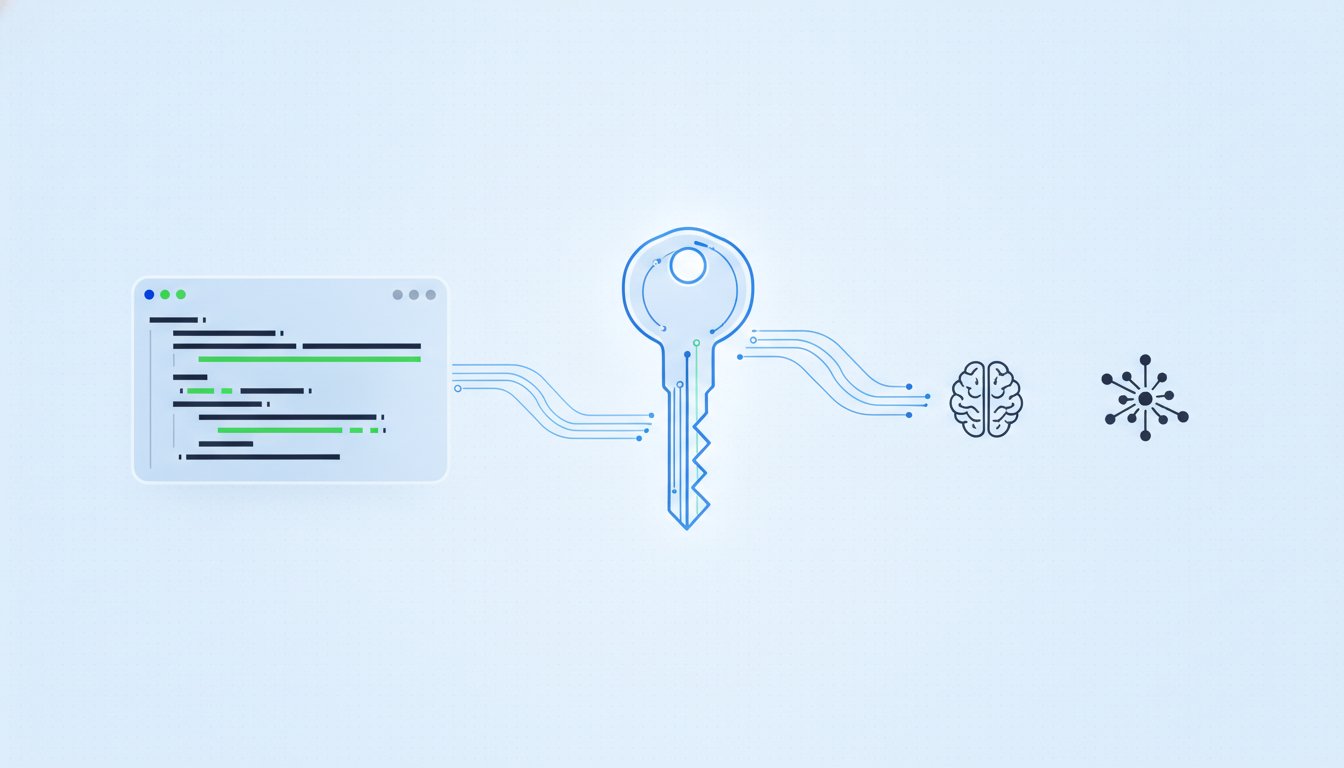
The traditional SaaS model for AI tools is built on bundled convenience. These platforms package the user interface and the machine learning model into a single subscription. While this seems simple, it creates a black box for your engineering budget. A bring your own API key code review strategy dismantles this box. It separates the orchestration layer from the intelligence layer. You provide the keys, and the tool provides the workflow.
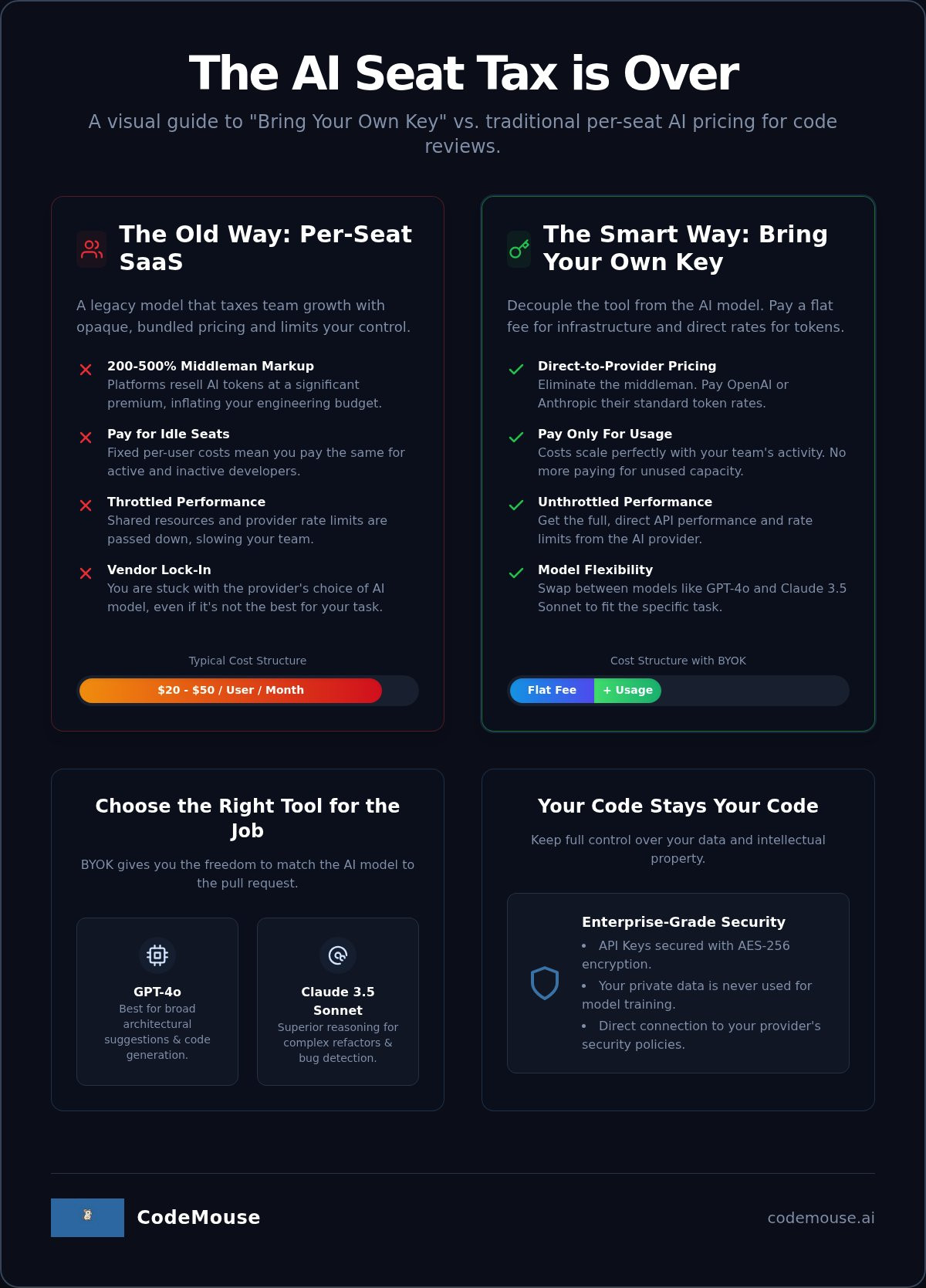
Managed platforms act as brokers. They purchase tokens from providers like Anthropic or OpenAI and resell them to you at a markup. They also throttle your usage to protect their own margins. By using your own keys, you access the raw API directly. You get the same rate limits and performance as an enterprise customer. You pay for the tokens your team actually consumes, nothing more. This transparency is essential for teams that value technical autonomy and cost efficiency.
The Problem with Per-Seat AI Pricing
Per-seat pricing is a legacy model that doesn't fit the variable nature of AI usage. It assumes every developer consumes the same amount of intelligence. In reality, usage fluctuates. One engineer might trigger dozens of reviews during a sprint. Another might be focused on architectural planning or documentation. Under a per-seat model, you pay the same rate for both. This leads to massive underutilization and wasted spend. Bundled plans also obscure the true cost of each review. You can't see the token count or the specific cost per pull request.
Adopting a flat rate AI code review model changes the math. You pay a predictable fee for the infrastructure. Your variable costs scale exactly with your development activity. If your team pushes less code during a holiday, your token costs drop automatically. You stop paying a "tax" on your team's growth.
Vendor Lock-in vs. Model Flexibility
Managed services lock you into their specific choice of LLM. If their chosen provider has an outage or a performance regression, your workflow stalls. You lose control over the most critical part of the stack. Understanding what an API key is helps you regain this control. It's a unique identifier that authenticates your direct relationship with the model provider.
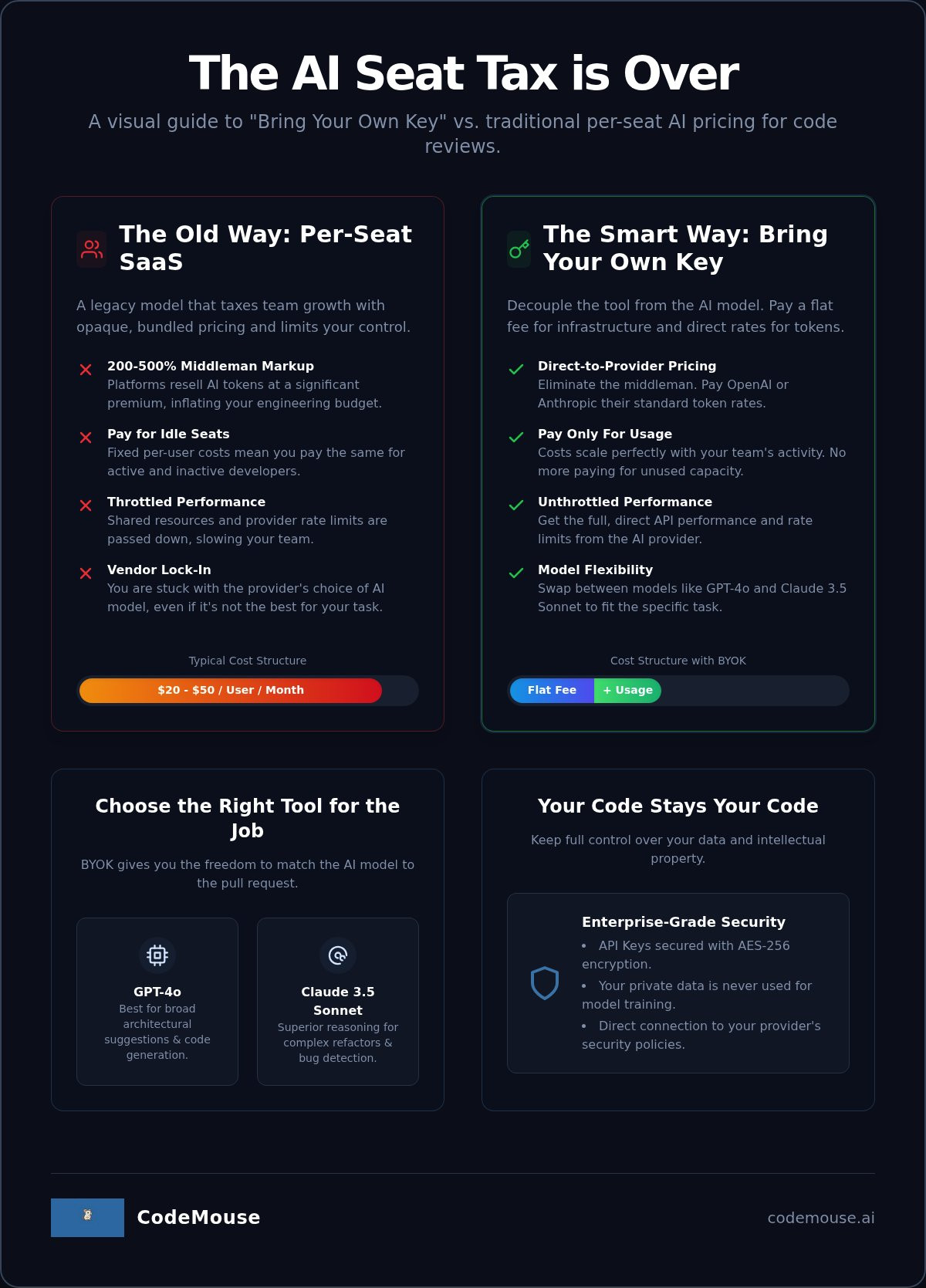
With a bring your own API key code review setup, you can swap models in seconds. You can use Claude 3.5 Sonnet for its superior reasoning in complex refactors. You can switch to GPT-4o for broad architectural suggestions. You aren't waiting for a third-party vendor to update their backend. You get unthrottled access to the latest models on release day. This modularity ensures your tools adapt to your needs, not the other way around.
How Does BYOK Compare to Managed AI Review Pricing?
Managed AI review services operate on a convenience premium. They bundle infrastructure and intelligence into a single price point. This model often hides a markup of 200% to 500% over the actual cost of compute. When you implement a bring your own API key code review, you bypass this reseller tax. You pay the infrastructure provider a flat fee and pay the model provider for exactly what you use. This transparency allows for granular financial control. You can set hard spend limits in your provider dashboard. Monitoring usage per project or per developer becomes a standard part of your DevOps metrics.
The concept of Bring Your Own Key (BYOK) is a standard in cloud security and cost management. It ensures you aren't paying for unused "seats" or bundled credits that expire at the end of the month. Your billing is split into two clear categories: the tool fee and the compute cost. This separation prevents the "per-seat tax" that often penalizes growing teams. Teams with high PR volume see the most immediate impact. They stop paying for the middleman's overhead and start paying for their own engineering output.
Breaking Down the Token Math
A typical pull request review involves sending the file diff and relevant context to the LLM. For a medium-sized PR of 200 lines, you might consume 2,000 to 5,000 tokens. Direct API costs for these reviews are measured in cents. Managed plans often charge $20 to $50 per user regardless of activity. For teams with high PR volume, the savings are compounding. This is why AI code review for small teams is more sustainable with a BYOK model. You scale your quality checks without scaling your fixed overhead.
Avoiding Throttling and Rate Limits
Direct API access eliminates the shared resource problem. Managed providers share a pool of API resources across all their customers. To maintain their margins, they often throttle high-volume users or cap daily requests. This creates latency during peak development hours. When you use your own key, your throughput depends on your specific account tier. Tier 4 and Tier 5 accounts on OpenAI or Anthropic offer massive limits. Your reviews stay fast even when your team is pushing code simultaneously. You aren't competing with other companies for a shared slice of a managed provider's quota. If you value consistent performance, consider how CodeMouse lets you leverage your own infrastructure tiers for maximum throughput.
Is Bring Your Own API Key Secure for Private Repositories?
Security in a bring your own API key code review model depends on the architecture of the orchestration tool. Modern platforms use AES-256 encryption to store keys at rest. This ensures that even if a database were compromised, the keys remain unreadable. The tool acts as a secure proxy. It passes your code and key to the LLM provider via an encrypted TLS connection. It doesn't store your code permanently. It only processes the diff to generate feedback. This "pass-through" architecture minimizes the attack surface for your intellectual property.
GitHub App permissions provide an additional layer of safety. You grant the review tool access only to the repositories you select. You control the scope. Most tools only require "Read" access to code and "Read/Write" access to pull requests. This limited scope prevents the tool from making unauthorized changes to your main branch or accessing sensitive environment variables. You can also use "restricted" keys in your provider dashboard. These keys can be limited to specific models or API endpoints. This ensures that even if a key were leaked, its utility would be strictly confined.
Key Management Best Practices
Don't reuse your primary developer keys for automation. Create dedicated API keys specifically for your review tools. This allows you to revoke access for a specific service without affecting other parts of your stack. Monitoring these keys is simple through your provider's dashboard. Follow these steps to maintain a secure environment:
- Set monthly usage quotas in the OpenAI or Anthropic dashboard to prevent runaway costs from large diffs.
- Restrict keys to specific models, such as Claude 3.5 Sonnet, to prevent unauthorized usage of more expensive models.
- Rotate keys every 90 days as part of your standard security audit to mitigate the risk of long-term credential exposure.
Data Privacy and Model Training
A common misconception is that sending code to an API is the same as pasting it into a chat interface. It's not. Enterprise API agreements from major providers explicitly state that data sent via API is not used to train their foundation models. Your code is used for inference only. This distinction is critical for compliance with SOC2 or ISO 27001 standards. Using an API ensures your code stays private while you catch bugs in pull requests using the latest intelligence. You get the benefits of AI without the risks associated with consumer-grade chat tools. Your intellectual property remains within your controlled environment.
Which AI Models Work Best for Pull Request Feedback?
A bring your own API key code review workflow allows you to optimize your intelligence layer for different codebases. You aren't constrained by the default model of a managed platform. In the 2026 landscape, model selection is a strategic decision. Claude 3.5 Sonnet is currently the industry leader for reasoning and syntax. It excels at identifying subtle logic errors and off-by-one bugs in complex algorithms. GPT-4o remains the standard for broad architectural suggestions and cross-file dependency analysis. As GPT-5 and Claude 4 gain adoption, the ability to switch providers instantly ensures your quality checks stay at the technological frontier. You can always use the best tool for the specific language or framework in your repository.
Using multiple models also mitigates the risk of hallucinations. No single LLM is perfect across all coding patterns. By comparing outputs from different providers, you can filter out false positives before they reach your developers. This multi-model approach ensures that feedback is both accurate and actionable. It turns the AI from a simple linter into a reliable peer reviewer. You gain the benefits of diverse perspectives without the overhead of manual multi-person reviews. This flexibility is the core advantage of maintaining your own keys.
Claude vs. GPT for Code Analysis
The decision between Claude and GPT often depends on the specific requirements of the pull request. Claude features a large context window. This makes it ideal for reviews that require understanding large chunks of legacy code or complex documentation. It's particularly effective for long-form reasoning in refactoring tasks. GPT excels at strict instruction following. It's better at adhering to specific style guides or security protocols you've defined in your system prompts. For low-stakes tasks like documentation proofreading or basic linting, use "mini" models. Claude Haiku or GPT-4o-mini provide rapid feedback at a fraction of the cost. You can tailor your spend to the importance of the code change.
The Power of Multi-Model Consensus
Reliability increases when models agree. CodeMouse utilizes multi-model consensus to verify critical bug reports. If one model flags a potential race condition, the system can query a second model for verification. This cross-check significantly reduces the noise that often plagues automated tools. You only see the issues that matter. This orchestration also allows for intelligent cost management. You can configure the system to run expensive, high-reasoning models only on complex files or critical paths. Standard boilerplate or CSS changes can be handled by cheaper models. This ensures you get the highest quality feedback without overspending on tokens. Connect your keys to CodeMouse to start building a multi-model review pipeline that scales with your needs.
How to Get Started with CodeMouse and Your Own API Key
Transitioning to a bring your own API key code review workflow is a matter of minutes. The process is designed for immediate utility. Start by installing the CodeMouse GitHub App on your selected repositories. This grants the infrastructure the necessary permissions to listen for pull request events. Once installed, navigate to your LLM provider's developer portal. Create a dedicated API key for this integration. Using a unique key for code reviews allows you to track usage specifically for your quality assurance pipeline. Copy this key and paste it into the secure settings field within the CodeMouse dashboard. The system encrypts this key at rest using AES-256 standards immediately upon submission.
After the key is linked, you can configure your review preferences. Choose your preferred model, such as Claude 3.5 Sonnet or GPT-4o, based on your team's specific needs. You can also define the feedback depth. Some teams prefer high-level architectural suggestions; others require granular syntax and logic checks. This flexibility ensures the AI acts as a functional partner rather than a generic linter. You control the intelligence level and the associated token cost for every review triggered.
Setting Your First Spend Limit
Financial predictability is a core benefit of the BYOK model. You should define a monthly budget in your OpenAI or Anthropic dashboard before running your first review. This prevents unexpected billing during high-velocity sprints. Configure your provider notifications to alert you when you reach 50%, 75%, and 90% of your allocated budget. These thresholds give you ample time to adjust your usage or increase your limit without service interruption. It keeps your compute costs transparent and manageable, unlike bundled plans that hide usage spikes behind a flat per-seat fee.
Optimizing the Feedback Loop
Efficiency increases when you reduce noise. Configure your review tool to ignore files that don't benefit from AI analysis. Lockfiles, compiled assets, and large binary blobs should be excluded in your settings. This saves tokens and keeps the feedback focused on your source code. For high-stakes production code, enable the "Consensus" mode. This triggers a multi-model verification process to ensure the highest accuracy for critical branches. When evaluating your options, consider how Codacy vs CodeMouse handles these configurations. CodeMouse prioritizes user autonomy and model choice. This allows you to scale your quality checks without the overhead of managed service limitations. You maintain full control over the feedback loop and the underlying economic strategy.
Future-Proof Your Engineering Quality
Decoupling your workflow from bundled AI providers is the most effective way to scale engineering quality. Direct token pricing removes the middleman markup. Unthrottled API access keeps your pipeline fast during peak hours. A bring your own API key code review setup ensures you only pay for the value you consume. It puts you in control of model selection and data privacy. Whether you need Claude's reasoning or GPT's architectural breadth, the choice remains yours. You've moved beyond the black box of managed subscriptions.
CodeMouse provides the infrastructure to orchestrate these keys across your repositories. You'll find no per-seat pricing to inflate your budget as your team grows. The platform offers automated GitHub integration and native support for both Claude and GPT models. Start your 14-day free trial with CodeMouse to eliminate the per-seat tax today. Build a more efficient, transparent, and modular review process for your team. It's time to own your intelligence stack.
Frequently Asked Questions
How much does it cost to use my own API key for code reviews?
You pay exactly what the model provider charges per token. A typical review consumes between 2,000 and 10,000 tokens. Depending on the model, this results in a cost of a few cents per request. You avoid the markup found in managed bundles. This transparency is a core benefit of a bring your own API key code review strategy. You only pay for active development.
Which AI model is the most cost-effective for GitHub PRs?
GPT-4o-mini and Claude 3 Haiku are the most cost-effective choices for standard reviews. These models are optimized for speed and low latency. They handle syntax validation and basic logic checks with high precision. For complex refactors, you can swap to Sonnet or GPT-4o. The modular nature of BYOK allows you to match the model's cost to the PR's specific complexity.
Will using my own API key make the review process slower?
Using your own key generally increases review speed. Managed providers often throttle requests to maintain their own margins across a shared user base. Your own API key utilizes your specific account tier's rate limits. Tier 4 or Tier 5 accounts on OpenAI provide massive throughput. Your reviews won't wait in a global queue during peak development hours. Speed remains consistent.
Can I use one API key for multiple GitHub repositories?
A single API key can support multiple GitHub repositories. You can configure the CodeMouse GitHub App to use the same key across your entire organization. This simplifies billing and management. If you prefer granular tracking, you can generate unique keys for different projects. Both approaches work within the dashboard settings. It's an efficient way to manage infrastructure across various engineering teams.
Is it possible to set a hard cap on my monthly token spend?
You can set a hard monthly spend limit directly in your LLM provider's dashboard. This is a standard feature for OpenAI and Anthropic. Once the limit is reached, the API stops authorizing requests. This prevents unexpected billing surprises. You can also configure email alerts at specific usage percentages. It ensures your compute costs stay within your defined engineering budget every month.
What happens if my API key expires or hits a rate limit?
If a key hits a rate limit, the review process fails to post a comment. The system will log an error in your dashboard. You'll need to wait for the rate limit window to reset or upgrade your account tier. If a key expires, you simply generate a new one in your provider portal. Update the settings in CodeMouse to restore service immediately. There's no downtime.
Does CodeMouse store my source code when using my own key?
CodeMouse doesn't store your source code on its servers. The system processes the pull request diff in memory to generate the review prompt. Once the AI provides feedback and the comment is posted to GitHub, the diff is discarded. This ephemeral processing model ensures your intellectual property remains secure. It aligns with standard bring your own API key code review security protocols for private repositories.
Can I use open-source models via providers like Groq or Together AI?
CodeMouse is optimized for high-performance integration with Claude and GPT models. These providers offer the specific reasoning capabilities required for meaningful code feedback. While the landscape for open-source models is evolving, the current infrastructure focuses on the industry leaders. This ensures consistent feedback quality and reliability. You get the best available intelligence for your code reviews without managing complex open-source deployments.