Best AI for Code Reviews 2026: Top Tools for GitHub Teams
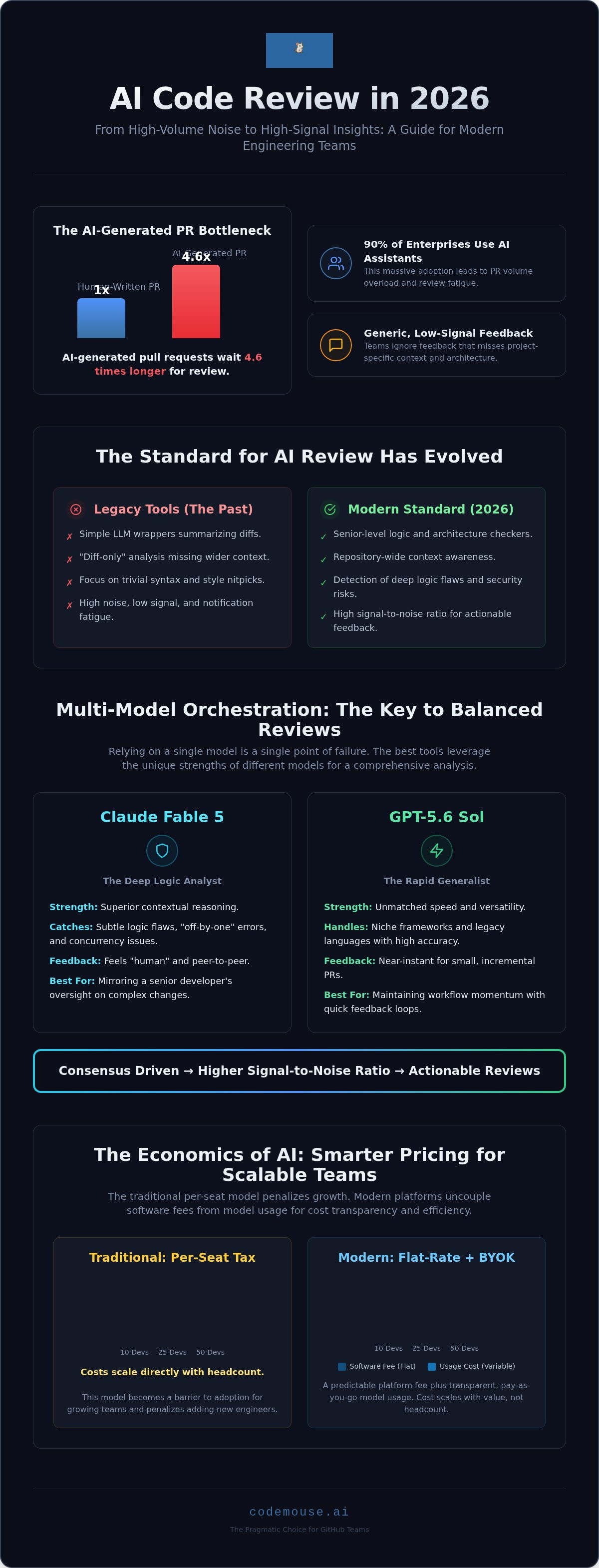
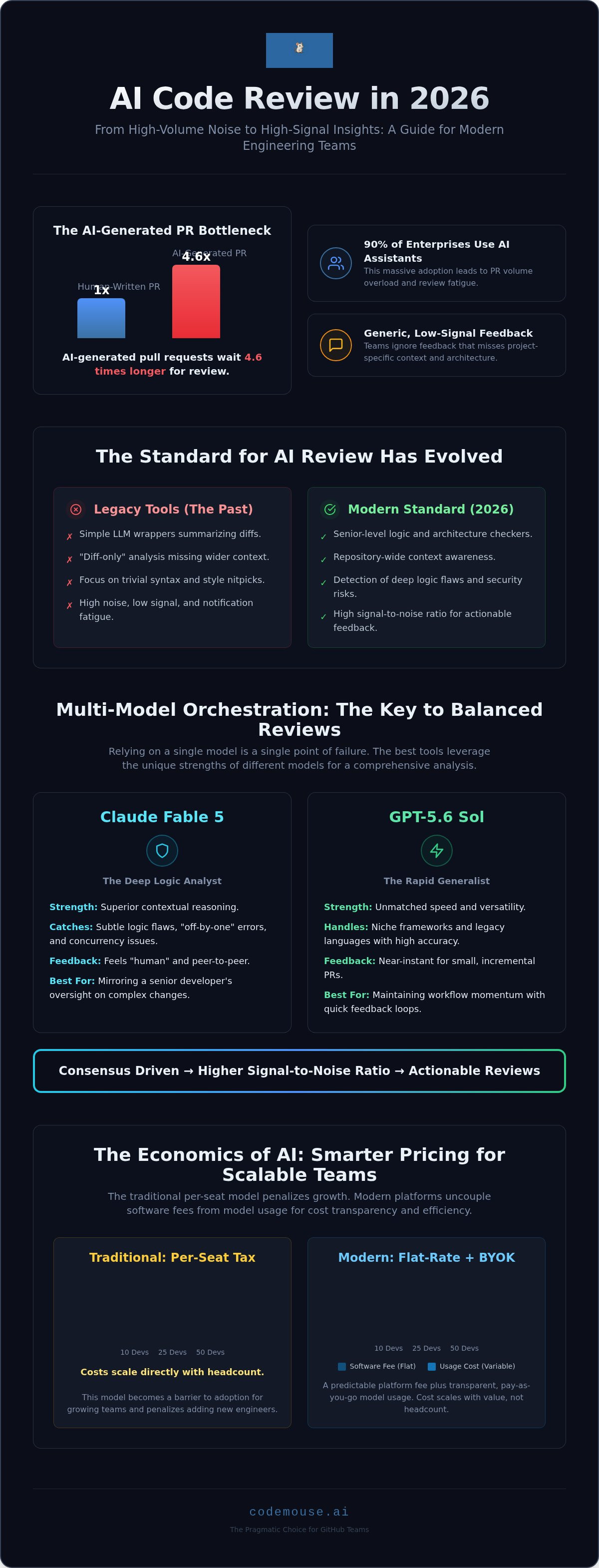
AI-generated pull requests currently wait 4.6 times longer for review than human-written code. While 90% of enterprises have adopted AI coding assistants, most teams are now drowning in the resulting PR volume. You've likely seen the symptoms: review bottlenecks, fatigue-driven rubber-stamping, and generic feedback that ignores your project's specific architecture. Finding the best AI for code reviews is no longer about just catching syntax errors. It's about finding a tool that understands context like a senior developer.
We agree that the current per-seat pricing model is broken for growing teams. You shouldn't be penalized for adding more engineers to your GitHub organization. This article provides a pragmatic comparison of the leading AI code review tools designed to slash cycle times and improve PR quality. We'll examine how context-aware orchestrators and bring-your-own-key models are replacing expensive, rigid platforms. You'll learn how to get the technical depth and cost transparency your team needs in 2026.
Key Takeaways
- Identify tools that prioritize repository-wide context and logical reasoning over simple syntax linting to reduce false positives.
- Understand the performance trade-offs between Claude’s superior reasoning and GPT’s speed when automating PR feedback.
- Select the best AI for code reviews by weighing managed enterprise features against the cost-efficiency of flat-rate platforms.
- Eliminate the per-seat tax by adopting tools that uncouple software fees from model usage costs through a bring-your-own-key model.
- Implement multi-model orchestration to achieve higher signal-to-noise ratios and context-aware feedback that mirrors senior developer oversight.
Table of Contents
What Defines the Best AI for Code Reviews in 2026?
The standard for the best AI for code reviews has shifted. In previous years, teams accepted simple "LLM wrappers" that summarized diffs or pointed out missing docstrings. Today, that level of utility is baseline. High-performance engineering teams now require tools that act as senior-level logic checkers. A tool must provide a high signal-to-noise ratio by ignoring trivial formatting issues and focusing on deep architectural flaws. If an AI tool flags a missing semicolon but misses a race condition, it is a net negative for your cycle time.
To understand the broader landscape of AI-assisted software development, one must look beyond simple autocompletion toward deep-logic validation. The best AI for code reviews in 2026 integrates directly into the GitHub PR workflow. It triggers automatically, provides comments in-line, and understands your specific CI/CD constraints. Efficiency also depends on cost. As teams scale, the traditional per-seat tax becomes a barrier to adoption. Pragmatic teams are moving toward models that uncouple the software platform from the underlying AI usage costs.
Signal vs. Noise in AI Feedback
Trivial comments are productivity killers. When an AI "rubber-stamps" a PR with generic praise or nitpicks variable naming, it creates notification fatigue. Developers start ignoring the tool. Modern 2026 models, such as GPT-5.6 Sol and Claude Fable 5, have improved significantly in detecting complex edge cases. These models can now identify security vulnerabilities that traditional static analysis misses. They focus on the "why" behind the code. If the AI cannot explain how a change might break a downstream service, it isn't providing enough signal. Leading tools now prioritize high-severity logical errors over stylistic preferences that should be handled by a local linter.
The Role of Context Windows
Diff-only reviews are inherently limited. If the AI only sees the lines changed in a single pull request, it cannot catch cross-file regressions. It misses how a modified function signature impacts a separate module. Modern tools solve this by ingesting repository-wide context. They use massive context windows to "read" the entire codebase before analyzing a specific PR. This allows the AI to recognize project-specific patterns and internal library usage.
- Repository Mapping: Tools must index your code to understand dependencies.
- Cross-File Analysis: Detecting how changes in
/authaffect/api/v2. - Model Reasoning: Utilizing models like Claude Fable 5 for superior reasoning over long-form technical documentation.
Accuracy depends on this depth. Without context, AI feedback remains generic. With it, the feedback feels like it came from a developer who has worked on the repo for years. This contextual awareness is the primary differentiator between a basic assistant and a professional-grade review tool.
Comparing the Core Models: Claude vs. GPT for Code Analysis
Relying on a single AI model is a single point of failure for code quality. Every LLM has specific biases and architectural blind spots. The best AI for code reviews in 2026 leverages the unique strengths of different models to provide a balanced critique. Claude Fable 5 and GPT-5.6 Sol currently lead the industry, but they serve different functions in the pull request lifecycle. One provides deep logical reasoning. The other offers rapid, broad-spectrum coverage. When these models reach consensus, the signal-to-noise ratio increases significantly, reducing the time developers spend filtering out hallucinations.
Claude's Reasoning Strengths
Claude Fable 5 excels at identifying subtle logic flaws. It catches "off-by-one" errors and concurrency issues that other models might skip. Its reasoning capabilities make it ideal for automated code review where the goal is to mirror a senior developer's oversight. Claude maintains context over long pull requests. It ensures that the original intent of the change isn't lost in the technical details. This model typically produces feedback that feels more "human" and peer-to-peer, rather than a list of automated warnings.
GPT's Versatility and Speed
GPT-5.6 Sol is the gold standard for speed and language breadth. It handles niche frameworks and legacy languages with high accuracy. Integrating GPT into a streamline pull request workflow ensures that small, incremental changes receive feedback in seconds. This rapid loop prevents developers from context-switching while waiting for a review. GPT is particularly effective at identifying security vulnerabilities and cross-file regressions in large, polyglot repositories where speed is a requirement for maintaining high velocity.
The real power lies in consensus. If Claude and GPT both flag a specific block of code, the likelihood of a genuine bug is near 100%. This multi-model approach eliminates the "hallucination tax" common in single-model tools. It turns the review into a reliable gate rather than a noisy suggestion box. You can test this multi-model orchestration with a CodeMouse AI Code Review 14-day trial to see how model consensus improves feedback depth. Using both ensures you don't have to trade depth for speed. It allows your team to maintain a fast shipping cadence without sacrificing the technical debt controls required for enterprise-grade software.
Top AI Code Review Tools: Performance and Integration Comparison
Selecting the best AI for code reviews depends on your team's specific workflow requirements and budget constraints. In 2026, the market has bifurcated into "managed platforms" and "flexible orchestrators." Managed platforms offer a hands-off experience but often lock you into specific models and per-seat pricing. Orchestrators allow you to bring your own intelligence, providing more control over the review logic and total cost of ownership. For GitHub teams, the choice usually comes down to the depth of the audit versus the speed of the feedback loop.
Codacy remains a primary choice for enterprises requiring strict compliance and a mix of static analysis and AI. It is built for organizations that need to consolidate security scanning and quality gates into a single dashboard. While robust for compliance, it often lacks the nuanced reasoning found in the latest frontier models used by more agile tools. GitHub Copilot provides basic PR features that are convenient for individual developers but limited for team-wide quality control. It excels at generating summaries and identifying simple syntax improvements, yet it lacks the deep logical auditing required to catch complex architectural regressions.
For teams prioritizing cost-control and multi-model flexibility, CodeMouse is the pragmatic builder's choice. It uncouples the software platform from the AI models, allowing you to use Claude Fable 5 or GPT-5.6 Sol through your own API keys. This ensures you only pay for the intelligence you actually use without being throttled by a third-party's compute limits. It transforms the PR from a static diff into an interactive technical audit that respects your team's existing shipping velocity.
Feature Breakdown: Automation vs. Assistance
The effectiveness of automated PR comments AI is measured by the signal-to-noise ratio. Leading tools now offer interactive chat within the PR thread, allowing developers to ask the AI for clarification or alternative refactors. You should look for tools that support custom instructions. This allows the AI to follow your team's specific style guides or ignore certain directories. High-signal tools focus on "show, don't just tell" by providing suggested code blocks that can be committed directly from the GitHub UI.
GitHub Integration and Workflow Fit
A GitHub PR review assistant must fit into your existing CI/CD pipeline without adding friction. Most professional tools install as a GitHub App, enabling granular permissions for specific repositories. If you manage large monorepos, ensure the tool can handle partial checkouts or incremental indexing to avoid timeout errors. For microservices, look for a tool that can maintain context across multiple repositories to identify breaking changes in shared libraries or API contracts. The goal is a silent partner that enhances your current habits rather than demanding a total overhaul of your shipping process.
The Economics of AI Reviews: Per-Seat vs. Flat-Rate Pricing
The best AI for code reviews should scale with your repository volume, not your headcount. Traditional SaaS models often impose a per-seat tax that makes AI adoption expensive for large teams. When costs range from $19 to $30 per developer each month, adding a dozen contractors or junior engineers significantly inflates your overhead. This pricing structure often forces teams to limit AI reviews to "critical" repositories. It defeats the purpose of automated quality control.
Predictable flat-rate billing changes this math. When the platform cost is fixed, the marginal cost of reviewing one more PR becomes negligible. This is especially vital for high-velocity teams using microservices architecture. In these environments, the number of repositories often exceeds the number of engineers. You shouldn't be penalized for maintaining a modular codebase or a growing team.
Why BYOK is the Pro Choice for 2026
The "Bring Your Own Key" (BYOK) model offers direct transparency that bundled pricing lacks. You pay a small platform fee and then pay model providers like OpenAI or Anthropic directly for the tokens consumed. This setup ensures you aren't paying a hidden markup on AI compute. It puts the control back into the hands of the engineering manager.
- Transparency: Monitor exact usage through your own provider dashboards.
- Flexibility: Switch between Claude Fable 5 for deep logic and GPT-5.6 Sol for speed without changing your review platform.
- Security: Your API keys remain under your organization's control, ensuring compliance with data residency requirements.
Scalability for Startups and Scale-ups
For a 20-person engineering team, per-seat pricing can easily reach $600 per month. Over a 12-month period, this totals over $7,000 for a single tool. A flat-rate model allows for unlimited users and repositories, drastically reducing the total cost of ownership. This allows you to allocate budget toward headcount or other infrastructure needs.
A flat rate AI code review removes the hesitation to run automation on every commit. It encourages junior developers to use the AI as a learning tool. They receive instant feedback on every draft PR without worrying about license costs. This turns the AI from a gated luxury into a standard part of the infrastructure. It fosters a culture of continuous improvement rather than a culture of cost-containment.
If you want to stop paying for seats and start paying for value, start your 14-day free trial today and see how the BYOK model scales with your team.
Why CodeMouse is the Pragmatic Choice for GitHub Teams
CodeMouse is built for engineering teams that prioritize utility over marketing fluff. Most platforms bundle AI compute into expensive per-seat tiers, but CodeMouse uncouples the software from the intelligence. You pay a $10/month flat fee for the platform and use your own API keys for models like Claude and GPT. This approach ensures you are never paying a markup on tokens. It gives you the best AI for code reviews by allowing you to choose the exact level of reasoning your project requires without hitting arbitrary platform throttles.
The core advantage is multi-model orchestration. Instead of being locked into a single provider's roadmap, you can get the best of Claude Fable 5 and GPT-5.6 Sol in a single PR thread. Claude provides the deep architectural reasoning, while GPT handles broad language support and rapid syntax checks. Because you use your own API keys, your speed is limited only by your provider's rate limits, not by a third-party SaaS queue. This setup respects your autonomy and provides a transparent, scalable infrastructure for high-velocity teams.
Getting Started in 5 Minutes
The onboarding process is designed to be as lean as the software itself. There are no long-winded sales calls or complex enterprise configurations. You can move from installation to your first automated review in minutes.
- Install the GitHub App: Grant CodeMouse access to specific repositories through the GitHub Marketplace.
- Add API Keys: Input your Anthropic or OpenAI keys into the secure dashboard.
- Configure Repos: Set your review triggers and define which branches require AI oversight.
Once connected, the system sits silently in your workflow. It triggers only when a PR is opened or updated, providing in-line comments that feel like peer feedback rather than automated noise.
The 14-Day Roadmap to Better Code
The best AI for code reviews shouldn't just be accepted on faith. It needs to be benchmarked. Use the 14-day trial to compare AI feedback against your current manual review process. Monitor how many logical bugs the system catches before they reach staging. You can refine the prompts to match your team's specific coding standards or internal library requirements. This allows the AI to learn your preferences, eventually providing feedback that is indistinguishable from a senior developer's audit.
Stop overpaying for seat licenses and start optimizing for signal. Start your 14-day free trial of CodeMouse today and build a more efficient, context-aware review workflow for your GitHub team.
Scaling Your Engineering Quality Without the Per-Seat Tax
The landscape of automated feedback has moved past simple diff summaries. Selecting the best AI for code reviews in 2026 requires a focus on repository-wide context and multi-model consensus. By uncoupling your review platform from the underlying AI models, you gain transparency and eliminate the financial friction of adding new developers. You don't have to choose between deep reasoning and fast shipping cycles when your infrastructure supports both Claude and GPT orchestration. This modular approach ensures your tools adapt to your codebase rather than the other way around.
CodeMouse provides this infrastructure for a flat fee, allowing you to run unlimited reviews across every repository in your GitHub organization. You can leverage your existing API keys to maintain full control over your security and token usage. Streamline your GitHub reviews with CodeMouse for $10/mo and start a 14-day free trial to experience high-signal feedback without the per-seat fees. It's time to build a more resilient PR workflow and get back to shipping with confidence.
Frequently Asked Questions
Is AI actually better than a human at catching bugs in code reviews?
AI isn't a replacement for human judgment; it's a consistency tool. It doesn't suffer from fatigue or time pressure during long sessions. While humans are better at assessing high-level architectural intent, the best AI for code reviews excels at identifying edge cases, race conditions, and security vulnerabilities across large diffs. It serves as a tireless first pass that catches errors before a human reviewer even opens the PR.
How much does the AI API usage typically cost per month for a developer?
Usage costs depend on your PR volume and the complexity of your code. Direct API costs for models like Claude or GPT typically range from $0.05 to $0.15 per review. For most active developers, this results in a few dollars per month. This bring-your-own-key model is significantly more cost-effective than the per-seat markups found in bundled SaaS platforms.
Does CodeMouse store my code on its servers?
No. CodeMouse is a stateless orchestrator. It fetches the PR diff from GitHub, sends it to your chosen AI provider, and posts the comments back to the PR. Your source code is not persisted on the CodeMouse infrastructure. This architecture ensures your intellectual property remains within your controlled environments and is not used for unauthorized model training.
Can I use my own custom prompts for the AI code review?
Yes. You can define custom instructions to align the feedback with your team's specific style guides and performance requirements. This ensures the best AI for code reviews understands your internal libraries and project-specific constraints. You can tell the AI to ignore specific files or prioritize certain security standards during its audit to maintain a high signal-to-noise ratio.
What happens if the AI suggests a 'fix' that is actually incorrect?
The developer always maintains final control. AI suggestions appear as standard comments or suggested changes in the GitHub UI. If a suggestion is incorrect, you can ignore it or use the interactive chat to ask for a corrected refactor. The AI is a collaborator designed to assist your decision-making, not a gatekeeper that merges code automatically without oversight.
Does an AI code reviewer support languages like Rust, Go, or TypeScript?
Yes. Frontier models have deep understanding of modern type systems and concurrency models. They provide specialized feedback for Rust's ownership model, Go's goroutines, and TypeScript's advanced generics. Because these models are trained on vast amounts of open-source code, they support nearly every language currently used in production environments, including legacy codebases and niche frameworks.
Can I use CodeMouse with private GitHub repositories?
Yes. The platform is built for professional engineering teams working on proprietary codebases. You authorize the GitHub App for specific private repositories through your organization settings. You retain full control over permissions and can revoke access at any time. It integrates seamlessly without requiring you to move your code or change your existing hosting provider.
How does multi-model consensus help reduce AI hallucinations?
Hallucinations are errors where a model perceives a bug that isn't there. Multi-model consensus uses both Claude and GPT to analyze the same PR. If both models identify the same logical flaw, the signal is verified. This cross-check significantly reduces false positives. It ensures that the feedback you receive is accurate, actionable, and free from the individual biases of a single model.