How to Streamline Your Pull Request Workflow: A 2026 Engineering Guide
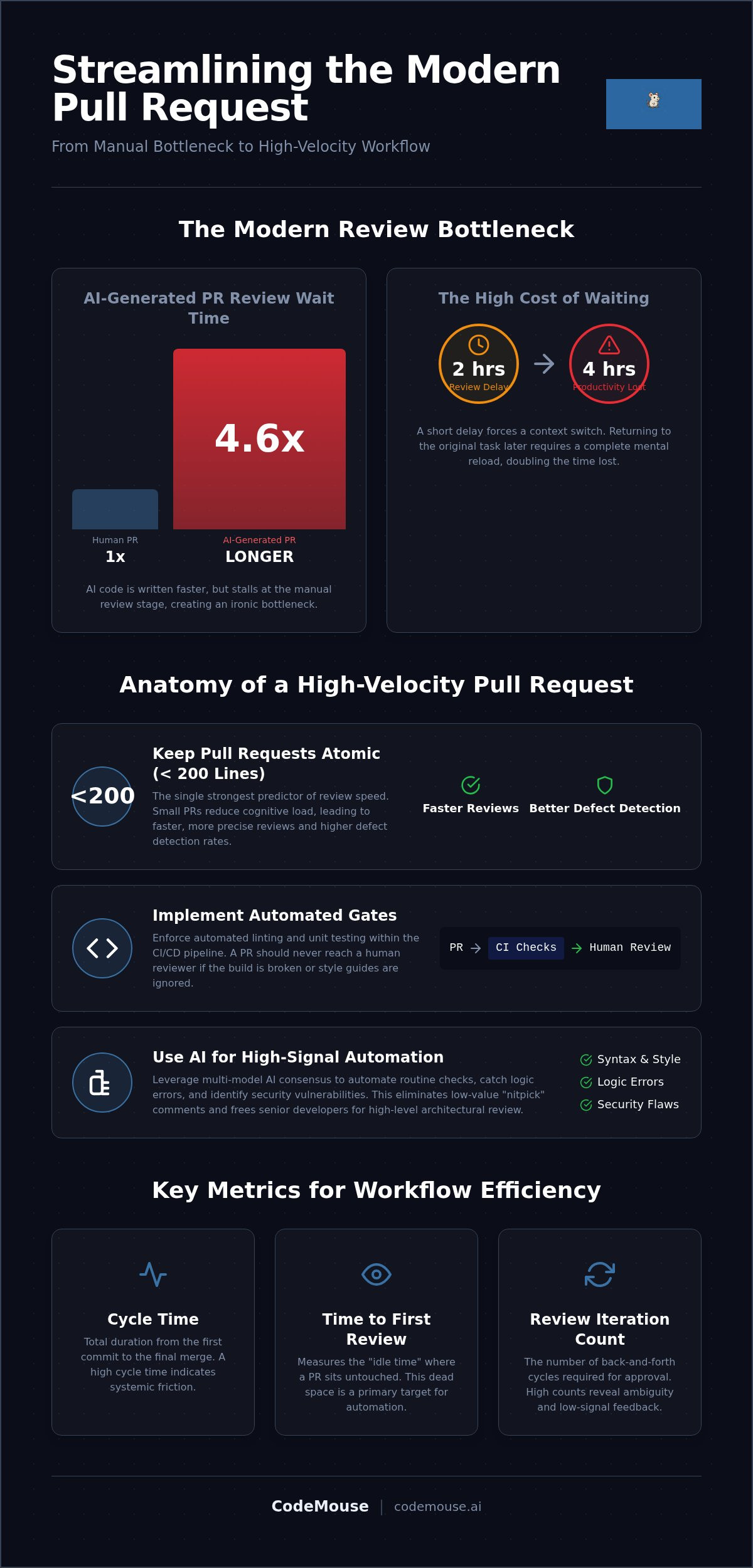
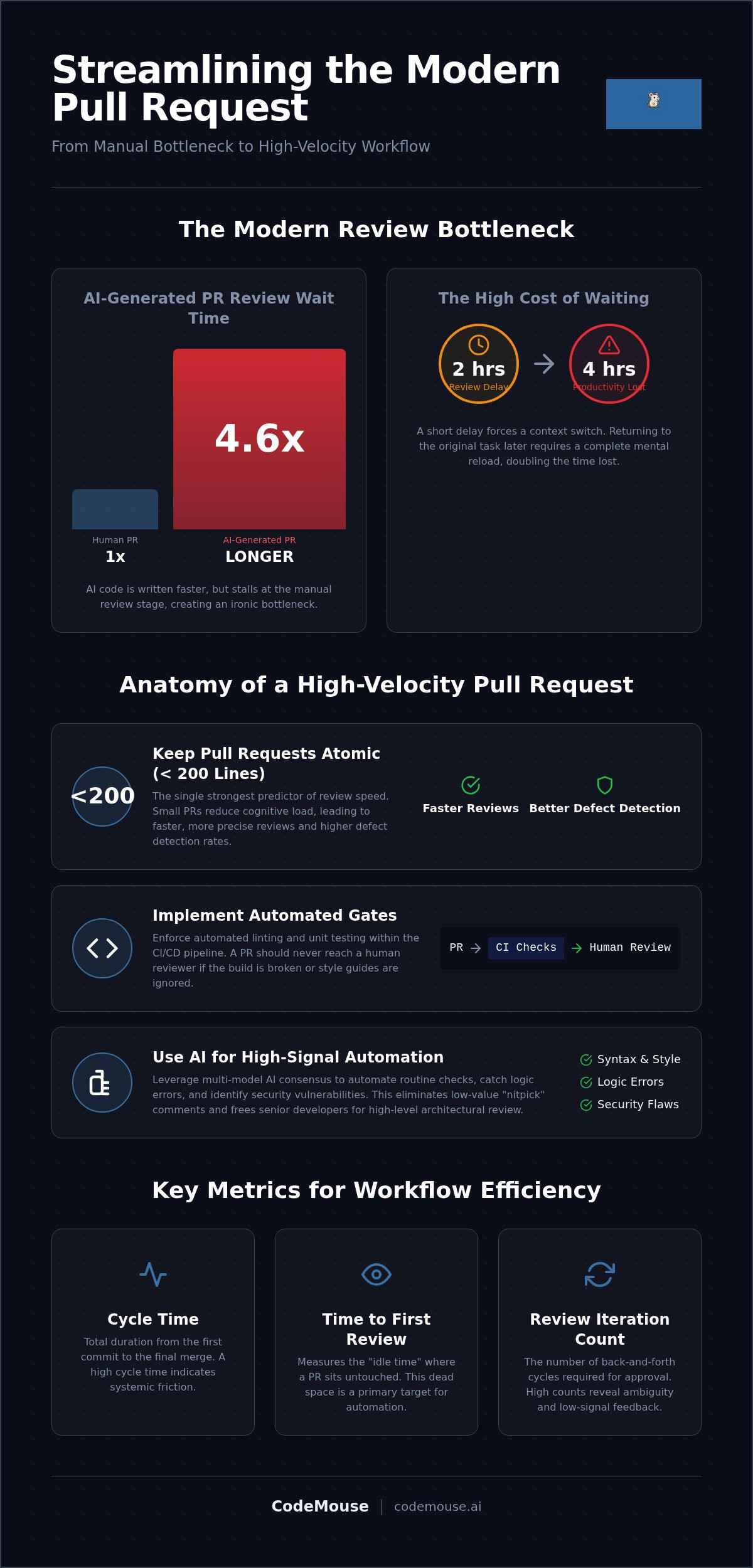
AI-generated pull requests currently wait 4.6 times longer for review than human-authored code. It's an ironic bottleneck; we're writing code faster than ever, yet the delivery cycle is stalling at the review stage. If you want to streamline pull request workflow in 2026, you can't rely on manual oversight for every line. With GitHub processing over 43 million pull requests monthly, the traditional manual review process has become a primary source of engineering debt.
You likely feel the friction of constant context switching and the frustration of low-signal nitpicks that add no real value. We agree that senior engineering time is too valuable for manual syntax checks or resolving avoidable merge conflicts. This guide explains how to eliminate these bottlenecks using high-signal AI automation and multi-model consensus. You'll learn how to accelerate your delivery cycle, improve feedback quality, and standardize your review culture. We'll show you how to move from manual gatekeeping to a focused, automated pipeline that respects your team's intelligence and time.
Key Takeaways
- Identify and eliminate idle time in the review loop to reduce cognitive friction across the engineering team.
- Implement atomic PRs under 200 lines to maximize review velocity and improve defect detection rates.
- Use multi-model AI consensus to automate routine checks and bypass the manual "nitpick trap."
- Audit your existing cycle time to identify specific bottlenecks and streamline pull request workflow automation.
- Leverage a flat-rate pricing model with BYO API keys to scale automated reviews without incurring per-seat taxes.
Table of Contents
What Does it Mean to Streamline a Pull Request Workflow?
Streamlining a pull request workflow is the deliberate reduction of "idle time" and "cognitive friction" within the development lifecycle. It targets the "Review Loop," the critical gap between PR creation and final approval. In many organizations, this loop accounts for a massive portion of total delivery time. Reducing this gap requires a fundamental shift from manual gatekeeping to automated validation. Efficiency here isn't just about speed; it's about removing the mental hurdles that prevent engineers from staying in a flow state.
To effectively streamline pull request workflow efficiency, you must measure specific telemetry. Cycle Time tracks the total duration from the first commit to the final merge. Time to First Review measures the dead space where a PR sits untouched. Review Iteration Count reveals the number of back-and-forth cycles required before consensus is reached. High numbers in these metrics indicate a process laden with unnecessary friction. Idle time is dead space. Cognitive friction is the mental resistance felt when a PR is too large or the feedback is irrelevant.
The Cost of a Fragmented PR Process
Fragmented workflows act as productivity killers. When a review is delayed by just two hours, the author usually context switches to a new feature. Returning to the original code later requires a complete mental reload, often costing four hours of actual productivity. This is the hidden cost of "waiting" states. Stale branches introduce a "Merge Conflict Tax," where developers spend more time resolving git history than writing new logic. Senior developers often become the ultimate bottleneck. They spend hours performing routine checks on the code review process instead of focusing on high-level architecture. This "Senior Debt" stalls entire feature teams and slows down the overall release cadence.
Defining the 2026 Standard for Velocity
Velocity in 2026 relies on shift-left principles. The goal is to catch logic errors, security vulnerabilities, and style violations before a human peer ever sees the diff. High-signal automation acts as a filter within the CI/CD pipeline, ensuring that human reviewers only engage with code that is already functionally validated. This approach respects the developer's time and intelligence by removing the need for low-value "nitpick" comments. PR streamlining is the elimination of non-value-added manual intervention. By automating the baseline, teams focus on architectural integrity rather than syntax. This transition transforms the PR from a hurdle into a high-speed lane for deployment.
The Anatomy of a High-Velocity PR Lifecycle
A high-velocity lifecycle depends on predictable inputs. Without structure, reviewers waste time deciphering intent rather than analyzing logic. To streamline pull request workflow efficiency, start with atomic changes. Data suggests that keeping diffs under 200 lines is the strongest predictor of review speed. Smaller PRs are easier to digest, lead to higher defect detection, and reduce the cognitive load on your team. This aligns with findings in A Case Study at Google, which highlights that small, frequent reviews improve overall code quality and developer satisfaction. Large diffs invite shallow reviews. Small diffs invite precision.
Automated linting and unit testing serve as the essential entry gate. If the build fails or style guides are ignored, the PR should never reach a human reviewer. This prevents the "Review Loop" from being clogged with trivial errors that distract from architectural logic. Integrating GitHub PR automation tools ensures these gates are strictly enforced without manual intervention. This setup creates a self-service environment where developers get immediate feedback from the system. It minimizes the time code spends in a "Waiting" state.
Standardizing the PR Description
Ambiguity is a velocity killer. Standardized templates force authors to document the "Why" behind a change rather than just the "What." Reviewers can see the code; they need to understand the intent and the trade-offs made. Link issues and deployment previews automatically to provide full context. A "Review-Ready" checklist ensures the author has self-reviewed and verified the build before pinging the team. This reduces "Information Request" cycles where a reviewer has to ask for basic context, a process that can add days to the cycle time. Clear documentation is a prerequisite for speed.
Automated Triage and Labeling
Manual triage is a scalable failure. Use automated labeling to signal urgency, complexity, and the type of change, such as a bug fix or a refactor. This allows reviewers to prioritize their queues based on their current mental bandwidth. Auto-assigning reviewers via CODEOWNERS files ensures the right domain experts are notified immediately. Incorporating automated PR comments AI provides instantaneous feedback on common patterns. This initial layer of critique happens in seconds. It allows the author to fix issues before a human peer even opens the tab. You can automate these routine checks to keep your senior engineers focused on high-impact work.
Eliminating the Review Bottleneck with AI Consensus
Manual code reviews are the primary cause of delivery delays. While your CI pipeline validates that code compiles, it rarely validates that the logic is sound. This creates the "Review Loop" where PRs sit in a "Waiting" state for days. To streamline pull request workflow efficiency, you must address the signal-to-noise ratio in your feedback loops. Most human peer reviews suffer from the "Nitpick Trap." This occurs when 80% of comments focus on stylistic preferences or surface-level syntax that provides only 20% of the actual value. These comments are expensive. They cost time for the reviewer to write and time for the author to context switch and resolve. Offloading this routine analysis to bots reduces reviewer fatigue and ensures your senior talent is focused on architectural integrity.
How AI Consensus Works in 2026
Single-model AI assistants can be unreliable. They occasionally hallucinate or miss edge cases that a human might catch. In 2026, the standard has shifted toward multi-model consensus. By comparing feedback from Claude 3.5 and GPT-4o simultaneously, the system can validate bugs with surgical precision. If both models identify a memory leak or an unhandled exception, the signal is high. If they disagree, the system can either flag it for human review or suppress the comment to avoid noise. This is why AI code review for GitHub is more reliable than standalone assistants. Multi-model consensus reduces the false-positive rate in automated reviews by requiring agreement between independent logic engines before surfacing a suggestion.
Shifting from "Approval" to "Audit"
The objective isn't just to find errors; it's to change the engineering culture. Using a github pr review assistant allows developers to self-correct in real-time. There's a distinct psychological benefit to "Bot-First" reviews. Developers are generally more receptive to feedback from a tool than from a peer, as it removes the ego from the interaction. This leads to cleaner code before a human even opens the PR. The human reviewer's role then shifts from line-by-line gatekeeping to high-level auditing. They look for architectural alignment and long-term maintainability while the AI handles the granular details. This evolution is a critical step in improving code review processes for high-velocity teams.
Step-by-Step: Implementing a Streamlined Workflow
Transitioning to a high-velocity environment requires a structured roadmap. You can't streamline pull request workflow efficiency by simply adding more tools; you must change the sequence of operations. Follow this linear progression to eliminate idle time and reduce cognitive friction across your engineering team.
- Step 1: Audit current cycle time. Use GitHub Insights or similar telemetry to identify the longest "Waiting" state. Pinpoint where PRs stall. Is it the time to first review or the iteration count?
- Step 2: Configure a GitHub App. Establish the automated feedback loop. Ensure your CI pipeline triggers immediately upon commit to catch linting and build errors before any human interaction occurs.
- Step 3: Define "Auto-Merge" criteria. Identify low-risk changes like dependency updates or internal documentation fixes. Set clear rules for automated merging to keep the main branch moving without manual oversight.
- Step 4: Deploy an AI Code Reviewer. Insert a bot to handle the first pass of every PR. This layer filters out routine syntax errors and logic flaws, ensuring human reviewers only see "clean" code.
- Step 5: Monitor "Time to Merge." Review your metrics monthly. If the review loop remains long, refine your automation rules or decrease the maximum allowable PR size.
Configuring Your AI Reviewer
Effective automation requires the right model for the right task. Use Claude 3.5 or 4 for complex logic analysis and GPT-4o or 5 for syntax and style validation. This multi-model approach ensures a higher signal-to-noise ratio. Setting up a "Bring Your Own API Key" model is the most cost-effective way to scale AI reviews. It gives you full control over costs and data privacy. You can also customize system prompts to align with your team's specific style guides. This ensures the bot's feedback is relevant and actionable rather than generic.
If you're ready to automate your first pass, install CodeMouse AI Code Review to start receiving high-signal feedback in seconds.
Establishing an "Automation-First" Culture
Success depends on team buy-in. Train your engineers to trust automated signals. If the bot flags an issue, the author should resolve it before requesting a human peer review. This respects everyone's time. There are exceptions, of course. High-security modules or complex architectural shifts still require senior human oversight. Create a feedback loop for the automation itself. If the bot provides a false positive, document it and refine the system prompt. This iterative approach builds confidence in the system and ensures the workflow stays lean. Trust but verify. Automate the routine; audit the exceptional.
Scaling Engineering Quality with CodeMouse
CodeMouse is built for engineering teams that prioritize shipping over administrative overhead. It integrates into your existing GitHub setup in seconds. By acting as a native GitHub App, it provides an immediate layer of intelligence without requiring a total overhaul of your current habits. This is the logical final step to streamline pull request workflow efficiency at scale. You gain the power of multi-model consensus from Claude and GPT without the typical enterprise complexity or implementation delays. It's a silent partner that enhances your existing pipeline.
The goal is simple. Automate the routine. Audit the exceptional. CodeMouse handles the high-volume, low-context checks that usually drain senior developer resources. This reduces "Senior Debt" and allows your most experienced talent to focus on architectural integrity and long-term maintainability. You get high-signal feedback on every PR, often before a human peer even sees the notification. This immediate feedback loop prevents logic errors from reaching the human review stage, effectively cutting your cycle time in half.
The CodeMouse Advantage: No Per-Seat Tax
Traditional SaaS models often penalize team growth. As you hire more developers, per-seat taxes increase, creating a financial barrier to maintaining code quality. CodeMouse replaces this friction with a $10/month flat rate. This flat rate AI code review model ensures your costs remain predictable regardless of how many developers join your organization. You get unlimited repositories and unlimited team members for one price. Autonomy is baked into the architecture. By using your own API keys, you maintain full control over which AI provider you use and exactly how much you spend on tokens. There are no hidden markups, no seat-based throttles, and no per-user fees to manage.
Getting Started with CodeMouse AI
Implementation is a linear, frictionless process. First, install the app via the GitHub Marketplace. Next, connect your OpenAI or Anthropic API keys to the dashboard. This connection allows CodeMouse to leverage the latest models, including Claude 3.5 and GPT-5, for surgical precision in logic analysis. Finally, configure your first repository for automated code review by defining your team-specific feedback rules. The system begins auditing every new PR immediately. It's a functional tool designed for technically literate teams who value utility over fluff. Start your 14-day free trial today to see how high-signal AI can streamline pull request workflow speed for your entire organization.
Ship Faster with High-Signal Automation
The transition toward automated validation is no longer optional for high-velocity teams. You've seen how reducing idle time and enforcing atomic PRs creates a predictable delivery cycle. By offloading the routine critique to multi-model AI consensus, you empower your senior engineers to focus on architectural integrity. This approach eliminates the cognitive friction of context switching and removes the manual bottlenecks that stall feature releases. It transforms the review process from a hurdle into a high-speed lane for deployment.
To streamline pull request workflow efficiency, you need a tool that integrates silently and scales without per-seat taxes. CodeMouse AI Code Review provides this infrastructure through a native GitHub App integration. It supports both Claude and GPT models, allowing you to leverage high-signal feedback for a flat monthly rate. You can streamline your PRs with CodeMouse AI for $10/mo and start with a 14-day free trial. Your team deserves a review process that values speed as much as quality. It's time to stop gatekeeping and start shipping.
Frequently Asked Questions
How do I reduce the time a pull request stays open?
Focus on reducing idle time between the "review requested" and "approved" states. Implement atomic PR sizing to keep diffs under 200 lines. This reduces the cognitive load on reviewers. Use automated tools to streamline pull request workflow cycles by handling routine syntax and linting checks before a human peer is even notified. This ensures human reviewers only engage with code that is already functionally validated.
What are the best GitHub PR automation tools for small teams?
Small teams should prioritize native integrations that require minimal maintenance. GitHub Actions is the industry standard for CI/CD pipelines. For code quality, CodeMouse AI Code Review provides a lightweight, flat-rate solution. It uses multi-model consensus to filter noise without the overhead of enterprise platforms. Avoid tools with complex per-seat pricing that scale poorly as your team grows or your repository count increases.
Can AI really catch logic bugs in a pull request?
Modern AI models like Claude 3.5 and GPT-4o are capable of identifying complex logic flaws. They can detect unhandled edge cases, potential race conditions, and security vulnerabilities that traditional static analysis tools miss. Using a multi-model consensus approach increases reliability. If two independent models flag the same logic error, the signal is high enough for immediate developer action without waiting for a human peer review.
How does atomic PR sizing affect workflow speed?
Atomic PRs are the primary predictor of review velocity. Keeping changes focused on a single task and under 200 lines ensures reviewers can maintain a flow state. Data suggests that larger pull requests lead to shallow reviews and significantly longer wait times. Small, frequent updates prevent the "Reviewer Bottleneck" and keep the main branch stable. They also make resolving merge conflicts much simpler for the author.
What is the difference between static analysis and AI code review?
Static analysis uses predefined rules to check for syntax errors and style violations. It is rigid and cannot understand developer intent. AI code review uses large language models to interpret the logic and context of the code. It identifies architectural trade-offs and complex bugs that static rules cannot define. AI provides a more nuanced, "human-like" critique of the codebase while catching errors that linters ignore.
How much does it cost to automate code reviews for a large team?
Costs vary significantly based on the pricing model you choose. Many SaaS providers charge per user, which becomes prohibitively expensive for large organizations. A more scalable approach is a flat-rate model. CodeMouse offers a $10 monthly fee combined with a "Bring Your Own API Key" system. This allows you to pay only for the tokens you actually consume while scaling to an unlimited number of developers and repositories.
Is it safe to use Claude or GPT for private code reviews?
Security depends on how the AI is accessed. Using Claude or GPT through professional API channels is safe for private code. Providers like Anthropic and OpenAI have strict data privacy agreements for API users. These agreements ensure your code is not used for model training. Always verify that your integration tool uses these secure API endpoints rather than public web interfaces to ensure your intellectual property remains protected.
What is the 'Reviewer Bottleneck' and how do I identify it?
The Reviewer Bottleneck occurs when the code review stage becomes the longest phase of the delivery cycle. You can identify it by monitoring "Time to First Review" and "Review Iteration Count" in your GitHub Insights. If PRs are sitting idle for days after creation, your manual review process is failing. Automating the first pass is the most effective way to streamline pull request workflow performance and clear this congestion.