CodeRabbit vs CodeMouse: 2026 AI Code Review Comparison
Your AI code reviewer shouldn't cost more than your cloud infrastructure. In 2026, the best review strategy focuses on the logic-to-cost ratio rather than a bloated feature list. You've likely noticed that as your team scales, the per-seat pricing of tools like code rabbit often outpaces the value of the feedback. High costs and generic suggestions lead to "LGTM" fatigue. They don't catch the context-specific bugs that actually matter.
We understand you need predictable billing and deep analysis. This article provides a technical breakdown of feature sets, review logic, and pricing models for CodeRabbit and CodeMouse. You'll learn how to use multi-model consensus and "Bring Your Own Key" (BYOK) architectures to reduce PR cycle times. We'll show you how to eliminate the scaling tax. You'll get a high-utility review process that respects your budget and your time.
Key Takeaways
- Analyze the economic shift from per-seat subscriptions to flat-rate models to prevent scaling costs from ballooning as your team grows.
- Compare the feature depth of code rabbit with leaner, logic-focused alternatives to find the right balance for your GitHub pull request automation.
- Learn how multi-model consensus uses Claude and GPT together to catch complex, context-specific bugs that single-model systems often overlook.
- Understand the operational benefits of the BYOK (Bring Your Own Key) architecture for maintaining full control over AI usage and billing transparency.
- Identify whether your development workflow requires managed enterprise security certifications or prioritizes model flexibility and high-utility review logic.
Table of Contents
What is CodeRabbit and the State of AI Code Reviews in 2026?
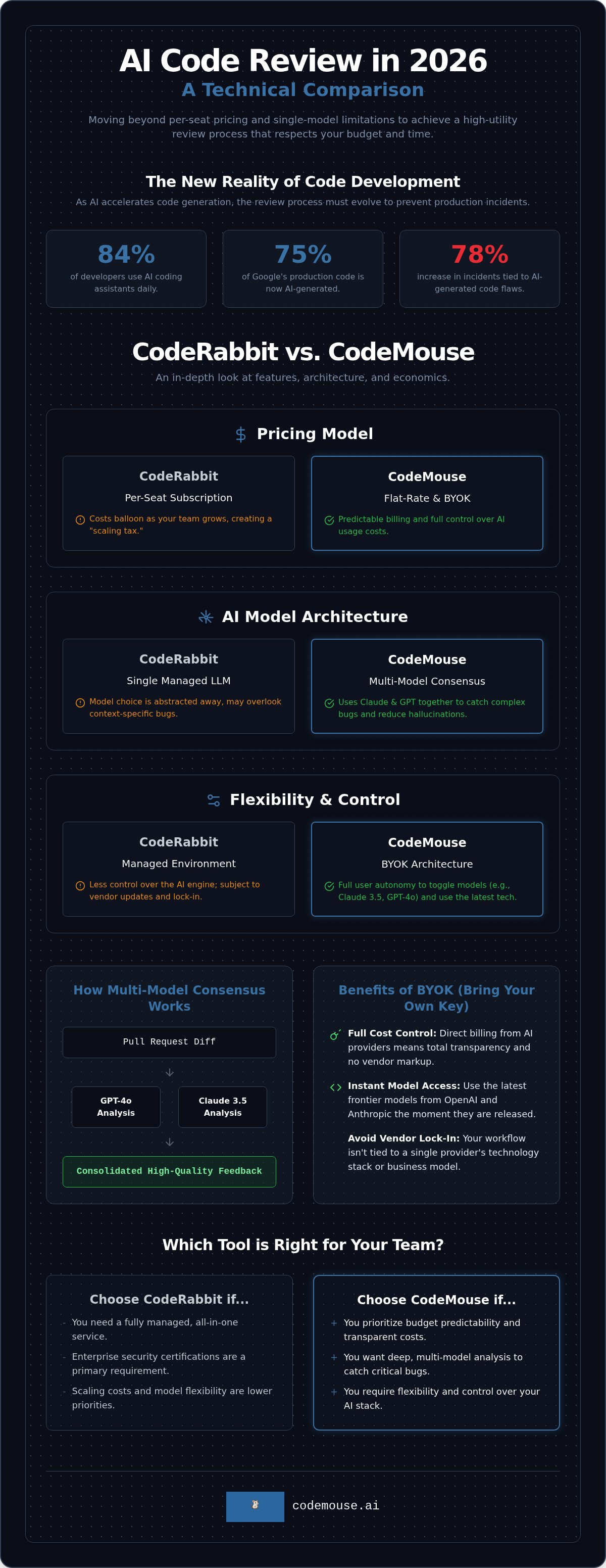
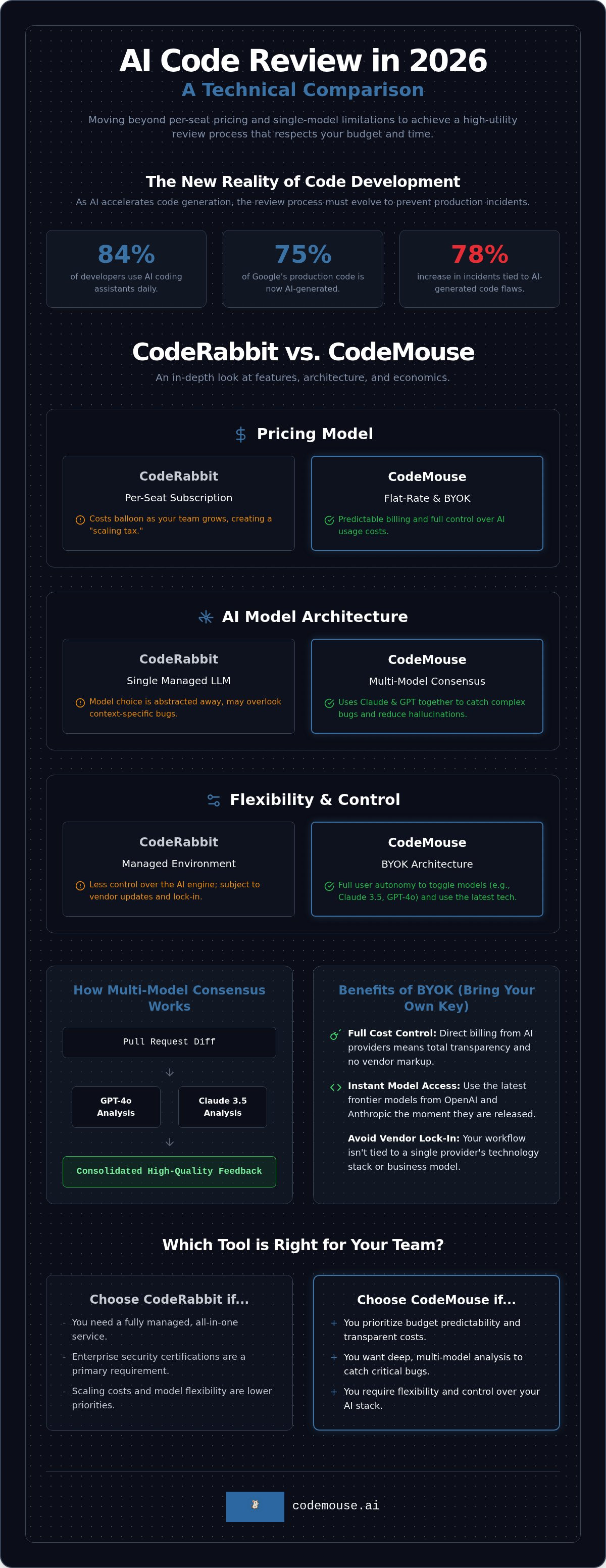
In 2026, manual Code review is a legacy bottleneck. AI tools have shifted from optional plugins to essential infrastructure. Research shows 84% of developers now use AI coding assistants daily. Companies like Google report that 75% of their production code is now AI-generated. As code generation accelerates, the review process must keep pace to prevent production incidents. code rabbit serves this need by providing an AI-first pull request reviewer. It focuses on reducing manual toil. It offers line-by-line suggestions and context-aware feedback that scales with your commit frequency.
The industry has moved beyond simple linters. We are now in the era of semantic analysis. Traditional tools check syntax. Modern AI reviewers analyze intent. They understand how a change in one module affects a dependency three layers deep. This requires a shift in how teams perceive PR automation. It's no longer about catching missing semicolons. It's about verifying logic and ensuring architectural integrity across the entire repository.
The Core Value Proposition of CodeRabbit
CodeRabbit relies on deep codebase intelligence. It indexes your entire repository to map out relationships between files. This allows the AI to provide feedback that isn't just local to the diff. It understands the broader context of your architecture. Developers can use the real-time chat feature to iterate on suggestions directly within the PR. This keeps the workflow inside GitHub. It handles pre-merge checks and automated tasks like unit test generation or merge conflict resolution. It's designed to be a comprehensive assistant for high-velocity teams that need a managed service.
Why Developers are Moving Beyond Static Analysis
Static analysis tools like ESLint or SonarQube remain useful for basic hygiene, but they're insufficient in 2026. They are rule-based and rigid. They miss architectural flaws and logic errors that don't violate syntax rules. As organizations report a 78% increase in production incidents tied to AI-generated code, the need for intent-aware reviews is critical. code rabbit and similar tools bridge this gap. They identify if a piece of code actually does what it's supposed to do. They catch edge cases that regex-based tools simply cannot see. This shift allows developers to focus on high-level design while the AI handles granular logic verification. It transforms the PR from a chore into a quality gate that actually improves the system.
Technical Feature Comparison: CodeRabbit vs CodeMouse
CodeRabbit provides a managed environment where the model choice is abstracted away. This simplifies onboarding. You don't manage API keys or model versions. In contrast, CodeMouse uses a modular architecture. It requires you to provide your own API keys. This difference impacts how they handle complex diffs. The evolution of AI-augmented software development shows that different models possess unique strengths in verification and logic reasoning. By using your own keys, you gain direct access to the latest frontier models without waiting for a vendor update.
Review depth depends on context window management. code rabbit indexes your repository to maintain a map of dependencies. It excels at identifying how a change in a utility function impacts the rest of the application. CodeMouse addresses this through multi-model consensus. By running a diff through two separate models, it reduces the risk of hallucinations. This is critical for large PRs where a single AI might lose track of the logic behind a complex refactor. This dual-verification approach ensures that feedback is grounded in the actual code change rather than a model's guess.
Model Flexibility and Choice
CodeRabbit manages the backend logic entirely. You get a consistent experience but less control over the underlying engine. CodeMouse prioritizes user autonomy. You can toggle between Anthropic and OpenAI models depending on the PR's complexity. For example, Claude 3.5 Sonnet often provides superior reasoning for functional programming logic. GPT-4o handles large-scale boilerplate changes with high precision. This flexibility allows you to optimize for specific languages or internal coding standards. It's a pragmatic choice for teams that want to avoid vendor lock-in regarding AI model performance.
GitHub Workflow Integration
Both tools integrate via native GitHub Apps. This ensures that feedback appears directly in the PR timeline. Automated comments can become noisy if not filtered correctly. code rabbit uses a conversational UI to help developers clarify suggestions. CodeMouse focuses on surgical, line-by-line feedback to minimize interruptions. If you are evaluating GitHub PR automation tools, consider how each tool handles 100+ file changes. Large diffs often trigger AI hallucinations. Multi-model verification acts as a secondary check. For teams that value this level of transparency, you can test multi-model reviews in your own environment to see the difference in feedback quality.
The Economics of AI Reviews: Per-Seat vs. Flat-Rate Pricing
The cost of code review shouldn't scale linearly with your headcount. In 2026, where AI writes the bulk of software, the bottleneck has shifted to validation. Traditional per-seat pricing models, like the one used by code rabbit, create a financial barrier to total team coverage. When you pay $24 to $60 per developer every month, the "Per-Seat Tax" becomes a significant line item. It often forces managers to choose which repositories or developers get AI coverage. This selective application undermines the goal of universal code quality. It's a legacy approach to a modern infrastructure problem.
CodeMouse operates on a different logic. We offer a $10 flat rate for unlimited users and repositories. This model separates the platform orchestration from the AI compute cost. By adopting a Bring Your Own API Key (BYOK) approach, you gain total transparency. You see exactly what you pay for the infrastructure versus the actual LLM tokens consumed. It's a pragmatic shift that treats AI review as a utility rather than a luxury subscription. You don't pay for idle seats. You pay for the work performed.
Analyzing Scalability Costs
Consider the math for a 100-person enterprise. A per-seat model could cost up to $6,000 monthly. For the same team, a flat rate AI code review keeps the platform cost at $10. The remaining budget goes directly to your OpenAI or Anthropic usage. Per-seat pricing often leads to "selective" tool usage. Teams might only enable reviews for senior devs or critical repos. This leaves a gap in the codebase where bugs can hide. A flat rate encourages 100% adoption across every branch and every developer.
The Hidden Benefit of BYO API Keys
Using your own keys removes artificial performance ceilings. Your review speed is determined by your specific Tier with providers like OpenAI or Anthropic. There's no vendor-side throttling. You also maintain control over your data. Your API usage logs stay within your own accounts. This is a critical security requirement for many firms in 2026. You pay only for the tokens you actually use. If a developer is on vacation, you don't pay for their seat. It's the most efficient way to manage high-volume code rabbit alternatives without the scaling overhead. It puts the power back into the hands of the engineering lead.
Review Quality: Single LLM vs. Multi-Model Consensus
Single-model reviews are prone to architectural bias. If a model is trained on specific patterns, it will favor those patterns even if they're suboptimal for your stack. code rabbit operates on a single managed LLM pipeline. While consistent, this approach lacks the cross-verification needed for mission-critical systems. In 2026, relying on one model's logic is a risk. Only 29% of developers trust AI output to be accurate. This trust gap exists because single models often miss edge cases that fall outside their primary training data.
Multi-model consensus is a verification strategy that runs your code through two distinct models simultaneously. CodeMouse typically uses Claude and GPT for this process. It compares the outputs in real time. High-confidence suggestions occur when both models agree on a logic flaw or a security risk. If the models disagree, the system flags the code for human intervention rather than providing a potentially incorrect suggestion. This process filters out the "noise" of generic AI feedback. It ensures that your developers only spend time on valid, verified issues.
The Case for Multi-Model Reviews
Different LLMs have unique strengths. Claude 3.5 Sonnet excels at high-level logic reasoning and understanding complex architectural dependencies. GPT-4o is often superior for syntax accuracy and handling repetitive boilerplate. By leveraging both, you get a more balanced review. Disagreement between models is a feature. It highlights ambiguous code that requires a senior developer's eye. This dual-model approach is the foundation of effective AI code review for GitHub. It prevents the "rubber-stamping" of bad code that single-model systems sometimes allow.
Eliminating the 'AI Hallucination' Problem
Hallucinations remain a persistent threat. A single model might confidently suggest a library method that doesn't actually exist. Consensus logic acts as a sanity check. It's statistically improbable for two different models from two different providers to hallucinate the same non-existent API. This is a critical step to catch bugs in pull requests before they reach production. It identifies high-risk vulnerabilities like SQL injection or memory leaks by looking for agreement on the underlying logic flaw. This builds long-term trust in your automation pipeline.
If you're tired of single-model bias and generic feedback, you can start your multi-model review trial to see the difference in logic depth. It's the most pragmatic way to secure your GitHub workflow without adding manual overhead.
Choosing Your GitHub PR Assistant: Final Verdict
The choice between these two platforms depends on your organizational requirements. CodeRabbit is a robust option for enterprise teams that mandate managed security certifications and vendor-led compliance. If your firm requires a "black box" service where infrastructure management is entirely abstracted, code rabbit fits that niche. It provides a traditional SaaS experience for teams that accept per-seat overhead in exchange for managed convenience. It remains a visible player for large-scale corporate environments with rigid procurement needs.
CodeMouse is the pragmatic choice for engineering leads who value technical autonomy and cost transparency. It targets teams that want to leverage the latest LLM logic without the scaling tax. Automation should function as a utility, not a financial burden that grows with your headcount. If you prioritize model flexibility and the accuracy of multi-model consensus, CodeMouse provides the necessary infrastructure. The decision rests on whether you value managed vendor services or a lean, logic-first review process.
CodeMouse for Small Teams and Startups
Startups must scale quality without ballooning their operational expenses. Per-seat billing models often force managers to limit AI access to specific developers. This creates gaps in codebase oversight. CodeMouse eliminates this bottleneck with a $10 flat rate for unlimited users. You can provide every engineer with high-quality feedback without increasing your platform costs. This makes it the most efficient AI code review for small teams. Integration takes under five minutes through the native GitHub App. You connect your repository, provide your API keys, and deploy the reviewer immediately. It removes the friction of seat management and procurement delays.
The Developer's Choice for 2026
The BYOK (Bring Your Own Key) model is the sustainable path for modern development. It ensures you never pay for idle software or unused seats. You only pay for the compute tokens consumed during active PR cycles. Multi-model consensus offers a level of verification that single-model systems like code rabbit cannot match. It identifies high-risk logic flaws while ignoring the noise of generic suggestions. Testing these tools on your actual codebase is the only way to verify their utility. Both platforms offer trial periods to assess their feedback quality. We recommend a head-to-head comparison on a complex refactor PR.
Don't let your code review process become a financial bottleneck. Shift toward a logic-driven, cost-effective workflow that respects your budget and your time. Start your 14-day trial with CodeMouse today to see how multi-model consensus streamlines your GitHub pull requests.
Future-Proofing Your Engineering Quality
The transition to AI-augmented reviews is a requirement for maintaining velocity in 2026. The primary decision involves balancing review depth with long-term economic sustainability. While code rabbit remains a viable choice for enterprise teams needing managed certifications, the per-seat model often creates financial friction for growing organizations. You shouldn't have to choose which developers get coverage based on a monthly budget ceiling.
Choosing a utility-first platform allows you to scale quality without the overhead. CodeMouse provides a $10 flat monthly fee and leverages Claude and GPT for multi-model consensus. This dual-verification logic identifies high-risk bugs while filtering out the noise of generic suggestions. By providing your own API keys, you ensure no throttling and maintain full transparency over your infrastructure costs. It's the most efficient way to secure your GitHub repositories without the scaling tax. You get high-utility feedback that respects both your code and your budget.
Start your 14-day free trial of CodeMouse AI today. Optimize your workflow and regain control of your engineering budget.
Frequently Asked Questions
Is CodeRabbit better than CodeMouse for large enterprises?
CodeRabbit is better for enterprises that require managed security certifications and a hands-off vendor experience. It provides a standard SaaS structure for teams that don't want to manage their own AI infrastructure. CodeMouse is a stronger fit for enterprises prioritizing logic transparency and cost efficiency. It removes the scaling barriers often found with code rabbit by offering a flat-rate model for unlimited developers.
How much does the BYO API key model actually cost per month?
Your monthly cost includes the $10 flat fee plus direct billing from your AI provider. Industry data suggests usage costs typically range from $0.05 to $0.15 per review. This BYOK model ensures you never pay for idle seats or unused capacity. It provides total transparency into your compute spend. You only pay for the tokens required to analyze your specific pull requests.
Does CodeMouse support private GitHub repositories?
Yes, CodeMouse supports both public and private GitHub repositories. You grant access via the native GitHub App integration. This allows the AI to analyze your private codebase while maintaining the same level of logic depth. The setup process remains under five minutes regardless of repository visibility. It's designed to integrate seamlessly with your existing private development workflows.
What is the difference between Claude and GPT for code reviews?
Claude typically excels at high-level logic reasoning and understanding complex architectural context. GPT is often more precise with syntax, boilerplate code, and specific library implementations. Using both models provides a balanced perspective. It catches bugs that a single-model system might overlook due to training data bias. This multi-model approach ensures a higher degree of verification for every pull request.
Can I use CodeMouse for languages like Rust, Go, or Python?
CodeMouse supports all major programming languages including Rust, Go, Python, and TypeScript. The underlying LLMs are trained on vast datasets of modern software. They understand language-specific idioms and common pitfalls. Whether you're building a microservice in Go or a data pipeline in Python, the review logic remains consistent. It adapts to the specific constraints and patterns of your chosen language.
Will an AI code reviewer replace my senior developers?
AI code reviewers are tools for augmentation, not replacement. They handle the repetitive task of checking for logic errors and edge cases. This allows senior developers to focus on high-level design and mentorship. AI catches the "low-hanging" bugs so humans can focus on complex business requirements. It improves the quality of the PR before a human ever looks at it.
How does CodeMouse handle security and data privacy?
CodeMouse leverages your existing API accounts to process reviews. This means your code data and logs remain under your direct control with providers like OpenAI or Anthropic. We don't use your proprietary code to train models. This BYOK architecture satisfies strict data sovereignty requirements. It's a functional approach for teams that need to maintain audit trails within their own infrastructure.
What happens if the AI models disagree during a consensus review?
Disagreement between models triggers a flag for human intervention. The system identifies the conflict as an area of high ambiguity rather than issuing a confident but potentially wrong suggestion. This consensus logic acts as a filter for AI hallucinations. It ensures that code rabbit alternatives like CodeMouse maintain high signal-to-noise ratios. Developers only focus on PR comments with high-confidence agreement.