GitHub PR Review Bot: Automating Engineering Quality in 2026
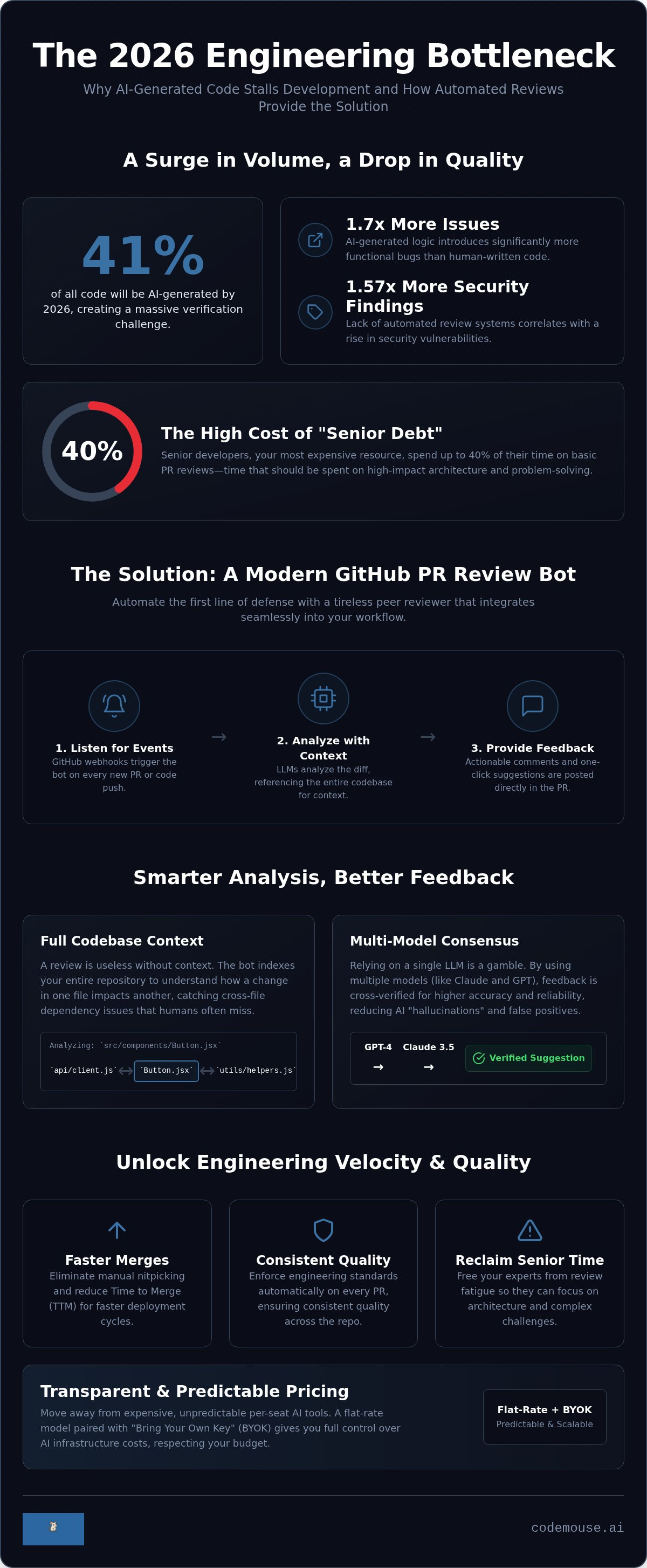
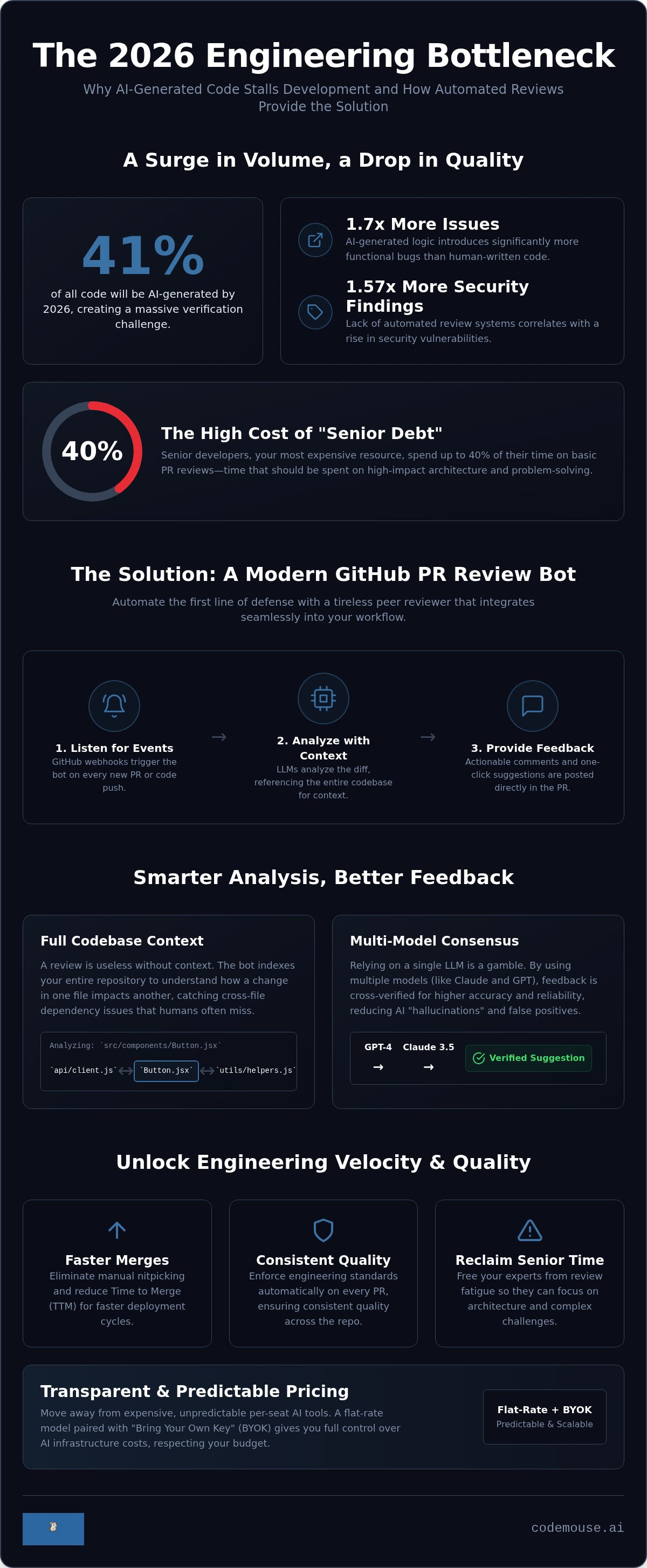
AI tools generate 41% of all code in 2026, yet that code introduces 1.7 times more issues than human-written logic. Senior developers are stuck in a verification bottleneck. They spend hours on reviews for code that is almost right but lacks context. This manual oversight delays merges. It creates inconsistent quality across the repository. Deploying a GitHub PR review bot solves this by automating the initial feedback loop. It acts as a tireless peer reviewer that handles the noise so you can focus on architecture.
The high cost of per-seat AI tools often outweighs the utility. You will learn how to eliminate code review bottlenecks using AI-powered bots that provide context-aware feedback and multi-model consensus. This guide shows you how to achieve faster PR merge times and better code quality with less manual effort. We explore the transition to codebase-aware agents and transparent, predictable tool pricing that respects your budget.
Key Takeaways
- Identify how a GitHub PR review bot eliminates manual bottlenecks by automating context-aware feedback on every pull request.
- Learn why multi-model consensus using Claude and GPT provides more reliable code analysis than single-model prompting.
- Understand the technical integration of GitHub Apps using webhooks and REST APIs to create a silent, automated workflow.
- Explore the benefits of a flat-rate pricing model paired with Bring Your Own Key (BYOK) for full control over AI infrastructure costs.
- Actionable steps to configure review triggers that balance merge speed with consistent engineering quality.
Table of Contents
Why Manual Code Reviews Are Your Biggest Engineering Bottleneck
Senior engineers are your most expensive resource. Every time they stop deep work to review a "nitpick" PR, the company loses money. This context switching is more than an annoyance; it's a productivity killer. In 2026, with approximately 41% of all code being AI-generated, the sheer volume of pull requests has spiked. This has created a verification bottleneck where manual oversight cannot keep pace with the speed of generation.
Relying solely on human reviewers leads to the "LGTM" trap. Cognitive fatigue is real. When a senior developer faces a queue of ten PRs, the depth of analysis drops. They miss critical edge cases. Statistics show that AI-generated code introduces 1.7 times more issues than human-written logic. Security findings also increase by 1.57 times in teams that lack robust automated code review systems. A GitHub PR review bot acts as the first line of defense, catching these errors before a human ever sees the diff.
The Rise of Senior Debt
Senior Debt occurs when your experts spend 40% of their time on basic PRs. It's a waste of talent. Experts should solve architectural challenges, not correct off-by-one errors or style violations. This friction leads to burnout and high turnover. While traditional linting handles formatting, it doesn't solve logic-level bottlenecks. A modern GitHub PR review bot goes beyond syntax. It understands intent and context, allowing seniors to reclaim their time for high-impact engineering tasks. It's about scaling quality without constantly increasing headcount.
Quantifying the Bottleneck
Calculations for PR delays must include the compounding effect on sprint velocity. A 24-hour delay on a single PR doesn't just stall one developer; it pushes back testing and deployment for the entire team. If three other branches depend on that merge, the whole sprint sequence stalls. Research indicates that 38% of developers now find that reviewing AI-generated code requires more effort than reviewing code from human colleagues. This paradox means that AI "productivity" gains are often lost in the review phase. For smaller teams, this is especially dangerous. You can read more about AI code review for startups to see how high-growth teams manage this risk. Reducing the Time to Merge (TTM) is the fastest way to increase your deployment frequency and stay competitive.
Anatomy of a Modern GitHub PR Review Bot
A modern GitHub PR review bot is a GitHub App that acts as a middleware between your repository and a Large Language Model (LLM). It operates by listening for activity via GitHub Webhooks. When a developer pushes code or opens a PR, GitHub sends a JSON payload to the bot's server. The bot fetches the specific diff using the GitHub REST API; it then processes the changes and returns feedback as inline comments. This architecture ensures the bot remains a silent partner in the workflow, only appearing when there is a meaningful event to analyze.
The technology has evolved beyond simple regex-based linting. Modern AI-powered code review tools now utilize semantic understanding to interpret the developer's intent. Instead of flagging a missing space, the bot analyzes whether a new function might cause a race condition or break an existing dependency. By 2026, these bots have become agentic. They don't just output text. They verify their own suggestions against the repository's context before posting, ensuring that the feedback is both accurate and actionable.
LLM Integration and Context Windows
Reading a diff in isolation is often useless. A GitHub PR review bot must understand the broader project to provide value. It uses vector embeddings to index the entire codebase. When a PR modifies a utility class, the bot retrieves relevant snippets from other files that rely on that class. This allows it to identify cross-file dependencies that manual reviewers might overlook. Large context windows in models like Claude 3.5 Sonnet enable the bot to process several hundred lines of code while maintaining a high signal-to-noise ratio. It ensures that the feedback is grounded in your specific architectural patterns rather than generic AI suggestions.
The Feedback Loop: Comments vs. Suggested Changes
A bot provides value through two primary mechanisms: educational comments and suggested changes. Comments explain the logic behind a critique. This is vital for junior developers who need to understand the "why" of a fix. Suggested changes allow for a "one-click apply" workflow. If the bot identifies a more efficient way to write a loop, it provides the exact code block. The developer clicks "Commit suggestion," and the fix is merged. This reduces the friction of back-and-forth review cycles. To optimize this process, you should learn how to automate code reviews effectively. Integrating a tool like CodeMouse AI Code Review can streamline this loop by providing precise, actionable feedback within seconds of a push.
Beyond Simple Prompting: The Multi-Model Consensus Advantage
Relying on a single LLM for code analysis is a risk. Every model has inherent biases and a tendency to hallucinate. If your GitHub PR review bot only uses one model, you are trading human error for machine error. Multi-model consensus changes this. It involves running multiple high-tier models, such as Claude and GPT, against the same code diff simultaneously. The system then de-duplicates and validates the findings to provide a single, high-confidence report.
This consensus logic acts as a high-pass filter. It removes low-confidence AI noise that often frustrates developers. If GPT flags a potential memory leak but Claude identifies it as a false positive, the bot analyzes the discrepancy. It can choose to stay silent or provide a weighted warning. This keeps the signal-to-noise ratio high. Using separate API keys through a Bring Your Own Key (BYOK) model ensures you aren't locked into a specific provider's versioning. You get the latest updates from both Anthropic and OpenAI immediately. This modularity allows for a "silent partner" workflow that respects your time and intelligence.
Claude vs. GPT for Code Analysis
Different models excel at different tasks. Claude 3.5 Sonnet is known for its long-context reasoning. It understands complex project documentation and architectural constraints better than most. GPT-4o remains the leader for specific logic-level edge cases and optimizing Python or JavaScript snippets. Combining them provides a comprehensive review that a single model cannot match. For a deeper dive into the specific performance differences, see our guide on GPT-4o vs Claude 3 Opus for code review. This technical comparison helps you decide which model should lead in your specific stack.
Reducing Hallucinations in PR Comments
Hallucinations occur when an AI confidently suggests a fix for a non-existent problem. In a pull request, this wastes time and erodes trust. Cross-checking models identifies these false positives before they reach the developer. If two models agree on a bug, the confidence level is high. Only suggestions that pass a "Truth Score" threshold appear in the PR. This methodical approach ensures that every comment provides concrete descriptive value. Multi-model consensus is the standard for 2026 code quality. It transforms a GitHub PR review bot from a simple prompter into a reliable engineering auditor that doesn't waste your team's focus.
Implementation Guide: Setting Up Your AI Review Workflow
Implementing a GitHub PR review bot effectively requires more than a one-click installation. A poorly configured bot creates noise and erodes developer trust. Start by selecting a tool that aligns with your team's budget and security requirements. For 2026, the industry has moved toward modular apps that allow you to control the underlying AI. Once installed, configure your review triggers based on your team's velocity. You have three primary options:
- On every commit: Best for high-velocity teams needing an instant feedback loop.
- On PR open: Balances speed with lower noise levels across the repository.
- On label or comment: Offers the most control, triggering the bot only when a human requests an audit.
You must also set strict ignore rules. Bots shouldn't waste tokens analyzing documentation, binary assets, or vendor directories. Use a configuration file to exclude paths like /docs, /assets, or /vendor. Finally, refine the bot's persona. A "strict auditor" persona is best for security-critical repositories. It focuses on memory leaks and vulnerability patterns. A "helpful assistant" persona works well for onboarding junior engineers, providing educational context alongside suggested fixes.
Integrating with GitHub Actions
Integrating your bot with GitHub Actions allows you to run reviews as a specific step in your CI/CD pipeline. This ensures that code only moves to the human review stage after passing the AI's initial audit. Ensure the bot has the correct read permissions for private repositories to allow for the cross-file context analysis mentioned in previous sections. Following AI code review best practices ensures your automation remains a help rather than a hindrance. For teams looking for a pragmatic, flat-rate solution, you can start with CodeMouse AI Code Review to see how an automated workflow fits your current stack.
Managing Developer Adoption
Developer morale depends on transparency. Introduce the bot as a tool designed to handle "nitpicks" so seniors can focus on architecture. It isn't a replacement for human sign-off. It's a silent partner that catches errors early. Encourage your team to "review the reviewer." If the bot provides a hallucination or a low-value comment, developers should flag it. This feedback loop helps you refine the bot's instructions over time. When developers see the bot catching legitimate bugs before they hit the main branch, adoption happens naturally. This transition turns the code review process from a source of friction into a predictable, high-quality engineering gate.
CodeMouse: The Pragmatic GitHub PR Review Bot for 2026
CodeMouse is built for engineering teams that value utility over marketing fluff. Most GitHub PR review bot options on the market utilize a per-seat pricing model. This effectively taxes your engineering quality as you grow. CodeMouse shifts this paradigm with a flat $10/month fee. It operates as a silent partner in your workflow, providing actionable feedback without the overhead of enterprise sales cycles. The design is lean and functional, mirroring the logic-driven flow of a well-organized README file. It avoids vague corporate jargon and focuses on precise, functional nouns and verbs that describe specific code actions.
The core of the platform is the "Bring Your Own API Key" (BYOK) model. This provides full transparency and control. You pay for the LLM infrastructure at cost directly to providers like Anthropic or OpenAI. There is no hidden SaaS markup on your tokens. This model also gives you autonomy over which models drive your consensus logic. You can utilize Claude 3.5 Sonnet for architectural reasoning and GPT-4o for logic optimization simultaneously. The multi-model consensus logic comes enabled out of the box. By comparing outputs from these models, CodeMouse de-duplicates findings and filters out hallucinations. This is the gold standard for 2026 code quality, implemented as a core feature rather than a premium add-on.
Unlimited Reviews, Zero Throttling
Traditional SaaS tools often throttle usage or charge extra for "high-priority" credits. With a BYOK model, these artificial limits disappear. You can scale to hundreds of pull requests daily without worrying about per-review costs or credit caps. This is the most cost-effective way to maintain high engineering standards across a growing organization. You can read more about the benefits of a flat rate AI code review and how it ends the per-seat tax on quality. It allows you to add every developer on your team to the review process without increasing your monthly subscription cost. Your costs scale only with your actual API usage, not your headcount.
Getting Started in Under 5 Minutes
Setup follows a linear, step-by-step progression. Install the GitHub App. Add your API keys. Configure your repository settings. You are ready to start reviewing code. The tool provides a 14-day free trial, allowing you to test the consensus logic on your actual codebase before committing. Because CodeMouse is operated by Squidcode, you get direct support from the builders who designed the infrastructure. There are no long-winded introductory clauses or complex sales funnels. It is a tool built by developers for developers who need to extract facts and move on to implementation. This modularity ensures the bot enhances your existing habits rather than demanding a total overhaul of your workflow.
Scale Your Engineering Quality in 2026
Engineering leadership in 2026 requires balancing velocity with code integrity. Relying on a single human or a single AI model is no longer sufficient. You need a system that de-duplicates noise and identifies logic errors with surgical precision. A GitHub PR review bot provides this infrastructure. It allows your senior developers to stop wasting time on syntax and start focusing on architecture. By implementing multi-model consensus, you ensure that every comment in a PR is backed by the logical strength of both Claude and GPT.
CodeMouse offers a pragmatic path forward for teams that value efficiency. You get consensus-driven reviews without the burden of per-seat taxes. The $10/month flat fee ensures your costs remain predictable even as your repository grows. Control your AI spend with the BYOK model and eliminate the verification bottleneck today. It's time to treat code quality as a utility rather than a luxury. Start your 14-day free trial of CodeMouse. Build faster, reduce senior debt, and merge with confidence.
Frequently Asked Questions
Is a GitHub PR review bot secure for private repositories?
Yes, modern bots use fine-grained GitHub App permissions to access only the metadata and code diffs required for analysis. When you use a GitHub PR review bot with a Bring Your Own Key model, your data is handled according to the API privacy policies of providers like Anthropic and OpenAI. This typically ensures that your proprietary code is not used to train public models.
Can an AI bot replace human code reviewers entirely?
No, a bot is a tool for augmentation, not a total replacement. It acts as a first-pass reviewer to catch logic flaws, security vulnerabilities, and style issues. Human reviewers remain essential for high-level architectural decisions and final sign-off. The bot handles the noise so senior engineers can focus on complex challenges.
How do I stop a PR review bot from being too "noisy"?
You reduce noise by configuring strict ignore rules and specific triggers. Exclude directories like assets, vendor, or documentation from analysis within your configuration file. You can also set the bot to only run when a PR is opened or when a specific label is applied. This ensures the bot only comments when its feedback provides concrete value.
What is the cost difference between per-seat pricing and BYO API key models?
Per-seat models often charge $30 or more per developer, which becomes expensive as teams scale. The Bring Your Own API Key model used by CodeMouse features a flat $10 monthly fee. You pay the AI providers only for the tokens you actually consume. This transparency eliminates the SaaS markup and ensures you don't pay for seats that aren't active.
Does CodeMouse support multi-model consensus with Claude and GPT?
Yes, CodeMouse is designed specifically to use multi-model consensus as a core feature. It runs your code changes through both Claude and GPT models simultaneously. The system then compares the findings to de-duplicate comments and validate suggestions. This process significantly improves the signal-to-noise ratio compared to tools that rely on a single LLM.
What happens if the AI bot makes a mistake or hallucination?
Multi-model consensus reduces hallucinations, but no AI is perfect. If the bot makes a mistake, the developer should simply ignore the comment or flag it for improvement. The bot is a silent partner that provides suggestions. Final authority always rests with the human engineer who signs off on the pull request.
How does a PR bot handle complex cross-file architectural changes?
Advanced bots use vector embeddings to index your entire codebase. This allows the GitHub PR review bot to understand how changes in one file affect dependencies in another. By maintaining this broader context, the bot can identify architectural issues that traditional static analysis tools or single-file AI prompts would miss.
Do I need a GitHub Copilot subscription to use CodeMouse?
No, you do not need a GitHub Copilot subscription. CodeMouse operates as an independent GitHub App. It connects directly to your own API keys for Claude and GPT. This allows you to maintain full control over your AI infrastructure and costs without being locked into a specific ecosystem.